Netflix reaffirmed this wording in its Q1 2026 shareholder letter, calling the mission ambitious and unchanged. Netflix vision statement: Netflix does not publish one. The line quoted across most business sites, “becoming the best global entertainment distribution service,” is a legacy phrase Netflix has never listed on its investor or careers pages. Netflix core values (June 2024 Culture Memo): four principles (The Dream Team, People over Process, Uncomfortably Exciting, Great and Always Better) and eight Dream Team values.
Netflix runs on a four-word mission that fits on a business card, and in 2026 it used that mission to justify walking away from an $82.7 billion acquisition.
That is the interesting part of this story, and almost no article about the Netflix mission and vision statement covers it. Most of them recycle a subscriber count from 2023, list a set of company values Netflix retired in June 2024, and quote a vision statement the company never wrote.
This analysis fixes all three. Below you get the sourced mission wording, an honest account of the missing vision statement, the current value set, and a test of whether the mission predicts what Netflix does with its money.
Netflix at a Glance (2026)
| Metric | Figure | Source |
|---|---|---|
| Mission statement | To entertain the world | Q1 2026 shareholder letter |
| Official vision statement | None published | Netflix investor and careers pages |
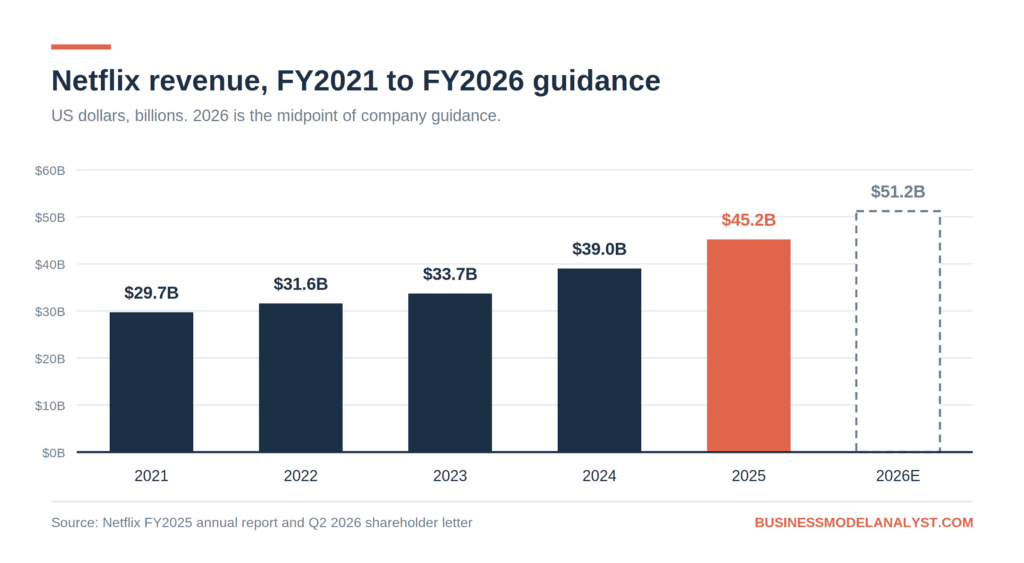
| FY2025 revenue | $45.2B, up 16% | FY2025 annual report |
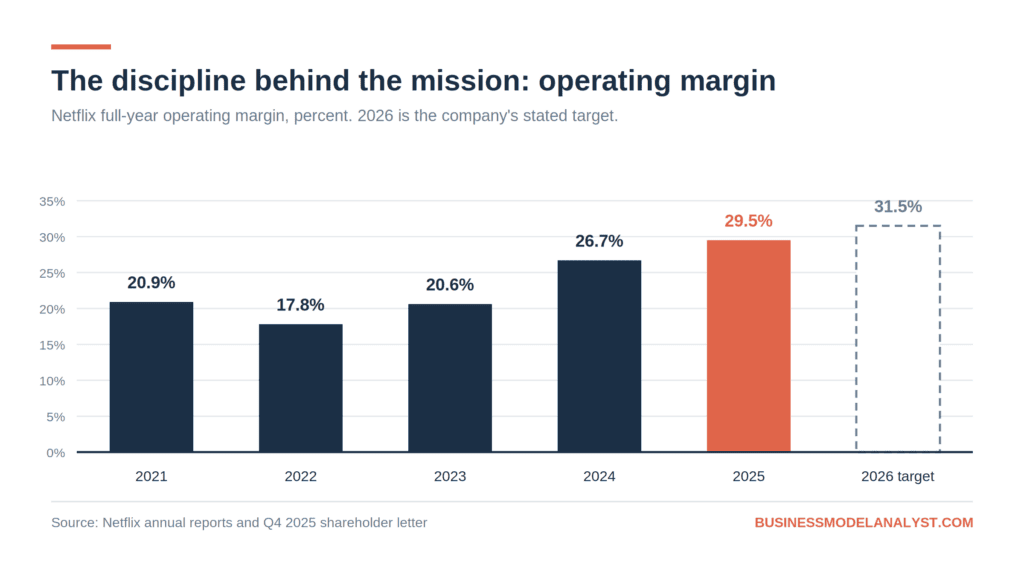
| FY2025 operating margin | 29.5% | FY2025 annual report |
| FY2025 net income | $11.0B | FY2025 annual report |
| Q2 2026 revenue | $12.56B, up 13.4% | Q2 2026 shareholder letter |
| FY2026 revenue guidance | $51.0B to $51.4B | Q2 2026 shareholder letter |
| FY2026 operating margin target | 31.5% | Q4 2025 shareholder letter |
| Paid memberships | 325M+ (last disclosed, Q4 2025) | Q4 2025 shareholder letter |
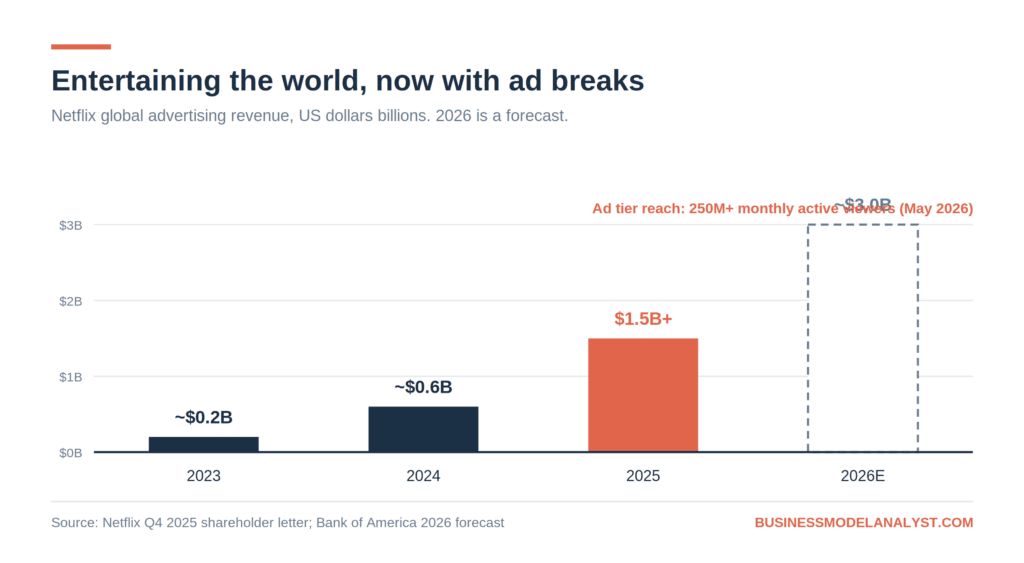
| Advertising revenue | $1.5B+ in 2025, forecast to roughly double in 2026 | Q4 2025 shareholder letter |
| Ad tier reach | 250M+ monthly active viewers | Netflix Upfront, May 2026 |
| Countries with local production | 50+ | The Netflix Effect, Q2 2026 |
| Co-CEOs | Ted Sarandos and Greg Peters | Netflix investor relations |
Netflix Mission Statement: “To Entertain the World”
Netflix has used the same four words for years, and it repeated them in April 2026 in the clearest possible setting. Writing to shareholders weeks after losing Warner Bros. to Paramount Skydance, co-CEOs Ted Sarandos and Greg Peters opened their strategy section by calling the mission “ambitious and unchanged: to entertain the world.”
Four words carry more strategic weight than they look like they should. Break the sentence into its two working parts.
“Entertain” sets the category, not the format. Netflix did not write “stream television.” That single word choice is what lets the company add video podcasts, mobile vertical video, in-app games, WWE Raw, NFL Christmas games and the Westminster Dog Show without contradicting itself. A narrower mission would have made each of those a departure. This one makes them expansions.
“The world” sets the scale, and Netflix pays for it. Netflix produces series and films in more than 50 countries. In its Q2 2026 report on cultural and economic impact, the company put its contribution to the global economy over the past decade at more than $325 billion in gross value. Programming for that many tastes and languages at once is the part of the mission that competitors have not matched, and the part Netflix leans on when defending its content budget.
What the mission does not do is promise a technology, a price point or a business model. Netflix mailed DVDs, then streamed ad-free, then launched an ad tier in 2022, then started buying live sports rights. The mission survived all four because it never named a delivery mechanism.
The Netflix Vision Statement Problem
Search for the Netflix vision statement and you will find the same sentence on dozens of sites: “becoming the best global entertainment distribution service,” followed by clauses about licensing content worldwide, opening markets to filmmakers and helping creators find a global audience.
Netflix does not publish that as a vision statement. It appeared in older descriptions of the company’s future on Netflix careers material, was repeated in strategy textbooks and business-school decks, and hardened into a fact through citation. No current Netflix investor page, annual report or careers page presents it under the heading “vision.”
The wording also dates itself. “Distribution service” and “licensing entertainment content” describe the Netflix of roughly 2014, when the company mostly licensed other studios’ output. Netflix now spends around $20 billion a year producing its own. Quoting that line in 2026 describes a business Netflix stopped being a decade ago.
Netflix does publish forward-looking language, just not under that label:
| Where | What it says | Function |
|---|---|---|
| Investor site, Long-Term View | Netflix expects to remain a leading firm of the streaming entertainment era | Closest to a vision statement |
| Annual report, core strategy | Grow the streaming business globally within an operating margin target | Financial strategy, not vision |
| Culture Memo, Great and Always Better | Netflix falls short today compared with where it wants to be | Cultural aspiration |
For anyone studying this for a class or a strategy exercise, the honest answer to “what is Netflix’s vision statement” is that Netflix folds vision into mission and culture instead of publishing a separate one. If you are drafting statements for your own company, the mission statement generator and this guide to what a vision statement is will get you further than copying Netflix’s structure, because Netflix does not have the structure people assume.
Does the Mission Predict Behavior? The Warner Bros. Test
A mission statement earns its keep when it explains a decision that would otherwise look strange. Netflix gave analysts one of those in early 2026.
The sequence:
| Date | Event |
|---|---|
| Dec 4, 2025 | Netflix agrees to buy Warner Bros. studios, HBO and HBO Max at $27.75 per WBD share, $82.7B enterprise value |
| Jan 20, 2026 | Both sides amend the deal to all cash to speed up the shareholder vote |
| Feb 26, 2026 | The WBD board rules Paramount Skydance’s $110.9B all-company offer superior |
| Feb 27, 2026 | WBD terminates; Paramount pays Netflix a $2.8B termination fee on WBD’s behalf |
| Apr 2026 | Netflix authorizes an additional $25B in share repurchases |
Netflix declined to raise its bid. Sarandos and Peters explained the walk-away in the Q1 2026 letter by describing Warner Bros. as a useful accelerant for the strategy, but only at a price that worked, and by pointing out that Netflix can reach the same goals by producing, licensing or partnering.
Read that against the mission. “Entertain the world” says nothing about owning a hundred-year-old studio. Netflix framed HBO as one route among several to the same end, which is exactly what a mission written at the level of outcome rather than method allows you to do. A mission written as “become the largest studio in Hollywood” would have made matching Paramount’s number close to mandatory.
The $2.8 billion fee and the buyback are the visible half of that decision. The invisible half is the 31.5% operating margin target Netflix set for 2026, which an $82.7 billion acquisition would have complicated for years.
Skeptics have a fair counter here, and it belongs in an honest analysis. Netflix did not walk away purely on principle. Paramount’s financing, backed by the Ellison family, was stronger, and Netflix faced a harder antitrust path as the market leader buying a direct rival. Mission language is also the most convenient available explanation for a bid you lost. Both readings hold at once: the mission gave Netflix a defensible frame for a decision that market conditions were pushing it toward anyway. That is what mission statements are for in practice.
Where the Mission Shows Up in the Numbers
Three current initiatives track directly back to “entertain the world,” and each is measurable.
Advertising. Netflix launched a $6.99 ad tier in November 2022 after a decade of insisting it would never run ads. Under a mission of entertaining the world, a lower price point is straightforward mission expansion. Ad revenue passed $1.5 billion in 2025, more than 2.5 times the 2024 figure, and Netflix expects it to roughly double again in 2026. At the May 2026 upfront, advertising president Amy Reinhard put ad-tier reach above 250 million monthly active viewers globally, up from 94 million a year earlier, with more than 80% of ad-tier members watching weekly.
Live events. Netflix buys a handful of high-profile live properties per quarter rather than full-season sports packages. WWE Raw, NFL Christmas Day games, a regular-season NFL game staged in Australia, marquee boxing and exclusive FIFA Women’s World Cup rights for 2027 and 2031. Each one gives an audience a reason to open the app at a specific hour, which on-demand libraries cannot manufacture, and each one creates premium ad inventory.
Engagement quality. Netflix reported viewing hours up 2% in the first half of 2026, against 1.5% growth in the same period of 2025, despite competition from the Winter Olympics and the World Cup. In the Q2 2026 letter the company acknowledged that hours alone are a weak proxy, arguing that quality and variety matter alongside quantity. Investors read that as an admission that YouTube and TikTok are pulling attention, and the stock has fallen more than 40% over the past year.
That last point is the honest limit on the mission-as-strategy story. “Entertain the world” is broad enough to justify almost any content bet, which makes it useless as a filter for deciding which bets to skip. Netflix needs the margin target to do that work, and it does.
Netflix Core Values in 2026
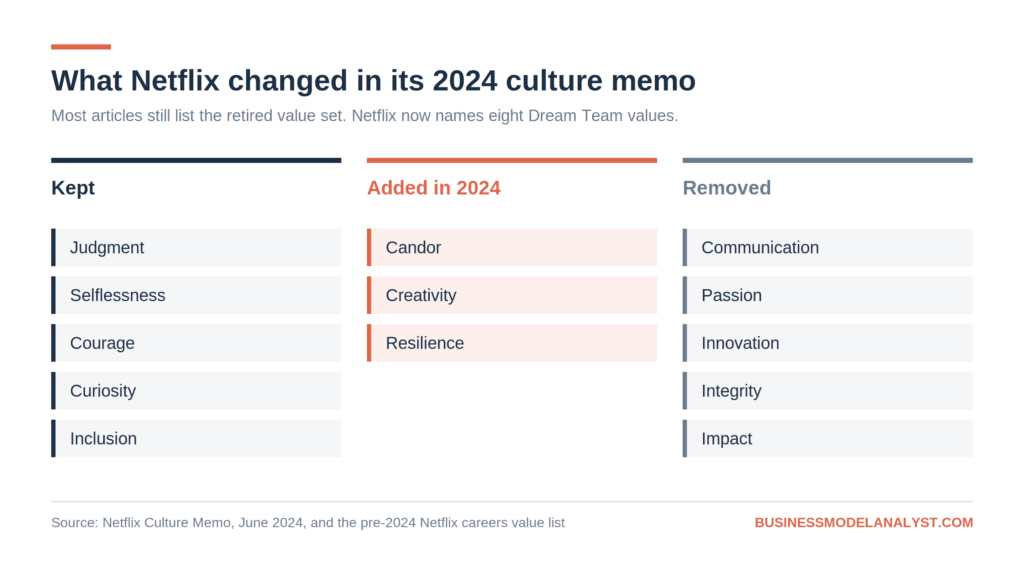
Netflix rewrote its culture document in June 2024 and titled it “The Best Work of Our Lives.” Twelve months of employee feedback went into it. Almost every article about Netflix’s values, including the version of this page it replaces, still lists the retired set.
The four core principles:
| Principle | What it means |
|---|---|
| The Dream Team | Netflix hires only high performers and models itself on a professional sports team rather than a family. Managers apply the keeper test: would you fight to keep this person? |
| People over Process | Employees get information and freedom to decide for themselves. The expense policy runs five words. |
| Uncomfortably Exciting | Entertaining the world requires bold bets, fast experiments and tolerance for discomfort |
| Great and Always Better | Netflix judges itself against where it wants to be, not against competitors |
The eight Dream Team values: selflessness, judgment, candor, creativity, courage, inclusion, curiosity and resilience.
Three of those are new in 2024: candor, creativity and resilience. Five values from the earlier list are gone: communication, passion, innovation, integrity and impact. Candor replaced communication, which sharpened a soft word into a behavioral one. Creativity replaced innovation, a fitting swap for a company that now employs writers and directors as well as engineers. Resilience is the new arrival with no predecessor, and it reads as a response to the 2022 subscriber shock and the layoffs that followed.
On the Dream Team, Netflix writes that it wants people who are “great at what they do, and even better at working together.” The keeper test is the enforcement mechanism, and it remains the most copied and most criticized element of the whole document.
What Founders Can Take From This
Four lessons transfer, and one does not.
Write the mission at the level of outcome, not method. “Entertain the world” survived DVDs, streaming, ads and live sports. “Stream movies online” would have died in 2022.
Accept that a broad mission needs a hard number beside it. Netflix pairs its mission with an explicit operating margin target every year. The mission says what to pursue and the margin says what to refuse. Without the second one, the first justifies everything.
Update the culture document instead of preserving it. Netflix revised a memo that had become an industry artifact, dropped five values it no longer used and added three it needed. Most companies treat their value list as scripture and let it drift into fiction.
Do not copy the vision statement, because there is not one. Netflix runs on a mission plus a culture memo plus a margin target. That combination works better for most companies than a separate aspirational paragraph nobody reads.
The part that does not transfer is the keeper test. It works at Netflix because the company pays at the top of the market and hires senior people who can absorb the risk. Run it in a startup paying below market and you get fear.
Frequently Asked Questions
What is Netflix’s mission statement? Netflix’s mission statement is “to entertain the world.” The company reaffirmed the wording in its Q1 2026 shareholder letter, describing the mission as ambitious and unchanged.
What is Netflix’s vision statement? Netflix does not publish a formal vision statement. The commonly cited line about becoming the best global entertainment distribution service is a legacy phrase from older careers material that Netflix has never presented under a “vision” heading. The closest official equivalent is the Long-Term View section of the investor site.
What are Netflix’s core values? Since the June 2024 Culture Memo, Netflix has organized its culture around four principles (The Dream Team, People over Process, Uncomfortably Exciting, Great and Always Better) and eight values: selflessness, judgment, candor, creativity, courage, inclusion, curiosity and resilience.
Has Netflix changed its mission statement? No. The wording has held for years and Netflix restated it in April 2026. The values underneath it changed in June 2024.
How many subscribers does Netflix have? Netflix stopped reporting membership numbers during 2025 and now leads with revenue and operating margin instead. The last disclosed figure was more than 325 million paid memberships, announced in Q4 2025.
Why did Netflix fail to buy Warner Bros.? Netflix agreed in December 2025 to buy Warner Bros. studios, HBO and HBO Max for $82.7 billion in enterprise value. In February 2026 the WBD board judged Paramount Skydance’s $110.9 billion offer for the whole company superior. Netflix declined to raise its bid and collected a $2.8 billion termination fee.
The Business Model Analyst Take
Netflix’s mission statement is the most useful four words in corporate strategy, and the least useful thing to copy.
Useful, because it does real work. It gave Sarandos and Peters a public rationale for adding ads after a decade of refusing them, for buying wrestling rights, and for letting an $82.7 billion studio go to a rival. A mission that can justify all three without sounding incoherent is a rare piece of writing.
Useless as a template, because most companies cannot afford that much room. Netflix earns the breadth with $45 billion in revenue, a 29.5% operating margin and 325 million paying households. A seed-stage company writing “entertain the world” has written nothing. The specificity that Netflix outgrew is exactly what a smaller company needs.
The item worth stealing is the pairing. Netflix never states the mission without stating the margin target in the same document. That pairing is what turned a slogan into a capital allocation rule, and it is the reason the company could say no to Warner Bros. in a quarter when saying yes would have been the more exciting headline.
For the operating detail behind these statements, the Netflix business model breakdown shows how the revenue is captured, the Netflix SWOT analysis covers the internal position, and the Netflix PESTLE analysis maps the regulatory and competitive pressures. For how the mission reaches audiences, see the Netflix marketing strategy and Netflix target market. For a company that structures its mission and vision differently, compare the Amazon mission and vision statement.