
Microsoft spent more than $80 billion buying its way to the top of the games industry. In July 2026, it started dismantling the machine it built. Xbox is cutting roughly 3,200 jobs, divesting five studios, and new leadership is calling the whole thing a “reset.” The company that owns Call of Duty, Minecraft, Fallout, and Halo is now telling staff its gaming business is “not healthy.” Here is how the biggest spending spree in gaming history turned into the biggest restructuring in Xbox history.
The News
On Monday, July 6, 2026, Xbox CEO Asha Sharma told employees the division would eliminate about 3,200 roles over its next fiscal year, which runs through June 2027. Roughly 1,600 of those cuts landed immediately. She also confirmed that five game studios would leave Microsoft, framing the combined move as the most significant restructuring in Xbox history.
The cuts are part of a wider reduction at Microsoft of around 4,800 jobs, or about 2.1% of its global workforce. Most of the pain sits inside gaming, with the rest concentrated in sales. For a division that Microsoft spent a decade and a fortune assembling, the message from the top was blunt: the current model does not work.
Inside the Cuts
The 3,200 figure represents close to a fifth of Xbox’s total staff, a steep reduction for a single business unit. Sharma singled out the platform group, which covers hardware, marketing, and Game Pass, noting that these teams had grown about 40% larger than they were at the start of the current console generation even as playtime and the active player base declined.
Five studios are being pushed out of the Microsoft umbrella, though none are being shut down outright. Compulsion Games and Double Fine are being returned to independent management. Ninja Theory and Undead Labs are being sold to new owners. Arkane, the France-based studio behind Dishonored, is entering a formal consultation process with its works council to review its options. These are the smaller, creatively ambitious teams that Microsoft once collected to keep a steady flow of original games flowing into Game Pass. In the new strategy, they no longer fit.
How the $80 Billion Bet Was Built
To understand the reset, you have to understand the spending. Under former chief Phil Spencer, Microsoft chose to buy scale rather than build it. Three deals did most of the heavy lifting.
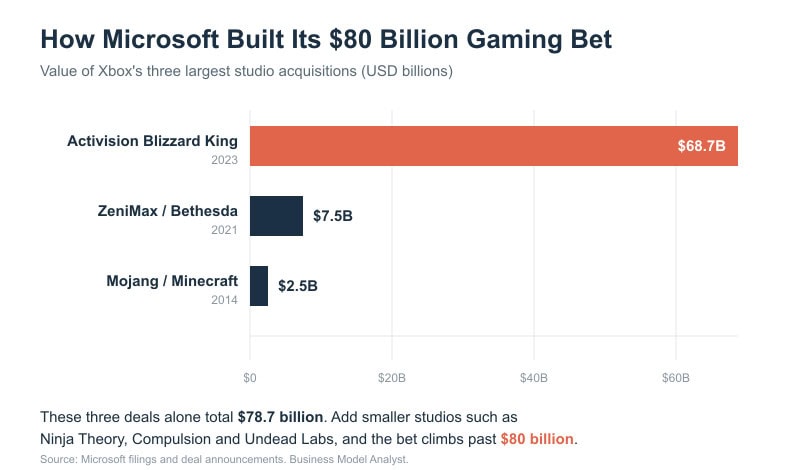
The $68.7 billion Activision Blizzard King purchase in 2023 was the largest acquisition in Microsoft’s history and one of the largest in the history of tech. It followed the $7.5 billion ZeniMax and Bethesda deal in 2021 and the $2.5 billion Mojang purchase back in 2014. Layer in a run of smaller studio buys, and the total content bill runs comfortably past $80 billion. The strategy was simple to state: own the games, feed them into a subscription, and make Xbox a service rather than a box.
The Margin Problem
The subscription-first idea sounded like the Microsoft business model applied to gaming, recurring revenue replacing one-time sales. In practice, the economics never cooperated. Sharma told staff that Xbox operates at margins three to ten times lower than comparable platform and publishing businesses. Independent estimates put Xbox’s operating margin near 3 cents on the dollar, against the 17 to 22 cents that is typical across the industry.
Her most pointed number came in a Fortune interview: the division had been losing roughly 64 cents for every dollar it invested in first-party studios. Over the previous five years, excluding the Activision deal, Xbox had spent more than $20 billion on content, platform, and hardware subsidies while annual revenue actually slipped by close to half a billion dollars. Spending went up. Returns went down. That is the definition of a bet that backfired.
The Game Pass Paradox
Game Pass sits at the center of the problem. The service crossed nearly $5 billion in annual revenue for the first time in Microsoft’s fiscal 2025, a real number that would flatter most companies. The trouble is what it replaces. Handing a subscriber a brand-new game on launch day quietly cannibalizes the roughly $70 that same player might have paid to buy it outright. Steady subscription income comes at the cost of thinner economics on the games themselves.
Growth stalled too. Microsoft has not officially confirmed a subscriber count since it reported 34 million members in February 2024. Reports suggest the service shed members after an aggressive October 2025 price hike, before a price cut in April 2026 pulled it back toward growth. A subscription can smooth revenue, but as our breakdown of the subscription business model shows, it only works when lifetime value clears the cost of the content, the cloud, and the platform underneath it. For Xbox, it did not.
Xbox by the Numbers
| Metric | Figure |
|---|---|
| Xbox roles being cut (through FY27) | ~3,200 (about 20% of division) |
| Studios being divested | 5 |
| Total content acquisition spend | More than $80 billion |
| Activision Blizzard King price (2023) | $68.7 billion |
| Estimated Xbox operating margin | ~3 cents per dollar |
| Loss per dollar invested in first-party studios | ~64 cents |
| Game Pass FY25 revenue | ~$5 billion |
| Last confirmed Game Pass subscribers (Feb 2024) | 34 million |
| Console market share | ~23% (vs PlayStation ~45%, Nintendo ~27%) |
What It Means for the Franchises
The reset is not a retreat from big games. It is a concentration of resources into the biggest ones. Content spend for the coming fiscal year is expected to stay roughly flat versus the prior record year, but the money is being funneled toward proven tentpoles: Minecraft, the Elder Scrolls franchise, Call of Duty, Fallout, and Halo. Sharma has been explicit that Xbox needs to recommit to its core, which is exactly why the quirky, mid-sized studios are the ones leaving. No previously announced first-party game has been cancelled as a direct result of the layoffs, though a smaller organization inevitably means tighter odds for anything on the margins.
The New Leadership and the Reset
The person delivering this message did not build the strategy she is unwinding. Asha Sharma took over Microsoft Gaming in February 2026, arriving from an AI and platform background after joining Microsoft from Instacart in 2024. She replaced Phil Spencer, who retired after 38 years at the company and 12 years running gaming, the executive who drove the Activision, ZeniMax, and Mojang deals. Xbox President Sarah Bond departed in the same reshuffle.
Sharma has been unusually candid about inheriting a mess. Microsoft, in her framing, made a series of expensive bets and, in chasing them, took its eye off the core business. Her summary to Fortune was that the company simply spread itself too thin. Reading between the lines, there is a second pressure in play. Every spare billion at Microsoft is now competing with artificial intelligence for capital, and gaming’s thin margins make it a hard case to defend at the budget table.
What Comes Next
Expect a leaner, more focused Xbox that behaves less like a growth story and more like a profit-discipline story. Fewer studios, fewer bets, and a heavier lean on the franchises that reliably pay their way. The open questions are whether a platform team cut this deeply can still ship a competitive next-generation console, whether Game Pass can grow without torching the value of the games inside it, and whether Microsoft’s patience with gaming survives an AI arms race that is swallowing capital across the company. The $80 billion is already spent. The task now is proving it was not wasted.
The Business Model Analyst Take
The Xbox story is a clean case study in a trap that catches even the richest companies: buying scale is not the same as buying a working business model. Microsoft acquired the best franchises money could buy and still could not fix the underlying unit economics, because the problem was never the catalog. It was the model wrapped around it. Game Pass asked players to stop buying $70 games and rent everything for a flat fee, then discovered that recurring revenue at a low price cannot outrun the cost of premium content, hardware subsidies, and cloud infrastructure all at once.
The deeper lesson is about subscription math. A subscription is only a good business when average revenue per user, retention, and content cost line up in your favor. Netflix engineered that balance over years. Xbox tried to buy it in a hurry, at the top of the market, and the arithmetic never closed. Compare it to the Sony business model, which kept premium game sales at its core and treated subscriptions as a complement rather than a replacement, and the contrast is stark. Sometimes the boldest strategy is also the most expensive way to learn that the old model was working better than you thought. Microsoft has the balance sheet to absorb an $80 billion lesson. Almost no one else does.