
Dow Jones stopped renting its executive readers to advertisers. Now it bills them directly, at roughly a hundred times what a subscription costs.
A September 10 dispatch about Ron Shaich reads like an interview. It is also the top of a funnel that ends at a membership council reported at around $25,000 a seat. Against Dow Jones’s own fiscal 2026 numbers, one seat prices like 83 to 127 subscriptions.
Lila MacLellan met Ron Shaich at the first Manhattan location of Tatte Bakery and Cafe. He talked about his parents, about the question he puts to the Cava board every time it meets, about what he wishes he had dealt with three years ago. Good copy. Free to read.
Look at the kicker above the headline, though. NEWSLETTERS. CEO BRIEF. That newsletter is published by the WSJ Leadership Institute, and the Institute is not a masthead. It is a membership business inside Dow Jones, with a president who reports to the Dow Jones chief executive, a head of content, a chief of staff and a vice president of operations and membership.
The interview is the sample. The councils are the product.
What Happened
The September 10 item ran under the CEO Brief banner, edited by MacLellan. Its subject was Shaich, who co-founded Panera, sold it to JAB Holding in 2017 in a deal valued around $7.5 billion, and now runs Act III Holdings with stakes in Cava and Tatte. He is 72 and still advises chief executives, which he says is the part he loves.
His pitch is a single question, asked at the start of every Cava board meeting. He wants to know what the board will wish, “in three years you’re going to wish we had dealt with today.” He applies it to his own life first, then to every business he is in. He also thinks most chief executives never get there, because they spend their days reacting, and because when they do set priorities they skip the deadlines and skip defining what winning looks like.
None of that is new. Shaich has been making the long-horizon argument in public for a decade, and he has a book about it. What is new is where the argument was published.
The item closes the way every CEO Brief closes. A pointer to the Institute’s Leaders podcast, hosted by Institute president Alan Murray. Three stories every chief executive should read. A quote of the day. An About Us block explaining that the Institute exists to build peer networking and executive development for industry leaders. A sign-up link for anyone who got the email forwarded by a friend.
Read that footer as a business document and it stops being a newsletter.
The Backstory
Dow Jones announced the venture in September 2024 and launched it as the WSJ Leadership Institute in January 2025. Murray runs it. He spent a decade at Fortune, first as editor-in-chief and then as chief executive, where he wrote the CEO Daily newsletter and hosted a leadership podcast. He built this exact machine once already and then took the blueprint down the street.
The Institute inherited the councils Dow Jones already had for chief executives, compliance officers, marketers, finance chiefs and technology chiefs. Then it started manufacturing new ones. A CEO Council: Titans tier, invitation only, restricted to public companies above $10 billion. A Top Directors Council for board members of public companies with revenue over $1 billion. A Chief People Officer Council launched in May 2025 with Workhuman. A Board of Directors Council with Heidrick and Struggles and Diligent as founding sponsors. A community for the next generation of C-suite leaders slated for early 2026. Adweek reported the ambition as two new councils a year.
The daily CEO Brief started on February 3, written at launch by Murray, free to anyone who signs up.
Pricing is the interesting part, because Dow Jones does not publish any. Digital Content Next put a CEO Council seat in the neighborhood of $25,000 in October 2024. Adweek used the same figure in a May 2025 headline. Neither number came from a rate card, because there is no public rate card. A price that gets reported but never posted is a pattern worth noticing, and it is the same shape as an AI subscription that never publishes its unit.
The Plan
Run the arithmetic against News Corp’s own filing and the logic gets obvious fast.
Dow Jones finished fiscal 2026 with $2.50 billion in revenue, up 7%, and $663 million in segment EBITDA, up 13%. Circulation and subscription revenue was $2.02 billion of that. Average subscriptions to Dow Jones news products ran 6.7 million in the fourth quarter, with digital-only at nearly 6.3 million.
Divide the whole circulation and subscription line by every subscription and you get about $300 a year per relationship. That is generous, because the same line carries Risk and Compliance, Energy and content licensing. Strip out just the two named business-to-business lines and the number falls to roughly $197.
So one reported council seat is worth somewhere between 83 and 127 subscribers. One room of a few dozen executives can carry the revenue of a small city’s worth of readers.
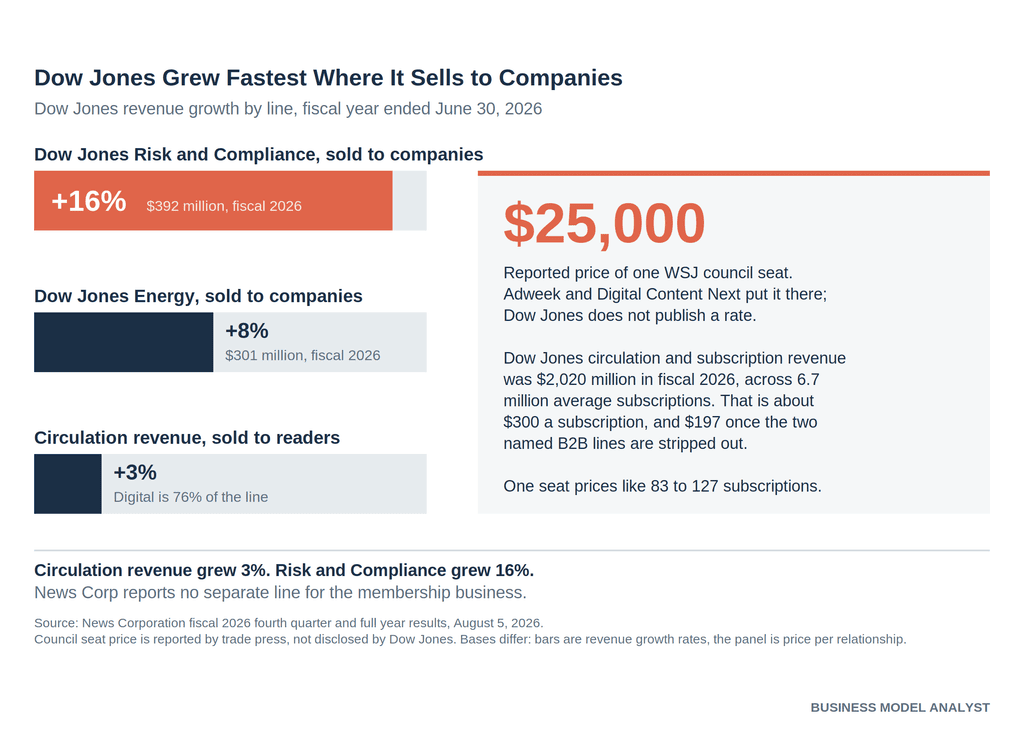
The growth mix says the same thing louder. Circulation revenue grew 3% in fiscal 2026. The professional information business grew 9%. Risk and Compliance grew 16% to $392 million. Dow Jones Energy grew 8% to $301 million. The fastest-expanding product inside one of the world’s great newspapers is compliance data sold to corporate procurement departments, and management has told investors it wants $1 billion of segment EBITDA out of Dow Jones by fiscal 2030.
The Institute is the next entry in that column. It just happens to be sold to a person rather than a purchasing system.
The Business Model Angle
The ranking is the qualification step. The WSJ newsroom published an inaugural Top 250 Board Directors report built on Diligent Market Intelligence data covering S&P 500 directors. Diligent describes that report as a complementary feature of the Board of Directors Council, and Diligent is one of the council’s founding sponsors. All of it is disclosed by the parties. Structurally, an editorial list identifies exactly the people the membership business wants, and hands them a reason to answer the phone. The same mechanic sits under the WSJ’s Built to Last ranking and under every list of best places to work ever published.
The same reader gets billed three times. Once for the subscription. Once for the council seat. Once more when a vendor like Workhuman or Heidrick and Struggles pays to sponsor the council that reader sits in. Advertising sells attention to a third party at a CPM. Membership sells the room to the occupant and to the vendor at the same time, and the occupant is the one who invited the vendor in.
This is a margin play, not a volume play. A newsletter with a hundred thousand readers and a council with a hundred members can throw off similar revenue, and the council does it without a single incremental ad impression. Anyone weighing a premium tier should run the contribution margin per relationship rather than per user, because the two numbers point in opposite directions here.
The moat is whatever cannot be summarized. News Corp has content licensing deals with OpenAI and Meta and a stated “woo and sue” posture toward everyone else. That is a fight over the article. A model can restate the Shaich interview in four sentences and lose almost nothing. What no model can do is put a chief executive in a room in London with the chief executive of Johnson and Johnson. Pricing power migrates to the part of the product that resists compression.
The Risk
The strongest objection is scale, and it is a good one. Two councils a year at a few dozen members apiece is single-digit millions against a $2.50 billion segment. Risk and Compliance alone did $392 million. If you are looking for what actually pays for Dow Jones, it is compliance software and energy price data, not dinners. The Institute could work perfectly and still never move the segment.
Second, rooms do not scale the way software does. The exclusivity is the product. Add enough councils and the thing being sold gets thinner, which is the trap every conference business eventually walks into. Fortune, Forbes, the Financial Times, Bloomberg, the Conference Board, YPO and Vistage all sell versions of this, and none of them turned it into a business that dwarfs the parent.
Third, key-man risk sits right on the surface. Murray is the product. He built it at Fortune, he brought the relationships, and relationships travel with people.
Fourth, and this is where most critics aim badly: the obvious worry is conflict of interest, and it is the wrong worry. Sponsors are named in the press releases, the rankings are done by the newsroom, and every business publication in the world runs events. The real fragility is quieter. Trust is the input to this entire product, the newsroom generates it, and the membership business spends it. If a list ever reads as bought, it stops qualifying anyone, and the funnel closes from the top. Dow Jones has to keep two things separate that its own org chart keeps adjacent.
Worth noting too that executives are not always buying what the brochure says they are buying. Research on return-to-office mandates found the trait that best predicted which bosses issued them was not productivity data. Peer status is a real product with real demand, and pretending it is only about learning misreads the customer.
Quick Questions
Does Dow Jones publish what a council seat costs? No. The roughly $25,000 figure comes from trade press reporting in 2024 and 2025, not from a rate card.
Where does membership revenue show up in News Corp’s results? Nowhere by name. The company names Risk and Compliance and Dow Jones Energy in dollars every quarter. The Institute gets no separate line.
Is the CEO Brief itself free? Yes. It launched February 3 and anyone can sign up.
Is this new for business media? Not remotely. Fortune, Forbes, the FT and Bloomberg all run paid executive communities and live events. What is newer is the tight loop between newsroom rankings, sponsor-funded councils and a daily free newsletter aimed at the same few thousand people.
Why does the ownership question matter here? Because media businesses keep discovering which parts of the value chain they actually control. Disney’s fight over its ABC licenses is the same lesson from the opposite end: the asset you own outright behaves nothing like the asset you rent.
The Business Model Analyst Take
Shaich told the WSJ that most chief executives never do the three-year work because they spend their days reacting. Fair. Here is the version of that question a publisher had to answer: in three years, what part of this product will a machine be able to reproduce for free?
Dow Jones answered it out loud. The reporting keeps flowing, and it flows free, because the reporting is now partly a qualification instrument. It finds the people worth $25,000 and proves to them that the room is full of peers. The article travels because traveling is its job.
Every subscription business has a version of this decision waiting. Find the piece of what you sell that survives being summarized, and check whether you are charging for it or giving it away as a sample of something cheaper.