
Who owns Zeus Network? Zeus Network is controlled by Lemuel Plummer, its co-founder, president, and chief executive, through the privately held California company Zeus Networks LLC. Three social media personalities, DeStorm Power, King Bach, and Amanda Cerny, are named as co-founders. Whether they still hold enforceable equity is now the subject of an active dispute, which is why the honest answer to this question in 2026 is more complicated than the one you will find on most pages.
That complication is the story. Almost every article about Zeus ownership repeats the same four-founder diagram, the same $100 million valuation, and the same user count. Very little of it is sourced, and some of it does not survive basic arithmetic. This analysis separates what is documented from what is merely repeated.
What does it mean to “own” Zeus Network? Zeus Networks LLC is a private limited liability company. There is no public share register, no filed annual report, and no regulator requiring disclosure. Ownership is defined by the operating agreement and by whatever equity or profit interests were actually issued, documents no outsider has seen. When public sources say someone “co-founded” Zeus, that describes their role at launch. It does not confirm they hold a current, enforceable stake. That gap between founder credit and legal ownership is exactly what is being litigated.
Zeus Network at a glance
| Item | Detail |
|---|---|
| Legal entity | Zeus Networks LLC |
| Company type | Private limited liability company, no public shareholders |
| Headquarters | Burbank, California |
| Launched | July 13, 2018 |
| Chief executive | Lemuel Plummer, also president and majority owner |
| Named co-founders | Lemuel Plummer, DeStorm Power, King Bach, Amanda Cerny |
| Business model | Subscription video on demand, no advertising tier |
| Published price | $5.99 per month or $59.99 per year |
| Flagship franchises | Baddies, Baddies Gone Wild, Bad Boys, Joseline’s Cabaret |
| Parent company | None. Zeus is independently held |
| Outside capital | No disclosed venture rounds. Two named individual investors before launch |
What is actually established about Zeus Network ownership
Four claims about Zeus ownership hold up against primary sources or direct statements from the company.
Lemuel Plummer controls the company. He is president and chief executive, and both he and his critics describe him as the majority owner. Nobody disputes this. He is the son of Detroit broadcasters who owned and operated television stations, and he built a production career at BET and WE tv before launching Zeus.
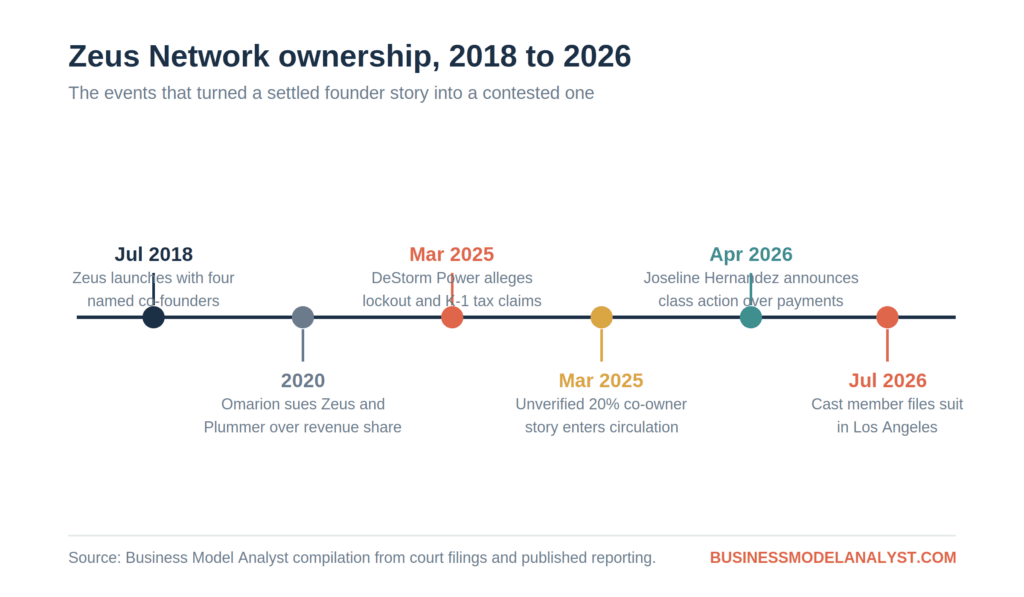
Zeus launched on July 13, 2018 with four named founders. Plummer plus DeStorm Power, King Bach, and Amanda Cerny. The three creators brought a combined social media audience in the tens of millions, which functioned as the platform’s launch marketing budget.
There were two early individual investors. In a 2021 interview, Plummer named them himself: Jonathan Rogers and Harold Lewis. He described their money as what let him move from selling shows to studios toward building his own platform. Note carefully what he did not say. The corporate affiliations widely attached to these two names across the web, NBCUniversal and Variety, do not appear in Plummer’s own account. They were added downstream by aggregator sites and then copied from each other.
Zeus has no parent company. It is not a subsidiary of a larger media group, it has not been acquired, and no institutional investor has disclosed a position. This independence is genuine and it is the single most important structural fact about the business.
The part that is contested
In March 2025, DeStorm Power published a video making direct allegations against Plummer. He said he had personally invested more than $130,000 of his own money to get Zeus off the ground on a promise of repayment once the platform was profitable. He alleged that he, King Bach, and Amanda Cerny continued to receive K-1 partnership tax documents reporting millions of dollars in Zeus income, meaning they were being taxed on money they say they never received.
Plummer responded publicly through the company’s social accounts. He denied the accusations, said he would answer them with documentation, and made a point of noting that Zeus had already been in litigation with Power for several years. His framing was that the matter belonged in court rather than in a viral video.
The dispute widened through 2026. In April, Joseline Hernandez, whose Joseline’s Cabaret ran six seasons on the platform before she launched a competing service, publicly accused Zeus of withholding payments owed to her and said she was organizing a class action. Plummer responded that Hernandez had breached exclusivity and non-disparagement terms in her agreement.
On July 1, 2026, a separate civil complaint was filed against Zeus Networks LLC and Plummer in Los Angeles County Superior Court by a former Baddies Gone Wild cast member, alleging sexual harassment, coercion, and related claims. Plummer has denied the allegations and said he intends to contest the case. The claims are untested and no court has ruled on them.
None of these actions has produced a judgment that changes the ownership register. But together they mean something specific for anyone researching who owns Zeus Network: the equity claims of three of the four named founders are disputed by the fourth, and no outsider can confirm the split.
The numbers everyone repeats, checked
Here is where most coverage of this topic falls apart. Three figures circulate constantly. All three are weakly sourced, and two of them fail arithmetic.
The “over 100 million users” claim
This figure appears across dozens of pages, usually paired with the $100 million valuation, and it is not plausible.
Sensor Tower’s public app overview for The Zeus Network has shown monthly US iOS revenue estimates in the region of $7 million against roughly 100,000 monthly downloads. Zeus publishes a $5.99 monthly price. Divide gross monthly app revenue by the monthly price and you get somewhere around 1.2 million paying subscriber equivalents on that one storefront.
That estimate is deliberately conservative in both directions. It excludes Android and direct web billing, so the true paying base is higher, plausibly in the range of two to three million. It also ignores that annual plans at $59.99 distort a simple monthly division. But no adjustment gets you within two orders of magnitude of 100 million. For scale, 100 million paying subscribers would put Zeus at roughly a third of Netflix’s global base, on a catalog of reality programming sold in one country.

The most likely explanation is mundane. Somewhere along the line a cumulative view count, an app download total, or a combined social media follower number was relabeled as “users,” and every subsequent article copied the relabeled version.
The “$100 million valuation”
This one fails in the opposite direction, which is the interesting part.
If Zeus is generating roughly $7 million a month in gross app store revenue, that annualizes to about $84 million from a single storefront before adding Android, web, licensing, and production revenue. A $100 million valuation against $84 million of revenue implies a multiple of about 1.2 times sales.
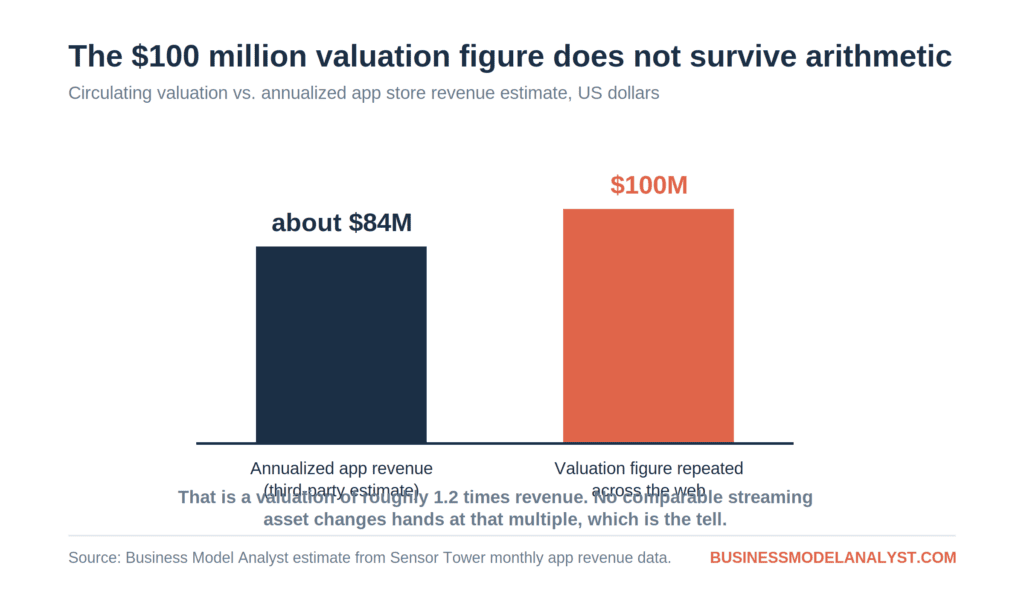
Streaming assets do not trade at 1.2 times revenue. Even distressed, subscale, single-genre streamers command meaningfully more, and profitable niche platforms with pricing power command a great deal more. The $100 million figure is not a lowball estimate of Zeus. It is a number with no derivation behind it that got repeated until it looked like a fact. If anything, the arithmetic suggests Zeus is worth considerably more than the figure attached to it, which is an unusual direction for internet misinformation to run.
The “20 percent co-owner” story
In March 2025, a cluster of articles appeared announcing that a new co-owner had acquired a 20 percent stake in Zeus Network. The claim then spread into ownership-focused pages across the web, including earlier versions of this one.
Trace it back and the trail ends at a set of sponsored placement and guest-post sites that publish supplied content, not at any entertainment trade, court filing, or company announcement. The Hollywood trades did not report it. Zeus has not confirmed it. A 20 percent transfer in a company of this size would ordinarily surface somewhere verifiable. Until it does, it should be treated as an unconfirmed promotional item rather than an ownership fact.
Why the ownership structure matters to the business
Concentrated private ownership is not incidental to how Zeus operates. It is the operating model.
Speed is the advantage. Zeus can greenlight a series, cast it, and ship it on a cycle that would take a public studio three budget cycles and a legal review. There is no board, no quarterly guidance, and no institutional investor asking about brand safety. That is precisely how a franchise like Baddies became a recurring content engine while larger platforms were still commissioning research on the demographic.
Founder-as-talent is the differentiator. Most streaming companies keep ownership and content creation in separate boxes. Netflix executives do not appear in Netflix shows. Zeus was built the other way around, with owner-creators who produced and starred in platform content. The subscription business model works far better when the owners themselves carry the audience.
Opacity is the cost, and the cost is now compounding. The same structure that removes disclosure obligations also removes the mechanism that resolves equity disputes quietly. In an LLC, it is usually the operating agreement that records each owner’s share and how profits are paid out. A public company with a share register and audited accounts does not end up with three co-founders alleging on social media that they are paying tax on income they never received. In a private LLC with an unpublished operating agreement, that outcome is available.
Key-man concentration is the real risk. Because Plummer is simultaneously majority owner, chief executive, chief content decision maker, and the named defendant in multiple actions, Zeus has no structural separation between company risk and personal risk. There is no independent board to insulate the business. For a platform whose entire supply chain runs on talent relationships, litigation involving talent is not a side issue. It is a direct threat to content supply.
Zeus compared with other streaming ownership models
| Platform | Ownership model | Public disclosure | Decision speed |
|---|---|---|---|
| Zeus Network | Founder-controlled private LLC, disputed minority stakes | None | Very fast |
| Netflix | Public company, dispersed institutional shareholders | Full SEC reporting | Slow, committee-driven |
| Peacock | Division of a listed media conglomerate | Reported within parent | Slow, parent-gated |
| Kick | Private, backed by named commercial owners | None | Fast |
The pattern is consistent across the industry. Ownership concentration buys speed and costs transparency. Zeus sits at the extreme end of that trade, which is why its ownership question is unusually hard to answer and unusually consequential when it goes wrong.
Frequently asked questions
Who is the owner of Zeus Network? Lemuel Plummer owns and controls Zeus Network as its majority owner, president, and chief executive. He co-founded the company in 2018 and operates it through Zeus Networks LLC, a private California company.
Is Zeus Network owned by DeStorm Power, King Bach, and Amanda Cerny? All three are named co-founders of the platform. Whether they currently hold enforceable equity is disputed. In 2025 they publicly alleged they had been locked out of the company while still receiving partnership tax documents. Plummer has denied the allegations and said the matter is in litigation.
Is Zeus Network owned by a larger company? No. Zeus has no parent company, has not been acquired, and is not a subsidiary of any media group. It is independently held.
How much is Zeus Network worth? There is no verified valuation. The widely repeated $100 million figure has no published derivation and implies an implausibly low multiple against estimated revenue. As a private company with no disclosure obligations, Zeus has never released audited financials.
How many subscribers does Zeus Network have? Zeus does not publish subscriber numbers. Third-party app revenue estimates imply a paying base in the low millions. Claims of 100 million users are not supported by any credible source.
Does Zeus Network have outside investors? Plummer has publicly named two individual investors who backed him before launch, Jonathan Rogers and Harold Lewis. No venture capital rounds, institutional investors, or public offerings have been reported.
The Business Model Analyst Take
The interesting thing about Zeus Network is not who owns it. It is that a company can reach a plausible nine-figure revenue run rate while the answer to “who owns it” remains genuinely unknown to everyone outside the operating agreement.
That is a feature of the model, not an accident of it. Plummer built Zeus by paying creators in equity, exposure, and upside rather than in the cash he did not have, which is the standard creator-economy bargain. It works beautifully at launch, when everyone’s incentives point the same direction and nobody is auditing the paperwork. It works badly at scale, when the platform is worth something and the paperwork is the only thing that decides who gets paid. Every creator-founded company eventually meets this moment. Most of them meet it in a conference room. Zeus met it on YouTube.
The strategic read for anyone building in this space is unglamorous. Equity granted informally to talent is not a cheap substitute for capital. It is deferred, undocumented liability that comes due exactly when the business becomes valuable enough to fight over. Zeus is not failing. It is profitable, independent, and dominant in a genre nobody else serves properly. But it now spends leadership attention and legal budget on ownership questions that a properly papered cap table would have settled for the cost of a lawyer in 2018.
For readers, the more useful takeaway is about sourcing. A company with no disclosure obligations generates an information vacuum, and that vacuum fills with numbers that have no origin. The 100 million users, the $100 million valuation, the unconfirmed 20 percent stake: none of these came from Zeus, and all of them are now presented as fact across the web. When a private company’s key figures are repeated identically everywhere with no primary source attached, that uniformity is not corroboration. It is copying.