
Texas made robotaxi fleet sizes public in May. Since then, the state registry has worked less like paperwork and more like a scoreboard, and Waymo just ran up the score.
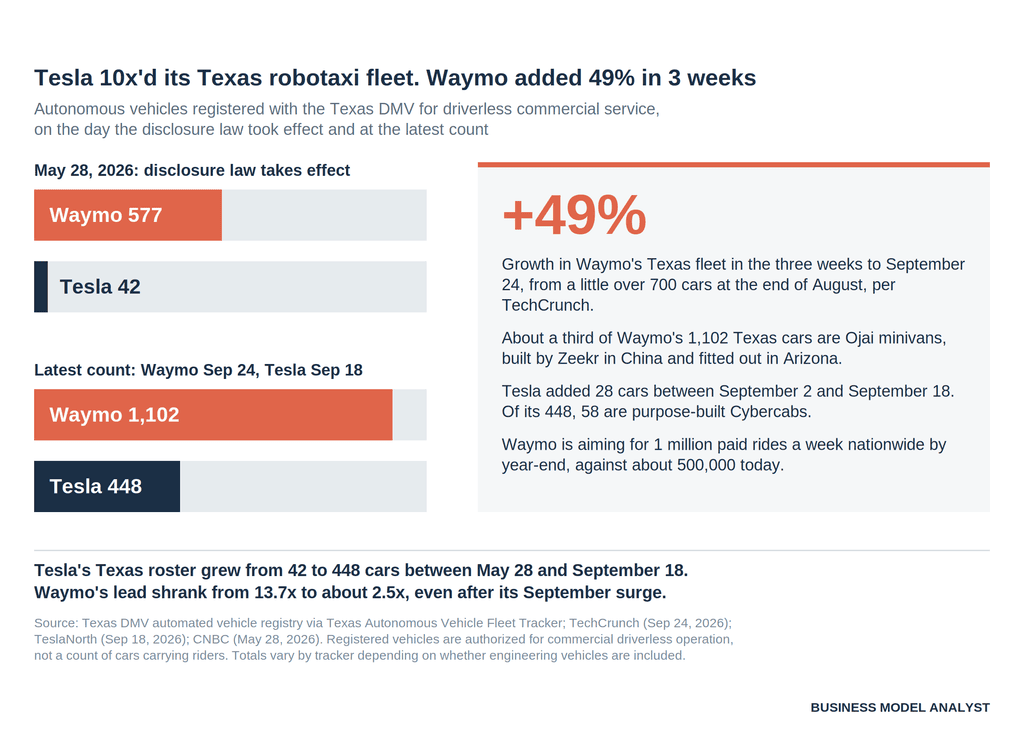
Waymo now has 1,102 autonomous vehicles registered in Texas, up 49% in three weeks, according to TechCrunch and state registration data. About a third of them are the new Chinese-built Ojai minivan. The headline everyone ran: Waymo is scaling fast.
The more interesting read is the timing. For most of the summer, Waymo’s Texas fleet barely moved, crawling from roughly 600 cars in June to a little over 700 by the end of August. Tesla spent that same summer taking its Texas roster from 42 vehicles to 420. On TechCrunch’s numbers, Waymo’s lead in the state had shrunk from almost 14 to 1 in May to under 2 to 1 by the first week of September.
Then Waymo added roughly 360 cars in 21 days. That is not a growth curve. That is a reply.
What Happened
TechCrunch’s fleet breakdown shows Waymo running about 4,000 robotaxis across 15 US cities and averaging 500,000 paid rides a week. Roughly 80% of those vehicles sit in just two states, California and Texas. The other 800 or so are spread across Arizona, Florida and the rest of the map.
Texas is where the fleet is moving now. Using the Texas Autonomous Vehicle Fleet Tracker, which scrapes the state’s official registry, TechCrunch counted 1,102 Waymo vehicles as of September 24, up from a little over 700 at the end of August. Waymo launched in Austin through Uber in March 2025 and has since added Dallas, Houston and San Antonio.
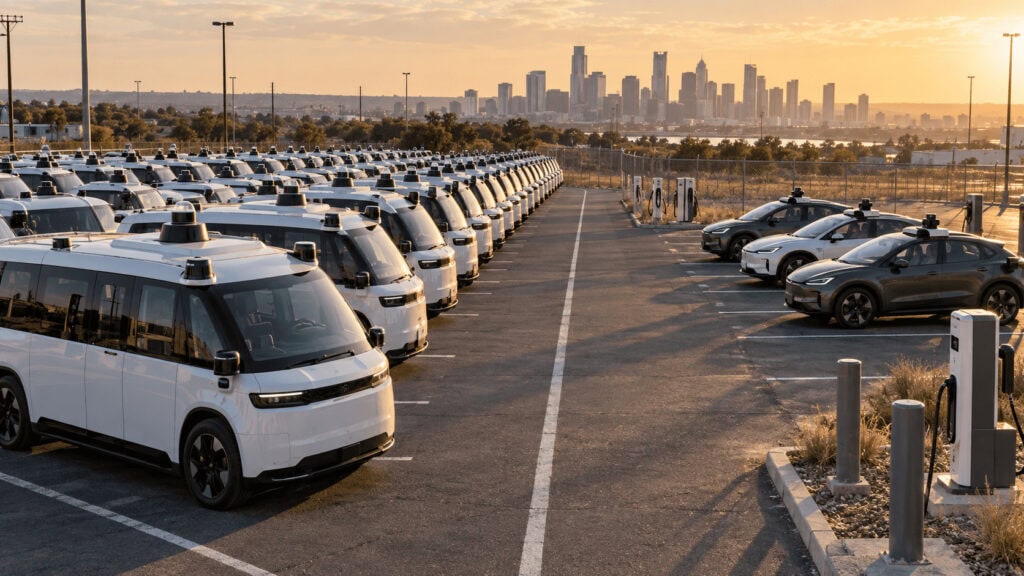
The surge is mostly Ojai. The minivan, built by Geely’s Zeekr brand, shipped without Chinese connected-car tech and finished at Waymo’s Arizona plant, now makes up about a third of the Texas fleet. That works out to roughly 367 vans in one state. When BMA looked at Waymo’s Ojai import pipeline on September 2, the Ojai count carrying riders nationwide was about 300.
Texas alone now holds more Ojais than the entire country did three weeks ago. The yard in Arizona is emptying, and it is emptying into Texas.
The Backstory
Texas Senate Bill 2807 changed the game on May 28, 2026. It set up a self-certification path for commercial Level 4 operators: file with the Texas DMV, attest to the capability, carry insurance, and keep an active vehicle list. That last requirement turned into something nobody wrote it to be. A public, daily-updated count of every company’s fleet.
Fan-built trackers started scraping it immediately. Here is what the scoreboard has shown since:
- May 28: Waymo 577, Tesla 42 (13.7x gap)
- Mid-July: Tesla about 175
- August 31: Tesla 276, including its first seven Cybercabs
- September 2: Tesla 420 after registering 106 Model Ys in about 24 hours, against Waymo’s roughly 740 on TechCrunch’s baseline (1.8x gap)
- September 18: Tesla 448, including 58 Cybercabs
- September 24: Waymo 1,102 (2.5x gap)
Tesla’s big jump landed the day before its September 3 Cybercab launch event in Austin. Waymo’s three-week addition of about 360 cars is equal to roughly 80% of Tesla’s entire Texas roster. Over roughly the same stretch, Tesla added 28.
The Plan
Waymo has not said why Texas got the cars, and the boring explanation deserves credit. Dallas, Houston and San Antonio are young markets that need fleets. The Ojai conversion line in Arizona is ramping, and MoffettNathanson, which tracks Ojai imports through shipping records, expects Waymo to land 5,100 of them in the US by year-end. Cars have to go somewhere.
But supply explains how many cars exist, not where they go. Waymo had choices. It sent them to the one state where its main rival is also concentrated, where the fleet count is public, and where that rival had just closed most of the gap in a single summer.
There is a second pressure pushing the same direction. Waymo’s co-CEO Tekedra Mawakana set a target of one million paid rides a week by the end of 2026. Rides are still around 500,000. At today’s roughly 125 trips per vehicle per week, one million rides needs about 8,000 cars. The company has about 14 weeks and half that fleet. Every car has to land somewhere it can find riders fast, and dense metros with an existing app base beat a fresh flag in a new city.
The Business Model Angle
Disclosure turned capex into marketing. SB 2807 was written as a safety and accountability rule. In practice it created a free, public, real-time leaderboard that fan accounts post every time a number moves. Once fleet size is visible, adding cars buys two things at once: capacity and narrative. Expect every state that copies the list requirement to get its own robotaxi arms race.
The scoreboard favors whoever owns the factory. Tesla can register Model Ys it already builds, at its own cost, in batches of 100 overnight. Waymo pays a steep China tariff on every Ojai body before it pays for sensors and integration. A registration is one form either way, but the capital behind it is not symmetric. Registered is also not the same as riding: trackers caught weeks this summer when as few as 20 Teslas were running unsupervised in Austin.
Density is the real moat, not coverage. Four out of five Waymos sit in two states. The fixed costs that do not travel (depots, charging, towing contracts, remote operators) get cheaper per car the more cars share them. Waymo is behaving like a company that has figured out the 15-city map is the brochure and the California-Texas corridor is the business.
The Risk
The obvious one: adding cars to a market does not add riders to it. BMA flagged in August that Waymo’s weekly ride count stayed flat while its city count jumped, pulling trips per vehicle down about 25%. Pouring 360 cars into Texas while national rides sit near 500,000 pushes that ratio lower unless Texas demand shows up fast. And the market Waymo just flooded is the one where a rival is also adding supply.
The steelman on timing is real too. Correlation is not strategy. Waymo’s Texas fleet may simply have been waiting on Ojai conversions that happened to clear in September. Nobody outside Waymo can prove intent from a registry.
Then there is the cost side. Waymo pays tariffs on every Ojai it imports, and the cost stack of a robotaxi ride is dominated by the vehicle and the humans around it. A car deployed to win a scoreboard still depreciates at the same rate as one deployed to win a ride.
Finally, Texas is the friendliest regime in the country right now. The purpose-built competition elsewhere is fenced in: Zoox’s no-steering-wheel design keeps it under a 2,500-vehicle federal exemption cap. Texas lets everyone self-certify. That is great for Waymo’s pace and equally great for Tesla’s.
Quick Questions
How reliable are the Texas numbers?
They come from the Texas DMV’s automated vehicle registry, which lists cars authorized for commercial driverless operation. They are real registrations, not estimates, but they are not a count of cars carrying passengers at any given hour. Totals also vary by who is counting: one tracker-based report put Waymo at 988 Texas vehicles on September 2, well above the roughly 740 implied by TechCrunch’s figures. On that higher count, Tesla’s closest approach was about 2.4 to 1, not 1.8. The direction of the story holds either way.
Is Tesla actually close to Waymo in Texas?
On paper, closer than anywhere else in the country. On the road, not yet. Tesla’s 448 includes 58 Cybercabs, and most of its roster is Model Ys that trackers show running unsupervised in far smaller numbers.
Will Waymo hit one million weekly rides this year?
The math is tight. It needs roughly double today’s fleet and double today’s riders in about 14 weeks. An independent FutureSearch forecast published this summer put the likelier year-end figure closer to 775,000.
The Business Model Analyst Take
Texas wanted a list of robotaxis on its roads. What it built is the first public, daily scoreboard in the history of the industry, and the two leaders are playing to it. Tesla closed a 14x gap to roughly 2x in a summer. Waymo spent three weeks and roughly a third of its Chinese van inventory putting the gap back above 2x.
None of that shows up in a ride count yet. The number that settles who is winning is not registrations. It is trips per car per week in Austin, Dallas and Houston, and that is the one number the registry does not publish.