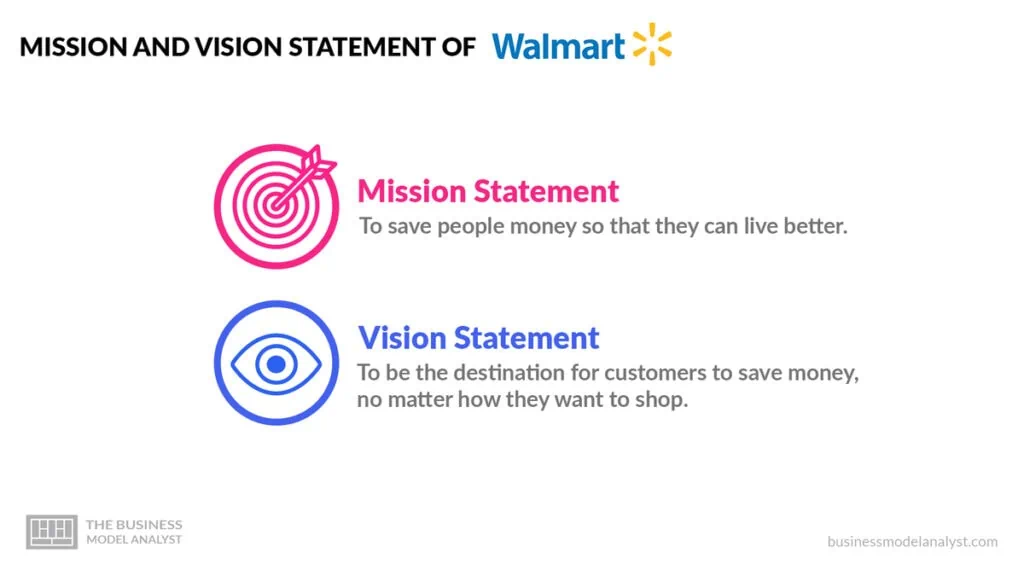
Most retailers talk about saving customers money. Walmart actually built a $713 billion company doing it. The mission and vision statements sound almost too simple, but reading them next to what Walmart actually did with $14 billion in capex, a failed clinic experiment, and a $2.3 billion TV company acquisition tells a much sharper story than the usual “EDLP and good values” summary.
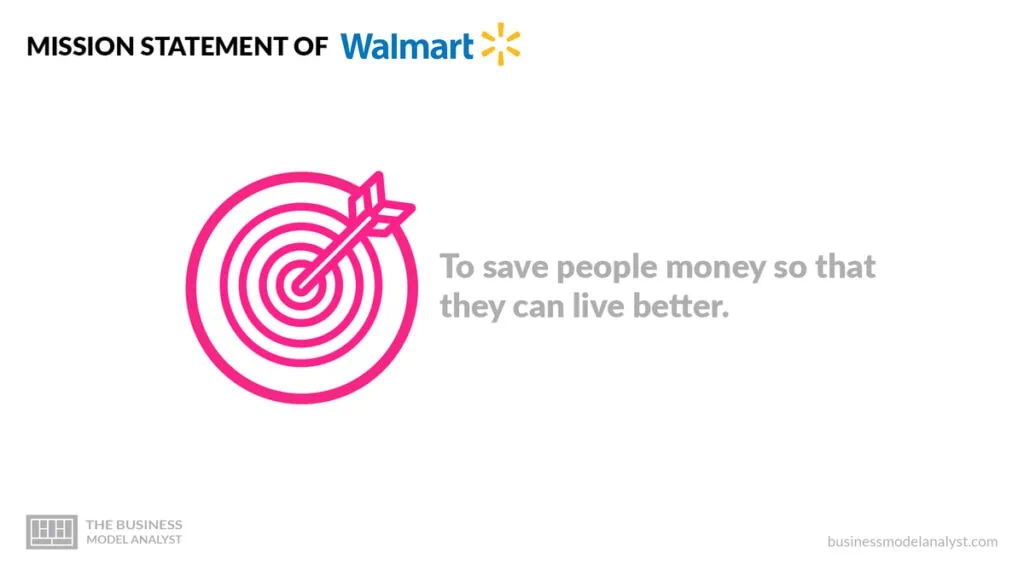
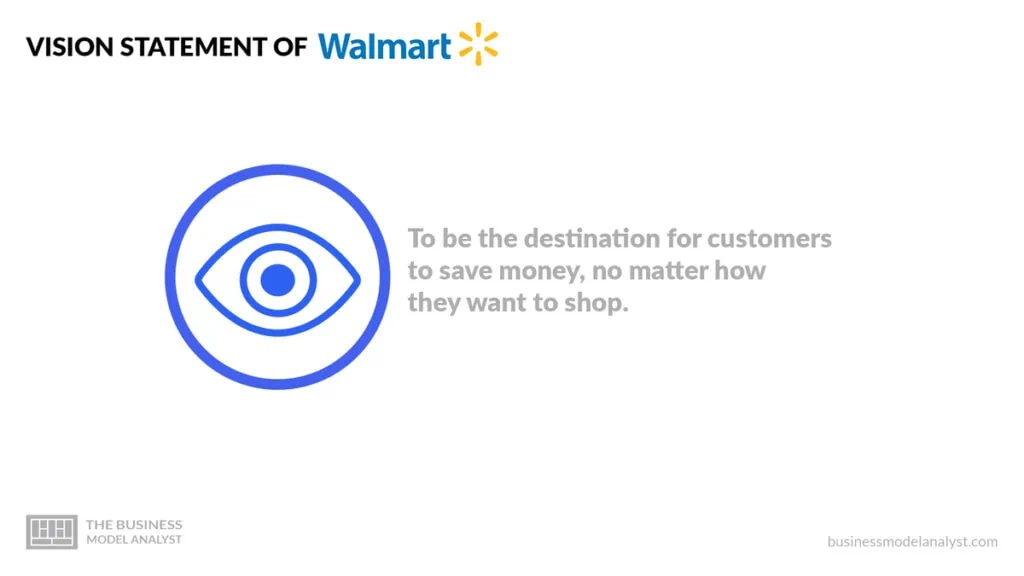
Walmart’s mission statement is “to save people money so they can live better.” Its vision statement is “to be the destination for customers to save money, no matter how they want to shop.” The company’s four official core values, per corporate.walmart.com, are: Service to Customers and Members, Respect for the Individual, Act with Integrity, and Strive for Excellence. Together they anchor Walmart’s Everyday Low Price (EDLP) strategy across 10,900+ stores in 19 countries and roughly 2.1 million associates, generating $713 billion in FY2026 revenue. The mission predicts price-led decisions (private brands, supply chain automation, low-cost fulfillment); the vision predicts omnichannel and ad-business investments (Walmart+, Walmart Connect, the Vizio acquisition).
Walmart Mission and Vision Statement at a Glance
| Element | Statement | Strategic Translation |
|---|---|---|
| Mission | To save people money so they can live better. | EDLP, private brands, supply chain automation, supplier negotiation leverage. |
| Vision | To be the destination for customers to save money, no matter how they want to shop. | Omnichannel investment, Walmart+, Walmart Connect, last-mile delivery. |
| Purpose (corporate.walmart.com) | To help people save money and live better. | The current, softer-worded version Walmart uses internally and externally. |
| Slogan | Save Money. Live Better. | Direct consumer-facing compression of the mission. |
| Core Values | Service to Customers and Members, Respect for the Individual, Act with Integrity, Strive for Excellence. | Code of Conduct, associate training (Walmart Academy), supplier audits. |
The slogan, the mission, and the corporate purpose all say nearly the same thing on purpose. Sam Walton’s original premise has been the company’s strategic North Star since 1962, and Walmart has resisted the corporate temptation to dress it up. The vision, refreshed years after the founding, is where the omnichannel ambition lives.
Why Walmart’s Mission Statement Still Matters in 2026
Walmart’s mission, “to save people money so they can live better,” is the rare corporate statement that actually predicts behavior. You can trace nearly every major Walmart decision in the past three years back to one of two verbs in that sentence: save (the cost discipline) or live better (the broader customer life).
Critics like to call it bland. They are missing the point. The mission’s value lies in what it filters out, not in what it inspires. When a leadership team is offered a high-margin but high-friction product line, the mission tells them to walk away. When automation pays back in lower per-order cost, the mission tells them to invest. The vagueness of “live better” is the only place where the company has historically taken expensive swings, and as we will see, that is also where Walmart has failed hardest.
Strategic Levers the Mission Activates
| Mission Lever | What Walmart Actually Does | Recent Evidence (2024 to 2026) |
|---|---|---|
| Everyday Low Price | Reject high-low promo cycles; commit to consistent low shelf prices. | Q4 FY26 U.S. comp sales grew 4.6% with EDLP intact during inflation. |
| Private brands | Build owned labels to undercut national brands and raise margin. | Launched private label “bettergoods” in April 2024 alongside Great Value expansion. |
| Supply chain automation | Push fixed cost out of fulfillment so it can be passed to the customer. | $13.3 billion in capex in FY24, continued automation rollout in FY26. |
| Supplier leverage | Use buying scale to pressure cost upstream. | Rolled back prices on more than 7,000 items in 2024 to defend basket value. |
| Wage and training investment | Treat associate stability as part of the “live better” promise. | Live Better U offers 100% paid tuition to U.S. associates. |
Where the mission gets uncomfortable is wages. Walmart has consistently argued that low prices for customers and modest wages for associates are part of the same equation. That trade-off is the mission’s permanent political tension, and it shows up in every union story, every state-level minimum-wage debate, and every shareholder proposal on pay. Reading Walmart’s mission honestly means accepting that the “save money” side has historically dominated when the two pull against each other.
For more on how price leadership cascades through Walmart’s operations, see the Walmart business model breakdown and the Walmart value chain analysis.
Why Walmart’s Vision Statement is Doing the Heavier Lifting Now
The vision, “to be the destination for customers to save money, no matter how they want to shop,” has aged better than the mission has had to. The mission has barely moved since 1962. The vision is what carries Walmart’s response to Amazon, to Shein, to TikTok Shop, and to whatever comes next.
The phrase that matters is “no matter how they want to shop.” That clause is doing the work. It justifies physical stores, app-based ordering, curbside pickup, third-party delivery, Marketplace selling, and connected TV commerce in a single breath. Without it, Walmart would have to defend each channel against a CFO who could otherwise argue the company is a store chain that does e-commerce on the side.
What the Vision Authorizes Walmart to Spend On
| Strategic Bet | Vision Connection | Recent Result |
|---|---|---|
| Walmart+ membership | Channel-agnostic loyalty for repeat shoppers. | Reached approximately 28.4 million members by January 2026 (Morgan Stanley estimate). |
| Walmart Connect (ads) | Monetize attention across channels, not just shelves. | Global advertising business grew 27% to $4.4 billion in FY25. |
| Vizio acquisition | Owning the smart TV operating system to extend ads into the living room. | $2.3 billion deal closed December 3, 2024. |
| Same-day and 3-hour delivery | Removing convenience as a reason to shop elsewhere. | 95% of U.S. households reachable in under three hours; same-day delivery grew roughly 180% year over year. |
| Marketplace and Walmart Fulfillment Services | Broaden assortment without owning inventory. | Walmart Connect ad partners grew 60% in Q3 FY25, driven by Marketplace expansion. |
The vision is also where Walmart’s most interesting financial play lives. Walmart Connect and Walmart+ are not really retail businesses, they are profit-pool businesses. They generate higher gross margins than groceries ever will, and they are funded by the foot traffic and digital traffic that EDLP already pays for. The vision essentially tells investors that Walmart is allowed to become a media company and an infrastructure company without abandoning what it was hired to do.
For deeper context, the Walmart vs Amazon analysis tracks how Walmart’s vision led to a fundamentally different bet than Amazon’s, and the Walmart marketing strategy guide details how the omnichannel vision shows up in actual campaigns.
Walmart’s Core Values, Officially
Plenty of competing articles list five, six, or even seven Walmart values. They are wrong, or at least outdated. The official values on Walmart’s own corporate ethics page in 2025 and 2026 are four, and only four. Source: corporate.walmart.com/purpose/ethics-integrity.
| Core Value | What Walmart Says It Means | What It Looks Like in Practice |
|---|---|---|
| Service to Customers and Members | Improve the customer experience every day; exceed expectations. | EDLP, Walmart+ benefits, Scan & Go, in-app generative AI search. |
| Respect for the Individual | Listen, show empathy, celebrate differences, recognize ideas from anywhere. | Live Better U tuition coverage, associate development programs, Walmart Academy training. |
| Act with Integrity | Be honest, fair, and transparent; do what you say. | Global Code of Conduct, responsible sourcing supplier audits, compliance escalation channels. |
| Strive for Excellence | Move with speed, attention to detail, high expectations. | Automation in fulfillment, in-stock and shrink controls, supplier scorecards. |
If you see “Embrace Change” or “Giving Back” listed somewhere as a Walmart core value, that reflects an older internal articulation. The Sam Walton “Three Basic Beliefs” predated the current four-value framework, and “Embrace Change” was one of the founder’s “Ten Rules for Building a Business,” not a current core value. Useful background, but not the current statement.
The Real 2024 to 2026 Test: Did the Mission and Vision Actually Steer Capital Correctly?
This is the section most competitor articles skip. They list the mission, list the vision, list the values, and call it analysis. The harder question is whether Walmart’s stated purpose actually filtered its big bets well. Here is the honest scorecard.
Win: Project Gigaton (Mission + Values)
Walmart launched Project Gigaton in 2017 with a goal to avoid, reduce, or sequester 1 billion metric tons of greenhouse gas emissions across its supply chain by 2030. The company announced in February 2024 that more than 5,900 suppliers had already pushed reported reductions past the 1 gigaton mark, hitting the target six years early. That outcome ties cleanly to both the cost-saving mission (suppliers running leaner pass less cost to Walmart) and the integrity value.
Worth noting: most still-active competitor analyses talk about Project Gigaton as an “ongoing 2030 goal.” It is not. It was achieved, and Walmart has since rolled its supply-chain emissions work into the broader path to net-zero by 2040.
Win: Vizio (Vision)
The $2.3 billion Vizio deal, finalized on December 3, 2024, is one of the cleanest vision-execution moves Walmart has made in a decade. Vizio’s SmartCast OS lets Walmart Connect place ads in front of viewers on roughly 18 million smart TVs, turning physical homes into another channel where Walmart can monetize attention. The vision said “no matter how they want to shop.” Owning the screen they watch is a fairly literal interpretation.
Win: Walmart+ Scale (Vision)
Walmart+ membership grew from roughly 11 million in 2022 to approximately 28.4 million by January 2026, per Morgan Stanley survey data reported by PYMNTS. Same-day delivery volume grew approximately 180% year over year by mid-2025. None of that is the most heroic growth in retail history, but it represents a credible, channel-agnostic loyalty asset built directly off the vision.
Failure: Walmart Health (Vision Overreach)
This is the case competitor analyses are most willing to ignore. In April 2024 Walmart announced it was closing all 51 of its Walmart Health clinics and shutting down its virtual care service. The official reason was “a challenging reimbursement environment and escalating operating costs.”
The honest reading is that Walmart Health was a stretch interpretation of “live better.” Care delivery is a structurally low-margin, regulatory-heavy business that does not benefit from Walmart’s supply chain advantages the way grocery does. The mission could justify the experiment, but it could not justify scaling unprofitable units indefinitely. When the math broke, the mission stopped protecting the project.
The lesson is uncomfortable for fans of corporate purpose: a mission statement cannot bend physics. “Live better” is broad enough to authorize healthcare as a target, but it is also broad enough to make a bad bet sound reasonable for longer than it should.
| Bet | Mission/Vision Fit | Outcome | What It Says About the Statements |
|---|---|---|---|
| Project Gigaton | Strong (cost discipline + integrity) | Achieved 6 years early in 2024 | Mission filtered well; supply chain savings reinforced EDLP. |
| Vizio acquisition | Strong (vision, omnichannel monetization) | Closed Dec 3, 2024; integrating into Walmart Connect | Vision authorized a non-obvious bet that fits the long-term model. |
| Walmart+ | Strong (vision) | Approximately 28.4M members by Jan 2026 | Vision is producing a real loyalty asset and an alternative profit pool. |
| Walmart Health | Weak (vision overreach into “live better”) | All 51 clinics closed April 2024 | Mission breadth allowed a bet that operations could not sustain. |
Mission vs Vision vs Purpose vs Slogan: The Distinction Actually Matters
A lot of writeups blur these terms. The distinction is small but useful when you are reading Walmart’s actual filings.
| Term | Walmart’s Version | Time Horizon | Where It Lives |
|---|---|---|---|
| Mission | To save people money so they can live better. | Indefinite | Operating philosophy, EDLP, supplier negotiation. |
| Vision | To be the destination for customers to save money, no matter how they want to shop. | 5 to 10 years | Capital allocation, M&A, omnichannel investment. |
| Purpose (current corporate wording) | To help people save money and live better. | Indefinite | Code of Conduct, sustainability, community programs. |
| Slogan | Save Money. Live Better. | Consumer-facing | Marketing, packaging, in-store signage. |
Notice how the “purpose” version on the corporate ethics page is softer than the classic “mission” version. “Help people save money” sounds slightly less paternal than “save people money.” This is not random. The purpose wording is calibrated for an associate-facing and stakeholder-facing context. The mission wording is calibrated for a strategy and operations context. Both are accurate, and Walmart uses them interchangeably depending on audience.
Walmart by the Numbers in 2026 (For Context)
Mission and vision statements only mean what the financial scale lets them mean. The reason “save people money” matters is that Walmart can use scale to actually do it. Here is the relevant 2026 backdrop, sourced from Walmart’s SEC filings and corporate press releases.
| Metric | FY2026 Figure | Source |
|---|---|---|
| Total revenue | $713 billion | Walmart Q1 FY27 press release, May 2026 |
| Net sales | $706.4 billion | Walmart FY26 earnings |
| Adjusted operating income | $31.0 billion | Walmart FY26 earnings |
| Operating cash flow | $41.6 billion | Walmart 2026 Proxy Statement |
| Return on Investment | 15.1% | Walmart 2026 Proxy Statement |
| Stores worldwide | More than 10,900 | Walmart Q1 FY27 release |
| Countries operated in | 19 | Walmart Q1 FY27 release |
| Weekly customers and members | Approximately 280 million | Walmart Q1 FY27 release |
| Associates worldwide | Approximately 2.1 million | Walmart Q1 FY27 release |
| Q4 FY26 global eCommerce growth | 24% | Walmart Q4 FY26 release |
| Q1 FY27 global eCommerce growth | 26% | Walmart Q1 FY27 release |
| Walmart+ estimated members (Jan 2026) | Approximately 28.4 million | Morgan Stanley via PYMNTS |
| FY25 global advertising business | $4.4 billion (up 27%) | Walmart FY25 Q4 release |
| Households reachable in under 3 hours | 95% (U.S.) | Walmart corporate announcement, April 2025 |
The financial scorecard is the part that makes the mission credible. A retailer with thinner margins or a more aggressive promotional cadence could say the same words and they would not mean the same thing.
For a deeper view of how Walmart compares to peers on these metrics, see the Walmart competitors and alternatives breakdown and the Walmart SWOT analysis.
Honest Critique: Where Walmart’s Mission and Vision Fall Short
Three things competitor articles tend to either skip or whitewash.
1. The mission does not include associates. Customers are the explicit subject. Suppliers and associates show up under values, not under the mission. That is a deliberate choice, and it explains why the wage debate has been a recurring vulnerability for Walmart’s reputation. Compare with Costco, where membership and employee stability are baked into the explicit value proposition. Walmart’s structure is different, and the mission reflects that.
2. The vision is silent on sustainability. Project Gigaton is a values-level commitment, not a vision-level commitment. That means if cost-saving and emissions-reduction ever pull in opposite directions (and at scale they will), the vision is not constructed to break the tie. A revised vision that includes “sustainably” or “responsibly” would force the trade-off into strategic decisions rather than letting it sit in the ESG report.
3. Neither statement names technology. Walmart’s actual 2026 operating reality is that “people-led, tech-powered” is the working framework leadership keeps quoting on earnings calls. Yet neither the mission nor the vision references technology. The result is a small but real gap between what executives say in public and what the official statements authorize. A future vision update will likely close this gap.
These are not catastrophic flaws. They are the price of having a mission statement that has remained intact for more than six decades. Stability is the feature, not the bug. But anyone analyzing Walmart should be honest about where the statements stop and the actual strategy takes over.
How Walmart’s Mission and Vision Compare to Direct Rivals
Reading any mission statement in isolation is a waste of time. Reading it next to competitors shows what a company chose to emphasize and what it chose to ignore.
| Company | Mission or Purpose | Key Emphasis | What It Predicts |
|---|---|---|---|
| Walmart | Save people money so they can live better. | Price | EDLP, supply chain, scale economics. |
| Amazon | To be Earth’s most customer-centric company. | Selection, convenience, invention | AWS, Prime, marketplace, satellite broadband. |
| Costco | Continually provide members with quality goods and services at the lowest possible prices. | Members, quality at price | Membership model, limited SKUs, treasure-hunt assortment. |
| Target | Help all families discover the joy of everyday life. | Experience and design | Owned brands, store design, design partnerships. |
| Kroger | To Feed the Human Spirit. | Food, community | Grocery-first focus, fresh and prepared food investment. |
The pattern is informative. Walmart and Costco both lead with price. Amazon leads with the customer experience as a whole. Target leads with discovery and design. None of these companies is doing the others’ job, and the mission statements predict that.
For more comparative analysis, see the Amazon mission and vision statement breakdown and the collection of company mission and vision statements.
Frequently Asked Questions
What is Walmart’s mission statement? Walmart’s mission statement is “to save people money so they can live better.” It has been the company’s guiding statement since founder Sam Walton’s earliest days running stores in the 1960s.
What is Walmart’s vision statement? Walmart’s vision is “to be the destination for customers to save money, no matter how they want to shop.” The vision is what authorizes the company’s omnichannel and digital investments.
What is Walmart’s official purpose statement on its corporate website? Walmart’s corporate ethics and integrity page states the company’s purpose as “to help people save money and live better.” It is a slightly softer rewording of the mission, used in stakeholder-facing contexts.
What are Walmart’s core values? Four values: Service to Customers and Members, Respect for the Individual, Act with Integrity, and Strive for Excellence.
Is Walmart’s slogan the same as its mission? “Save Money. Live Better.” is the consumer-facing slogan. It compresses the mission into a tagline used on marketing materials, packaging, and in-store signage.
Has Walmart’s mission ever changed? The wording has been adjusted slightly over time (versions appear in different filings using “save,” “help save,” and “anytime and anywhere”), but the substance has been consistent since 1962. The vision is more modern and has been reframed around omnichannel since the rise of e-commerce.
Who is Walmart’s CEO in 2026? Doug McMillon remains President and CEO of Walmart Inc. as of 2026. Leadership changes effective February 1, 2026, included naming David Guggina as President and CEO of Walmart U.S. and Chris Nicholas as President and CEO of Walmart International. Per the Walmart Q1 FY27 release.
Did Walmart hit Project Gigaton? Yes. Walmart announced in February 2024 that it had achieved its 1 billion metric ton greenhouse gas reduction goal six years ahead of its 2030 target, with more than 5,900 suppliers participating.
What happened to Walmart Health? Walmart closed all 51 of its Walmart Health clinics and shut down its virtual care service in 2024, citing a challenging reimbursement environment and escalating operating costs. The closure marked a significant retreat from its push into primary care.
Bottom Line
Walmart’s mission and vision statements are not poetry, and they are not supposed to be. The mission, “to save people money so they can live better,” is a operational filter that has correctly pointed the company toward cost discipline, private brands, supply chain automation, and scale advantages for more than six decades. The vision, “to be the destination for customers to save money, no matter how they want to shop,” is the more interesting document in 2026, because it is what justifies Walmart’s $2.3 billion Vizio bet, its 28.4 million Walmart+ subscribers, and the rapid scaling of Walmart Connect into a $4 billion-plus advertising business.
Where the statements show their limits is the same place every corporate statement does: at the margins of the wage debate, in the silence on sustainability, and in the absence of technology language. Walmart Health’s collapse in 2024 is the cleanest recent example of what happens when “live better” gets stretched past where the operating model can support it.
Taken together, the mission and vision still do what good corporate statements are supposed to do. They predict the company’s behavior. If you read the mission carefully, you can guess most of what Walmart will spend money on next year. That, more than any aspirational phrasing, is the real test, and Walmart’s statements pass it.