
Aramark’s uniform business earned $213 million in its last year as a subsidiary, at a 14.3% adjusted EBITDA margin. Three fiscal years later, cumulative net income as an independent company is negative. The $1.457 billion that left the building on day one explains most of the difference.
On September 30, 2023, a business that had been quietly laundering work shirts inside Aramark for decades became Vestis Corporation, ticker VSTS on the New York Stock Exchange. It had roughly 300,000 customer accounts, about 3,300 routes, 325 or so processing plants and depots, and a 14.3% adjusted EBITDA margin. It also had $1.5 billion of brand new term loans and had just wired about $1.457 billion of the proceeds to the parent it was leaving.
Nineteen months later the stock fell 37.5% in a single session. The CEO was gone, the CFO was leaving, guidance had been withdrawn, and the securities class action bar had arrived.
The usual way to tell this story is that Aramark offloaded a tired business and the buyers found out. That reading does not survive the filings. The business Aramark handed over was good. What the separation did was fix the price of being wrong about it, and then the company was wrong about it.
What the Vestis Spin-Off Actually Was
Leveraged spin-off: a corporate separation in which the departing subsidiary raises debt in its own name and transfers most of the proceeds to the parent as a cash consideration before the distribution. The parent receives cash without selling anything and without triggering tax. The subsidiary receives the debt, the interest bill, and the covenants. Shareholders own both sides, so on paper nothing has moved.
The structure is standard and legal and used constantly, and it is one of the few entries in the catalog of business model types that describes a financing event rather than a way of serving a customer. Aramark announced the intention in May 2022, the board approved it in September 2023, and every Aramark holder got one Vestis share for every two Aramark shares. Goldman Sachs and J.P. Morgan advised. Wachtell Lipton papered it. It was a tax-free distribution under Section 355, which is the whole reason for doing it this way instead of selling the division.
The mechanics that matter sit in a single paragraph of the closing 8-K. Vestis entered $1,800 million of senior secured financing: an $800 million term loan A-1, a $700 million term loan A-2, and a $300 million revolver. The filing then says plainly that the term loan borrowings were used in part to fund a cash transfer of approximately $1.457 billion to Aramark.
Vestis borrowed the money. Aramark took the cash. Vestis kept the obligation.
There is a second piece of the structure that almost nobody reads and that turned out to matter enormously. The Tax Matters Agreement barred Vestis, for two years after the distribution, from merging, liquidating, issuing or selling stock in a way that would change ownership by 50% or more, or selling assets outside the ordinary course, unless it obtained an IRS ruling or a tax opinion satisfactory to Aramark in Aramark’s sole and absolute discretion.
The window of that restriction ran to September 30, 2025. The business broke inside it.
The Business Aramark Handed Over
Start with what the division actually was, because the “bad business” story falls apart here.
| FY2023, inside Aramark | FY2024 | FY2025 | FY2026, first 9 months | |
|---|---|---|---|---|
| Revenue | $2,825.3M | $2,805.8M | $2,734.8M | $1,984.5M |
| Operating income | $217.9M | $158.0M | $64.4M | $80.6M |
| Adjusted EBITDA | $404.0M | $352.9M | $257.4M | $225.8M |
| Adjusted EBITDA margin | 14.3% | 12.6% | 9.4% | 11.4% |
| Interest expense, net | $2.1M | $126.6M | $92.3M | $63.4M |
| Net income | $213.2M | $21.0M | $(40.2)M | $7.3M |
| Net leverage, period end | 3.95x | 3.62x | 4.72x | 4.10x |
Fiscal 2023 revenue grew 5.1%. Adjusted EBITDA margin was 14.3%. Net income was $213.2 million, which included a $51.8 million gain on the sale of an equity investment, so call the underlying figure roughly $175 million. Free cash flow was $190.3 million, a 47.1% conversion of adjusted EBITDA.
Structurally it was a route-based service business of the ordinary kind: a truck, a driver, a fixed territory, a weekly stop, 95% of revenue recurring under contract, which gives it the retention economics of a subscription business, 91% in the United States and 9% in Canada. Those businesses are not exciting and they are not supposed to be. They are supposed to be durable.
Interest expense, net in that final year inside Aramark was $2.1 million. Against $217.9 million of operating income, that is one cent on the dollar. The business had essentially no debt service because the parent held the debt at the group level.
That single line is the whole separation, expressed as a number.
The Check: $1.457 Billion Left on Day One
Two comparisons put the size of the transfer in perspective, and both come straight from disclosed figures.
The first is against earnings. The $1.457 billion cash transfer was 3.6 times the division’s fiscal 2023 adjusted EBITDA of $404.0 million, and about 8.3 times its underlying net income excluding the investment gain. Add finance leases and subtract cash and the business opened for business at 3.95x net leverage.
The second is against the equity itself. On May 7, 2025, after Vestis withdrew its fiscal 2025 guidance, the stock closed at $5.44. With roughly 131.8 million shares outstanding, the entire common equity of Vestis Corporation was worth about $717 million that afternoon. The cash Aramark took out on day one was more than twice that.
Put plainly: nineteen months after the separation, the market valued the whole company at 49 cents for every dollar the former parent had extracted from it.
This is what the mechanics of a leveraged spin-off do when the underlying business misses. The parent monetized the subsidiary without a buyer, without a price negotiation, and without tax. Every ordinary discipline that a sale process imposes, diligence, financing conditions, a counterparty arguing about leverage, was absent, because the counterparty was the same shareholder base on both sides of the trade. The same asymmetry shows up in sale-leaseback financing, where the seller books a gain today and buys back the same asset in rent for twenty years.
What That Debt Costs
The interest bill is the clearest measurement of the separation, because it is the only line on the income statement that would not exist in any other structure.
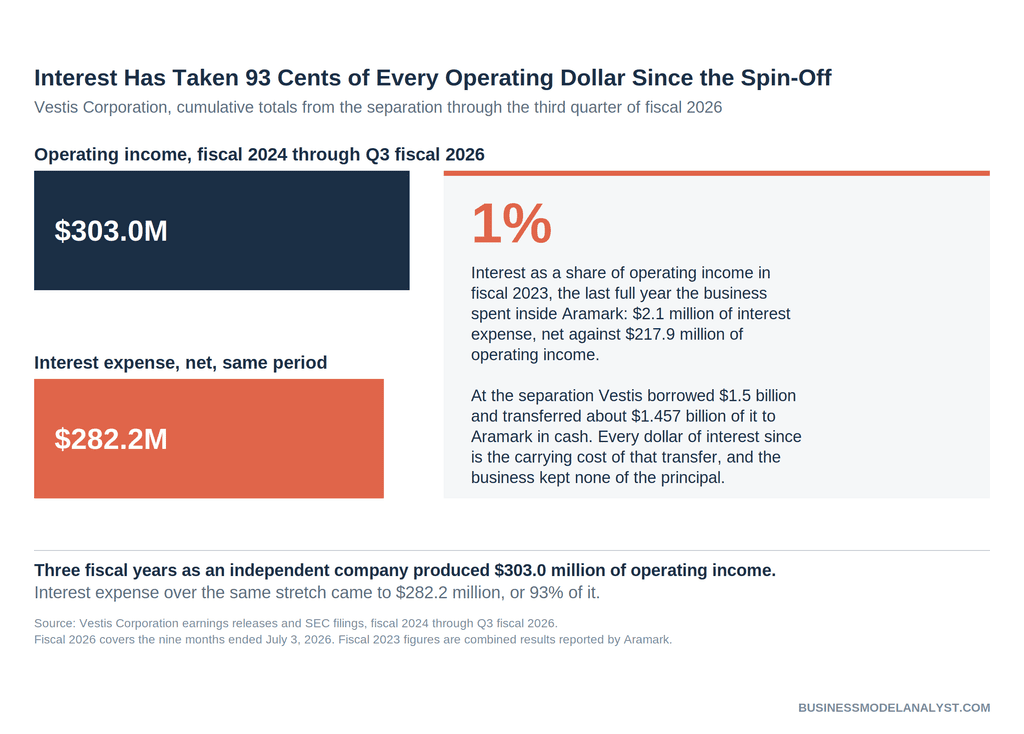
Add fiscal 2024, fiscal 2025 and the first nine months of fiscal 2026. Operating income across that stretch totals $303.0 million. Interest expense, net totals $282.2 million.
Interest has consumed 93 cents of every dollar of operating income Vestis has produced as an independent company.
Inside Aramark, the same line took one cent. That is a 93-fold change in the share of operating profit claimed by lenders, and not one cent of it bought Vestis a plant, a truck, a route or a customer. The principal went to Philadelphia.
The cumulative result is the number that should be read first by anyone studying this transaction. Net income of $21.0 million in fiscal 2024, a loss of $40.2 million in fiscal 2025, and $7.3 million over the first nine months of fiscal 2026 sum to negative $11.9 million. Three years of independent operation have produced, in aggregate, less than nothing for shareholders, from a business that made $213.2 million in its last year as a subsidiary.
The Operating Failure Was Separate
Here is where most post-mortems get lazy, and where the honest reading gets more interesting. The debt did not cause the margin collapse. Adjusted EBITDA sits above the interest line. Whatever happened to it happened in the operating business.
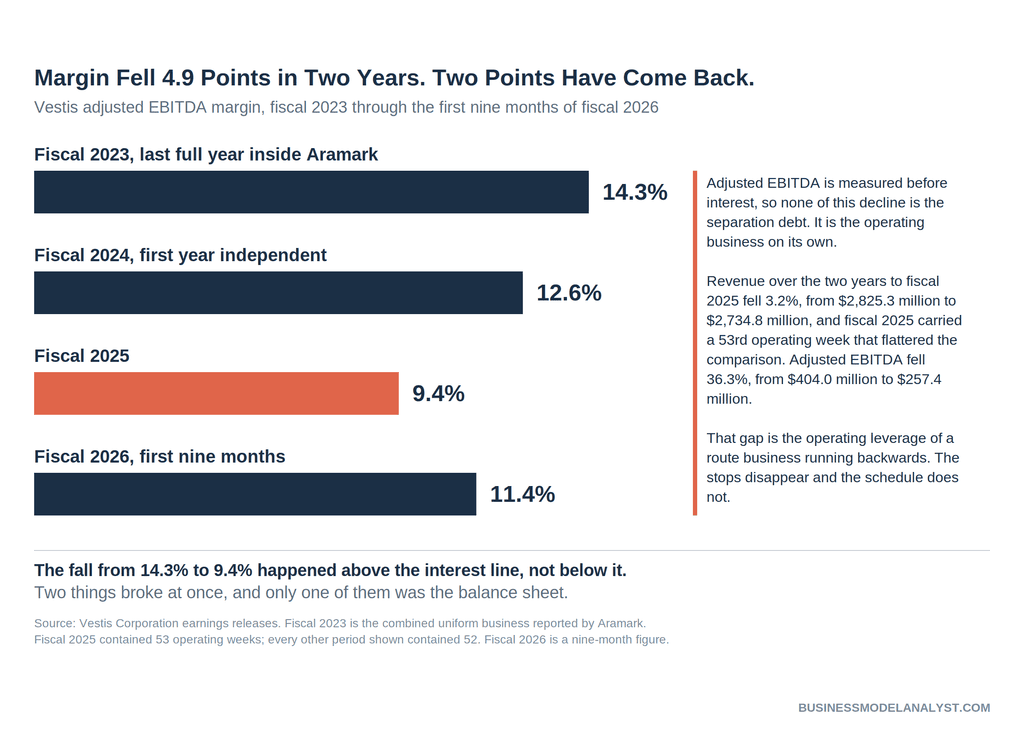
Between fiscal 2023 and fiscal 2025, revenue fell 3.2% and adjusted EBITDA fell 36.3%. Fiscal 2025 contained a 53rd operating week that flattered both figures, so normalize it and the revenue decline widens while the earnings decline widens too. On reported numbers, Vestis gave up roughly $1.60 of EBITDA for every $1.00 of revenue it lost. On any sensible normalization it is still well above a dollar for a dollar.
That ratio is the defining arithmetic of route businesses, and BMA has run it before from the cost side. When a stop disappears, almost no cost disappears with it. The driver still works the day, the truck still runs the territory, the plant still washes at the same fixed absorption. Lose a tenth of your stops and you lose a tenth of your revenue and roughly a hundredth of your cost.
Part of the fall was mechanical and foreseeable. The corporate segment, which carries the cost of being a standalone public company, went from a $45.9 million adjusted EBITDA drag in fiscal 2023 to $74.6 million in fiscal 2024. That $28.7 million is the price of a board, a finance function, an SEC reporting stack, a treasury desk and an investor relations program that Aramark used to supply. It is a known cost of every spin-off and it was disclosed in advance.
The rest was not mechanical. It was volume, and volume in a contracted route business means customers.
How Deleveraging Ran Backwards
Vestis said from day one that deleveraging was the capital allocation priority. In fiscal 2024 it delivered: $337.5 million of principal repaid, $298.0 million of it voluntary prepayment, net leverage down from 3.95x to 3.62x. Management was doing exactly what it said it would do.
Then fiscal 2025 happened.
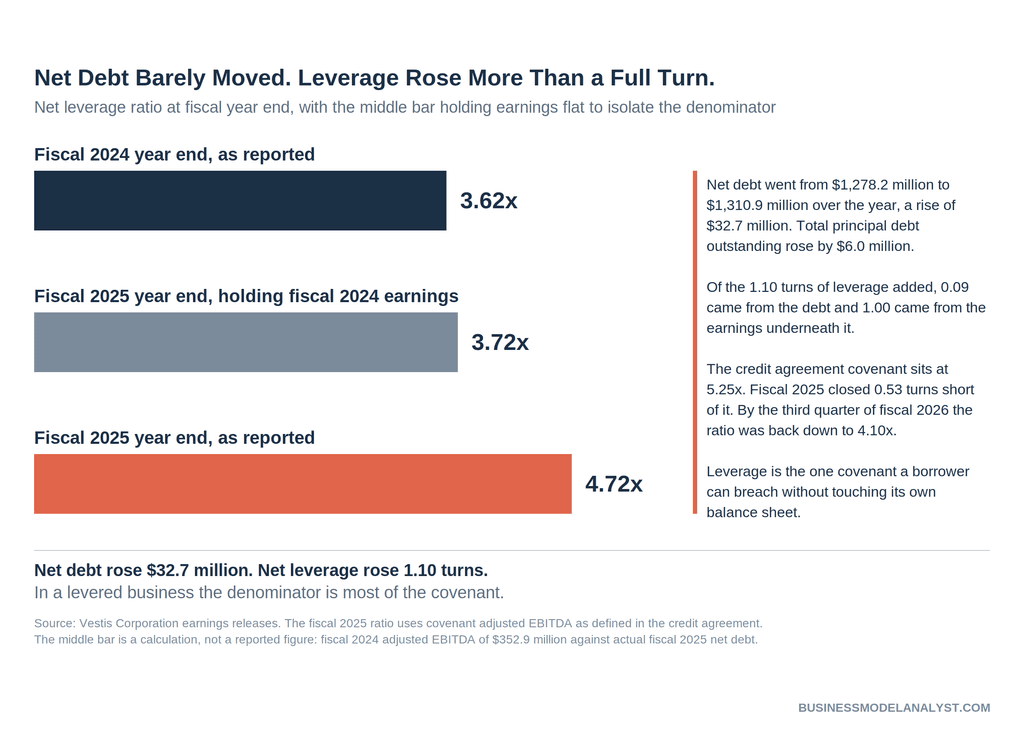
Net debt over fiscal 2025 rose from $1,278.2 million to $1,310.9 million, an increase of $32.7 million. Total principal debt outstanding rose $6.0 million. Nothing about the borrowing explains the ratio.
Hold fiscal 2024 adjusted EBITDA of $352.9 million against actual fiscal 2025 net debt and leverage lands at 3.72x. The reported figure was 4.72x. Of the 1.10 turns of leverage the company added in a single year, 0.09 came from the balance sheet and 1.00 came from the earnings underneath it.
The covenant sits at 5.25x. Fiscal 2025 closed 0.53 turns away from it, on a denominator that had just fallen 27% in twelve months.
This is the structural point that generalizes beyond Vestis. A leverage covenant is the only financial covenant a borrower can approach without doing anything at all to its debt. Every operating miss is automatically also a credit event in waiting, and the closer the opening leverage, the smaller the miss that gets there.
The Loop That Made It Worse
The securities complaint tells the sequence in the language of alleged misstatement. Read as operations, it describes a loop.
In November 2024 Vestis guided fiscal 2025 to $2.8 billion to $2.83 billion of revenue and $345 million to $360 million of adjusted EBITDA. In early 2025 the CFO announced he was leaving and guidance was not revised. On March 18, 2025, Kim Scott left the company and the board, with the company stating there was no disagreement on operations, policies or practices. Phillip Holloman, the board chairman and a former president and chief operating officer of Cintas, took over on an interim basis at $125,000 a month.
On May 7, 2025, Vestis reported second quarter results, withdrew full year guidance and guided the third quarter well below consensus. It attributed the shortfall to lost business exceeding new business and, principally, to lower adds over stops, which is the industry’s phrase for existing customers shrinking what they buy. The stock went from $8.71 to $5.44 in a day. The class action that followed, captioned Torres v. Vestis Corporation in the Southern District of New York, runs a class period of May 2, 2024 to May 6, 2025.
The allegation at the center of the complaint is the operationally interesting part: that price increases were pushed through before service problems were fixed. Whatever a court eventually decides about disclosure, that sequencing is exactly what a levered balance sheet encourages. Price is the fastest lever available to a route business. Service quality is the slowest. A company that needs EBITDA inside four quarters reaches for the fast one.
The loop runs like this. Leverage demands near-term earnings. Price rises ahead of service repair. Customers reduce or cancel. Volume falls with almost no cost relief. EBITDA falls. Leverage rises on an unchanged debt balance. The demand for near-term earnings intensifies.
Jim Barber, a 35-year UPS veteran who ran that company’s global operations, became president and CEO on June 2, 2025. A CFO transition was announced on December 16, 2025. Steve Cochran joined as chief commercial and supply chain officer in June 2026.
What the Turnaround Is
Vestis launched a transformation plan in the first quarter of fiscal 2026, targeting at least $75 million of annualized operating cost savings with roughly $50 million of in-year benefit, of which about $30 million had been realized through the third quarter. Three pillars: operational excellence, commercial excellence, and asset and network optimization. Corporate support functions have been outsourced to a third party, expected to save about $10 million of annual SG&A from fiscal 2027.
The operating metrics have turned. Plant productivity improved 9% in the third quarter. On-time deliveries improved 80 basis points and customer complaints fell 74 basis points. Adjusted EBITDA margin rose to 12.2% in the quarter from 9.5%. Net leverage is back to 4.10x. The company raised its full year free cash flow outlook by $30 million at the midpoint and now guides to $160 million to $170 million, against $5.9 million delivered in fiscal 2025.
The commercial metric is the one worth staring at. For the first time as a public company, revenue per pound rose while cost per pound held flat. Revenue per pound was up 3% in the third quarter.
Pounds processed fell 4.5%.
Management calls that exiting unprofitable volume, and in a business with a fixed weekly schedule that is a defensible thing to do deliberately. It is also, described neutrally, the same combination that was alleged against the previous management: price up, volume down. The difference now is that cost per pound is flat, so the price increase reaches the bottom line instead of being absorbed. That is a real change and it is the reason the margin moved.
But the volume line has now declined for three consecutive years, and a route network that keeps shrinking eventually has to shrink its fixed base to match. That is what asset and network optimization means. The company is marketing non-operating properties for sale.
Where the Cash Is Actually Coming From
The free cash flow swing is the headline of the recovery, and it deserves a look underneath.
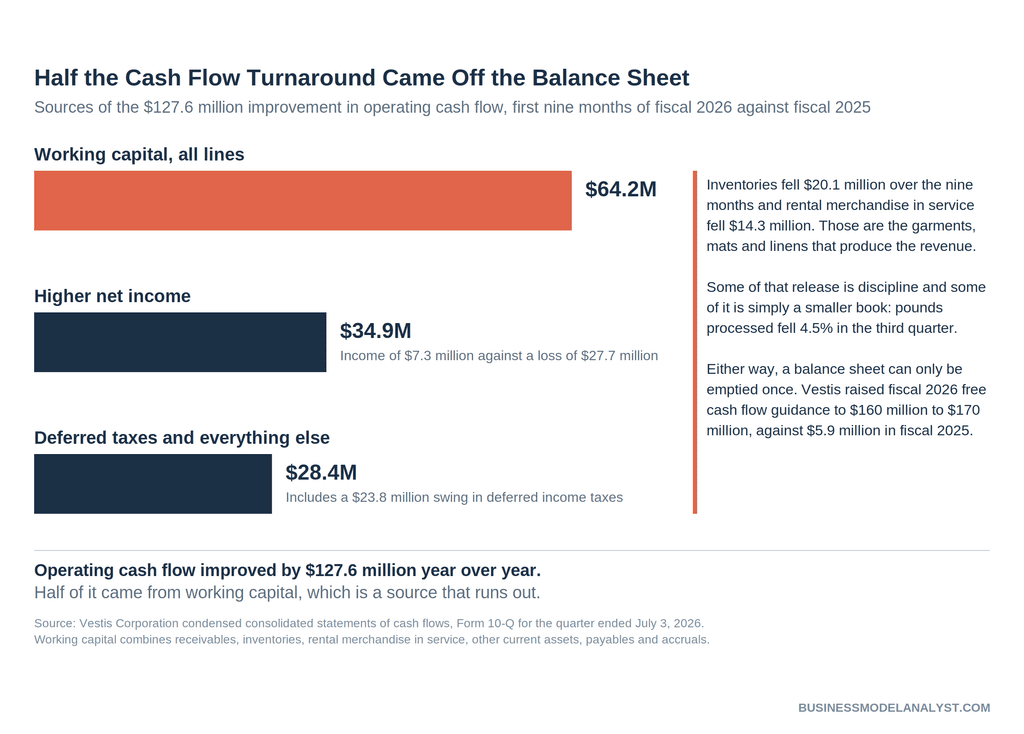
Operating cash flow over the first nine months of fiscal 2026 was $160.9 million against $33.3 million in the same period of fiscal 2025, an improvement of $127.6 million. Of that, $64.2 million came from working capital lines, $34.9 million from higher net income, and $23.8 million from a swing in deferred income taxes.
Half of the turnaround is the balance sheet emptying out. Inventories fell $20.1 million over nine months and rental merchandise in service fell $14.3 million. Those are the garments, mats, towels and linens in circulation, which in this industry is where the real capital intensity lives. Reported capital expenditure is modest, 2.0% of revenue year to date, because the asset base is amortized inside cost of services rather than shown as depreciation.
Some of that release is genuine working capital discipline after a period of poor control. Some of it is arithmetic: a book processing 4.5% fewer pounds needs fewer garments in float. Both readings point the same way. It is a one-time source. You can drain the float once.
Strip working capital and deferred taxes out and the underlying earnings improvement is $34.9 million over nine months. That is real and it is meaningful against a company that lost $40.2 million last year. It is not $127.6 million.
What Vestis Would Have Been Without the Check
The counterfactual is worth running because it isolates what the separation structure did, as distinct from what management did.
Fiscal 2025, as reported: a pre-tax loss of $44.3 million and a net loss of $40.2 million. Add back the interest line of $92.3 million, which is the only item that exists purely because of how the separation was financed, and fiscal 2025 becomes a pre-tax profit of $48.0 million.
The same year. The same customers lost, the same pricing mistakes, the same service problems, the same 9.4% adjusted EBITDA margin. A profitable, if disappointing, year instead of a loss, no covenant pressure worth the name, and no forced choice between fixing service and hitting a number.
This is not an argument that Vestis would have been well run without leverage. The operating deterioration was real and it was the company’s own. It is an argument about tolerance. An unlevered Vestis absorbs a bad two years, replaces its CEO calmly, spends eighteen months repairing service, and comes out the other side with its equity roughly intact. A Vestis at 3.95x opening leverage does the same operational things and arrives at a withdrawn guidance, a 37.5% single-day decline, a securities class action, a management clear-out, and a stock that at its worst was worth half the check written to its former parent.
Leverage does not create operating mistakes. It sets the exchange rate between a mistake and a crisis.
How to Read a Leveraged Spin-Off Before You Own One
A short diligence list, all of it available in the separation documents on day one.
- How much cash went to the parent, and against what? Express the transfer as a multiple of the departing business’s own EBITDA and its own net income. Above three times EBITDA, the separation is a financing event wearing a strategy costume.
- What was interest expense in the last year inside the parent? If it was near zero, the entire debt service line is new and untested. Nobody at the company has ever run this business against a covenant.
- What is opening leverage against the volatility of the category? A 4x opening leverage is conservative for a regulated utility and aggressive for anything cyclical or contract-based. The relevant question is how many points of EBITDA margin the business has lost in its worst historical two-year stretch.
- What is the standalone cost, and is it in the guidance? Corporate overhead the parent supplied is a permanent new expense. Vestis disclosed $28.7 million of it and still guided as if growth would cover it.
- How long is the lock in the Tax Matters Agreement? A two-year restriction on mergers, stock issuance and asset sales removes every emergency exit for exactly the period in which a new company is most likely to need one.
- What is the decremental margin of the category? For route businesses, assume near total. Cost does not follow volume down because cost is a schedule, not a variable.
- Who is on the board and who was on the parent’s board? Directors who negotiated the terms from the parent’s side and then took seats on the child’s side are worth noticing, whatever the conclusion.
Frequently Asked Questions
What was the Vestis spin-off? On September 30, 2023, Aramark separated its uniform and workplace supplies business into Vestis Corporation through a tax-free pro rata distribution of one Vestis share for every two Aramark shares. Vestis listed on the NYSE under VSTS with about 130.7 million shares outstanding.
How much debt did Vestis take on in the spin-off? Vestis entered $1,800 million of senior secured facilities, made up of an $800 million term loan A-1, a $700 million term loan A-2, and a $300 million revolver. It drew $1.5 billion of term loans and transferred approximately $1.457 billion in cash to Aramark. It opened at 3.95x net leverage.
Why did the Vestis stock collapse? On May 7, 2025, Vestis reported weak second quarter results, withdrew its fiscal 2025 guidance and guided the third quarter below expectations, citing lost business exceeding new business and lower volume from existing customers. The stock fell from $8.71 to $5.44 in a single session, a 37.5% decline, and a securities class action followed covering purchases from May 2, 2024 to May 6, 2025.
Was Vestis a bad business when Aramark spun it off? The numbers say no. In fiscal 2023 it produced $2.83 billion of revenue growing 5.1%, a 14.3% adjusted EBITDA margin, $404.0 million of adjusted EBITDA and $190.3 million of free cash flow. It deteriorated after the separation rather than before it.
Is the Vestis turnaround working? The operating metrics have improved. Adjusted EBITDA margin reached 12.2% in the third quarter of fiscal 2026 against 9.5% a year earlier, plant productivity rose 9%, net leverage fell to 4.10x and full year free cash flow guidance was raised to $160 million to $170 million. The caution is that volume is still declining, pounds processed fell 4.5% in the quarter, and roughly half the nine-month cash flow improvement came from working capital release rather than earnings.
Who runs Vestis now? Jim Barber, previously chief operating officer of UPS, became president and CEO on June 2, 2025, succeeding interim leader Phillip Holloman, who had replaced founding CEO Kim Scott in March 2025. Barber bought 84,500 shares in the open market at $12.37 on September 2, 2026, taking his direct holding to 867,222 shares.
Do leveraged spin-offs usually fail? No, and the structure is used successfully all the time. What the Vestis case illustrates is the sensitivity: a separation dividend sized at several turns of EBITDA converts an ordinary operating disappointment into a capital structure problem. The relevant variable is the gap between opening leverage and the covenant, measured against how much margin the category can lose in a bad year.
What happens to Vestis next? The tax restrictions from the separation expired on September 30, 2025, which reopens strategic options that were closed during the worst of the decline. Cintas and UniFirst are meanwhile attempting to combine, a deal that received an FTC second request in June 2026, which changes the shape of the competitive set Vestis operates against.
The Business Model Analyst Take
The tempting conclusion is that Aramark dumped a problem and shareholders paid for it. The filings do not support that. Aramark handed over a real business with real margins, and it told everyone exactly what it was doing, in an 8-K, in a single sentence, on the day it closed.
What the separation actually did was set a price on being wrong. A business with no debt service and a 14.3% margin has years to fix a service problem. The same business at 3.95x leverage, with a $126 million annual interest bill and a 5.25x covenant, has about four quarters. Vestis used those four quarters to raise price before it had fixed service, which is the most predictable mistake available to a route operator under earnings pressure, and the loop closed on itself: price, churn, volume, EBITDA, leverage, pressure, price.
The number that captures it is not the stock chart. It is 93 cents. That is the share of every dollar of operating income Vestis has generated as an independent company that has gone to service debt raised to pay its former parent. Inside Aramark, the same line took one cent. Nothing about the trucks, the plants, the routes or the customers changed on September 30, 2023. The only thing that changed was who owed what to whom, and that turned out to be sufficient.
The general lesson for anyone reading a separation document is narrow and useful. Read the financing paragraph before the strategy deck. The strategy is a forecast. The cash transfer is a fact, it happens on day one, and it is the single variable that determines how large a mistake the new company is allowed to make. Most business failures are decided long before anyone recognizes them, and in a leveraged spin-off the decision is made in a sentence that almost nobody reads.