
The growth came from more people standing in front of cameras, not from better selling. That makes live commerce a broadcast business, and the company that just went through bankruptcy is the one that knows how to run it.
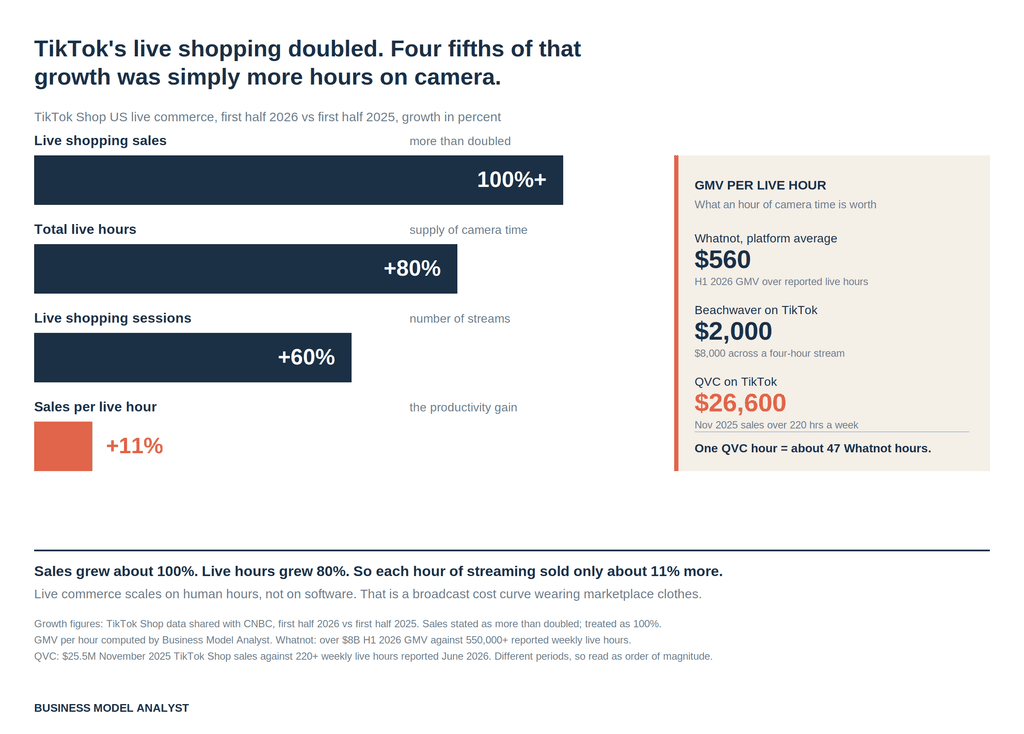
TikTok Shop told CNBC that its US live shopping sales more than doubled in the first half of 2026. It also disclosed the two numbers underneath: live sessions rose more than 60%, and total live hours rose more than 80%. Divide the sales growth by the hours growth and the productivity gain is about 11%. Four fifths of a doubling came from adding camera time.
That single ratio reframes the whole category. Live commerce does not scale like software, where one server handles the next million users at close to zero cost. It scales like television, where the next dollar of revenue needs the next hour of someone talking. TikTok and Whatnot have built a way to buy those hours without paying for them.
The Four-Hour Shift
Sarah Potempa runs Beachwaver, the curling iron brand, out of a warehouse north of Chicago. She is a celebrity hairstylist and the company’s chief executive. CNBC watched her sell on TikTok Live in late July: limited-edition irons auctioned off, product demos, her teenage son on the decks behind her. The first four hours brought in about $8,000.
Work that out and you get $2,000 of merchandise for every hour she stood there. TikTok takes 6% plus payment processing, so the platform earned roughly $120 an hour from a founder-run stream with a DJ.
Potempa got her start on QVC, and she told CNBC the digital format demands longer sessions but leaves her “more in control of the revenue”. Both halves of that sentence matter. Longer sessions are the price of admission. Control is the reward. The people paying that price are sellers, and the hours they supply are the input the platform resells.
What Happened
CNBC published a feature on September 1, 2026 arguing that US livestream shopping has finally arrived, carried by TikTok Shop and Whatnot. The reporting holds up. Whatnot closed a $545 million round in August at a $20 billion valuation and passed $8 billion of gross merchandise volume in the first half of 2026, more than it did in all of 2025. TikTok rolled out live auctions in January. eMarketer puts US live shopping sales near $20 billion for 2026, about 35% above last year.
The fee structure is unremarkable by marketplace standards. Whatnot charges commission of 4% to 8% depending on category. TikTok charges 6%. Both add payment processing on top. Neil Saunders of GlobalData told CNBC that the hardest part for sellers is visibility, keeping the feed aligned with an algorithm that decides who sees the stream.
The disclosure gap is more interesting than the fees. Amazon, Walmart and eBay all run live shopping products. Amazon and Walmart declined to comment. All three declined to give CNBC any sales figures. Meta shut its live shopping product in 2023 and never came back.
Then there is QVC. The channel that invented this format now streams more than 200 hours a week on TikTok across seven channels, and Patrick Nommensen of TikTok Shop Americas described QVC to CNBC as a merchant that turned out to work rather than a competitor.
The Backstory
John Malone bought QVC for $7.9 billion in 2003 and folded HSN into it in 2017. The business worked for decades on a simple trade: buy cable carriage, employ hosts, own studios, hold inventory, and sell to a loyal customer base that skewed over 45. Cable subscriptions fell year after year and the model went with them. QVC cut 900 staff, consolidated HSN operations into West Chester, and filed a prepackaged Chapter 11 in Houston on April 16, 2026.
It came out in under four months. Debt fell from about $6.6 billion to $1.325 billion, lenders extended a $600 million revolver, David Rawlinson stepped down, and Mike George returned as interim chief executive after previously running the company for nearly 16 years. The new shares trade on Nasdaq under QVCG.
What QVC sold its lenders was not a turnaround of the cable business. It was the TikTok number. QVC signed with TikTok in August 2024, launched a 24/7 TikTok Shop stream in April 2025, and added close to a million new US customers on the platform that year, growing its total customer file for the first time in more than four years. By June 2026 it listed over 95,000 products there and produced more than 220 hours of live programming a week. TikTok named it a Seller of the Year.
In November 2025 QVC led all of TikTok Shop with $25.5 million of sales across roughly 442,500 items.
The Numbers Nobody Divided
Take that $25.5 million month and set it against the 220 weekly hours QVC reports producing. The two figures come from different points in the year, so treat the result as an order of magnitude rather than a precise rate. It works out near $26,600 of merchandise per live hour.
Now line up the three data points the coverage gives you:
| Seller | GMV per live hour | Basis |
|---|---|---|
| Whatnot, platform-wide | about $560 | Over $8B H1 2026 GMV against 550,000+ reported weekly live hours |
| Beachwaver on TikTok | about $2,000 | $8,000 across a four-hour stream |
| QVC on TikTok | about $26,600 | $25.5M in November 2025 against 220+ weekly hours |
One QVC hour is worth roughly 47 hours of the average Whatnot stream and about 13 hours of a founder-run TikTok stream. At a 6% commission, TikTok collects around $1,600 from an hour QVC produces and around $120 from an hour Beachwaver produces.
That spread is the business. Everything else in the category is a rounding error next to it.
The Business Model Angle
QVC did not lose to TikTok. QVC became TikTok’s supplier.
Read the two cost structures side by side. QVC pays for studios, lighting, camera crews, host salaries, merchandising staff, warehouses and inventory it owns outright. It carried $6.6 billion of debt built partly on that fixed base, and the cable carriage fees that once justified the whole apparatus stopped being worth what they cost. TikTok pays for none of it. TikTok supplies distribution and a checkout button, and takes 6% of what QVC’s studios produce.
Live commerce in the United States is QVC’s business model with the studio, the payroll and the inventory pushed off the platform’s balance sheet and onto the seller’s. The take rate is the visible part. The externalized production cost is the part that makes the model work.
Which explains the growth decomposition. TikTok added 80% more live hours in six months because it does not pay for hours. It recruits them. Every new seller who opens a stream, every affiliate creator, every brand that hires a host, and above all QVC’s 200-plus weekly hours: those all show up as supply on TikTok’s side of the ledger and as cost on somebody else’s. A software business grows by serving more demand from the same infrastructure. This one grows by signing up more people willing to stand in front of a camera.
It also explains why the productivity number is only 11%. Selling live is a craft skill. Getting better at it means better hosts, better scripts, tighter merchandising and better rundowns. QVC spent 40 years industrializing exactly that and it shows up in a per-hour rate 47 times the platform average. Nobody scales craft skill 80% in six months. So the platform scales the thing it can scale, which is headcount pointed at cameras.
And it clarifies what Whatnot’s $20 billion price actually rides on. We ran the fee arithmetic in our breakdown of Whatnot’s take rate and again when the Series G doubled the valuation. At an effective rate near 12.5%, $560 of GMV per hour yields about $70 of revenue per hour of live content on the platform. Whatnot’s growth math needs either far more hours or far better hours. It has been buying the first.
There is a supply-side version of this that sellers should run before they commit. A Nebraska coin dealer streamed for 177 straight hours to move $2 million, and the margin story at the end was the twist. Divide any live commerce plan by hours and the answer usually lands somewhere between a job and a broadcast operation. Rarely does it land on software economics.
The Risk
The strongest argument against all of this comes from China, and it does not say what the trend pieces think it says.
Everyone frames China as where the US is heading. China left. JD.com said in March 2026 that more than 70,000 sellers now use its AI digital humans as livestream hosts, that the cost has fallen to roughly one tenth of a human host, and that the feature has been free to all sellers since December 2025. Baidu says its digital hosts cut merchants’ operating costs by more than 80% while raising average GMV 62%. Chinese platforms are estimated to run over 100,000 AI hosts.
In June 2025 the retail personality Luo Yonghao ran a six-hour Baidu stream fronted by two synchronized AI avatars of himself and a co-host. It drew 13 million views and about $7.7 million of GMV. That is roughly $1.28 million per live hour, on a stream where the labor input was a script and a GPU.
If the constraint in live commerce is human hours, and someone removes humans from the hours, then the American market is currently buying the labor-intensive version of a business China has already automated. TikTok’s 80% hours growth would be capital expenditure on a cost base about to be undercut.
The counterargument runs the other way and deserves a fair hearing. Saunders’ point to CNBC was that the binding constraint is visibility, not supply, and he may be right: the algorithm decides who watches, and more hours chasing the same finite attention drives the per-hour rate down rather than up. On that reading TikTok’s 11% productivity gain is not a labor story at all, it is early saturation, and adding hours makes it worse.
Two facts sit awkwardly with the whole bull case. Live commerce grew from 10% to 14% of TikTok Shop’s US GMV between 2024 and 2025. In China, live streams carry 70% to 80% of social commerce sales. After three years and a doubling, the US format has moved four points of mix. And Amazon, Walmart and eBay all declined to give CNBC a single number, which is what companies do when the number is small.
Here is the condition that would break this piece: if TikTok’s next disclosure shows sales growth running well ahead of hours growth, the productivity engine is real and live commerce is compounding on skill rather than headcount. Watch the ratio, not the headline.
Quick Questions
How much does it cost to sell on live shopping platforms? Whatnot charges 4% to 8% commission depending on the category and TikTok Shop charges 6%, with payment processing added on top of both. Those headline rates understate the all-in cost. Applying Whatnot’s published fee schedule to real order sizes produces an effective rate closer to 12.5%.
Is live shopping profitable for sellers? It depends almost entirely on merchandise per hour. At Beachwaver’s rate of roughly $2,000 an hour, a founder who spends four hours streaming has to cover product cost, fulfillment, platform fees and the value of that time. Sellers in thin-margin categories need volume that pushes the model toward continuous operation.
Why did QVC file for bankruptcy if live shopping is booming? QVC’s problem was the cost of its distribution, not demand for its format. Cable carriage and its fixed studio and inventory base could not be supported once viewership declined. It cut debt from $6.6 billion to $1.325 billion in Chapter 11 and now streams more than 200 hours a week on TikTok.
How big is US live shopping compared with China? eMarketer puts US live shopping near $20 billion for 2026 against a Chinese market projected to top $1.1 trillion. Alibaba launched Taobao Live in 2016 and the Chinese market passed $50 billion within five years.
Will AI hosts replace human livestream sellers? In China this is already underway at scale, with JD.com reporting over 70,000 sellers using AI digital humans and costs around a tenth of human hosts. US platforms have not deployed this at comparable scale, which is the single largest open variable in the category’s economics.
The Business Model Analyst Take
Read the CNBC piece as a supply story rather than a demand story and it gets sharper. US live shopping is growing because more sellers are willing to spend more hours in front of cameras, and the platforms have found a structure where those hours arrive free.
That structure is durable while sellers keep showing up, and it is worth understanding as a general pattern. Any business that converts a competitor’s fixed cost base into your variable supply is worth studying, whether it is a livestream platform, a delivery marketplace or a creator network. The competitive question is never who owns the format. It is who owns the cost.
The awkward part is that QVC is the most productive participant in this market by roughly a factor of 47, and QVC just spent a year in bankruptcy. Industrializing the live hour is a real skill with real economics, and it did not save the company that was best at it, because the distribution it was industrializing for went away. QVC’s second act is renting that skill to a platform that takes 6% and owns the audience.
For sellers, the operating question is narrow and answerable. What is your merchandise per live hour, and what does an hour of your time cost? Everything else in this category is decoration on that ratio.