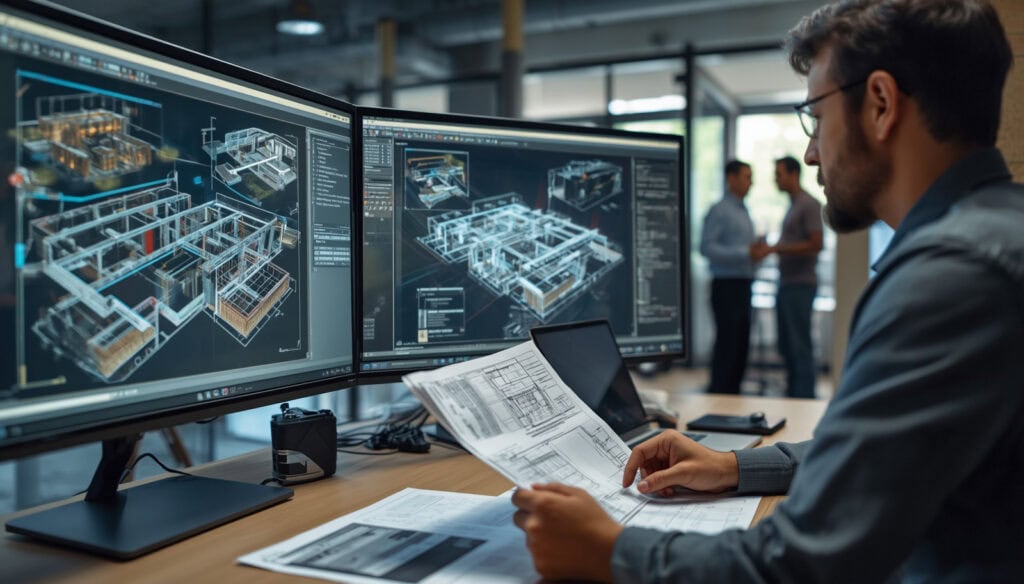

There’s a quiet trade happening inside electrical contracting firms, and most people outside the industry never notice it. A few years back, if you ran a mid-sized electrical shop and wanted modeling done, you hired modelers. Built a department. Bought the licenses, the workstations, the whole kit. Now? A lot of those same firms are tearing that department down to the studs and renting the work instead.
I think the reason is mostly money. But it’s not only money — that’s the part people miss. The whole arrangement of who owns the modeling talent has flipped, and the firms that caught on early are running leaner than the ones still carrying payroll through every slow stretch. Outsourced VDC in electrical work has turned into an actual product. Something you buy by the project, not a fixed line that sits on your books whether or not there’s work to feed it. That difference sounds small. It isn’t.
This shift is also reshaping how general contractors write their bid packages, how regional subs decide which jobs to chase, and where the real margin in coordination work ends up sitting. Worth walking through the whole thing.
Why electrical contractors built BIM teams in the first place
Go back maybe a decade. General contractors started writing model requirements straight into bid packages. If you wanted the job, you needed somebody who could open Revit and not break things. So electrical subs did the obvious move — they hired.
Most started small. One modeler, maybe two, usually pulled from the field because they understood conduit and gear better than some fresh CAD grad fresh out of school. That part actually worked well. A guy who’s bent pipe for fifteen years models conduit runs that a desk-only modeler would route through a beam.
The trouble showed up later. Workload turned out to be wildly uneven. A modeler gets slammed for six weeks during preconstruction on a big hospital job, then has almost nothing to do for two months after. You’re still paying them. Full salary, benefits, the works, plus the software seat that’s idling right alongside them.
And the demands kept climbing. GCs wanted tighter clash detection. Fabrication-level detail. Sometimes laser scanning thrown in. A single field-promoted modeler couldn’t carry all of it, so firms hired again, and the department crept bigger than anyone planned. Overhead grew faster than the revenue it supported.
The hidden math of an in-house BIM department
Here’s where business owners get surprised. The salary is the number everybody quotes. It’s also the smallest piece of the true cost.
When you run the full figure — not the headline wage but everything bolted onto it — an in-house modeling seat looks very different from what the offer letter said. The gap is wide, and it hides in places that don’t show up on a quick glance at the books.
Salaries aren’t the whole bill
Take a coordinator earning, say, ninety grand. Layer on payroll taxes, health insurance, a retirement match, paid time off. You’re already past a hundred and twenty thousand before anybody models a single panel schedule. Add their slice of the software stack — Revit, Navisworks, a clash seat, fabrication add-ons — and the hardware to run it. Workstations that need replacing every three years or so.
Then training. Every version drops and shuffles half the menus, and somebody’s got to relearn the workflow. That’s billable field time you’re spending on a desk skill.
There’s management overhead too. A person has to supervise the modeling, review it, catch the stuff that’s wrong before it goes to the GC. That reviewer costs money, and their attention is finite. Stack it all and the loaded cost of one seat can run nearly double the wage. Most owners never do that arithmetic until something forces them to.
The utilization problem
This is the killer. It’s also the thing nobody puts on a spreadsheet, because it’s awkward to look at.
A salaried modeler gets paid fifty-two weeks a year. Your project pipeline does not cooperate with that schedule. Construction work is lumpy — feast, then famine, then feast again. So you end up paying premium wages for idle hours. Or you swing the other way, under-staff on purpose, and then you’re scrambling to subcontract anyway when three jobs land in the same month.
Either path bleeds money. The in-house setup quietly assumes steady demand. Steady demand basically doesn’t exist in this business, and anybody who’s run a shop knows it.
What outsourcing actually sells
An electrical VDC provider isn’t selling labor by the hour the way a temp agency does. What they’re really selling is access without ownership — modeling capacity you can switch on and off like a faucet.
Think about what that does to the contractor’s books. The expense moves from fixed to variable. No idle salaries during the dead months. No license renewals gathering dust. You pay when there’s a deliverable, and the cost lands inside a specific project’s budget where it actually belongs, instead of getting smeared across the whole year as faceless overhead.
The provider, for their part, sells the same modeling team to many contractors at once. That’s the whole trick. Your one in-house modeler sits idle half the year. A VDC firm keeps a dozen modelers busy because they’re pulling work from twenty clients into one pipeline. The same math that wrecks the contractor is what makes the outsourced shop profitable. Two sides of one coin.
How the VDC provider makes money
Margin comes from utilization and specialization, plain and simple. A focused electrical VDC firm models conduit, gear, cable tray, and prefab assemblies all day, every day. Repetition makes them fast. Speed plus high billable hours equals decent profit — even at rates the client reads as cheaper than carrying staff.
The way these firms price and staff their work tells you a lot about how the relationship will actually go. Let me lay out the pieces, because they’re not interchangeable.
Pricing models you’ll run into
Providers structure deals a few different ways, and the structure signals where the risk sits:
- Per-project fixed fee. Best when scope is clear. The contractor gets a known number, the provider eats any overrun. Risk lands on the modeling firm.
- Hourly or per-seat. Flexible, used when scope is fuzzy. Now the contractor carries the overrun risk, so they watch the clock closely.
- Retainer or monthly capacity. A set block of hours every month. Predictable for both sides — feels almost like having staff minus the payroll mess.
- Per-sheet or per-deliverable. Common for fabrication drawings. You pay for output, not for effort or hours logged.
Each structure shoves risk somewhere different. Sharp contractors pick based on how much they trust the provider and how messy the job looks going in.
Why specialization beats a generalist team
A firm that only does electrical coordination builds muscle a general BIM shop never will. They’ve seen the conduit fill conflicts a hundred times. They know which GCs are sloppy with their backgrounds. They’ve got prefab templates ready instead of building assemblies from scratch.
That accumulated know-how is the product, honestly — more than the software, more than the labor. You’re renting judgment, not just hours. A generalist who splits time between plumbing, ductwork, and electrical never gets deep enough in any one trade to move that fast. Specialization is the moat.
Risk shifts, and somebody new carries it
When the work was in-house, every risk landed on the contractor. Bad model? Your problem. Modeler quits mid-job? Your problem, and good luck hiring a replacement in a labor market this tight.
Outsourcing reshuffles the pile. A solid provider absorbs the staffing risk — somebody’s out sick, they swap in another modeler and you never feel the gap. They carry the software risk, the training burden, the chore of keeping up with version changes that break old workflows. All of that becomes their headache, priced quietly into the rate.
But you give up some control. No way around it. You’re now leaning on a vendor’s schedule, their quality bar, their willingness to answer the phone at 6pm when the GC yanks a deadline forward. Contractors who get burned usually got burned on communication, not on modeling skill. The strong firms know this cold and over-invest in being reachable, because that’s where trust actually lives.
The offshore versus domestic question
A fair number of VDC firms run a split crew. Senior coordinators stateside handle clash resolution and client calls. Production modeling gets pushed to lower-cost labor somewhere else. The blended rate stays attractive, the quality stays acceptable, because that senior layer catches mistakes before anything ships out the door.
I’ll be honest — this part makes some contractors nervous, and not without reason. Time zones, language gaps, the occasional model that comes back looking wrong. The firms that pull it off do one thing well: they keep a real person, on your hours, who owns the relationship. When that’s missing, the cracks show fast. When it’s there, you mostly can’t tell the difference and you wouldn’t care if you could.
The talent angle nobody talks about
Maybe the quietest force behind all of this is hiring. Skilled BIM coordinators are scarce, and the ones who exist know exactly what they’re worth. A small electrical contractor in a secondary market simply can’t match what a large outfit pays. So they couldn’t staff up even if they wanted to — the people just aren’t available at a price that works.
Outsourcing sidesteps the whole fight. You don’t need to win the recruiting war. You rent a team that already won it somewhere else. For a regional contractor, that access alone can decide whether you bid the big coordinated jobs or quietly walk away from them.
There’s a culture piece too. Field guys who got pulled into modeling sometimes resent the desk. They miss the trailer, the crew, the work they actually signed up for. Pushing modeling to a specialist lets your best field people stay in the field — where they’re worth the most to you, and where they’d rather be anyway.
So the firms making this switch aren’t only cutting cost. They’re freeing up their good people and buying skill they could never hire. Both things at once, which is rare.