
Every Circle Card swipe still gets 5% off. The bank that shares the card’s profits now covers about 60 cents of each discount dollar, and Target has stopped publishing the number you need to check.
Target pays for the 5% Target Circle Card discount itself, and it earns back part of that cost through a profit-sharing deal with TD Bank, which owns the credit card loans. That profit share fell from $734 million in fiscal 2022 to $522 million in fiscal 2025. Using Target’s own filings, BMA estimates each dollar of card discount brought back about 69 cents in fiscal 2022 and about 60 cents in fiscal 2025, leaving roughly $350 million a year uncovered.
Target Circle Deal Days runs through today, October 7, stacked head to head with Amazon’s Prime Big Deal Days, a sale built to protect a $139 membership fee. The pitch is the usual one: up to 40% off apparel, toys, home and tech for members, and an extra 5% off for anyone paying with a Target Circle Card. Target is even paying $75 in Target Circle Rewards to shoppers approved for a new card between September 27 and October 10.
That $75 is the price of 5% off on $1,500 of shopping. It is also a bet that the card still pays for itself.
The numbers say it pays for less of itself every year. Target’s 10-K shows credit card profit sharing at $734 million in fiscal 2022, $667 million in 2023, $576 million in 2024 and $522 million in fiscal 2025, a 29% slide in three years. Over the same stretch, Macy’s grew its own card income 24.6% last year to $669 million on one-fifth of Target’s sales. Below: what the 5% actually costs, what comes back, and the disclosure that quietly disappeared right when the math got interesting.
What Happened
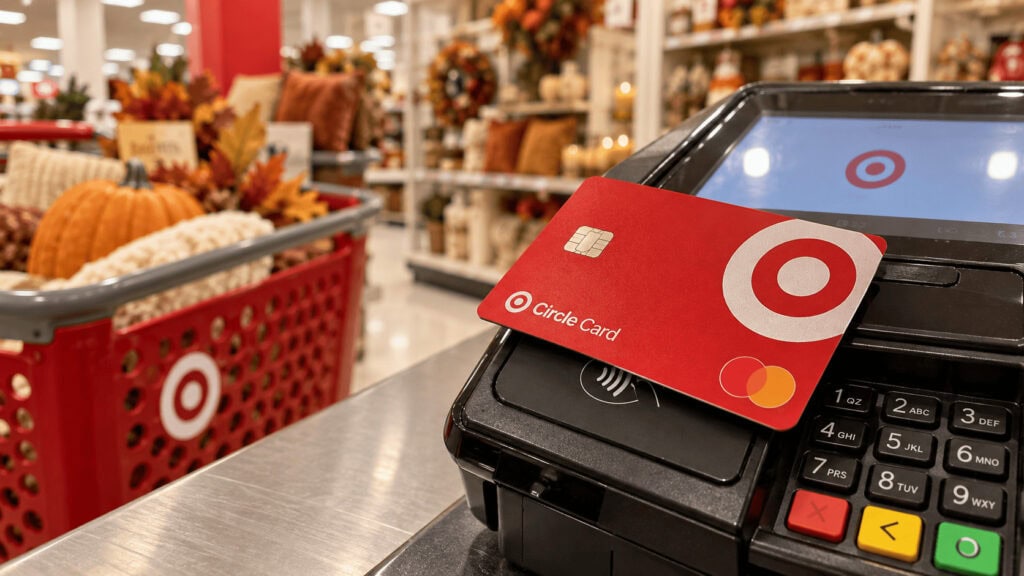
Target runs the most generous house-card discount in mass retail. Pay with a Target Circle Card, whether the debit card, the store credit card or the Target Mastercard, and nearly everything in the store rings up 5% cheaper. No points, no tiers, no annual fee.
The discount is Target’s money. It comes straight off the sale.
What comes back is a single line in Target’s revenue table called “credit card profit sharing.” Under a program agreement with TD Bank Group, Target performs account servicing and primary marketing for the credit cards, and in exchange it collects a percentage of the profits the card receivables generate. TD underwrites the accounts, funds them, owns the balances, sets the risk policies and handles compliance.
Here is how that line has moved:
- FY2020: $666 million
- FY2021: $710 million
- FY2022: $734 million (the peak)
- FY2023: $667 million (a 53-week year)
- FY2024: $576 million
- FY2025: $522 million
Three straight annual declines, nine straight quarters of year-over-year declines from the first quarter of fiscal 2024 through the first quarter of fiscal 2026. Then, in the second quarter of fiscal 2026, the line ticked up 3.7% to $139 million. The first half of the year is still down 2.2%, at $269 million against $275 million.
Profit share is now about half a cent of every dollar of Target’s $104.8 billion in fiscal 2025 net sales. Advertising, at $915 million, is bigger by three quarters.
The Backstory
Target sold its U.S. credit card portfolio to TD in 2013, which turned the card from a lending business into a fee line in the Target business model. The original deal ran seven years; a 2015 amendment pushed it to March 2025, and in September 2022 the two companies extended it again, this time through 2030, with TD remaining the exclusive issuer of Target’s co-branded and private-label consumer credit cards.
At that 2022 extension, Target said RedCard holders had saved more than $9.7 billion over 12 years. That averages out to roughly $800 million a year of discounts.
The timing is worth noticing without overreading it. Fiscal 2022 was the profit-share peak. The contract was renewed that September. Every full fiscal year since has come in lower. Target has never disclosed the split percentage, before or after the extension, so nobody outside the two companies can say whether the terms changed or the portfolio did.
Two structural details matter more than the timing.
The 5% goes to debit too, and debit earns nothing from TD. The Target Debit Card pulls straight from a checking account. There is no loan, no interest and no profit to share. The last time Target broke out card usage by type, in its first-quarter 2022 release, the debit card carried 11.6% of sales and the credit cards 8.7%. More than half the discounted volume came from the product that generates zero profit-share revenue.
TD’s U.S. balance sheet is capped. In October 2024, TD pleaded guilty to anti-money-laundering failures, paid about $3.09 billion in penalties, and accepted an Office of the Comptroller of the Currency asset cap of $434 billion on its two U.S. banking subsidiaries, TD Bank, N.A. and TD Bank USA. TD Bank USA is the entity that signed Target’s card agreement. The cap came with an open timeline and a requirement for regulator sign-off on new products. Target’s revenue line does not say whether the cap has touched the card book. It does mean Target’s card economics sit inside a partner that cannot grow its U.S. balance sheet until its regulator says so.
The Math Target Stopped Publishing
For years, Target reported a metric called Target Circle Card Penetration: the share of purchases paid with a Circle Card. It said it tracked the number because its internal analysis showed a meaningful portion of card purchases are incremental sales.
Multiply penetration by merchandise sales and you get card-paid sales. Take 5% of that and you get a close estimate of what the discount costs. Set that against the profit share and you get the number that matters: how much of each discount dollar the bank deal pays back.
- FY2022: 19.8% penetration on $107.6 billion of merchandise sales is about $21.3 billion paid by card. Discount cost: about $1.07 billion. Profit share: $734 million. 69 cents back per discount dollar.
- FY2023: 18.6% on $105.8 billion is about $19.7 billion. Discount: about $984 million. Profit share: $667 million. 68 cents.
- FY2024: 17.8% on $104.8 billion is about $18.7 billion. Discount: about $933 million. Profit share: $576 million. 62 cents.
- FY2025 (estimate): 17.0% on $102.7 billion is about $17.5 billion. Discount: about $873 million. Profit share: $522 million. 60 cents.
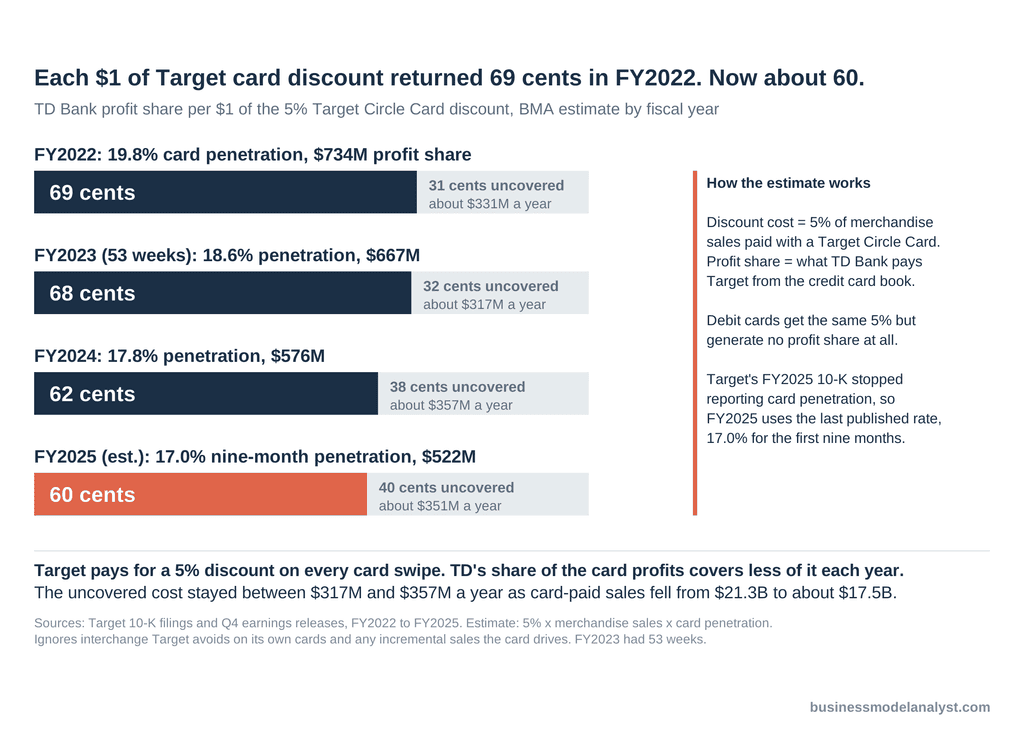
Notice what did not shrink. Card-paid sales fell by almost $4 billion, yet the uncovered gap stayed in a tight band between $317 million and $357 million a year. The discount bill shrank with the volume. The profit share shrank faster.
Now the part nobody seems to have flagged. The fiscal 2025 figure is an estimate because Target stopped reporting penetration. The FY2024 10-K carried the full three-year series in its sales discussion. The FY2025 10-K, filed March 11, 2026, keeps the paragraph describing the cards and drops the penetration numbers. The fourth-quarter 2025 earnings release dropped the penetration table that the year-earlier release had. The second-quarter 2026 10-Q has no penetration figure either. The last published number is 16.9% for the third quarter of fiscal 2025, and 17.0% for the first nine months, which is the rate used above.
Companies trim metrics all the time, and Target gave no reason. But this one was the denominator. Without it, outsiders can still see the profit share falling. They can no longer see what it is being measured against.
The Business Model Angle
Macy’s is the cleanest contrast, because it runs the same basic structure. In 2005 it sold its card receivables to Citibank and kept a long-term marketing and servicing alliance, and it books what comes back as credit card revenue. In fiscal 2025 that line rose $132 million, or 24.6%, to $669 million. Macy’s credits a strong credit portfolio and active management of losses.
Put the two side by side and the gap is structural, not cyclical:
- Macy’s: $669 million of card revenue on $21.8 billion of net sales, or 3.1 cents per sales dollar. Card penetration 40.1%. About 7.7 cents back per dollar spent on its card.
- Target: $522 million on $104.8 billion, or 0.5 cents per sales dollar. Penetration about 17%, now unreported. About 3.0 cents back per dollar spent on its cards, including debit.
Here is the detail that settles what drives the line. Macy’s penetration actually fell last year, from 41.6% to 40.1%, and its card revenue still jumped a quarter. Swipes did not move the number. Credit performance did. A profit share is paid on the profit of a loan book: interest, late fees, minus charge-offs and funding costs. Target’s card is built to be used, not carried. A 5% discount attracts careful shoppers who pay in full, and debit attracts shoppers who never borrow at all.
Three implications for operators:
- A discount card and a lending card are different products. Macy’s sells a credit relationship and pays for it with points. Target sells a price cut and hopes a bank can make money on the slice of users who revolve. The more successful the price cut, the more of its volume arrives through debit.
- Profit sharing transfers your marketing budget to someone else’s credit cycle. Target controls the discount. TD controls underwriting, risk policy and, under the asset cap, how much the book can grow. The cost line and the revenue line answer to different people.
- Unpublished metrics become unmanaged metrics in the market’s eyes. Once investors cannot compute the coverage ratio, the profit share reads as a stray revenue line. That is fine while it is small. It is less fine on a 10-K that names credit card profit-sharing revenue among the things a weaker economy could reduce.
Our look at what the almost-premium credit card tier really sells found issuers pricing the gap between tiers, and our ranking of what premium card perks are actually worth showed partners funding the credits. Target’s card has no fee, no tier and no partner merchants, which is exactly why its economics live entirely in the bank’s loan book.
The Risk
The case for the card is stronger than one ratio, and it deserves a full hearing.
Interchange Target never pays. On a typical rewards credit card, a merchant pays interchange of around 2% of the purchase. On Target’s store-only credit card and its debit card, which draws straight from checking, that toll mostly disappears. Net of avoided card fees, the true cost of 5% off is closer to 3% on many transactions. Our debit interchange breakdown shows how much those fees move between parties. Counting avoided interchange would shrink the uncovered gap, possibly by a lot.
Incremental sales. Target’s filings say a meaningful portion of card purchases are incremental. If even a modest slice of that $17.5 billion in card-paid sales would otherwise have gone to Walmart or Amazon, the gross margin on it can outweigh a $350 million gap. The Target SWOT analysis puts loyalty at the center of the recovery for this reason.
The cycle, not the contract. Macy’s card revenue also fell hard after 2022, from $863 million to $537 million in fiscal 2024, before its rebound. Even after last year’s jump, Macy’s is still 22% below its 2022 level. Target is 29% below. The whole store-card industry rode the same rise in charge-offs; the divergence is a single year wide.
The turn may have started. Target’s second-quarter 2026 profit share rose 3.7%, with comparable sales up 3.8% and traffic up 3.6%. If the loan book follows traffic, fiscal 2026 could be the first flat year since 2022.
Each of these is real. None changes the direction of the disclosed numbers, and the first two are exactly the claims that penetration data would let outsiders test.
Quick Questions
How does the Target Circle Card make money for Target? Mostly indirectly. Target funds the 5% discount and receives a percentage of the profits TD Bank earns on the Target credit card receivables, in exchange for servicing the accounts and marketing the cards. That profit share was $522 million in fiscal 2025.
Does Target lose money on the 5% discount? On the profit-share line alone, yes: BMA estimates the discount cost about $873 million in fiscal 2025 against $522 million of profit share. Counting the interchange Target avoids and any extra sales the card drives narrows that gap, but Target no longer publishes the data needed to measure by how much.
Why did Target’s credit card profit sharing fall? Target has not given a reason. The filings show fewer purchases paid by card (penetration fell from 19.8% to about 17%) and less profit share per card dollar (from about 3.45 cents to about 2.99 cents). Industry-wide charge-off increases after 2022 hit store-card income across retail.
Is the Target Circle Card still worth it for shoppers? For anyone who pays in full, 5% off at checkout with no annual fee is one of the best flat returns in retail, and it stacks with Deal Days pricing. Carrying a balance changes the math fast, because card interest can wipe out the discount.
Who issues the Target Circle Card? TD Bank, under an agreement extended in 2022 through 2030. TD underwrites the accounts and owns the balances.
The Business Model Analyst Take
The 5% discount is one of the best-designed loyalty tools in American retail: simple, instant, honest, and impossible to misunderstand at the register. That simplicity is also the problem with its funding. A card that rewards using is a strange thing to finance through a share of a lender’s profits, because the best customers of the discount are the worst customers of the loan.
Target’s own numbers show the arrangement drifting: 69 cents back on each discount dollar in 2022, about 60 cents now, with a partner whose U.S. balance sheet is capped by its regulator. The second-quarter uptick is a real counterpoint, and the case for incremental sales may well carry the program. It would be easier to believe if the metric that measures it were still in the 10-K.
Deal Days ends tonight. The $75 sign-up bonus runs three days longer. Somebody at Target has done this math with the penetration number in hand. The rest of us now have to estimate it.