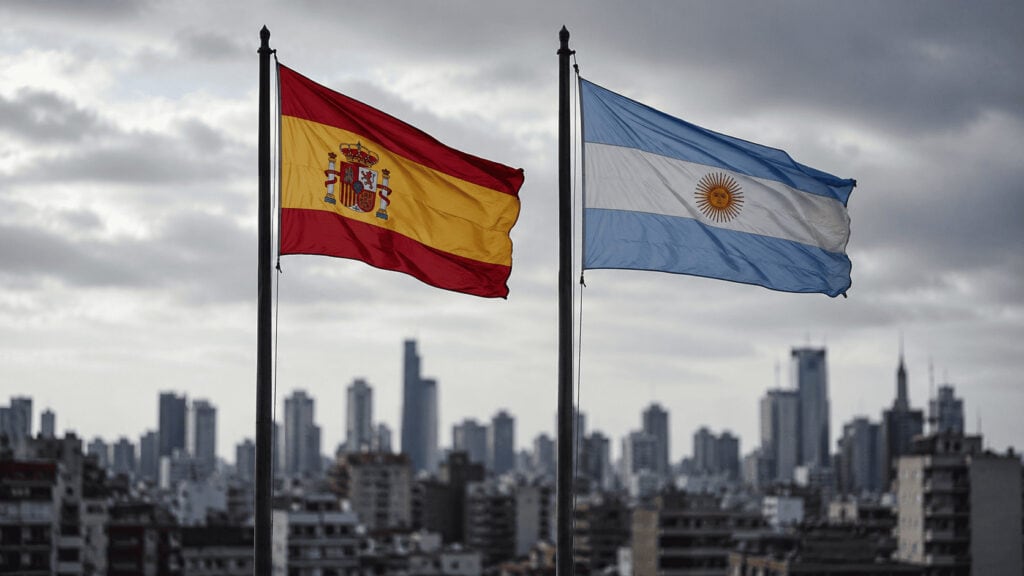

Put Spain and Argentina on a pitch and you get one of the most loaded fixtures in football. Reigning South American giants against a European powerhouse, Messi’s heirs against the country that won it all in 2010. Put their economies on the same pitch and the story flips into something stranger, because a century ago this match would have looked very different.
In 1913, Argentina was richer than France, richer than Germany, and close to twice as prosperous as Spain. Buenos Aires had electric trams and grand avenues while much of Spain still farmed by hand. Fast forward to 2025 and Spain produces more than two and a half times Argentina’s total output, and a Spaniard earns roughly two and a half times what an Argentine earns. This is one of the great reversals in modern economic history, and it makes the head-to-head worth scoring station by station.
We ran both economies through seven Hyrox-style stations: size, wealth per person, growth, price stability, jobs, debt, and fiscal discipline. Here is how the match plays out.
How We Score an Economy
Nominal GDP measures total output in current US dollars. It answers “how big is the economy?” GDP per capita divides output by population. It answers “how rich is the average person?” PPP (Purchasing Power Parity) adjusts for local cost of living, so a haircut in Buenos Aires and a haircut in Madrid count fairly against each other. Real GDP growth strips out inflation to show whether the economy actually expanded. Debt-to-GDP compares what a government owes to what its economy produces in a year. Lower is healthier.
The Full-Time Scorecard
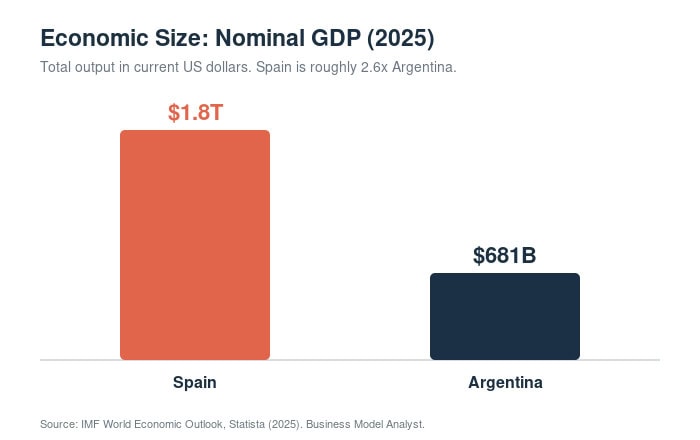
Final score: Spain 4, Argentina 3. A tighter match than the raw size gap suggests.
Station 1: Economic Size – Spain by a Distance
Spain’s economy runs at roughly $1.8 trillion in nominal output for 2025, on its way toward the $2 trillion mark as the strong euro inflates its dollar value. Argentina sits near $681 billion. Spain produces about 2.6 times what Argentina produces from a population only slightly larger.
That gap did not exist for most of the 20th century’s early decades. Spain overtook Argentina and never looked back, driven by European Union membership, an open trade relationship with 450 million neighbors, and decades without the currency crises that repeatedly wiped out Argentine savings.
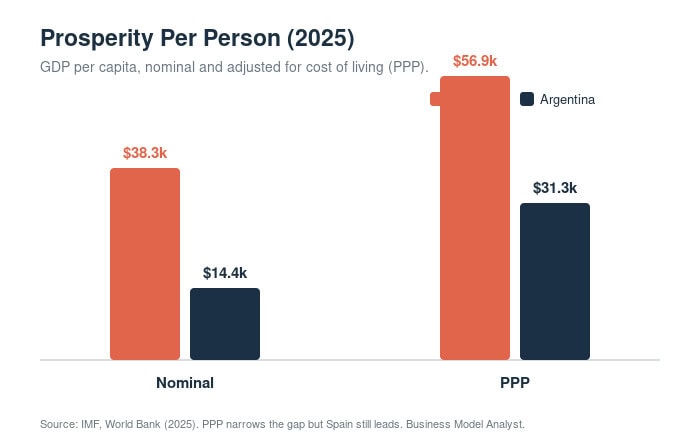
Spain wins this station on scale. A German carmaker choosing a supplier, a fund allocating to European equities, a tourist deciding where to spend, all of them meet a larger, deeper Spanish market.
Station 2: Wealth Per Person – Spain Leads, PPP Narrows It
Nominal GDP per capita tells a blunt story: Spain’s $38,290 against Argentina’s $14,360. A Spaniard produces roughly two and a half times what an Argentine produces at market exchange rates.
Adjust for cost of living and the match tightens. On a PPP basis, Spain sits near $56,888 and Argentina climbs to $31,310. Prices in Argentina run low in dollar terms, so pesos stretch further at home than the exchange rate implies. The gap shrinks from 2.7x to about 1.8x.
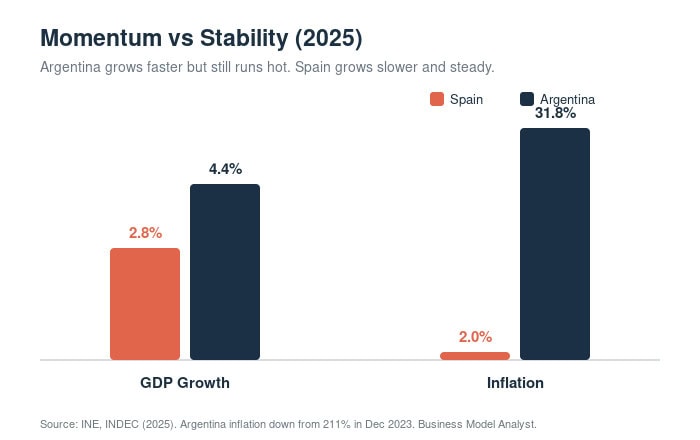
Spain still takes the station, but PPP is the reason Argentines living in Buenos Aires often feel less poor than the raw dollar figures suggest. Their salaries buy more locally than a straight conversion would show.
Station 3: Momentum – Argentina Sprints
Here the underdog scores. Argentina’s economy grew 4.4% in 2025 after years of stagnation and a brutal recession at the start of Javier Milei’s shock therapy program. Spain grew a respectable 2.8%, itself one of the eurozone’s stronger performances, well ahead of Germany and France.
Argentina’s rebound came off a low base, so fast growth partly reflects recovery from a deep hole. Still, the direction changed. The IMF projects around 3.5% for Argentina in 2026 and roughly 2.0% for Spain, so the momentum edge holds into next season.
Station 4: Price Stability – Spain in Control
Argentina wins on the pitch here in reverse, because the metric where you want a low number is inflation, and Argentina’s number is enormous. Consumer prices rose about 31.8% year on year as of late 2025.
Context matters. That 31.8% is a triumph, not a disaster, because inflation hit 211% in December 2023 when Milei took office. Cutting it to the low 30s inside two years counts as one of the fastest disinflations any major economy has managed. Spain, anchored by the euro and the European Central Bank, runs inflation near 2%.
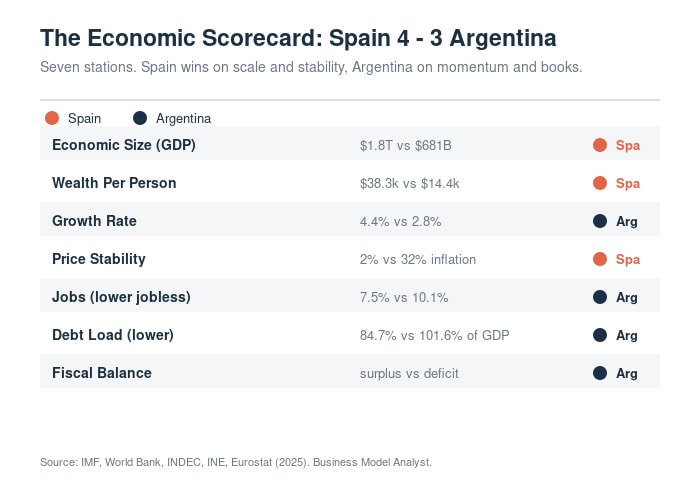
Spain takes the station. A business planning five years out can trust the euro to hold its value. In Argentina, planning around a currency that lost most of its value within living memory remains the national sport nobody wants to play.
Station 5, 6, and 7: Jobs, Debt, and the Books
Argentina sweeps the back three stations, which is why the final score stays close.
Jobs. Argentine unemployment sat at 7.5% at the end of 2025. Spain, despite its size and wealth, carries a chronic unemployment problem: 10.1% as of December 2025, the highest among major eurozone economies. Youth unemployment in Spain runs far higher still. Spain’s labor market has struggled with rigidity and seasonal tourism dependence for decades.
Debt. Spain’s government owes about 101.6% of GDP. Argentina, after restructurings and defaults that shut it out of global credit markets, actually carries a lower ratio at 84.7%. Lower debt on paper, though, sits against a history that makes lenders nervous.
The books. This is the headline of Milei’s program. Argentina ran a fiscal surplus of roughly 0.5% of GDP in 2024, its first in years, achieved through deep spending cuts. Spain ran a deficit near 3.2% of GDP. On raw discipline, Argentina outscored the far wealthier country.
What Each Economy Actually Runs On
Spain runs on services. Tourism alone pulls in tens of millions of visitors a year and anchors a services sector worth three quarters of the economy. Add carmaking, machinery, pharmaceuticals, renewable energy, and a banking sector with deep roots across Latin America. Exports topped $410 billion in 2024, most of it flowing into the EU.
Argentina runs on the land and, increasingly, on what sits under it. It is the world’s third-largest soybean exporter and a top beef and wine producer. The newer story is energy: the Vaca Muerta shale formation pushed oil output to record levels and generated a multi-billion-dollar energy trade surplus in 2025, with more expected. Lithium and a genuine tech scene, home to MercadoLibre and Globant, round out the mix. Total exports ran near $87 billion in 2025, a fraction of Spain’s but climbing.
Spain sells stability and access to Europe. Argentina sells commodities and a bet that this time the reforms stick.
Information Gain: Three Numbers That Reframe the Match
1913: Argentina’s GDP per capita nearly matched Canada’s and beat Spain’s by a wide margin. The reversal since then is the single sharpest cautionary tale in development economics. 211% to ~32%: Argentina’s inflation drop between December 2023 and late 2025, the disinflation that upgraded its credit rating from CCC+ to B- and cut country risk from around 2,000 basis points to under 600. 861,000 barrels per day: Vaca Muerta’s record oil output, the resource that could rewrite Argentina’s export story if the macro stability holds.
Frequently Asked Questions
Is Spain richer than Argentina? Yes, by most measures. Spain’s economy is about 2.6 times larger, and Spaniards earn roughly 2.5 times more per person at market exchange rates. Adjusted for cost of living (PPP), the gap narrows to about 1.8 times.
Was Argentina ever richer than Spain? Yes. In the early 1900s Argentina ranked among the wealthiest countries on earth, well ahead of Spain. A century of currency crises, defaults, and political instability reversed that lead.
Why does Argentina have such high inflation? Decades of money printing to cover fiscal deficits. The number fell sharply under Milei’s austerity program, from 211% in late 2023 to around 32% by late 2025, but it stays high by global standards.
Which economy is growing faster? Argentina, at 4.4% in 2025 against Spain’s 2.8%. Argentina’s figure partly reflects recovery from a deep recession, while Spain’s is strong for a mature eurozone economy.
Who would win the economic match? By our scorecard, Spain edges it 4 to 3. Spain wins on size, wealth, and price stability. Argentina wins on growth, jobs, debt ratio, and fiscal discipline.
The Business Model Analyst Take
Spain is the finished product. A large, diversified, EU-anchored economy that trades some growth ceiling for a floor that rarely gives way. Its weakness is a labor market that leaves one in ten workers idle even in good years, and a debt load above 100% of GDP that limits room to maneuver.
Argentina is the turnaround play. For the first time in a generation, the numbers point the right way: growth up, inflation down, budget in surplus, energy exports rising. The catch is that Argentina has looked promising before and squandered it. Investors are pricing a real recovery while remembering every prior collapse.
If you had to buy one economy today, the honest answer depends on your risk appetite. Spain is the blue-chip stock, steady and slow. Argentina is the deep-value bet, cheap for a reason but finally showing a pulse. On the pitch the match would be electric. On the balance sheet, Spain wins the trophy and Argentina wins the momentum, and momentum is the thing that turns cautionary tales into comeback stories.