
Signet Jewelers just told investors what it costs to admit a mistake. In its most recent quarterly filing, the parent of Kay, Zales, and Jared booked $32.7 million of inventory write-down charges tied to discontinuing James Allen and Rocksbox as separately operated brands and decommissioning their websites.
The concrete noun in all of this: jamesallen.com is going dark. The domain that once represented the future of diamond retail is being switched off, and its merchandise is being repackaged as a collection inside Blue Nile.
This is the mall jeweler euthanizing the digital natives it bought to save itself.
The site is going dark
Signet announced the wind-down on March 19, 2026, alongside its fiscal 2026 results. The plan is straightforward and brutal. The James Allen brand shuts down and transitions into a proprietary collection available at Blue Nile. Rocksbox stops operating as a standalone brand and moves inside Kay Jewelers. Roughly 100 physical stores close in the coming fiscal year.
The James Allen site is slated to go dark during the second quarter of fiscal 2027, which ends in early August 2026. That is now.
Chief Operating and Financial Officer Joan Hilson framed the logic to analysts: Signet had been supporting eight distinct independent businesses. It will now run four core brands, Kay, Zales, Jared, and Blue Nile, with Blue Nile positioned as an elevated luxury brand anchored in natural diamonds.
Eight businesses down to four. James Allen was one of the four that did not make the cut.
The $32.7 million line item
The write-down appears in Signet’s 10-Q for the 13 weeks ended May 2, 2026. The company recorded $32.7 million of inventory write-down charges associated with the planned disposal of inventory tied to the discontinuance of James Allen and Rocksbox and the decommissioning of their websites. Those charges hit cost of sales.
That figure sits inside a larger restructuring. Signet expects total costs under the plan to run approximately $90 million to $100 million, including roughly $55 million to $60 million of non-cash charges for inventory write-downs, asset disposals, and impairments. Cumulative asset impairment charges under the plan reached $18.2 million through May 2, 2026. The company expects the plan to be substantially complete by the end of fiscal 2027.
Signet also guided to a net revenue reduction of $60 million to $80 million in fiscal 2027 from the James Allen transition, with what management describes as minimal impact on adjusted operating income.
Read that last clause again. Signet is telling investors it can lose up to $80 million of revenue and barely feel it. That is not a company mourning a brand. That is a company relieved to stop feeding one.
Half a billion dollars of digital ambition
To understand the scale of the reversal, rewind to 2017.
Signet was an underperforming mall retailer watching e-commerce eat its category. Newly appointed CEO Virginia Drosos bought R2Net, the parent of JamesAllen.com, for $328 million in cash. The deal brought a fast-growing online brand with strong millennial recognition and, crucially, Segoma Imaging Technologies, the arm behind the 360-degree HD diamond visualization that made James Allen famous. At the time of the acquisition, Signet said R2Net was expected to contribute roughly $80 million to $90 million in revenue for the upcoming fiscal year.
The buying did not stop there. Signet acquired Rocksbox, a jewelry subscription service, in April 2021. It acquired Diamonds Direct in October 2021. And in August 2022 it closed on Blue Nile for $360 million in cash, the best-known name in internet diamond retail.
Add it up and Signet spent well over a billion dollars assembling a digital and specialty portfolio. The James Allen and Blue Nile pieces alone cost $688 million.
Nine years after the R2Net deal, one of those two brands is being deleted.
What actually killed James Allen
The revenue chart tells the story faster than any strategy memo.
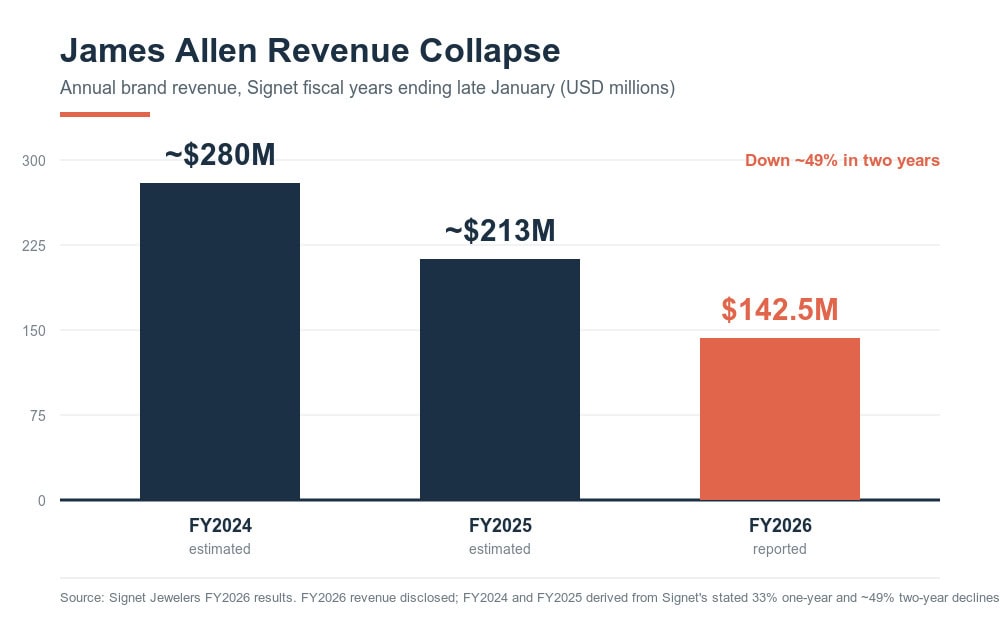
James Allen’s sales dropped 33% to $142.5 million in fiscal 2026, and fell nearly 49% across two years. Signet had already taken a $13 million impairment charge on the James Allen trade name the prior year, which is the accounting equivalent of a doctor quietly telling the family to prepare.
For context, Blue Nile, the brand James Allen is being folded into, did $339 million in the same fiscal year. It slipped only 2%.
The drag showed up at the group level too. Signet’s full-year fiscal 2026 online sales declined 2.4%, and digital fell to 21.8% of total sales, down from the prior year. The company attributed the decline primarily to underperformance at James Allen. In the first quarter of fiscal 2027, e-commerce sales fell 4.9% year over year to $322.1 million, again pinned on James Allen, even as same store sales grew 1.8% and brick-and-mortar comps rose 3.8%.
That last combination is the whole thesis. Signet’s stores were growing. Its digital pure-play was bleeding. The mall won.
The Blue Nile consolidation bet
Signet’s stated rationale is not “digital failed.” It is “we ran two overlapping digital brands and one of them had to die.”
James Allen and Blue Nile sold to a similar customer, in a similar way, through a similar funnel, competing for a similar set of expensive engagement-ring keywords. Two brands bidding against each other for the same search intent is not a portfolio. It is a tax.
Blue Nile has the stronger name, the larger revenue base, and a more affluent demographic. Signet is choosing it as the survivor and repositioning it upmarket toward natural diamonds. James Allen’s complementary products and styles migrate over. Its customization and imaging technology, the actual asset Signet paid for in 2017, gets deployed across the other banners rather than trapped inside one URL.
Framed that way, the write-down is not a retreat from digital. It is a decision to stop paying rent on a second storefront that served the same street.
Rocksbox gets folded into Kay
Rocksbox is the quieter burial. Signet acquired it in 2021 as a jewelry subscription and rental service, then transitioned it toward traditional retail. It now becomes a proprietary collection operating within Kay Jewelers rather than a standalone entity.
The subscription thesis for jewelry was always awkward. Fine jewelry buying is episodic, emotional, and tied to milestones. Renting it borrows the mechanics of a category, apparel, where novelty is the point. Signet appears to have concluded that Rocksbox works better as a merchandising idea inside a brand customers already trust than as a brand customers must be taught to trust.
What Signet keeps
The company is not walking away empty-handed, and it would be lazy analysis to pretend otherwise.
Signet keeps the Segoma imaging and customization technology. It keeps James Allen’s customer records and product data. It keeps the diamond inventory relationships. It sheds the cost of running a duplicate marketing engine, a duplicate merchandising team, a duplicate site, and a duplicate brand.
Meanwhile, the core business is performing. Q1 fiscal 2027 total sales rose 0.8% to $1.55 billion, same store sales grew 1.8%, average unit retail rose 4.5%, and the company delivered double-digit adjusted operating income growth. Signet returned more than $125 million to shareholders and launched a $50 million accelerated share repurchase. Core brands Kay, Zales, and Jared delivered more than 3% same-store sales growth and account for roughly 70% of revenue.
CEO J.K. Symancyk has organized fiscal 2027 around what he calls “Grow Brand Love,” a three-banner focus with sharper brand differentiation. Killing James Allen is not a symptom of distress. It is a company with a working core amputating the part that was not.
The skeptic’s case
Here is the argument against Signet, and it deserves airtime.
They destroyed the asset, then blamed the asset. James Allen was growing 50% a year when Signet bought it. It contributed $80 million to $90 million in year one and eventually scaled well past $250 million. The decay to $142.5 million happened under Signet’s ownership, not before it. A skeptic would argue that a mall conglomerate absorbed a fast-moving digital brand, starved it of autonomy, layered on corporate process, and then pointed at the resulting decline as proof the brand was never viable.
Buying Blue Nile created the cannibalization. Signet did not inherit two competing digital brands. It bought the second one, in 2022, for $360 million, five years after buying the first. The redundancy Signet is now solving is a redundancy Signet created.
Consolidating to natural diamonds is a bet, not a fact. Signet is repositioning Blue Nile around natural diamonds at the exact moment lab-grown stones are reshaping the category. Symancyk himself says lab-grown fashion sales continue to show strong growth. Anchoring the surviving digital flagship to the more expensive input is a defensible premium play, and it is also a way to lose the next decade of entry-level buyers.
The $60 million to $80 million revenue hole is real. Management says the operating income impact is minimal, which means James Allen was contributing revenue at close to zero margin. Fine. But a business that ran at zero margin at $142 million of scale was a business Signet had already stopped investing in.
What operators should take from this
Three lessons worth stealing.
Acquiring a digital-native brand is not the same as acquiring digital capability. Signet wanted the imaging technology, the millennial customer, and the e-commerce muscle. It got them, and it is keeping them. What it could not do was preserve the conditions that made James Allen good in the first place. If the point of a deal is a capability, buy the capability and build the distribution. If the point is a brand, protect the operating independence that made the brand work. Signet tried to do both and ended up with a technology purchase that cost $328 million and came with a brand it eventually had to bury.
Portfolio sprawl is a margin problem before it is a strategy problem. Eight independent businesses meant eight marketing budgets, eight merchandising teams, eight tech stacks, and eight sets of keyword bids, several of which pointed at the same customer. The write-down is the visible cost. The invisible cost was years of internal competition. This is the same pattern that pushed Nike to unwind its direct-to-consumer-first strategy and rebuild wholesale, and the same logic behind Walmart’s omnichannel consolidation.
Digitally native does not mean structurally advantaged. The DTC playbook assumed that cutting out the middleman created durable margin. In practice, customer acquisition costs rose, incumbents learned to sell online, and the advantage evaporated. James Allen’s differentiation, 360-degree diamond imaging, is now table stakes. When your moat becomes a feature, your brand becomes a collection page.
The Business Model Analyst Take
The $32.7 million write-down is the cheapest part of this story. The expensive part was the $328 million Signet paid in 2017 and the nine years it spent proving that owning a digital-native brand is not the same as being one.
The uncomfortable truth is that Signet’s decision looks correct. Its stores are growing, its core brands are compounding, its margins are expanding, and its most digital asset was the thing dragging the numbers down. A company that spent a decade being told it would be disrupted by the internet is now shutting down its internet brands and buying back its own stock.
That should trouble anyone who built a business on the premise that digital-native beats incumbent by default. It did not. It bought a decade of pressure, forced the incumbents to modernize, and then got absorbed. James Allen taught Kay how to photograph a diamond. Kay is what survived.
The site goes dark in August. The technology stays. That trade, in the end, is what Signet actually bought.
FAQ
Is James Allen shutting down? Yes. Signet Jewelers is decommissioning the jamesallen.com website during the second quarter of fiscal 2027, which ends in early August 2026. The brand becomes a proprietary collection available through Blue Nile.
Why is Signet closing James Allen? James Allen’s revenue fell 33% to $142.5 million in fiscal 2026 and dropped nearly 49% over two years. Signet had already taken a $13 million impairment on the James Allen trade name and decided the brand duplicated Blue Nile, its larger and better-known digital retailer.
What is the $32.7 million charge? It is an inventory write-down recorded in Signet’s first quarter of fiscal 2027, tied to disposing of inventory associated with discontinuing James Allen and Rocksbox as standalone brands and shutting down their websites.
What happens to Rocksbox? Rocksbox stops operating as a standalone brand and becomes a proprietary collection operating within Kay Jewelers.
How much did Signet pay for James Allen? Signet acquired R2Net, the parent company of JamesAllen.com, for $328 million in cash in 2017. It later acquired Blue Nile for $360 million in 2022.
Are existing James Allen orders and warranties affected? Signet has framed the change as a brand transition rather than a liquidation, with products and styles moving to Blue Nile. Customers with existing orders or service questions should contact the retailer directly for the current policy.