
The city finally priced the back end of a conversion. Every deal still dies, or lives, on the front end: the price of the building.
San Francisco’s new incentive for turning empty offices into apartments pays developers a share of the property tax their finished building generates, for up to 30 years. Run the city’s own financing plan per apartment and the checks add up to about $131,700. Discount them back to the day a developer buys the building and they are worth roughly $40,400, or 19% of the $213,700 per apartment the city’s consultant assumed as the purchase price. The rebate helps. It does nothing about the number that decides whether a conversion happens, which is what the seller will accept, and the AI leasing boom is pushing that number the wrong way.
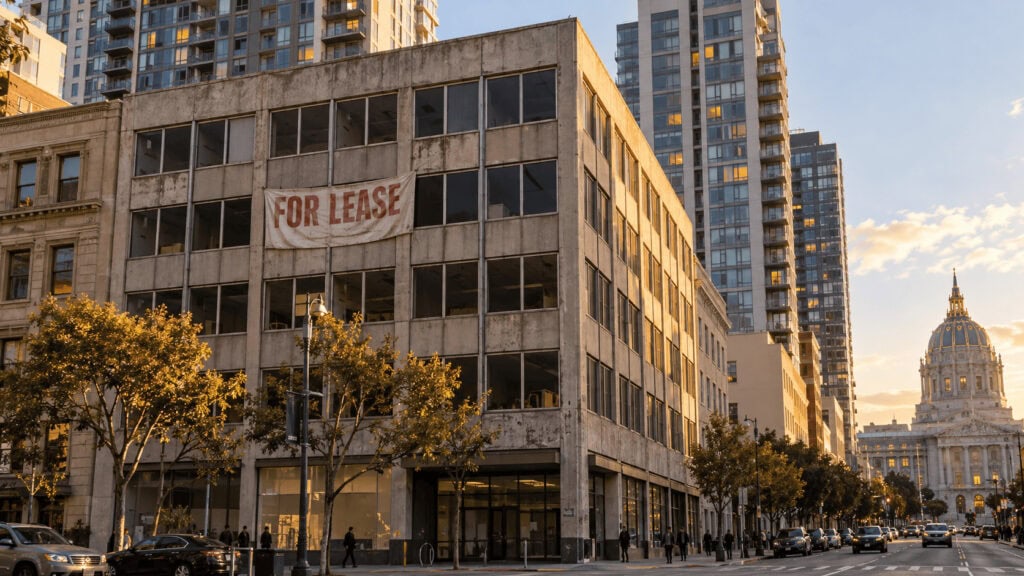
A one-bedroom in San Francisco now rents for a median $4,400 a month, up 25.4% in a year, according to Zumper’s October rent report. The city has roughly 30 million square feet of vacant office space. Those two facts have been sitting next to each other for four years, and the number of completed post-pandemic office-to-housing conversions between them is still zero.
The New York Times reported on Sunday that the city is trying again, with a tax incentive that has drawn three applications so far. The coverage frames it as San Francisco finally copying what worked in New York and Washington. The more useful question is what kind of money the city is offering, and when it arrives.
What Happened
Earlier this year San Francisco adopted a law, built on a 2024 state bill, that lets developers converting commercial buildings downtown get back part of their future property taxes for 30 years. The district covers the Financial District, South of Market and Civic Center. It took effect on February 12, 2026, and projects can opt in until the end of 2032.
Three developers have applied, according to the Times. Emerald Fund, the local firm run by Marc Babsin, has teamed with another developer to buy a midcentury office building and turn it into 106 apartments. Permit filings place that project at 150 Hayes Street in Civic Center, a vacant 1968 building owned by the Academy of Art University. Hudson Pacific Properties, the West Coast office REIT, wants to put 136 apartments in the upper floors of 901 Market Street, a 114-year-old landmark it already owns.
The backdrop is a city with too few homes and too much office. Office vacancy is 30.1%, per Cushman & Wakefield, among the highest in the country. New York and Washington, the top two conversion markets, had nearly 25,000 units in development combined at the start of the year, according to RentCafe. Emerald and Hudson Pacific together are proposing 242.
Babsin told the Times the city’s whole package of incentives should cut about 25% from total project costs. He also flagged the catch: more AI leasing is making building owners and lenders reluctant to sell at a price where a conversion still works.
The Backstory
San Francisco did not ignore this problem. It worked it from every angle except the one that pays.
A 2023 study from SPUR and partners found many downtown office buildings physically suitable for conversion. The city then relaxed codes and waived requirements such as bike parking and open space. In March 2024 voters eliminated the transfer tax on the first sale of a converted building. Fee waivers followed, worth an estimated $70,000 per unit. None of it produced a finished project. The one conversion that got moving after the pandemic, at 785 Market Street, was abandoned after its developer could not secure financing.
The tax incentive is the piece the city saved for last, and it is a genuinely different instrument. California law calls it a downtown revitalization financing district. In plain terms it is tax increment financing pointed at a single building: the city keeps the property tax the old office was paying, and hands the project the City’s share of whatever extra tax the new apartments generate.
The details live in the district’s adopted financing plan, and they matter more than the headline:
- The City’s share is 64.59% of the 1% property tax levy. Schools, the state’s ERAF fund and BART keep their share of the increment. The developer gets the rest, minus up to 5% for administration.
- The base is set before construction. The increment is measured against the assessed value on the roll last equalized before the first building permit.
- Payments start the fiscal year after the certificate of occupancy. Nothing flows during design, permitting or construction.
- It is strictly pay-as-you-go. The plan states that “in no event may future allocations of tax revenues be accelerated.” The city will not front the money.
- Conditions come attached. Opted-in projects must pay prevailing wages. Affordable set-asides of 5% to 10% of units apply after the first 1.5 million square feet enroll.
The city’s consultant, BAE Urban Economics, identified 49 buildings that are good candidates: built before 1990, Class B or C, at least 20,000 square feet, more than half empty. Together they hold 3.76 million square feet that could become 4,403 apartments. The plan projects $610 million of total payments over the district’s life and caps them at $1.22 billion. The annual report filed this year confirms no project had opted in during the reporting period, and the plan does not expect any completions before fiscal 2028-29.
The Plan
Here is the arithmetic the city published but never put on a per-apartment basis.
BAE assumed the 49 buildings change hands at $250 per gross square foot, which works out to a baseline value of about $941 million, or $213,700 per finished apartment. After conversion it assumed each unit is worth $750,000, with rents around $4,300 a month. That lifts assessed value by about $2.33 billion across the pool, or roughly $529,100 per apartment.
Apply the City’s 64.59% share of the 1% levy, take off the 5% administration fee, and the first annual check is about $3,250 per apartment. Grow it at the 2% a year Proposition 13 allows, for 30 years, and the total comes to $131,700 per apartment. That matches the plan’s own projection of $579.9 million net of admin divided across its 4,403 units, so the model and the city agree.
Now put a date on it. A developer buys the building, pulls permits, builds for about three years, gets a certificate of occupancy, and receives the first check the following fiscal year. Discount that 30-year stream at 7% from the day of purchase and it is worth about $40,400 per apartment. At 5% it is about $54,300. At 10%, a rate closer to what risk capital charges for a contingent stream that starts years out, it falls to $27,300.

The rebate’s present value is about 19% of the purchase price the city’s own consultant assumed. Source: San Francisco Downtown Revitalization Financing Plan, BAE Urban Economics, BMA calculations.
That 19% is the whole story in one ratio. The incentive is real money, but it is smaller than the variance in what a building costs. A seller who asks about 18% more than the consultant’s figure absorbs all of it. And because the base is the assessed value before the first permit, a higher purchase price that reaches the roll also raises the base and shrinks the increment. The developer pays twice.
Which explains the applicant list better than any policy memo.
Look at where the two named projects got their buildings. Hudson Pacific bought 901 Market in 2012 for $90 million, about $425 a square foot, and is not buying anything now. Its basis is sunk. Emerald is buying 150 Hayes from a for-profit art school that has been shedding downtown property as its courses moved online. The building was listed at $29 million, or $209 a square foot, roughly $274,000 per apartment on the Times’ unit count. The final price was not disclosed.
Neither seller is an office landlord pricing an AI tenant. One is the developer itself. The other is a school leaving the real estate business. The deals that showed up are the ones whose front end was solved before the city’s back end was ever needed.
The office buyers are still bidding. In April StartupHQ, a local office owner and operator, paid $20 million, or $200 a square foot, for the historic 55 New Montgomery. That is the kind of older stock a conversion developer wants, at roughly the price a converter can pay, bought by someone betting the building still has a life as office. Every trade like that raises the reference price an owner quotes to a converter.
The Business Model Angle
A back-end subsidy cannot fix a front-end constraint. The rebate is paid out of value the developer creates, after the developer creates it. Conversions fail at acquisition, where the owner’s reservation price includes an option on a future office tenant. Babsin said the quiet part to the Times. The incentive is designed for the problem the city controls, not the one that stops deals.
Subsidies to a scarce input get capitalized into its price. There are 49 good candidate buildings, not 4,900. When every qualified buyer can collect the same $40,000 per apartment, a well-advised seller prices the building to collect it instead. That is the standard result when a subsidy attaches to a scarce, specific parcel. Our piece on Hawaii’s tech tax credits found the mirror image: pay for an input and you get more of that input, not the outcome you wanted.
Timing is the product, not the dollar amount. New York’s 467-m program exempts conversions from property tax entirely for up to three years of construction, then gives up to a 90% exemption for decades, in exchange for 25% affordable units. The benefit starts while the developer is still spending. San Francisco’s starts the year after the developer stops. Same direction of subsidy, very different shape of cash flow, and developers underwrite shape. Amazon’s community pledge showed the difference between a rebate and a price cut from the corporate side. San Francisco just picked the rebate.
The first 1.5 million square feet are the prize. Affordability requirements switch on after that much space enrolls, which is about 40% of the 3.76 million square feet BAE counted. The Emerald and Hudson Pacific projects use well under a quarter of it. Early movers get the cleanest economics, so expect enrollment to come in a burst rather than a trickle once financing clears.
The Risk
The strongest case for the city’s design is that a pay-as-you-go increment costs taxpayers nothing that would otherwise exist. If the building stays empty, there is no increment to give away. BAE’s own fiscal analysis spells out the trade-off: under a standard method the conversions run a General Fund deficit of up to $8.3 million a year, because new residents need services and the property tax growth goes to developers, while under an adaptive-reuse sensitivity that assumes the city already staffs downtown for full offices, they produce a small surplus of about $540,000. Either way, the city is not writing checks for buildings that never convert. That is real fiscal discipline, and New York’s comptroller put the present-value cost of 467-m at $5.1 billion.
The second defense is that tax increment has worked before. New York’s 421-g program, which ran from 1995 to 2006, produced 12,865 converted units in Lower Manhattan at a cost the Citizens Budget Commission put at $1.2 billion, or about $92,000 per unit. San Francisco’s nominal $131,700 per apartment is in the same range. The commission also found 421-g was often more generous than needed, which is the opposite of the problem here.
Third, the revenue side has never looked better. BAE’s model assumed $4,300 a month in rent. The median one-bedroom already rents for $4,400, and two-bedrooms for $6,340. If rents keep running ahead of the plan’s assumptions, stabilized values rise, the increment rises with them, and the rebate gets bigger without anyone changing the law.
And the AI story cuts both ways. The same companies driving office leasing are hiring the people driving rents. The 49 candidate buildings are pre-1990 Class B and C stock with more than half their space empty, not the towers AI tenants are choosing. Babsin’s own read was that dozens of Class B and C office buildings continue to struggle. If he is right, the sellers who matter are the owners of those buildings, and their lenders, not the ones fielding calls from model labs.
The honest version is narrower than either camp wants. The incentive shifts the math at the margin. Whether that margin is reachable depends on a price the city does not set.
Quick Questions
How does San Francisco’s office conversion incentive work? Eligible downtown projects get an annual payment equal to the City’s share of the extra property tax the converted building generates, for up to 30 years. Payments begin the fiscal year after the building receives its certificate of occupancy, and projects must enroll by December 31, 2032.
How much is it worth per apartment? On the city’s financing plan assumptions, about $131,700 in nominal payments over 30 years. Discounted at 7% to the day the building is bought, assuming a three-year build, it is worth about $40,400.
Why hasn’t San Francisco completed an office conversion since the pandemic? Costs, financing and acquisition prices. The last major conversion was Emerald Fund’s 418-unit 100 Van Ness, finished in 2015. The one post-pandemic project that got underway, at 785 Market Street, was abandoned.
How is this different from New York’s program? New York’s 467-m exempts most of a conversion’s property tax from the start of construction for up to 35 years, in exchange for 25% affordable units. San Francisco pays a share of new tax after completion and waives the district’s affordable set-aside for the first 1.5 million square feet that enroll.
Does a higher purchase price change the rebate? Yes. The increment is measured from the assessed value before the first building permit, so a higher price that reaches the tax roll raises the base and lowers the payments.
The Business Model Analyst Take
San Francisco built a careful, fiscally clean incentive that pays for success after it happens. That is good governance and a weak lever. A conversion is a bet whose biggest input is the price of the building, and the city’s money shows up four years after that price is paid, in installments, measured from a base the price itself helps set.
The applicant list already proved the point. One project belongs to an owner that does not have to buy anything. The other got its building from a seller with no interest in the office market. Those are the deals that work, and they worked because someone outside the AI leasing cycle set the price.
If the city wants the next 40 buildings, the cheapest move is not a bigger rebate. It is a faster one: a lender-ready payment stream that can be borrowed against at signing, or a front-loaded exemption during construction, so the subsidy lands on the same day the seller does. Pair that with renters who already pay more than a mortgage would cost in most of the country, and the demand side is not the problem. Anyone who has read a net lease pitch knows the same truth from the buyer’s chair: the residual is where the money is, and the residual here belongs to whoever owns the building today.
San Francisco now pays developers to finish. The market still charges them to start.