Every sale-leaseback pitch leads with the cap rate. The cap rate is not the interest rate, and the gap between the two is where the whole decision lives.
A sale-leaseback looks like a real estate transaction and gets underwritten like one. It is not. For the company selling the building, it is a financing: a fully drawn, non-amortizing, non-prepayable loan at 100% of appraised value, secured by collateral you hand over on day one and never get back. Priced correctly, it can be the cheapest capital a weak credit will ever raise. Priced the way most companies price it, by comparing the headline cap rate to their bank’s quote, it is one of the most expensive.
The market is busy. US sale-leaseback volume reached 714 transactions and roughly $14.4 billion in 2025, a 3% increase in count and an 18% increase in dollars, the first year above 700 deals since 2022. The first quarter of 2026 produced 168 deals, the strongest first quarter since 2022, with Gaming and Leisure Properties buying Bally’s Twin River for $700 million and Essential Properties picking up 69 Denny’s locations for $146 million. Almost none of that volume is analyzed as debt by the party paying for it.
This piece works the seller’s side of the table. What the instrument really is, what it really costs, which of the standard justifications survive contact with current accounting rules, and the narrow set of circumstances where it is the right answer anyway.x’
Sale-leaseback (SLB): a transaction in which a company sells an asset it owns and occupies, then immediately leases it back from the buyer under a long-term lease, usually triple net. The seller receives cash equal to the asset’s value and becomes a tenant in a building it used to own.
How the price is set: the buyer divides the first year’s contractual rent by the purchase price to get a capitalization rate. A 6.80% cap rate on a $50 million building means $3.4 million of first-year rent.
What the seller gives up: legal title, the residual value of the property at the end of the lease, the ability to close or relocate without negotiating an exit, and the flexibility to defer maintenance spending in a bad year. What it keeps is occupancy and, in most structures, renewal options.
What the seller gains: immediate liquidity of up to 100% of the asset’s market value, against the 60% to 80% a conventional commercial mortgage will advance.
The instrument, in one table
The clearest way to see a sale-leaseback is to line it up against the mortgage it replaces. Same building, same money, different structure.
| Mortgage | Sale-leaseback | |
|---|---|---|
| Cash raised | 60% to 80% of value | Up to 100% of value |
| Periodic payment | Interest, then principal | Rent, rising annually |
| Payment at maturity | Balloon or fully amortized | Nothing. There is no maturity |
| Who owns the asset at the end | You | The buyer |
| Refinancing risk | Yes, at every maturity | None |
| Can you prepay | Usually, with a penalty | No |
| Can you close the site | Yes, sell it and repay | Only by negotiating a buyout or rejecting the lease in bankruptcy |
| Maintenance | Deferrable in a bad year | Contractually required under a triple net lease |
| Rate quoted to you | An interest rate | A cap rate, which is not the same thing |
The last row is the one that costs people money.
The price is not the cap rate
An interest rate on a loan tells you what the money costs, because at the end you repay the principal and keep the asset. A cap rate on a leaseback tells you only what the first year’s payment is. Two things push the true cost above it.
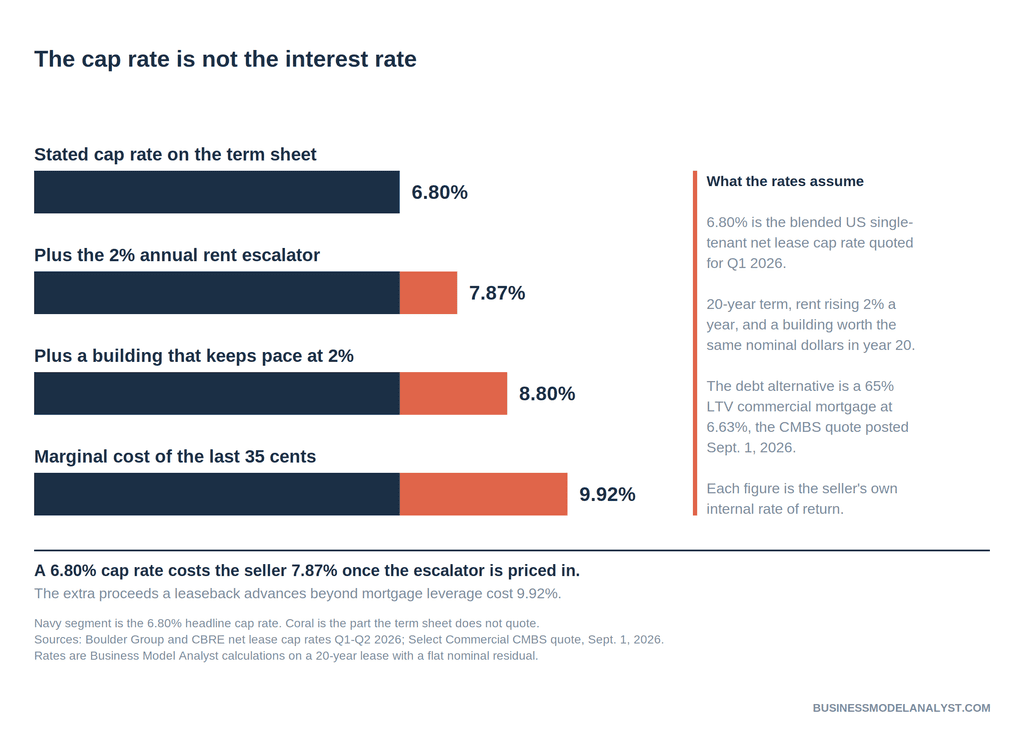
The first is the escalator. Almost every net lease carries a contractual rent increase, commonly a fixed uplift such as 2% a year or 10% every five years, and sometimes a CPI link on longer-dated leases. A 6.80% cap rate with a 2% annual bump is not a 6.80% obligation. Rent in year 20 is 1.46 times the year-one figure. Run the seller’s cash flows as an internal rate of return, with the proceeds coming in on day one and the rent going out for 20 years, and the implied rate is 7.87%.
The second is the building. Under a mortgage you still own it in year 20. Under a leaseback you do not. If the property merely holds its nominal value across the term, the seller’s implied rate rises to 8.80%. If it tracks the July 2026 CPI reading of 3.4% a year, it rises to 9.55%.
None of this is hidden. It is simply not on the term sheet, because the term sheet is a real estate document and the decision is a corporate finance decision.
Why the quote has so little to do with your credit
Here is the part that explains why sale-leasebacks keep happening even when the arithmetic looks bad. The net lease market prices credit on a much flatter curve than the bond market does.
Take one clean comparison, held at the same date against the same benchmark. In the corporate bond market, moving from the BBB index to the single-B index costs 170 basis points. In the net lease market, moving from a restaurant run by its corporate parent to the identical format run by a franchisee costs about 100.

The gap widens as credit deteriorates. Bally’s Corporation carries an issuer credit rating of B- from S&P. It sold the real estate under its Kansas City and Shreveport casinos to Gaming and Leisure Properties for $395 million at an 8.2% initial cash capitalization rate, with expected first-year rent coverage of 2.2 times. The companion Chicago transaction priced at an 8.4% initial cash yield, for a blended 8.3% across the package. Against an ICE BofA single-B index of 7.23% and a CCC index of 14.67% in August 2026, an 8.2% leaseback for a B- borrower is cheap money by a wide margin.
That is the honest structure of the instrument. A net lease buyer is underwriting the building, the lease document, and the coverage ratio at that specific site, in that order, with the corporate rating as a secondary input. If your credit is bad, you are borrowing against something the market thinks is better than you are. If your credit is good, you are paying a premium to borrow against your own real estate.
The crossover sits somewhere in the single-B range. Above it, a sale-leaseback is expensive. Below it, it may be the only capital available at any price, which is exactly why the companies with the least room to make a mistake are the ones signing the longest leases.
The twenty-year bill
Cumulative arithmetic makes the point that annual arithmetic hides. Raise $100 at a 6.80% cap rate with a 2% escalator and hold the lease for its full 20-year primary term, and you will pay out $165 of rent. At a 2.5% escalator, $174.

A mortgage of the same size, at the 6.63% CMBS rate quoted on September 1, 2026, would also cost more than $100 in interest across 20 years. The difference is the ending balance sheet. The mortgage borrower has a repaid loan and a building. The leaseback seller has a set of renewal options and a landlord.
The only comparison that matters
Most companies compare a leaseback to doing nothing. The right comparison is to the debt they could actually raise, and the right question is what the extra money costs.
Suppose a lender would advance 65% of the building’s value at 6.63%. A leaseback advances 100% at a 6.80% cap with a 2% escalator. The first 65 cents are roughly a wash. The last 35 cents are not. Isolate them, and the marginal cost of the additional proceeds is 9.92%.

The relationship runs the wrong way from intuition. The more a bank would have lent, the fewer incremental cents the leaseback provides, and the more expensive those cents become. If a lender would go to 80%, the leaseback’s extra 20 cents carry a marginal rate of 11.99%.
This reframes the decision cleanly. A sale-leaseback wins on size, not on price. It is the right answer when you genuinely need more money than a lender will give you and the use of that money clears a double-digit hurdle. It is the wrong answer when you needed 65% and took 100% because it was offered.
Three reasons that no longer work
“It takes the debt off our balance sheet.” This stopped being true when ASC 842 took effect. Operating leases now sit on the balance sheet as a right-of-use asset and a corresponding lease liability. The line item has a different name than debt. It is still there.
“It deleverages us.” Not in the eyes of the people whose opinion determines your cost of capital. S&P Global Ratings treats a sale-leaseback as a form of financing and capitalizes the sale amount back into adjusted debt. Moody’s has long capitalized lease obligations using rent multiples, applying factors of 5x, 6x, 8x or 10x by sector, and in no case capitalizing at less than the present value of future lease payments discounted at the long-term borrowing rate. Fitch anchors on the US GAAP treatment while Moody’s and S&P favor the IFRS approach, so the exact adjustment differs, but none of the three is fooled. Where a leaseback genuinely helps is with contractual covenants written against reported GAAP debt, and that is a negotiation with your existing lenders, not a change in your credit.
“We can always buy it back.” For real estate, this is the trap. ASC 842-40-25-3 precludes sale treatment when the seller-lessee holds a repurchase option, unless the exercise price is fair value at the time of exercise and substantially similar alternative assets are readily available in the marketplace. Sale and leaseback transactions involving real estate and integral equipment do not qualify for that exception. Write in the buyback right you actually want and the transaction becomes a failed sale: the asset never leaves your books, the cash is recorded as a financial liability, and you keep depreciating the building as though you still owned it. Which, in substance, you do. The same logic runs through the tax analysis, where Frank Lyon Co. v. United States remains the governing authority on when form gives way to substance.
The tax bill nobody models
Where a sale-leaseback is properly structured and respected as a true sale, the seller recognizes gain on the sale and deducts the new lease payments as an operating expense, while the buyer takes the depreciation and reports the rent as income. Three consequences follow that rarely make it into the board deck.
The gain is taxable now, all of it, in the year of the sale. On real estate held for decades at a low basis, that can absorb a meaningful share of the proceeds before a dollar is deployed. The headline price is not the liquidity number.
You trade a depreciation shield for a rent deduction. Whether that is an improvement depends on your remaining basis, your effective rate, and whether you have losses to absorb.
And the whole structure is conditional. If the IRS treats the arrangement as a financing device rather than a sale, the seller is treated as still owning the property and the gain or loss is not recognized, with payments recast as principal and interest. Courts test this against the benefits and burdens of ownership, looking at whether title passed, whether the buyer acquired an equity interest, who holds possession, who pays property taxes, who bears the risk of loss, and who receives the profit from operating, holding and selling the property. Bargain repurchase rights and very long lease terms are the usual failure points.
What you actually sell: the closure option
The largest cost in a sale-leaseback is not in the rate. It is the conversion of a flexible asset into an inflexible liability.
An owned building in a market you want to exit is a problem you can solve by selling it. A leased building in a market you want to exit is a problem you solve by paying rent on an empty box, buying your way out, or filing.
Red Lobster is the case study, and it is worth stating precisely because the popular version blames a shrimp promotion. When Golden Gate Capital bought the chain from Darden for $2.1 billion in 2014, it funded part of the purchase by selling the real estate under roughly 500 locations to American Realty Capital Properties for $1.5 billion in a sale-leaseback. By 2023 rent ran about $200 million a year, roughly 10% of revenue, and the CEO told the bankruptcy court that a material portion of the leases were priced above market. More than $64 million of that annual rent sat on underperforming stores. In Chapter 11 the company rejected more than 100 leases and shed roughly $140 million of annual rent expense.
Look at the scale. The annual rent bill in year nine was 13.3% of the cash the 2014 transaction raised. The rent shed in bankruptcy alone, $140 million a year, equaled 9.3% of the original proceeds. The chain got its flexibility back. It had to go through a court to do it.
The strongest case for doing it anyway
A fair analysis has to make the other argument properly, because there are four situations where a sale-leaseback is clearly correct.
You cannot raise the money any other way. For a B- credit, a leaseback priced hundreds of basis points inside the high yield market is not expensive capital. It is the only capital. Comparing it to a theoretical mortgage nobody will write is not analysis. The same logic governs smaller deals, where an SBA 7(a) loan for a business acquisition is often the only priced alternative on the table.
The reinvestment clears the hurdle. If the proceeds fund something that returns well above 10% after tax, the marginal cost of the incremental cash is a bargain. This is the honest version of the private equity use case: monetize the real estate, redeploy into unit growth or an acquisition, and the arithmetic works as long as the redeployment is real. Buyers who fund acquisitions with outside equity rather than property proceeds face the same hurdle test, which is the calculation at the center of how search funds work.
The rent is a short position on inflation. A fixed 2% escalator in a world where CPI ran 3.4% in July 2026 means your rent falls about 1.4% a year in real terms, roughly 23% across a 20-year term. Tenants who expect persistent inflation are getting a genuinely favorable clause. The counterweight is that the building you handed over compounds at the same inflation rate you are betting on, which is why the residual is the larger of the two exposures.
A lease is easier to walk away from than a mortgage. In Chapter 11, a debtor can reject a lease and the landlord’s damages claim is capped by statute at the greater of one year, or 15% not to exceed three years, of the remaining rent. A defaulted mortgage has no such cap. Red Lobster’s $140 million of shed rent is the demonstration. This is a real advantage, and it comes with a real price: you have to be in bankruptcy to collect it.
Six questions before you sign
- What is our all-in implied rate, not our cap rate? Model the full rent schedule plus the forgone building. If nobody has produced that number, the deal has not been priced.
- What would a lender advance, and what does the difference cost? The marginal rate on the incremental proceeds is the decision number.
- What is the after-tax liquidity? Purchase price, less mortgage payoff, transaction costs, transfer taxes and the tax on the gain.
- Where does the money go, and does that use clear the marginal rate? If the answer is “general corporate purposes,” the answer is no.
- Which of these sites might we want to close in year 12? Price the exit now. Termination rights, contraction options and go-dark provisions are cheaper to buy at signing than to negotiate later.
- What does the escalator do to fixed charge coverage in a bad year? Rent rises whether or not sales do. Model the covenant at trough EBITDA, not at plan.
Frequently asked questions
Is a sale-leaseback debt or equity? Neither, legally. Economically it behaves like debt: a fixed, senior, non-deferrable payment obligation secured by a specific asset. Rating agencies treat it as debt. Analysts should too.
Why would a company do this if it costs more than a mortgage? Three reasons. It advances more money, up to 100% of value against 60% to 80% for a mortgage. It carries no refinancing risk, because there is no maturity. And for weak credits it prices far inside anything the unsecured market will offer.
Does ASC 842 mean sale-leasebacks are pointless now? No, it means the balance sheet argument is pointless. The liquidity, the credit arbitrage and the refinancing-risk arguments all survive. Volume has continued to grow since the standard took effect, which tells you the accounting was never the main driver.
Can I keep an option to buy the building back? Not a fixed-price one, if you want sale accounting. For real estate, essentially any repurchase option makes the transaction a failed sale, meaning the asset stays on your books and the cash is recorded as a liability. Companies that want the option are usually better off negotiating a right of first refusal, which is treated differently.
What lease term should I sign? Longer terms fetch lower cap rates, so the buyer will push for 20 years. The seller is buying a lower rate with reduced flexibility. Anything past 15 years should be tested against the honest question of whether you can forecast that location’s usefulness that far out, and lease terms of 30 years or more also raise tax recharacterization risk.
Is the cap rate negotiable? Less than the rent is. Buyers underwrite the rent against site-level coverage, so an unrealistically high rent produces a high headline price that fails diligence or produces a lease you cannot service. The negotiation that matters is the escalator, the term, the renewal structure and the exit rights.
How is this different from a triple net lease? A triple net lease is the lease structure. A sale-leaseback is the transaction that creates one. Nearly all sale-leasebacks are documented as triple net leases, which is why the seller keeps paying property taxes, insurance and maintenance after selling the building.
The Business Model Analyst Take
The sale-leaseback market’s greatest asset is a category error. It is sold by real estate professionals, quoted in real estate units, and evaluated by real estate metrics, while being a corporate financing decision with corporate financing consequences. Cap rates and interest rates are printed in the same font and mean different things, and the difference is worth 100 to 200 basis points before you count the building you gave away.
Underneath the framing sits a real economic fact, and it is the reason the instrument exists. The net lease market prices credit on a flatter curve than the bond market. For a company at the bottom of the credit stack, that flatness is a genuine subsidy, sometimes worth several hundred basis points against unsecured alternatives. For an investment-grade company, it runs the other way: you are paying a real estate buyer to take a risk your own bondholders already price more cheaply.
Which sets up the uncomfortable pattern. The companies best positioned to use a sale-leaseback well are the ones with strong operations, weak balance sheets and a specific high-return use for the cash. The companies most likely to be offered one are the ones a distressed-adjacent sponsor has just bought. In the second case the proceeds usually leave the business, and the rent, the escalator and the 20-year term stay behind. That is not a flaw in the instrument. It is a question about who is on which side of the table, and it is the question a seller should ask first.