
A certified used Rolex costs about 30% more than the same watch from an independent dealer. Rolex says it keeps none of that markup, and that is the most interesting number in the program.
What is Rolex Certified Pre-Owned? A program launched in December 2022 that lets official Rolex retailers sell used Rolex watches the brand has checked, serviced and backed with a new two-year international guarantee.
How much more does it cost? The median certified listing is priced 30.2% above comparable non-certified watches, according to Morgan Stanley and WatchCharts.
How big is it? Certified sales reached about $186 million in the second quarter of 2026, up from roughly $120 million a year earlier.
Who keeps the markup? The retailers. Rolex says it takes no share of the profit, although it owns Bucherer and Tourneau, which hold about a fifth of certified inventory.
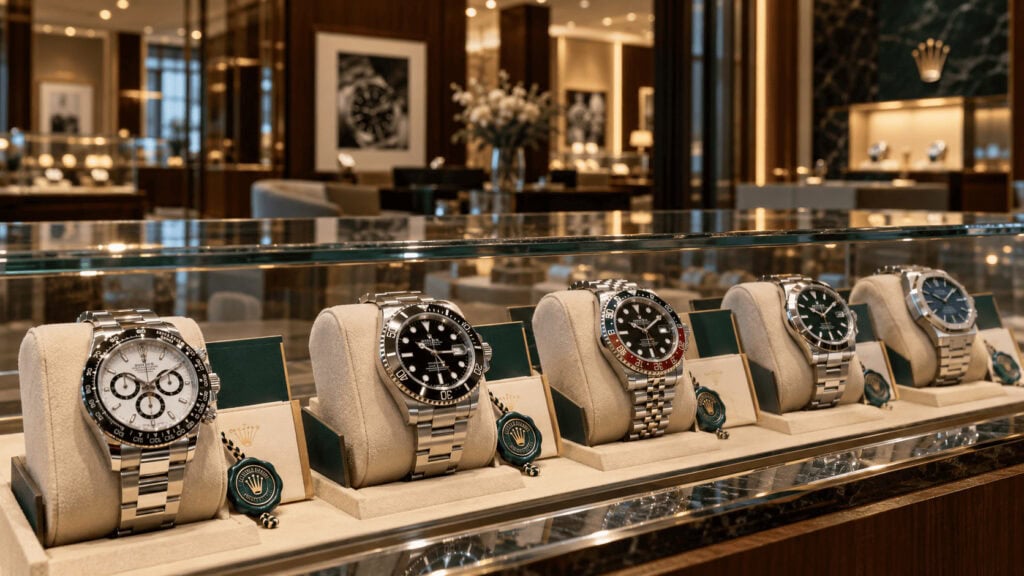
Walk into a Bucherer in Geneva or New York and you can buy a used Submariner in a Rolex box, with a Rolex seal and a Rolex guarantee card. You will pay close to a third more than a reputable independent dealer charges for the same reference a few blocks away.
Plenty of people pay it. Certified sales grew about 55% year over year last quarter, in a market where the uncertified version of the same watch is one click away on Chrono24.
The standard read is that Rolex muscled into its own secondary market to grab a cut and police the price. That is half right. Rolex built the price. It did not take the cut. Run the numbers on what the 30% actually buys and the program looks less like a resale business and more like a credential Rolex issues, prices through its dealers and then gives away.
In September we showed how Hermès watches lose 59% at resale while a pristine Rolex holds close to all of its value. That was a brand being graded by the secondary market. This is the brand that bought the grading booth.
What Happened
Morgan Stanley and WatchCharts published their second-quarter secondary market report in July, and WatchPro ran the headline figure: Rolex Certified Pre-Owned sales of $186 million in the quarter.
The pricing data is the more revealing part. The median certified listing worldwide carries a 30.2% premium over what non-certified dealers charge for the same reference in the same region. A quarter of listings sit at 41.6% or more. Three quarters sit at 18.8% or more.
The spread between retailers is wide:
- The 1916 Company, the cheapest of the big sellers: +18.7%
- Median across all certified listings: +30.2%
- Watches of Switzerland in the UK, the most expensive: +38.8%
At launch, first movers including Bucherer and Watches of Switzerland were charging close to 40%. So the premium is coming down, but slowly, and from a level that would get a used-car dealer laughed off the lot.
The network is still a minority club. Just 157 of Rolex’s 712 retailers take part, running 288 of its 1,334 doors, about 22% on both counts. Only 13 new partners have joined since January, three of them last quarter. The ones already in are selling more, though: the median participating retailer did about $899,000 of certified sales in the first half of 2026, against $578,000 a year earlier.
Underneath all of it sits a hot primary market. The same Morgan Stanley report found current-production Rolex models trading an average of 9.8% above retail across the five markets it tracks as of June 29, and 14.0% above in the United States. For a current reference at those averages, a certified example could list around 43% above the boutique price of a brand-new one. Most certified inventory is older and has no current list price, so treat that as an illustration rather than a typical receipt. It still explains why nobody in this channel discounts.
The Backstory
Rolex launched the program in December 2022 through Bucherer stores in Europe, then took it to the United States through Tourneau Bucherer the following spring, with Watches of Switzerland and The 1916 Company joining soon after. Watches had to be at least three years old, a rule widely read as a way to keep flippers from cycling new allocations straight into certified stock.
In 2023 Rolex agreed to buy Bucherer itself, more than 100 stores at the time, 53 of them selling Rolex, plus the Tourneau chain Bucherer had bought in 2018. Rolex said its relationships with other retailers would stay unchanged.
Then the program started to scale. WatchCharts puts 2025 certified sales at around $500 million, up about 60%. The fourth quarter alone came to about $172 million, roughly what Morgan Stanley estimates Breguet sells in a full year. In May 2025, Rolex cut the minimum age to two years, telling Hodinkee it was responding to growing demand for second-hand Rolex watches. That one change pulled an extra year of watches into the eligible pool.
Now set that next to what Rolex did with new watches. Morgan Stanley and LuxeConsult estimate Rolex’s 2025 sales at about CHF 11.0 billion, up 4%, on roughly 1.1 million watches. Volumes fell about 2%, the second straight annual decline, which the report says had not happened in more than 20 years.
Fewer new watches went into dealers. More certified used watches went out through the same doors. That is not a coincidence of timing. It is the same shelf being restocked from a different source.
The Plan
Rolex’s plan is easiest to see if you split the price of a certified watch into two parts: the watch, and the paper that comes with it.
Start with the quarter. If certified watches sold at the median listing premium, $186 million of second-quarter sales breaks down like this:
- The watch, at what non-certified dealers would charge: about $143 million
- The paper, meaning the certification premium on top: about $43 million
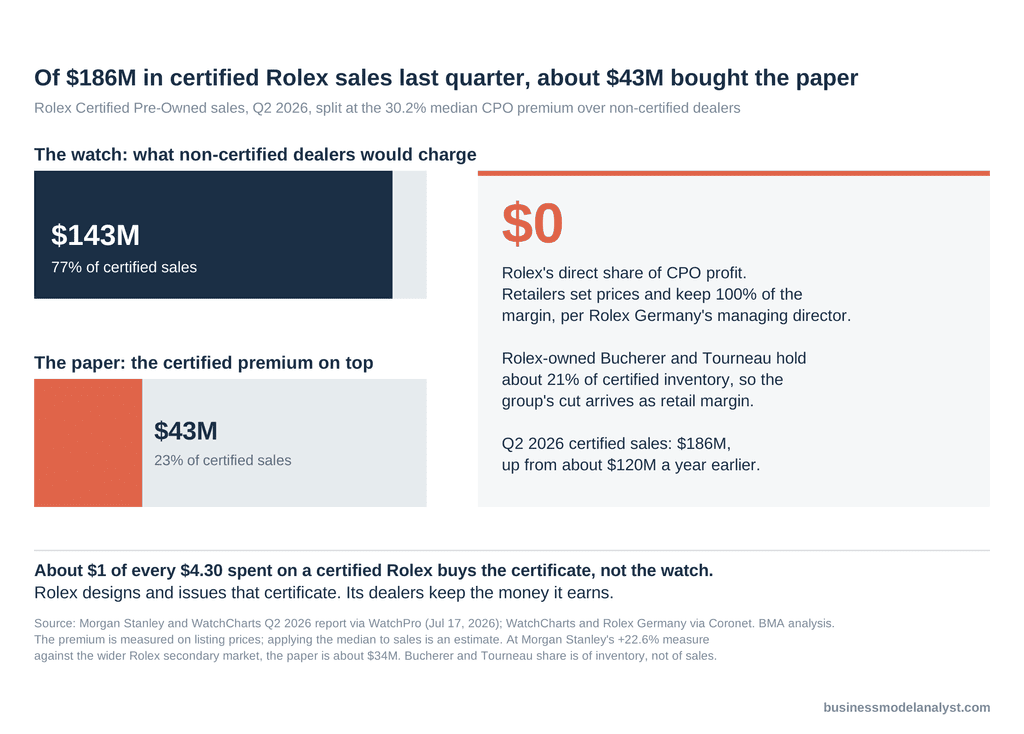
Use Morgan Stanley’s lower measure, a 22.6% median premium over the wider Rolex secondary market, and the paper comes out near $34 million. Either way, the certificate is a product doing somewhere around $140 million to $170 million a year at the current run rate. Nobody reports it as one.
Now one watch. EveryWatch, which tracks dealer and auction transactions, counted 393 certified Submariner 116610LN sales worth $6.40 million in the first half of 2026. That is about $16,285 per watch. At the median premium, roughly $3,780 of that price is the paper.
What does the paper contain? A full service at an official Rolex service center, which Bob’s Watches estimates at $800 to $1,600 for a standard model, since Rolex publishes no fixed menu. A two-year international guarantee. A seal, a guarantee card and official papers. And the one thing no independent dealer can supply: Rolex’s own name on the statement that the watch is real.
So the paper sells for roughly 2.4 to 4.7 times the service inside it. The remaining $2,200 to $3,000 or so buys the guarantee and the authentication. That gap is the price of trust, and only one company is allowed to print it.
Here is the twist. Rolex does not collect it. Rémi Corpataux, managing director of Rolex Germany, has confirmed that the brand earns nothing on certified sales, and Rolex says retailers will keep 100% of the profit. Retailers also set their own prices. Rolex’s only route to the markup is through the stores it owns: Bucherer and Tourneau together hold about 21% of global certified inventory, according to WatchCharts. If their share of sales tracks their share of stock, about $9 million of the second quarter’s paper landed inside the Rolex group, as retail margin, not as brand revenue.
The Business Model Angle
A certificate is a toll you can hand to someone else. Rolex designs the standard, controls who may issue it and lets dealers keep the fee. That works as dealer compensation that never touches the wholesale price list, and it arrived in the same two years Rolex cut the number of new watches it ships. A retailer with a thinner allocation still has something premium to sell. It is the take rate logic run in reverse: the platform sets the rate and declines to keep it, because what it wants is the behavior the rate produces.
The floor is built by warehousing, not by a price. Rolex has never published a minimum resale price, and the certified tier sits above the market rather than under it. What the program does is give retailers a reason to take trade-ins and hold them at a premium instead of wholesaling them to gray dealers. WatchCharts has counted more than 10,000 watches in certified inventory. Every one of those is a watch not being dumped onto the open market in a soft quarter. The floor comes from that absorbed supply, which is a more durable mechanism than any price rule, and harder to call price fixing.
The size of the spread tells you what the market thinks uncertified supply is worth. aBlogtoWatch has noted that certified used cars carry a premium of about 1.8% over uncertified ones. Rolex’s median is 30.2%. Cars come with VIN histories, inspection reports and title records, so certification adds little. Watches come with counterfeits good enough to fool dealers, so certification adds a lot. If your product has a liquid resale market and a forgery problem, the authentication is a product in its own right. Lululemon sets a price on its own store credit; Rolex sets a price on its own word.
The Risk
Four arguments cut against this reading, and the first is already showing up in the data.
The premium is shrinking as the program grows. It was near 40% at launch and is about 30% now, and WatchCharts has said it expects average premiums to keep falling if the program is to reach real scale. Rolex helped that along itself by opening eligibility to two-year-old watches. More certified supply means more competition between certified sellers, and the paper’s price is the first thing that compresses.
The program competes with new Rolex sales, and Rolex earns nothing on the substitute. Coronet, which covers Rolex closely, has reported that customers increasingly buy certified watches when they walk into Rolex boutiques instead of new models. Every certified sale that replaces a new one moves margin from Geneva to the dealer. That is fine while new watches are scarce. It looks different in a year when Rolex wants volume back.
The numbers are softer than they look. The premium is measured on listing prices, not completed sales, and a median says nothing about the average. Certified inventory has historically skewed toward watches made between 1990 and 2010, which makes comparisons with current models shaky. Even the size of the market is disputed: EveryWatch puts first-half 2026 certified sales at $385.4 million, WatchCharts at $330 million. Our $43 million is an estimate built on the median, and the honest range is wide.
Most dealers have not been convinced. Nearly four in five Rolex retailers stay out, and the pace of new joiners has slowed to a trickle. Servicing every watch before sale is expensive and slow. The 1916 Company’s chief executive, John Shmerler, said this summer that the program had taken an enormous commitment, and the company opened its own Rolex-accredited service center to keep up. A paper worth $3,780 to the buyer is worth less to a retailer once the cost of producing it is counted, and that cost does not show up in anyone’s premium data.
Quick Questions
Does Rolex set the prices of certified pre-owned watches? No. Rolex says participating retailers set their own prices and keep the profit. It controls eligibility, servicing standards and the certificate itself.
How old does a watch have to be? At least two years since May 2025. Before that, the minimum was three years.
What comes with a certified Rolex? A Rolex Certified Pre-Owned seal, a two-year international guarantee card, a service booklet and official papers. Each watch is serviced and checked to Rolex standards before sale.
Is a certified Rolex cheaper than a new one? Not always. Current-production Rolex models traded about 9.8% above retail in Morgan Stanley’s June snapshot, so a certified example of a popular model can cost more than the boutique price of a new one, if a new one is available at all.
How many stores sell them? About 288 doors at 157 retailers, roughly 22% of the Rolex network, mostly in Europe and the United States.
The Business Model Analyst Take
Most luxury houses are still arguing about whether resale steals from them. Rolex settled it by turning resale into a credential and pricing the credential at about 30%.
The clever part is what it did next. It let the dealers keep the money. That buys their loyalty in a period of shrinking allocations, it pays them to hold used supply off the open market, and it keeps the most valuable asset in the program, the right to say what is real, firmly in Geneva. The fee is a rounding error next to CHF 11 billion of sales. The control is not.
Set it beside the rest of the season’s luxury stories. Prada counts what its best customers spend per euro of hospitality. Hermès watches show what happens when the resale market grades you without asking. Rolex skipped both problems by deciding what the grade would be.
Founders can take one test from this without owning a single watch factory. Ask what your customers pay to be sure, not what they pay for the thing. If that number is large and nobody is collecting it, someone eventually will. Better that it is you, even if you then decide to give it away.