
Robinhood’s first underwriting job pays almost nothing. What it buys is a seat where allocation gets decided, and a list bigger than the company selling the stock.
Robinhood is listed 18th and last on Oura’s IPO filing. At that position in a syndicate, the fee is a rounding error. The reason to take the job anyway is that Robinhood’s 28.4 million funded customers are 5.7 times the size of Oura’s entire global paid membership, and the two groups are roughly the same age. The shares are the medium of exchange here. Customers are the product.
Smart-ring maker Oura filed its S-1 on September 3, 2026, for a Nasdaq listing under the ticker OURA. Goldman Sachs, Morgan Stanley, JPMorgan, Allen & Co. and Jefferies are the lead bookrunners, which means they do most of the work and take most of the money. Then there are twelve more names. Then there is Robinhood.
The Wall Street Journal read that placement as a foot in the door for a retail broker with ambitions. That is true, and it is also the smaller half of the story. The bigger half is what each side is actually trading, and it is not underwriting services.
What Happened
Robinhood Securities got regulatory clearance to act as an underwriter on June 9, 2026. Vlad Tenev announced it on X, said the firm intended to be disruptive, and framed the shift in a sentence worth holding onto: the industry question had moved from why allocate to retail at all, to “how big can the allocation be?”
Three months later the first credit line arrived, on a deal Oura has not yet priced. The company has disclosed neither a share count nor a range. The Journal put the expected value north of $11 billion; Bloomberg has reported a raise of up to $3 billion at more than $16 billion. Whether either number survives contact with public markets is the argument we ran when Oura and Whoop first lined up to list, with Fitbit as the cautionary comparison. Either way it is a large consumer listing landing in what is shaping up to be the busiest IPO year on record, with Anthropic expected within weeks and OpenAI possibly behind it.
The numbers underneath are good. Oura reported $1.21 billion in revenue for the nine months ended June 30, 2026, up 74% year over year, with 5 million paid members. Hardware is roughly 80% of revenue and membership about 20%, but membership carries an 89% gross margin, and the company generated about $328 million in operating cash flow over those nine months. This is not a company that needs Robinhood’s balance sheet.
It needs Robinhood’s address book.
The Backstory
The detail almost every write-up skipped is that Robinhood was already distributing IPO shares. IPO Access launched in 2021 and has been handing allocations to app users ever since. What it held was selling-group membership, which lets a broker pass along shares that somebody else priced and allocated.
Underwriter status is a different legal object. It puts the firm inside the syndicate that negotiates terms with the issuer, and it puts the firm’s name on the registration statement. Under Section 11 of the Securities Act, underwriters sit among the parties who can be sued over material misstatements or omissions in that document, with due diligence as the statutory defense. Section 11(e) generally caps any one underwriter’s exposure at the total offering price of the securities it underwrote.
Read those two facts together and Tenev’s line inverts. “How big can the allocation be” is also “how big can the liability be,” because the statute sizes one off the other. Every incremental share Robinhood pulls toward its customers is an incremental dollar of its own statutory ceiling. That is the actual price of the seat, and it is not the fee split.
Robinhood signed up for it two weeks after a proposed class action landed on Oura. The complaint, filed August 20 in California by Clarkson Law Firm on behalf of a buyer who paid $513.68 for a ring, alleges the device cannot support its advertised sleep-stage accuracy. It names both Oura Inc. and Finnish parent Oura Health Oy, runs to seven counts including fraud by misrepresentation, and targets a specific marketing claim of 95% sleep staging accuracy against a clinical sleep lab. Oura’s response was flat: “We dispute the allegations in this complaint.”
There is a structural irony here. Oura’s own boilerplate says the ring is not a medical device, a classification the industry lobbied hard to keep and which carries real commercial consequences. Staying outside the medical-device definition avoids the FDA. It does not avoid California consumer protection law, which is where this complaint was filed. The disputed claim is the one that sells the hardware, and hardware is 80% of revenue. Whether it belongs in the risk factors is now somebody’s diligence problem. As of this month, partly Robinhood’s.
The Plan
So why take it. Because Robinhood is not running an underwriting business. It is running a customer business, and IPO access is one of its better retention products.
The Q2 2026 numbers show what that business earns. Funded customers reached 28.4 million, up 7% year over year, with total platform assets up 32% to $369 billion. Revenue was $1.308 billion, average revenue per user rose 24% to $187, and Gold subscribers grew 39% to 4.84 million. Gold adoption sits at 17% overall, and roughly 40% of new funded customers signed up for it during the quarter.
Order flow, net interest and subscriptions are where the money actually comes from, and every one of those lines scales with funded customers who stay engaged. That is the machine an IPO allocation feeds. Not the fee. The fee is slot 18. The allocation is what makes a Gold subscription feel worth $5 a month, and Gold is the line growing 39%.
Now flip to Oura’s side of the table, because this is where it gets interesting. The Journal reports that Oura sees Robinhood’s investor base as prospective customers, and it is not a throwaway. Per the S-1, about a third of Oura’s new members say it is their first wearable, and another 29% say it replaced one they already had. The company grows by recruiting people who were not already wearing anything. Oura says 42% of its members are 30 to 45 and 31% are under 29. Robinhood’s median customer age was 35.
Same people. One list is 5.7 times the size of the other.
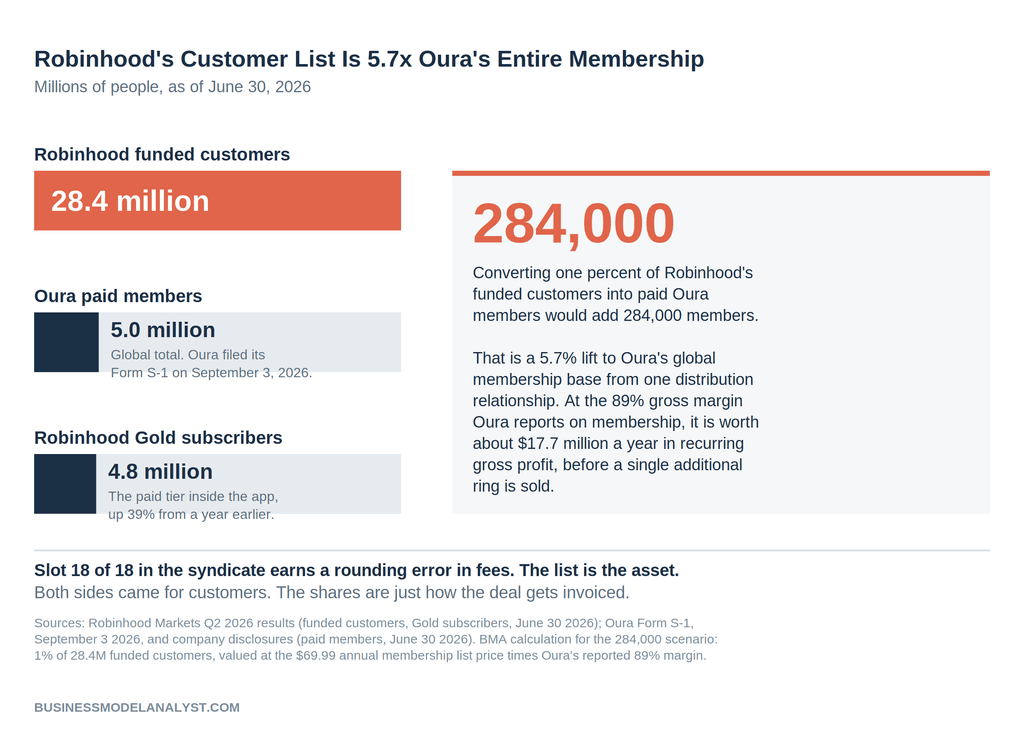
Run the conversion. One percent of 28.4 million funded customers is 284,000 people. At the $69.99 annual membership price and the 89% gross margin Oura reports on that line, those members carry about $17.7 million a year in recurring gross profit, and they lift the global paid base by 5.7%. Before a single ring ships.
One percent is a made-up conversion rate and should be read as a scaling exercise, not a forecast. The ratio is the point. A distribution relationship that reaches a pool nearly six times your existing customer base is worth more to a consumer subscription company than any underwriting fee is worth to a broker sitting last on the cover.
The Business Model Angle
A license can be a procurement contract. Robinhood did not buy a revenue line, it bought purchasing rights. Underwriter status is the credential that gets it into the room where allocation is decided for a product its customers want and it cannot otherwise source. Read new licenses, charters and registrations by what they let you buy, not by what they let you bill.
When the shareholder and the customer are the same person, the cap table becomes a channel. Oura’s members skew 30 to 45. So do Robinhood’s investors. For any consumer brand with a subscription attached, the IPO stops being purely a financing event and starts being the largest paid-media placement of the year, with the added feature that the audience has already funded an account. Expect more consumer issuers to weight syndicate seats by audience overlap rather than league-table rank.
Price the liability, not the fee. The economics of slot 18 are trivial and the Section 11 exposure is not. Any firm entering a regulated distribution role should underwrite the statutory obligation first and the revenue second, because the obligation scales with volume while the fee is set by position. This is the same lesson from the other direction as the finfluencer channel, where the regulated firm carries the supervisory burden its unlicensed partners do not.
The Risk
Start with the strongest objection, which the Journal gets from Georgetown’s Reena Aggarwal: bulge-bracket banks are not threatened, and the money involved on the retail side stays small. She is right on the immediate arithmetic. Purdue’s Jeremy Michels puts the structural version more usefully, describing retail as “the residual claimant of whatever shares are left” and wondering aloud whether Robinhood changes that. Wondering is the honest posture. Nothing in a syndicate seat obliges the leads to hand over shares.
The demand evidence cuts against optimism too. When SpaceX listed this summer, individual investors requested roughly $100 billion of stock. They got about 20%, more than the usual allocation, and the complaints on launch day were loud anyway. Position 18 does not fix a shortage of that magnitude. It gets you into the negotiation.
Then there is the uncomfortable precedent. The last company to hand retail a genuinely oversized slice was Robinhood itself, allocating about 25% of its 2021 IPO against a typical 10%, with more than 300,000 users participating in a deal that raised roughly $2 billion at a $32 billion valuation. Retail-heavy allocation is not automatically a gift to the people who receive it. Sometimes it is a way of distributing shares that institutions priced carefully and wanted less of.
And the conflicts deserve a plain reading rather than an accusation. Robinhood Ventures Fund I, the closed-end vehicle Robinhood launched in March, holds Oura at 3.64% of the fund. The fund raised $658.4 million at its own IPO, which puts the stake near $24 million on that basis, though private positions are marked quarterly and the current number will differ. Goldman was sole bookrunner on that offering, six months before Robinhood joined Goldman on this one. Add a former Robinhood CFO, Jason Warnick, sitting on Oura’s board, and a Robinhood Gold Card that originally bundled a complimentary Oura membership before swapping it for rival Whoop.
None of that is improper and all of it is disclosed. But it means Robinhood is simultaneously a pre-IPO holder through a fund it manages and charges fees on, a member of the syndicate that will price the offering, and the broker selling the shares to retail buyers who may also own the fund. Three roles, one security. Investors are entitled to notice which hat is speaking.
Quick Questions
Does underwriter status guarantee Robinhood more shares for its users? No. It gets Robinhood into the room where allocations are negotiated. Lead bookrunners still control the book.
What does slot 18 actually pay? Very little. Gross spreads on large offerings are thin and the lead-left banks take the overwhelming majority. Oura has not disclosed the spread, and will not until it prices.
Is being an underwriter riskier than being a selling-group member? Materially, yes. Underwriters are named in the registration statement and carry Section 11 exposure with a due-diligence defense. Selling-group members do not occupy the same position.
Why would Oura care about Robinhood’s users? Because a third of Oura’s new members are buying their first wearable, and Robinhood’s base skews to exactly the ages Oura already sells to. It is a customer list, not just a share-distribution channel.
Does the sleep-accuracy lawsuit threaten the IPO? It is a proposed class action, not a judgment. Oura disputes it. It does, however, sit squarely inside the diligence every underwriter on the cover now owns.
The Business Model Analyst Take
The interesting thing about this deal is not that a retail broker crashed the party. It is that both sides showed up for the same thing and neither one came for the securities.
Robinhood wants allocation because allocation retains customers worth $187 a year and pushes them into a $5 subscription that is growing 39%. Oura wants Robinhood because 28.4 million investors clustered around age 35 are the best ring-buying list in America and a third of its new members have never worn a wearable before. The stock is what they use to settle up. Somebody will eventually write the fee check, and it will be the least consequential number in the transaction.
That is the shift worth tracking, and it generalizes well past smart rings. When an issuer’s shareholders and its customers are the same cohort, the syndicate stops being a pure capital-markets construct and starts behaving like a media buy with a settlement date. The league table ranks banks by dollars raised. It has no column for audience overlap. For a company like Oura, that missing column may be the only one that matters, and the firm sitting 18th of 18 is the only name on the page that fills it.
Wall Street sold Oura a listing. Robinhood sold it a demographic. Only one of those is priced.
Reporting: The Wall Street Journal (Jasmine Li and Hannah Erin Lang, September 7, 2026), Oura’s Form S-1 filed September 3, 2026, Robinhood Markets Q2 2026 results, Robinhood Ventures Fund I offering materials, and court filings in the Northern District of California.