
Reckitt didn’t rent China’s influencer machine. It bought the hour outright, and the hour turned out to be the asset.
Reckitt, the company behind Lysol, Dettol, Durex and Veet, runs 18 livestream studios outside Shanghai that broadcast for 12 hours a day, and many of the hosts are its own employees. China has now delivered 12 straight quarters of double-digit growth for the company. The under-told part is the cost structure: in Chinese live commerce a brand can rent an influencer’s audience for a commission of roughly 20% to 30%, or it can put the host on payroll. Reckitt chose payroll, and that only pays off at volume, which is exactly why the cameras never switch off.
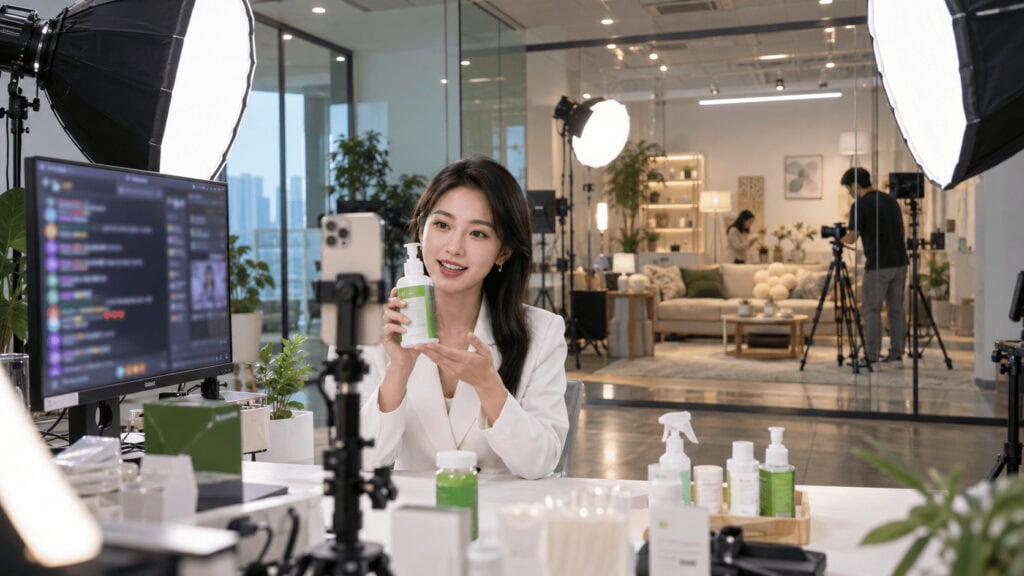
Picture a woman at a white desk on the edge of Shanghai, ring lights blazing, holding up a bottle of Dettol while a chat window scrolls faster than anyone can read. She is not a celebrity. A few years ago she might have been answering customer-service emails about what is in the disinfectant. Now she answers the same questions live, in front of whoever the algorithm sends, and a team in the next room swaps the featured product in real time depending on what the comments ask for.
The coverage of this story frames it as a Western brand cracking China’s social commerce boom while Starbucks, LVMH and Nike stumble. That is true, and it is the less interesting half. The interesting half is a make-or-buy decision about attention, and Reckitt made the call the influencer economy was built to prevent.
What Happened
The Wall Street Journal reported on October 10, 2026 that Reckitt’s China team went to CEO Kris Licht around 2022 asking for money to chase a shift in how people buy household staples. Licht assumed they meant China’s versions of Amazon and Walmart+. He told the paper he was informed that e-commerce was “a yesterday technology.” The thing to chase was social commerce, where people scrolling for entertainment end up buying.
The team first tried to hire influencers and agencies and could not find the right experience, so staff did it themselves. The first studio was a converted conference room where customer-service employees explained the chemistry of disinfectants on camera.
That conference room became a five-story building with 18 studios. Some run live shopping streams for 12 hours a day, with hosts fielding a flood of chat questions and a monitoring team steering which products get airtime. Others shoot short skits and mini-dramas, often under a minute long, built around domestic life. In one, a parent and a teenager fight about smelly shoes and Dettol settles the argument.
The output, per Reckitt:
- 15 billion views of its short-form videos last year
- 40 million new customers attributed to that short-form team
- 12 consecutive quarters of double-digit growth in China, confirmed again on the company’s July 29 results call
- Replication underway in Brazil, Mexico and Malaysia
Divide the first two and you get the number nobody ran: one new customer for every 375 video views, a conversion rate of about 0.27%.
Then set the attention against the country. About 800 million Chinese use apps like Douyin and Kuaishou every day, for roughly 90 minutes by Reckitt’s estimate, which is about 1.2 billion hours of scrolling a day, or roughly 438 billion hours a year. Fifteen billion videos that mostly run under a minute add up to, at most, about 250 million hours. That is under 0.06% of a year’s scroll, or about five hours of one ordinary day in China. Reckitt bought 40 million customers with a sliver of attention so thin it barely registers.
The Backstory
To see why the host’s employment status matters, you need the old model.
China’s livestream boom was built on superstars. A handful of hosts could move hundreds of millions of yuan in an evening, and brands paid for the privilege in three currencies at once. There was a slot fee to get a product into the show, often ¥20,000 to ¥40,000 per product link according to China-market agency WalktheChat. There was a commission on sales, commonly 20% to 30% in beauty and home categories. And there was usually a demand for the lowest price anywhere online, which turned the brand’s list price into a negotiating position the brand did not control.
One agency executive described a pitch to the trade site PARKLU in which a top streamer asked for a $20,000 base fee, a 30% commission and a 75% discount for a five-minute slot. The brand needed 17,000 units sold just to break even.
Then the superstar era cracked. Viya, once the biggest host in China, was fined about ¥1.34 billion for tax evasion in December 2021 and disappeared from the platforms. Austin Li, the “Lipstick King,” took a public beating in 2023 after snapping at viewers who complained about the price of an eyebrow pencil. Platforms got nervous about concentration risk in a handful of personalities and started steering traffic toward merchants.
The result shows up in Douyin’s own mix. According to an informed source cited by 36Kr, shelf-style shopping (search, store pages and the Douyin mall) made up over 40% of Douyin e-commerce sales in 2024. Store-hosted live broadcasts, meaning brands and merchants running their own rooms, made up slightly more than 30%. Influencer live broadcasts made up the remaining 30% or so, and only about 9% came from influencers with more than a million followers.

Read that slowly. The tier that defined Chinese live commerce in every Western trend piece carried under a tenth of Douyin’s sales in 2024. Brand-run rooms carry more than three times as much, and roughly as much as every influencer on the platform combined. In March 2025 Douyin announced nine measures to support smaller merchants, including fee cuts and algorithm changes, so the platform itself is pushing in the same direction.
Reckitt did not invent the brand-run room. It scaled it harder than most foreign companies did.
The Plan
Reckitt’s machine has three parts, and each one replaces something it used to rent.
The live rooms replace the influencer. A host on salary does what a top streamer did, minus the slot fee, the commission and the lowest-price clause. The price on screen is the price Reckitt chose.
The skits replace the ad agency. Sub-one-minute dramas shot in-house with staff and guest actors feed the algorithm a constant supply of creative, which is the raw material short-video platforms rank on.
The monitoring desk replaces the merchandiser. A team watching the comments in real time decides which product the host should pick up next. That is the job a store planogram does in a supermarket, compressed from a quarterly reset to a few seconds.
Now the make-or-buy arithmetic, built from published industry figures rather than anything Reckitt discloses.
Jiaogeyou, the livestream agency behind Luo Yonghao’s room, told the Chinese media outlet Newrank in 2022 that most of its hosts cost ¥150 to ¥300 an hour once salaries and bonuses are converted to an hourly rate. Take the top of that range, ¥300, and set it against a 25% influencer commission, the middle of the 20% to 30% band. One host pays for herself once her room sells more than ¥1,200 an hour.
A real room needs more than a host: an assistant host, someone controlling the stream, an operator and someone buying traffic. Multiply the host’s cost by five to staff the whole room, which overstates it because support roles earn less, and the break-even rises to ¥6,000 an hour. Over a 12-hour broadcast day that is ¥72,000, or about ¥26 million a year per room.
Below that line, renting an influencer is cheaper. Above it, every extra yuan of sales keeps 25 fen that would have gone to someone else’s commission, before counting the slot fees that never get paid and the discounts that never get demanded.
That is why the 12-hour day matters. A commission is a variable cost: it scales down to zero when sales stop. A studio, a crew and a salaried host are fixed costs. The only way a fixed cost beats a variable one is utilization. Reckitt is running its studios the way a factory runs shifts, because the economics are the same.
The financial results are consistent with a company that kept control of its price. Emerging markets, where China sits, grew like-for-like revenue 8.5% in the first half of 2026 and 9.4% in the second quarter, and the region’s adjusted operating margin rose 150 basis points to 21.4%. Europe fell 3% over the half, and North America edged up 0.8%. Emerging markets now generate 44% of Core Reckitt’s sales.
Reckitt does not break out China’s revenue, so the floor is the most anyone outside can say: twelve quarters at 10% or more compound to at least 1.33 times the starting level. A business that size, growing that fast, in a market where Western consumer brands are mostly shrinking, is worth an 18-studio building.
The Business Model Angle
Attention has a make-or-buy line. Small sellers should rent hosts on commission because they cannot fill a schedule. Scaled brands should hire, because past the crossover the commission becomes the most expensive line in their marketing budget. The same split shows up in the US, where TikTok grows live hours by recruiting sellers to supply them for free. Reckitt is what the far end of that curve looks like: a seller big enough to own the hour instead of donating it.
Customer service is now a distribution channel. Reckitt’s first hosts were the people who already knew what was in the bottle. For products where the buyer’s questions are about chemistry, dosage or safety, which covers disinfectant, condoms and vitamins, the most credible host is the manufacturer. Any company with a knowledgeable support team is sitting on a content operation it is paying for as a cost center.
Owning the room means owning the price. A marketplace take rate is a fee you can model. An influencer’s lowest-price clause is a fee you cannot, because it shows up as a permanently lower reference price in the shopper’s head. By hosting itself, Reckitt removed the one cost in Chinese live commerce that compounded against the brand.
The Risk
The cost did not vanish. Some of it moved. A brand-run room has no audience of its own on day one, so it has to buy traffic from the platform’s ad system to fill the room, and Reckitt does not disclose what it spends there. The influencer took a commission. The platform takes an ad budget. If Douyin decides to raise the price of traffic to merchant rooms, the landlord simply changes from a celebrity to an algorithm. The break-even math above deliberately leaves paid traffic out on both sides, and it is the biggest unknown in the whole model.
The outlier framing is also weaker than it looks. Procter & Gamble, Reckitt’s most direct rival in household and personal care, grew Greater China organic sales 5% and then 3% in the first two quarters of its 2026 fiscal year, with baby care growing double digits for six straight quarters. The struggling names in the Journal’s list are coffee, luxury and sneakers. Health and hygiene staples may be holding up in China across the board, which makes the studios one cause among several rather than the whole story.
Reckitt’s own explanation points elsewhere too. The company credits China’s growth to Dettol Activ Botany, a new body wash range, and to its vitamins and supplements portfolio. That is product innovation. From outside, nobody can separate how much of the growth is the new product and how much is the new way of selling it.
There is concentration risk inside the portfolio as well. Durex, historically one of Reckitt’s strongest China brands, was flat in the first quarter after China applied a 13% value-added tax to condoms and contraceptive pills. A single policy change can erase a brand’s growth regardless of how good the livestream is.
And the human studio may be a transitional asset. As we noted in our look at US live shopping, Chinese platforms already offer AI digital hosts at a fraction of a human host’s cost. If an avatar can run the 3 a.m. shift, the fixed cost Reckitt built becomes cheaper for everyone, and the advantage of owning it shrinks.
Exporting the playbook is its own test. TikTok Shop only launched in Mexico in February 2025 and in Brazil in May 2025. Twelve hours of broadcasting needs an audience that already buys inside the feed, and outside China that habit is young. As our math on Whatnot’s real fees and a Nebraska coin dealer’s 177-hour stream showed, Western live commerce still runs on sellers grinding out hours for thin returns.
Here is the condition that would break this piece: if Reckitt’s China growth holds while it cuts studio headcount, the asset was never the people, it was the room’s standing in the algorithm. If growth stalls the moment Douyin raises traffic prices, the asset was rented all along.
Quick Questions
What is social commerce in China? Social commerce is buying directly inside social and short-video apps such as Douyin and Kuaishou, usually after watching a livestream or a short video, without leaving the app. About 800 million Chinese use these apps daily, for roughly 90 minutes by Reckitt’s estimate, and about half of them have bought something there.
Is Lysol sold in China? Reckitt sells Dettol in China, which it describes as Lysol’s international equivalent. Both are germ-protection brands from the same company. Reckitt also owns Durex, Veet, Finish, Mucinex and Strepsils.
How much do Chinese livestream influencers charge brands? Top hosts commonly combine a slot fee, often ¥20,000 to ¥40,000 per product, with a 20% to 30% commission in beauty and home categories, plus pressure for the lowest price anywhere online. Mid-tier and smaller influencers usually work on commission alone.
What is a brand-run livestream? A brand-run or store-hosted livestream is a broadcast produced by the brand itself, with hosts on its payroll, rather than an appearance on an influencer’s channel. On Douyin these rooms made up slightly more than 30% of e-commerce sales in 2024, according to a source cited by 36Kr.
Why are Western brands struggling in China? Many are losing share to local competitors and adjusting to slower growth, and some have changed who owns the China business entirely. As we found in our analysis of KFC and Yum! Brands, the reported numbers often reflect ownership structure as much as demand.
The Business Model Analyst Take
Every Western trend piece on Chinese live commerce for five years has been about the superstar who sold a billion yuan of lipstick in a night. The superstar now carries about a tenth of the biggest platform’s sales, and the room that replaced her looks a lot like a customer-service department with good lighting.
Reckitt’s real decision was not “go social.” It was to treat the hour of attention as a capital asset instead of a rental. Rent the hour and you pay a toll on every sale, forever, at a price someone else sets. Own the hour and you pay a fixed bill that only makes sense if you run it all day, every day.
That choice is available to any brand with enough volume and enough expertise to put on camera. The question for founders is not whether to do livestreaming. It is where your crossover line sits, and whether you are already past it while still paying someone else’s commission.