
The hand-off to the second screen is not a design compromise. It is the measurement, and measurement is what lets Amazon price a television ad like a search ad.
Amazon announced a set of Prime Video shopping features on September 10 2026: a Shop tab inside X-Ray, a visual search mode called Shop the Scene, and an expansion of Shop the Show from 1,300 titles to more than 8,000 in the US. None of them completes a purchase on the television. Every path ends in the Amazon Shopping app on a phone, where the login, the saved card and the purchase record already sit. That routing is not a limitation of the feature. It is the feature.
Amazon’s advertising line booked $19.8 billion in the second quarter of 2026, up 26% year over year. On the earnings call the company said Sponsored Products remained the largest contributor to that growth. Sponsored Products is the small ad beside a search result, and it performs because the shopper already typed what they wanted.
Prime Video sits on the other side of the same building. Amazon Ads puts its average monthly ad-supported reach above 315 million viewers globally. Almost none of that inventory sells on performance terms. It sells impressions, priced by the thousand, billed whether or not anything happens next.
The distance between those two businesses is the entire reason Shop the Scene exists.
What Happened
The X-Ray path works the way X-Ray always has. Pause the show, press up on the Fire TV remote, and a new Shop tab appears alongside the actor bios and soundtrack listings. To actually buy, you open the Amazon Shopping app, which recognizes what is playing and drops you into a feed synced to that moment.
Shop the Scene is the genuinely new piece. Tap the image in the app and Amazon Lens, the company’s visual search technology, identifies products inspired by what is on screen: the character’s jacket, the lamp behind her, the rug. It is live now on iOS and Android in the US across more than 600 titles.
Shop the Show, launched last year, gets the volume upgrade. It went from 1,300 titles to more than 8,000, covering Prime Originals, licensed titles and live sports, and it no longer requires typing “shop the show” into the app. Opening the app while something is playing is enough.
Two numbers are worth holding onto. The shoppable catalog grew 6.2 times. The Lens-powered scene search covers 600 titles, which is 7.5% of it.
Amazon is upfront about the limits. Lens will not always find an exact match, because characters wear high-end brands and handmade costumes that Amazon and its sellers do not stock. TechCrunch describes the result as “a jumping-off point for finding products” that get you a similar look.
Hold that sentence. We come back to it.
The Backstory
Shoppable television has been announced roughly once a year since 2013 and has never worked. YouTube has offered creators a merch shelf for years and sells shoppable connected TV ads. Peacock launched Must ShopTV in 2023. Roku shipped remote-based checkout with Shopify merchants the same year. Disney has run shoppable formats across Disney+, Hulu and ESPN.
Every one of them hit the same wall. A television is a terrible place to enter a credit card, and the company running the show usually did not own the store on the other end. Roku had to borrow Shopify’s merchants. Peacock had to borrow everyone’s.
Amazon owns the store. It also owns the operating system on the Fire TV stick, the streaming service, the ad exchange, the payment credential and the shipping address. That stack is the only reason this attempt is different, and it has nothing to do with the interface.
There is a second history running underneath. Putting products inside content is already a large business: PQ Media sized global product placement near $33 billion in 2024 and forecast US placement across television, film and music at $23.5 billion by 2026, with television taking roughly three quarters of the US total. Placement pays the production, buys the frame, and tells the brand almost nothing about what happened afterward. A brand that put a blender on a kitchen counter in a hit show has never been able to count the blenders.
The Plan
Look at where Amazon put each half of the experience and the strategy reads straight off the page.
The television is the display surface. It shows the Shop tab, the product list, the scene. It sells nothing.
The phone is the transaction surface, and Amazon needs it for two reasons. The obvious one is friction: the credential, the address and the one-click flow already live there. The second one is the actual point. The phone is where Amazon’s purchase record lives. Same account, same session, same device graph. When the impression happens on the TV and the order happens in the app, Amazon can write both to the same row.
That row is what a television advertiser has never had. It is why the second screen is not a fallback. Building checkout into the Fire TV interface would have been easier and would have produced a worse asset.
The 600-versus-8,000 gap says something too. If the constraint were computer vision, it would not exist, because visual search scales to any frame Amazon can decode. The constraint is per-title work and per-title rights: someone has to clear, map and merchandise each show. Amazon expanded the cheap surface six-fold and the expensive one to 600.
The Business Model Angle
Here is the arithmetic nobody ran.
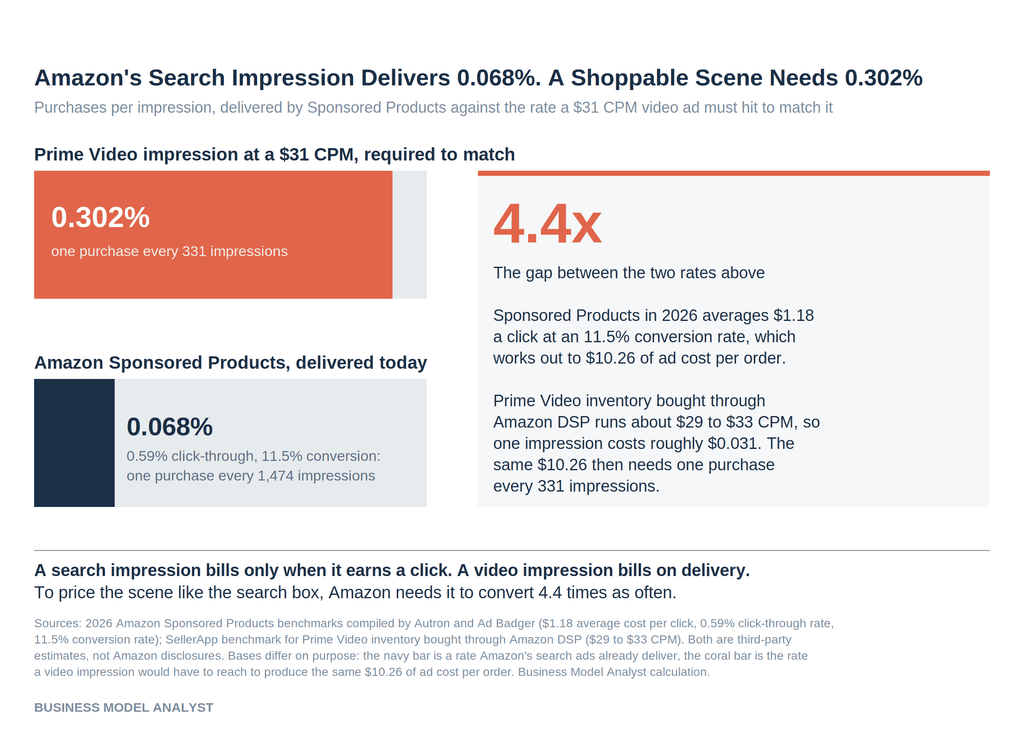
Third-party benchmarks compiled for 2026 put Amazon Sponsored Products at roughly $1.18 per click, a 0.59% click-through rate and an 11.5% conversion rate. Multiply the last two and a search impression turns into a purchase 0.068% of the time, or once every 1,474 impressions. Divide the click price by the conversion rate and each order costs about $10.26 in advertising. Now flip the click price into an impression price: $1.18 times 0.59% is an effective CPM of about $7, and Amazon only bills when the click happens.
Prime Video inventory bought through Amazon DSP runs around $29 to $33 CPM on the same third-party benchmarks. Take the midpoint and one impression costs roughly $0.031, billed on delivery. For that impression to produce the same $10.26 of ad cost per order, it has to convert once every 331 impressions, a rate of 0.302%.
That is 4.4 times the rate the search box delivers, demanded of a viewer on a couch who has to pick up a second device. Which gives us the three implications.
Attribution is the repricing lever, not the shopping cart. Amazon is not trying to make couch commerce a revenue line on its own. It is trying to move video inventory from the CPM shelf to the performance shelf, and the only thing standing between those two shelves is a verifiable link between the impression and the order. Every feature announced this week builds that link. Retail media pays for exactly this kind of plumbing: at Target the advertising line stays under 1% of net sales while supplying more than a fifth of operating income.
A scene query arrives with no words attached. Search advertising captures stated intent, which constrains what a platform can serve: type “running shoes” and the results have to be running shoes. A viewer tapping a frame has stated nothing. Amazon decides what the query was, and the “will not always find an exact match” caveat is the commercial core of the product rather than an apology for it. When there is no correct answer, ranking is entirely the platform’s to set, and Amazon has more than a million brands and sellers who will bid for the slot. Every frame in 8,000 titles becomes another shelf the platform can charge for, and the FTC is already litigating what happens inside that auction.
Placement buys the frame. Lens monetizes the traffic the frame creates. A brand pays a production for the blender on the counter. The viewer taps the blender. Amazon Lens returns a ranked set of blenders, and the one that paid for the placement has no structural claim on the top slot. Two decades of placement economics were built on owning the moment of attention. This splits the moment of attention from the moment of purchase and puts the second one in an auction the placement buyer never entered.
The Risk
The strongest objection is that the arithmetic above measures the wrong thing, and it deserves full weight.
Nobody buys CTV inventory expecting search-grade conversion, and no advertiser is asking a Prime Video impression to pay for itself in one hop. SellerApp’s benchmark work found that 36.5% of DSP-attributed purchases come from shoppers who had never bought that brand on Amazon before, which is precisely the job the format is hired for. Reach against new buyers is worth a premium over harvesting demand that already exists. If that is the frame, the 4.4x hurdle is a category error, not a problem.
The demand data also argues against urgency. Tinuiti reported Prime Video ad spending up 71% year over year in the first quarter of 2026 and Amazon DSP spending up 67% in the second, and found Prime Video CPMs briefly edging above Netflix in late 2025. Inventory clearing at a premium to Netflix does not look like inventory that needs rescuing.
There is a supply-side risk too. Product placement partners and brands with negotiated integrations may not enjoy discovering that a competitor can be surfaced from their frame, and the fix, giving placement buyers priority in scene results, would quietly convert Lens from a search feature into a placement upsell. Watch for that as a tell.
Last, none of this scales yet. Both features are US-only, Shop the Scene covers 600 titles, and Amazon has published no conversion data at all. Every number in this piece about what the format must deliver is BMA arithmetic against third-party benchmarks, not an Amazon disclosure.
The falsification condition is clean. If Amazon starts selling Prime Video placements on a cost-per-order or cost-per-acquisition basis, or begins reporting shoppable conversion metrics to advertisers, the repricing argument is confirmed. If two years from now the inventory still sells on CPM and Shop the Scene sits at a few thousand titles, this was a retention feature and the piece is wrong.
Quick Questions
Can you buy something on the TV screen? No. X-Ray shows the products, and the purchase happens in the Amazon Shopping app on a phone.
How many titles are shoppable? More than 8,000 US titles for Shop the Show, up from 1,300. Shop the Scene, the Lens-powered version, covers more than 600.
Does Lens find the exact item on screen? Often not. Amazon says characters wear high-end brands and handmade costumes it does not stock, and the feature returns similar products instead.
Is this new? The concept is not. YouTube, Peacock, Roku and Disney have all shipped shoppable formats since 2021. Amazon is the first to run one while also owning the store, the payment credential and the ad exchange.
Why does the second screen matter so much? Because it carries the purchase record. Linking a TV impression to a confirmed order is the thing television advertising has never been able to do.
Does this show up in Amazon’s numbers? Not separately. Advertising services revenue was $19.8 billion in Q2 2026, and Amazon does not break out Prime Video advertising inside it.
The Business Model Analyst Take
Every screen has an owner, and every purchase has a receipt. For most of media history those two things belonged to different companies, which is why television advertising has always been sold on reach and priced on faith. The advertiser paid for eyeballs because the receipt lived somewhere else, usually in a store that had no reason to share it. The impression is a weak unit of account and getting weaker, given who is generating a growing share of them.
That is the rule worth taking away, and it generalizes well past this announcement: whoever owns the receipt sets the price of the impression. Not who owns the content, not who owns the pipe, not who built the best interface. Peacock could ship a flawless shoppable experience and would still be selling CPMs, because it would have to buy the outcome data back from somebody. Amazon can ship a clunky two-device hand-off and price the same impression on performance, because it is the somebody.
This is also the quiet reason retail media keeps eating share from media. A retail media network is not an advertising product with better targeting. It is an advertising product sold by the party holding the receipts, and that is a difference in kind rather than in degree. It is the same structural advantage that lets a marketplace business model charge for placement inside its own results, extended to a screen that used to be somebody else’s.
For operators, the practical version is smaller and more useful. If you sell attention, find out who owns the receipt at the end of your funnel, because that party sets your ceiling. If it is you, you are underpricing. If it is not, every improvement you make to the top of the funnel is an improvement you are handing to whoever owns the bottom of it. Amazon spent this week wiring a phone to a television. What it was really doing was making sure both ends of that funnel stayed on the same account. That is what Amazon’s business model has always been for.