
Free news clips are not a TikTok play. They are fuel for the one Prime Video number Amazon actually reports.
Amazon added short-form news clips to Prime Video on Monday, and the wire framing wrote itself: the streamers are coming for TikTok. Peacock shipped short-form in March, HBO Max and Netflix in July, Disney+ in August, and now Amazon.
Read Amazon’s own announcement instead and a different sentence jumps out. The news destination inside Prime Video is free to every customer in the United States, with or without a Prime membership, and it sits in the app’s top navigation.
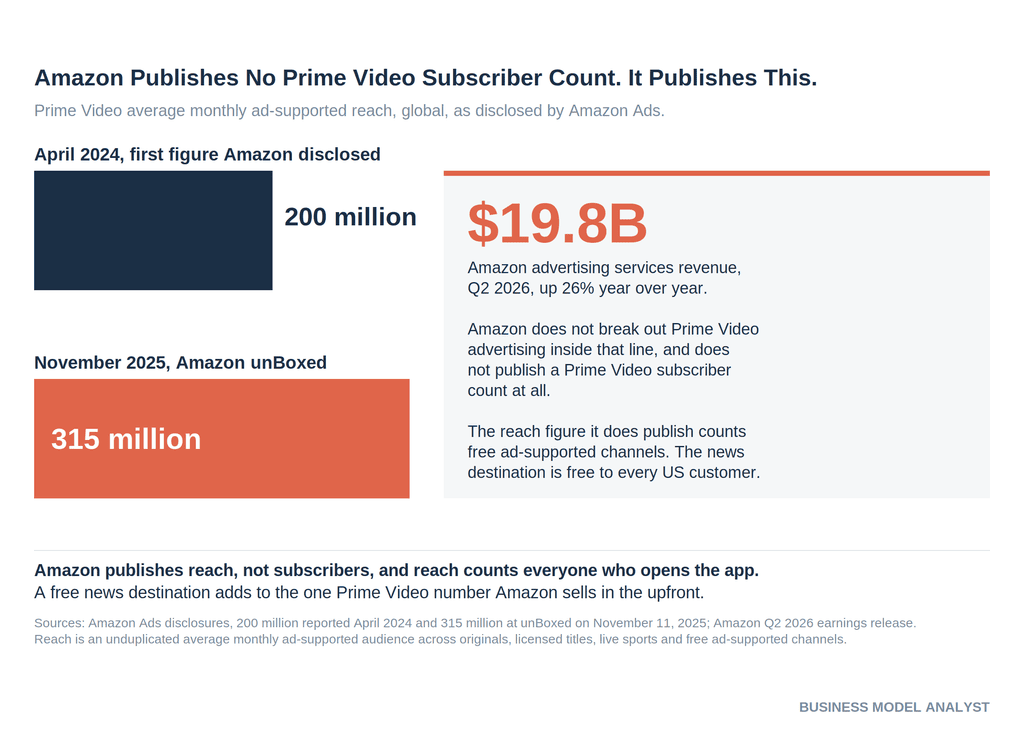
That is not a detail about generosity. Amazon’s advertising line booked $19.8 billion in the second quarter of 2026, up 26% year over year, and the company does not break out Prime Video inside it. It does not publish a Prime Video subscriber count either. The single audience figure Amazon puts in front of advertisers is average monthly ad-supported reach, and that figure is 315 million.
Now read Amazon Ads’ footnote on how the 315 million is assembled. It counts originals, licensed titles, live sports, and free ad-supported channels. A free news destination open to non-Prime customers feeds directly into the only number being sold.
What Happened
Prime Video’s News destination now carries curated playlists of on-demand clips, pulled from multiple outlets and grouped by story. They live in two carousels, Trending Topics and Local News. Living room devices first, with mobile and web promised later.
The clips join what was already there: 24/7 live feeds from ABC News Live, CBS News 24/7, LiveNOW from Fox, CNN Headlines and NBC News NOW, plus what Amazon describes as hundreds of other free ad-supported streaming television channels. Brian Griffin, who runs global app experience at Prime Video, framed the goal as making Prime Video “a truly comprehensive destination for news.”
One reported detail is worth holding. TechCrunch asked whether the mobile clips would be vertical. Amazon would not say, confirming only that they count as short-form on iOS and Android.
A company genuinely building a TikTok competitor knows the aspect ratio. Amazon shipped to the television first and has not decided what the phone version looks like.
The Backstory
Prime Video has spent eighteen months converting itself from a Prime perk into an advertising property, and the metric came before the product.
At its first upfront disclosure in April 2024, Amazon put average monthly ad-supported reach at 200 million globally. By unBoxed in November 2025 the figure was 315 million, a 58% increase in nineteen months. Amazon has never published a matching subscriber number. The last Prime membership figure the company disclosed was more than 200 million, back in 2021, and every estimate circulating since then traces to analysts rather than to Amazon.
Reach and subscriptions are not the same kind of number, and the difference is the whole story. A subscriber is someone who pays. Reach is anyone the company can plausibly say saw an ad, and its size depends entirely on where you draw the boundary.
Amazon Ads draws it generously. Its own 2026 upfront page puts the average monthly ad-supported audience in the United States above 300 million consumers across owned-and-operated properties and premium third-party supply, against a US population near 340 million. That is not a claim about people. It is a claim about counting rules.
Four days before the news clips, Amazon wired the television to the phone with a set of shoppable features. Same app, same week, two different problems: one about measuring what a viewer does, this one about how many viewers there are to count.
The Plan
Start with cost, because it explains the speed.
Amazon is not producing these clips. The networks are, from newsrooms whose budgets are already spent. Amazon supplies the shelf, the recommendation logic and the ad server. Whatever the revenue split, the marginal content cost of a local news carousel is close to nothing next to a company that spent north of $22 billion on video and music content in 2025.
Now look at what sits next to the free shelf. Inside the same News destination, Amazon sells third-party subscriptions through Prime Video Channels: Peacock Premium Plus, Paramount+, FOX One, CNN All Access. Amazon has never disclosed what it keeps on those. The public estimates are old and wide, with BMO putting the average cut near 30% back in 2019 and Digiday reporting that Amazon was pressing some partners toward 50%.
That is the highest-margin dollar in the building, because Amazon produced nothing to earn it. Free news is the cheapest possible traffic to route past that rack, and the undisclosed cut is the same structure Amazon runs everywhere else it owns the shelf.
Then there is what the clips do to the supplier.
Local television news is the last product broadcast stations have that nobody can substitute, and it is the argument that justifies retransmission fees. Unbundling it into a Local News carousel on somebody else’s free app does not kill that, but it does teach the viewer that the newscast is not a place you go. It is a thing you scroll. The stations supplying the clips are the same ones whose reach already runs through carriage relationships they do not fully control.
They will supply anyway. The incremental revenue looks free, because the content was already made.
The Business Model Angle
The published metric is the product roadmap. Amazon reports reach, so Amazon builds doors. A free news destination open to non-Prime customers is the cheapest possible way to add unduplicated monthly bodies to a figure sold in an upfront. Netflix reports paid memberships and therefore builds conversion. Before you design the funnel, decide which number you will be graded on, because that number will design the rest of it for you.
The free aisle exists to sell the paid aisle. Channels revenue costs Amazon no production, no rights risk and no talent. Anything that increases footfall past that rack is worth running at zero margin, which is exactly what a free news carousel is. Watch for the CNN All Access and FOX One placements to creep closer to the clips over the next two quarters.
Suppliers are licensing their own unbundling, and it looks like distribution. Broadcasters hand over clips, get reach they did not pay for, and book it as upside. The cost lands somewhere else, in the slow erosion of the reason anyone tunes to a channel at a time. That trade has been available to publishers since 2015 and has rarely aged well.
The Risk
The strongest objection is that reach is not inventory, and it deserves full weight.
Advertisers buy impressions, and impressions come from hours. A viewer who watches ninety seconds of a local news clip adds one unit to a monthly reach count and almost nothing to sellable inventory. If the news destination pulls in millions of people for two minutes a month, the headline figure climbs while the ad business barely moves. Media buyers are not naive about this. Reach without frequency does not clear at premium rates.
The demand evidence also argues against reading Amazon as a company that needs to pad anything. Nielsen measured Prime Video at 4.3% of all US television viewing in December 2025, a record, and Tinuiti found Prime Video CPMs briefly running above Netflix in late 2025. Inventory pricing above the category leader does not look like inventory in trouble.
There is a simpler reading available too, and it might just be right. News is cheap, it fills an obvious gap in a general-entertainment app, and every rival shipped short-form this year. Sometimes a feature is a feature.
The pivot-to-video history cuts both ways as well. Publishers who fed Facebook Watch and Snap Discover mostly lost, but the ones who kept their own distribution and treated platform clips as marketing did fine. Broadcasters supplying Amazon are not betting the newsroom.
The falsification condition is clean. If Amazon starts reporting hours, impressions or engagement for the news destination, the metric-inflation reading weakens considerably. If two years from now reach has climbed again while Amazon still publishes no Prime Video subscriber count, no viewing hours and no breakout of Prime Video advertising, the reading holds.
Quick Questions
Do you need Prime to watch the news clips? No. The News destination inside Prime Video is free to all US customers, with or without a Prime membership.
Is this actually a TikTok competitor? Amazon shipped it to televisions first and would not confirm whether the mobile version is vertical. That is not how a company launches a phone-native feed.
Who makes the clips? News organizations already producing the footage, including the networks behind the free 24/7 channels in the same destination. Amazon supplies distribution, not journalism.
How many Prime Video subscribers are there? Amazon has never said. It publishes average monthly ad-supported reach, most recently 315 million globally, and its Q2 2026 advertising revenue of $19.8 billion is not broken out by property.
What does Amazon earn on the paid news channels? Undisclosed. Estimates for the Prime Video Channels cut are years old and range from roughly 30% to 50%.
Why does the free part matter? Because Amazon’s own definition of its reach metric includes free ad-supported channels, so a free surface open to non-Prime customers lifts the number being sold.
The Business Model Analyst Take
Tell me which number a company chooses to publish and I will tell you what it is about to build.
It is a reliable trick because reporting is a commitment. Once a company teaches the market to grade it on a metric, every roadmap meeting quietly reorganizes around making that metric go up, and nobody has to say so out loud. Netflix publishes paid memberships, so Netflix ships password crackdowns and ad tiers that convert. Spotify publishes monthly active users, so Spotify ships free tiers. Amazon publishes average monthly ad-supported reach, so Amazon ships free doors, and a news destination open to every American with a Fire TV is a very wide door.
The corollary is the useful part, and it is about what stays unpublished. Amazon does not break out Prime Video advertising, does not report Prime Video subscribers, and has never named its Channels take rate. Those three silences are not an oversight. They are the same instinct that shows up in how Amazon prices its own ad auction: publish the number that grows, withhold the number that would let somebody else do the arithmetic.
For operators the practical version is small. Pick your headline metric before you pick your roadmap, because you will end up serving it either way. Then look at what you have chosen not to disclose, and ask whether the gap between those two lists is a strategy or an accident. At Amazon it has never once been an accident, which is what that business model is for.
News on Prime Video is free because free is what makes the number bigger.