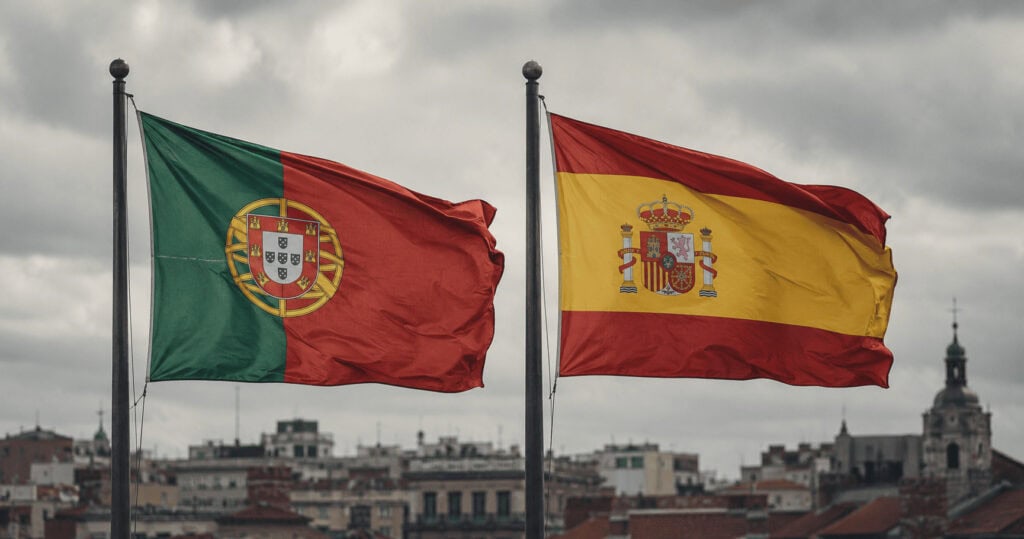

On Monday, July 6, two neighbours who share a peninsula, a border, and roughly 500 years of arguing about it will meet at AT&T Stadium in Arlington for a World Cup Round of 16 tie. Cristiano Ronaldo against Lamine Yamal. The reigning European champions against a Portugal side that had to grind past Croatia in stoppage time. On the pitch, Spain go in as favourites.
Run the same fixture as an economic contest and the bookmakers would set the same line. Spain is one of the ten or so largest economies on the planet. Portugal is a small, open economy with the lowest GDP per capita in Western Europe. This should be a walkover.
It is not. And the reason it is not tells you something useful about what “bigger” actually buys you.
The mismatch on paper
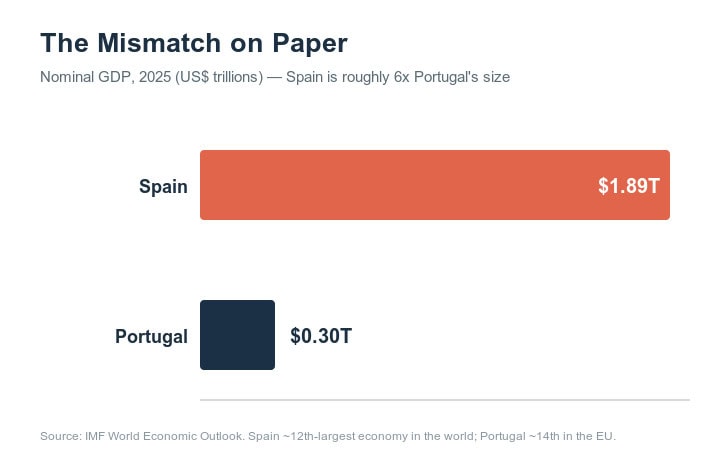
Start with the tale of the tape, because it is genuinely lopsided. Spain’s nominal GDP sits around $1.89 trillion for 2025, making it roughly the twelfth-largest economy in the world and the fourth-largest in the EU. Portugal’s is around $300 billion. Spain is about six times the size.
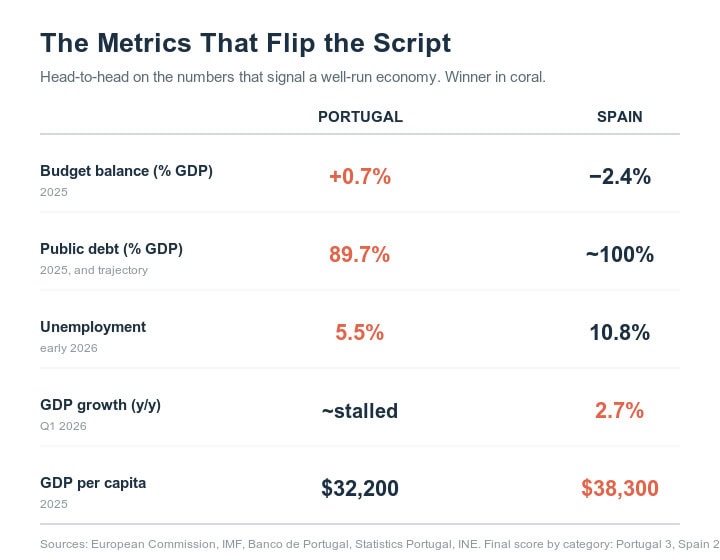
Spain also carries the better individual numbers where scale matters. GDP per capita is about $38,300 against Portugal’s $32,200. And Spain has been the growth story of Western Europe: real GDP expanded 2.7% year-on-year in Q1 2026, the kind of pace that has the OECD noting it is outrunning its European peers. Portugal, by contrast, stalled to a standstill in Q1 2026 after winter storms and an energy-price spike knocked the wind out of it.
So Spain wins the size battle, the per-capita battle, and the current-momentum battle. If the scoreboard stopped there, this is a comfortable Spanish win and a short article.
The counter-attack Spain does not want to talk about
Here is where the underdog does the thing underdogs occasionally do: it wins the parts of the game nobody was watching.
Portugal runs a budget surplus of 0.7% of GDP for 2025. Spain runs a deficit of 2.4%. That is not a rounding-error difference in framing. One country is taking in more than it spends; the other is still borrowing to close the gap.
The debt picture follows the same script. Portugal’s public debt fell to 89.7% of GDP in 2025 and is projected to keep dropping toward 86%, passing below the euro-area average. Spain’s sits near 100%, only now forecast to slip under that line. A decade ago, Portugal was the bailout patient and Spain the larger, sturdier neighbour. On fiscal discipline, that relationship has quietly inverted.
The midfield battle: jobs
If fiscal balance is the counter-attack, the labour market is where Portugal wins the midfield outright.
Spain’s chronic weakness is unemployment, and it remains chronic: 10.8% in early 2026, with youth unemployment running near 25%. Portugal’s rate sat at 5.5% by May 2026, less than half Spain’s, with youth unemployment around 19%. For all the talk of Spain’s growth engine, it is a growth engine that still leaves one in ten workers idle and a quarter of its young people out of work. That is a structural problem no single strong quarter fixes.
Where they are the same team
The uncomfortable truth for both is that they are built on the same foundation, which means they share the same vulnerabilities. Both are heavily services-led and tourism-dependent. Portugal’s service sector generates more than three-quarters of its gross value added, with tourism posting record external revenue. Spain leans on the same pillars, which is why the European Commission flags weaker tourism inflows as a top risk to Spanish growth.
Translation: a bad tourism year, a European slowdown, or another energy shock hits both sides in the same place. Neither has fully solved the productivity and low-wage problem that keeps Iberian incomes below the northern-European frontier. They are, in the end, two versions of the same economic model at different scale.
The final score
Score it by category and Portugal edges it three-two: surplus over deficit, lower and falling debt, and far healthier employment, against Spain’s superior size, richer population, and stronger current growth.
But football does not award the trophy on possession, and economics does not award it on a scorecard. Spain’s six-times-larger economy is a real, durable advantage. Scale buys resilience, market power, and a far bigger domestic cushion. If this were a war of attrition, Spain wins. The lesson is narrower and more interesting: on the metrics that actually signal an economy is being run well right now, the small neighbour is playing the better football.
The Business Model Analyst Take
The instinct with a fixture like this is to reach for David and Goliath. Resist it. Portugal is not a plucky minnow overachieving against a giant; it is a smaller economy that has simply made better recent decisions on the things a government actually controls, its books and its labour market, while the giant coasts on size and momentum it has not yet converted into full employment.
For operators, the transferable point is sharper than the football metaphor. Size and growth are the numbers everyone quotes because they are the numbers on the front page. Balance-sheet discipline and the health of your workforce are the numbers that decide who is still standing after the next shock, and they rarely make the headline. Spain is the bigger, flashier business with a hiring problem it keeps deferring. Portugal is the smaller operation with cleaner books and a fuller team. Ask any founder who has survived a downturn which of those they would rather be running when the tourism revenue wobbles.
Spain will very likely win the actual match. On the economic tape, the result is a lot closer than the size chart suggests, and that gap between “biggest” and “best run” is the whole point.