
Most “passive income” lists rank ideas by how much money they can make. That is the wrong question. The money is real for some of these. What almost nobody tells you honestly is how much work stays on your plate after the setup is done, and how much cash you need up front to make any of it matter.
So we ranked 12 popular passive income streams on a single axis the gurus avoid: how passive each one actually is once it is running. A score of 100 means genuinely set-and-forget. A score near zero means you have built yourself a job and hung a nicer label on it.
The short version: the truly passive streams almost all require capital, and the cheap-to-start streams almost all require labor. There is no free lunch, only a choice about which currency you pay in.
The ranking at a glance
Here is the full list, most passive to least. The two streams in coral are the only ones that come close to earning the word “passive” without an asterisk.
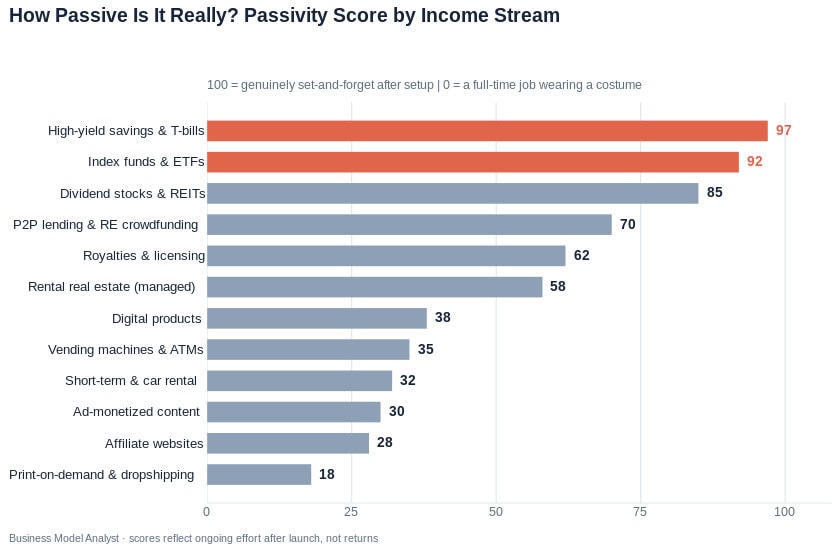
Notice what sits at the top. Not a clever side hustle. Not a digital product. It is boring capital sitting in boring accounts. That is not a coincidence, and it is the whole point of this ranking.
How we scored “passive”
Passivity here measures one thing: ongoing effort after the setup phase, not the size of the payout and not the difficulty of getting started. A stream scores high when, once it exists, it keeps paying with little or no attention from you. It scores low when it needs constant feeding: new content, customer service, inventory, restocking, or babysitting a platform’s rules.
We deliberately separated that from two other things people confuse with passivity:
- Upfront effort: how hard it is to build the thing in the first place.
- Capital required: how much money you need before the income is meaningful.
A book royalty, for example, takes enormous upfront effort but almost none afterward. An index fund takes almost no effort at either stage but needs real capital to produce real income. Both can be “passive,” in different ways, for different people. Lumping them together is exactly how the passive income conversation goes wrong.
Tier by tier
The genuinely passive (scores 85 to 97)
High-yield savings, T-bills, and money market funds top the list because they are the only streams that are close to pure passive. You deposit money, it earns yield, and nothing is asked of you again. The catch is baked in: the income is a function of how much capital you park, and the yields, while decent lately, will not make anyone rich on a small balance.
Index funds and ETFs and dividend stocks and REITs sit just below. Slightly more variance, slightly more temptation to tinker, but functionally hands-off once the money is invested. These are the streams financial independence is actually built on, which is unglamorous enough that no one sells a course about it.
This is the honest core of passive income, and it is worth sitting with why it works. These are ownership stakes in productive assets. You are renting out capital. If you want the conceptual version of this, our breakdown of revenue streams in the business model canvas frames it the same way a company would: the most durable income comes from owning an asset, not from running an activity.
Passive after a real down payment (scores 58 to 70)
Peer-to-peer lending and real estate crowdfunding (70) let you rent out capital with a bit more risk and a bit more oversight than an index fund. Royalties and licensing (62), a book, a song, a patent, a photo library, are the “do the work once” dream in its purest form, but the upfront work is brutal and most royalty streams decay without new releases.
Rental real estate with a property manager (58) is where the label starts to strain. Even with a manager taking day-to-day calls, you still handle vacancies, capital expenditures, financing, and the occasional 11 p.m. decision. It is a small business you can mostly delegate, not a stream that runs itself.
Mislabeled as passive (scores 18 to 38)
This is where the guru economy lives, and where the honesty gap is widest.
Digital products (38), courses, ebooks, and templates, are sold as the ultimate passive play. In reality, the product is the easy part. The marketing never stops, the content decays, and the market crowds instantly. Our pillar on passive income’s new math documented one creator who an AI tool projected would earn $7,000, and who actually made $250. Treat those projections as fan fiction, not forecasts.
Vending machines and ATMs (35) involve physical routes, restocking, cash handling, and breakdowns. Short-term rentals and car rentals (32), the Airbnb and Turo playbook, are hospitality and fleet-management jobs with a tech wrapper. Ad-monetized content and affiliate sites (30 and 28) can absolutely produce income, but only through relentless publishing, and they live at the mercy of an algorithm you do not control. That is, incidentally, the business model this very site runs on, which is exactly why we will tell you it is not passive.
Print-on-demand and dropshipping (18) sit at the bottom. Thin margins, brutal competition, constant ad spend, and a supply chain you do not own. It is a real business for a few operators and a slow leak of money and time for most. If you want the pattern in the wild, look at the car detailing side hustle or the coin dealer who livestreamed for 177 straight hours to move $2 million: the money is real, the “passive” part is a myth.
The two axes the label hides
Rank the same 12 streams by effort instead of by score, and the story gets sharper. The horizontal axis is how hard the thing is to set up. The vertical axis is how much work it demands forever. Only the bottom-left corner deserves the word “passive.”
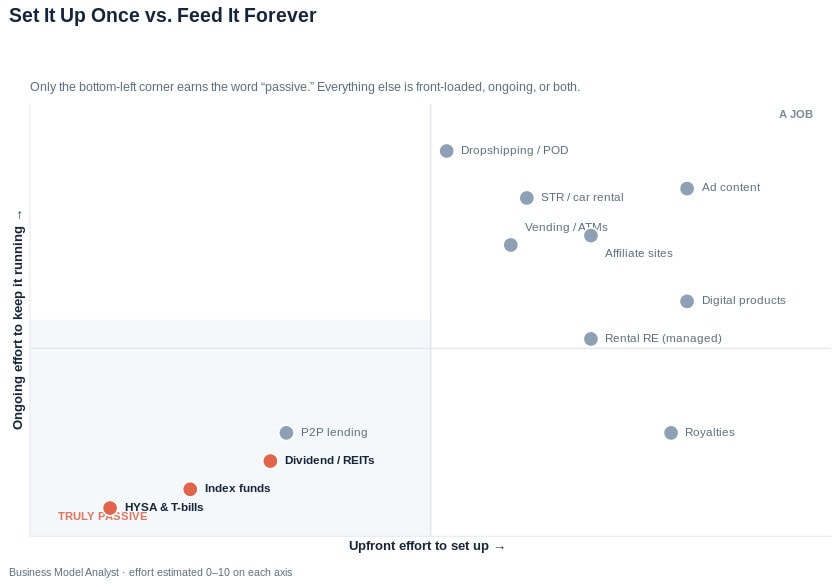
Two things jump out. First, the streams marketed hardest as passive, digital products, content, dropshipping, all cluster in the high-ongoing-effort zone. Second, the genuinely low-maintenance corner is nearly empty except for the financial instruments. The passive income industry sells you the top of this chart while showing you a picture of the bottom.
Why the top of the ranking costs money
If ongoing effort were the only axis, everyone would just buy index funds and be done. The reason they do not is the axis the effort chart hides: capital.
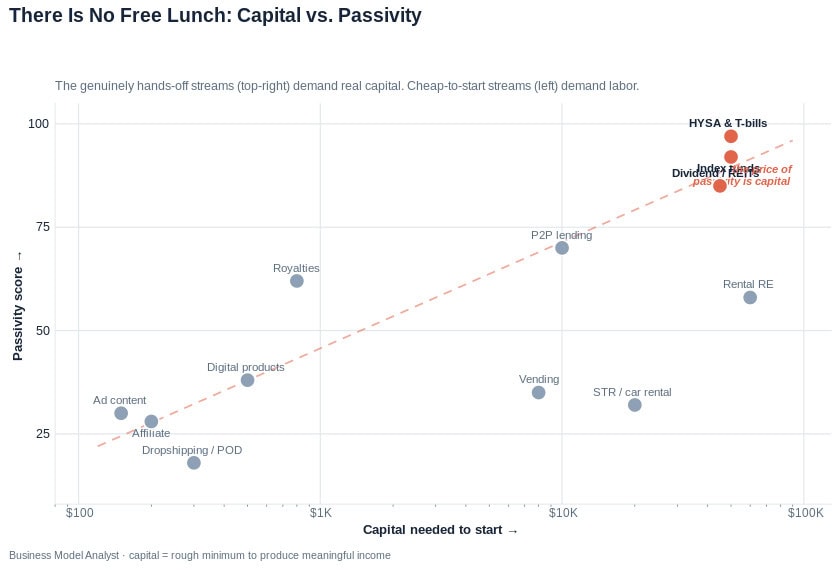
Plotted this way, the tradeoff is undeniable. The genuinely hands-off streams sit in the top-right: high passivity, high capital. The cheap-to-start streams sit in the bottom-left: low capital, low passivity, because you are paying in labor instead of dollars. The dashed line is the frontier almost no stream beats. You can buy passivity with money, or you can buy it with years of work, but you rarely get it for free.
This is why “passive income” is such a seductive and misleading phrase for people who do not already have capital. If you have $100 to start, the chart tells you plainly: your realistic options live in the low-passivity zone, which means the income will not be passive at all. It will be a second job until it either builds real capital or fails.
So which one is right for you
Strip away the marketing and the choice comes down to what you actually have:
- You have capital and want true passivity: stay in the top tier. Savings instruments, index funds, dividends, REITs. Unsexy, honest, and the only streams that reliably deliver on the promise.
- You have some capital and tolerance for oversight: lending, crowdfunding, or managed rental real estate. Semi-passive, higher return, real risk.
- You have skill and time but little capital: royalties, digital products, or content. Understand that you are trading years of upfront and ongoing labor for a chance at an asset, and that most attempts do not compound. If you go this route, study the automated business ideas for passive income with clear eyes about the “automated” part.
- You have neither capital nor a durable skill: the honest answer is that passive income is not your first move. Building capital or a skill is. The frontier does not bend for anyone.
Frequently asked questions
What is the most passive income stream?
Interest from high-yield savings, Treasury bills, and money market funds. Once your money is deposited, these require essentially no ongoing effort. The limitation is that the income scales with how much capital you have parked, not with cleverness or hustle.
Is passive income actually passive?
Rarely, in the way it is marketed. A handful of streams, mostly financial instruments, are close to genuinely hands-off, but they require significant capital. Most popular “passive” ideas, digital products, content, dropshipping, rentals, demand continuous work and are better described as businesses than as passive income.
Can you build passive income with no money?
You can start streams that need little capital, such as content, affiliate sites, or digital products, but these are the least passive options on the ranking and the most competitive. With no money, you are paying in labor, and most of these attempts do not reach meaningful, durable income.
Why do so many passive income ideas fail?
Two reasons. Good ideas get crowded fast, which kills margins, and an entire industry profits by selling courses about making money rather than making it. Among business-course scams reported to the Better Business Bureau in one recent year, the median loss was $1,326, and the FTC once refunded $2.8 million to 890 people burned by an operation promising passive income on autopilot.
The Business Model Analyst Take
The word “passive” is doing enormous marketing work, and it is doing it dishonestly. Rank these streams by how passive they really are and the picture inverts the usual advice: the genuinely hands-off options are boring financial assets that require capital, while the exciting, low-cost ideas are the least passive things on the list.
That is not a reason for despair. It is a reason for clarity. Every stream here is a business model in miniature, with an asset, a capital requirement, an ongoing cost, and a moat, or a lack of one. The people quietly winning did not escape work. They did the work once, in the right spot, and built something they own. Choose your currency, capital or labor, on purpose. Just stop paying for the fantasy that you can skip both.
This article is analysis, not financial advice. Returns, risk, and capital requirements vary widely by market and individual situation.