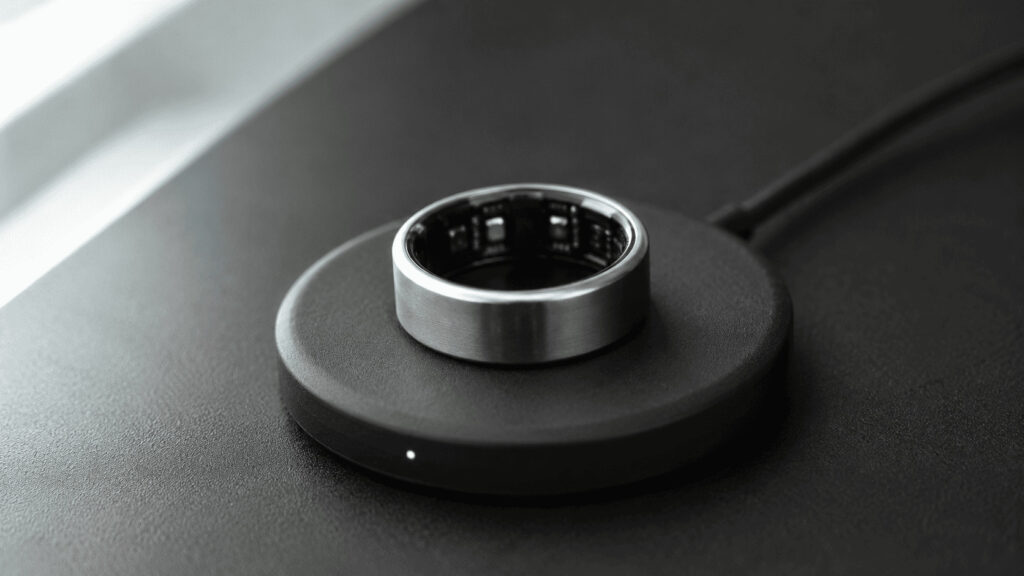

Oura just shrank its flagship smart ring by 40 percent and stretched the battery to a full week, and the reviews are glowing. Engadget handed the Oura Ring 5 a 9 out of 10 and called the miniaturization a genuine feat of engineering. That is the product story, and it is a good one.
The business story is the part nobody puts in the headline: Oura is barely competing on hardware anymore. The most revealing lines in that review are not about size at all. They are the reviewer shrugging that there are “no new features to add” and rolling his eyes at paying “$100 for paint.” Read those two complaints back to back and you have the entire Oura business model sitting in plain sight, right as the company files to go public at an $11 billion valuation.
The 30-second version
| What launched | Oura Ring 5, 40% smaller than the Ring 4, up to 7-day battery, $399 base price |
| The catch | Colors cost $100 extra (same titanium, just paint). Full features need a $6/month or $70/year subscription |
| The real moat | Patents. Oura got rival rings banned from the US, then turned one competitor into a royalty payer |
| The backdrop | Oura filed confidentially for a US IPO in May 2026 at roughly an $11B valuation |
| Why it matters | When hardware stops differentiating, the fight moves to recurring revenue and IP. Oura is winning both |
What Oura actually shipped
On the spec sheet, the Ring 5 is the Ring 4 in a smaller body. Same sensors, same health tracking, same app reducing your night into a Sleep score and a Readiness score. The headline change is physical: 40 percent smaller, with battery life that went up rather than down, which is the hard part of any miniaturization.
The pricing is where it gets interesting. The base ring in Silver or Black runs $399. Want Gold, Stealth, Brushed Silver, or Deep Rose? That is another $100. As Engadget’s reviewer points out, you are not paying for a different material. You are paying for paint. There is also a $99 travel charging case sold separately, and the subscription that unlocks the features that make the ring worth wearing.
The tell: “no new sensors to add”
The single most important sentence in the review is the one that sounds like filler. The reviewer notes there are no genuinely new features, because without a leap in medicine or physics, there are no new sensors that squeeze more insight out of your finger than the ones already there.
That is not a knock on Oura. That is the smart ring category hitting the ceiling of what hardware can do. And when every competitor can buy the same optical heart rate sensor and the same temperature probe, hardware stops being a moat. It becomes a commodity input. The only things left to compete on are form factor (hence the 40 percent shrink) and everything that is not hardware: the software, the subscription, and the legal right to sell the thing at all.
Oura figured this out before anyone. The proof is in where the money comes from.
The monetization stack
Here is what Oura is actually selling, and the order matters:
| Layer | Price | What it really is |
|---|---|---|
| Base ring | $399 | The on-ramp. Gets you into the ecosystem |
| Color finish | +$100 | Pure margin. Same titanium, different coating |
| Membership | $6/mo or $70/yr | The recurring engine. Required to unlock the data |
| Travel case | +$99 | An accessory upsell on a charger that fits in a pocket |
The ring is the customer acquisition cost. The subscription is the business. Once you have someone wearing the thing every night and trusting it to flag when they are run down, you have a customer who renews $70 a year almost without thinking about it. That is the SaaS dream wearing a titanium costume.
Revenue is quadrupling. The subscription slice is the catch
Oura’s numbers are staggering. Revenue went from roughly $500 million in 2024 to about $1 billion in 2025, and CEO Tom Hale has floated close to $2 billion for 2026. That is a fourfold jump in two years for a consumer hardware company, which almost never happens.
But look at the mix. Sacra estimates Oura’s revenue runs about 80 percent hardware and 20 percent subscription. In 2024 that meant roughly $390 million in rings and $110 million in memberships. Oura says it is on pace to pass 5 million paid members in the second quarter of 2026, which is real and growing fast. It is also still a fifth of the pie.
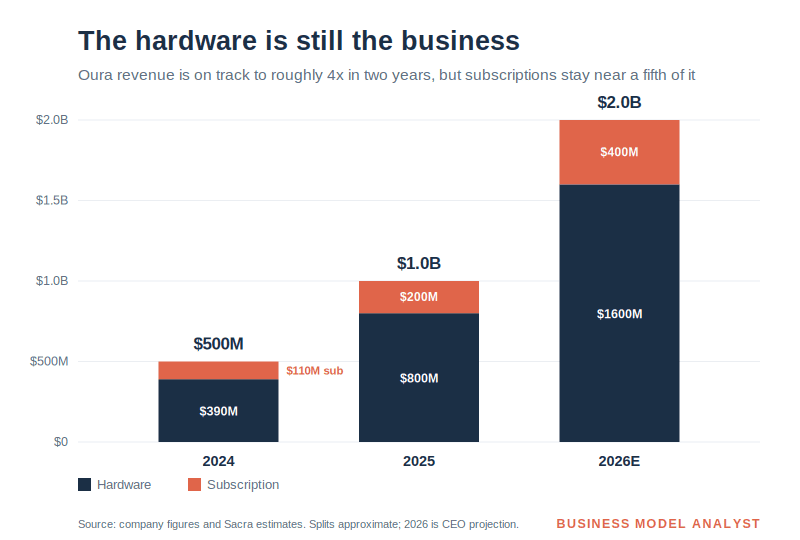
That tension is the whole investment question. Oura wants public markets to value it like a recurring-revenue health platform. The income statement still says hardware company with a promising subscription attached. Both things are true at once, and which one wins decides whether $11 billion is cheap or a trap.
The moat the review never mentions: patents
Here is the part that makes the “just buy the Ultrahuman instead” advice more complicated than it looks. In 2025, Oura took its main rivals to the US International Trade Commission and won. The ITC issued exclusion and cease-and-desist orders against Ultrahuman and RingConn, and once the presidential review window closed with no veto, US Customs started blocking the infringing rings at the border. The contested patent covers the specific way an Oura ring packs its sensors into that tiny form factor.
Then Oura did something smarter than just winning. It cut a deal with RingConn: a multi-year patent license with royalties flowing back to Oura. An adversary became a paying customer. Ultrahuman, meanwhile, had to physically redesign its ring to dodge the patent and re-clear customs before it could sell in the US again, which it only managed to do in spring 2026. The US is nearly half of Ultrahuman’s user base, so that ban was close to existential.
This is the move most hardware companies forget. Oura spent a decade turning a form factor into enforceable IP, and now that IP does what no product feature can: it decides who is even allowed on the shelf.
Ultrahuman’s counterpunch is aimed at the subscription
Ultrahuman is back, and it came back swinging at the exact thing holding up Oura’s valuation. Its pitch for the redesigned Ring Pro is no mandatory subscription. Core sleep, recovery, movement, and stress insights are included with the hardware. It makes its recurring money from optional clinical add-ons instead, and it is touting a battery life roughly double Oura’s.
That is not a random product choice. It is a direct attack on the recurring-revenue thesis. If “no subscription” becomes the thing buyers reward, Oura’s most valuable revenue line is also its most exposed. The smart ring market is projected to grow from about $417 million in 2025 to nearly $3.8 billion by 2034, so there is plenty of room for two philosophies to coexist. But the philosophies are pointed straight at each other.
Why launch a smaller ring right now
Timing is never an accident. Oura submitted its confidential IPO paperwork to the SEC in May 2026, after a $900 million Series E led by Fidelity doubled its valuation to $11 billion in a single year. A company about to walk onto Wall Street needs a growth story for the hardware line even as it tells investors the real value is the platform. A dramatically smaller ring that opens the category to everyone who found rings too bulky is exactly that story.
We have argued before that this is the riskiest moment in Oura’s life, because the last screenless wearable to hit an $11 billion valuation was Fitbit, and it sold to Google for $2.1 billion. The Ring 5 is Oura’s answer to that ghost: keep the hardware narrative alive, keep the members climbing, and convince the market the subscription line is a software business and not a hardware fad in a SaaS outfit.
What operators should take from this
Strip away the rings and the lesson is portable to almost any hardware-adjacent business:
| Old playbook | Oura’s playbook |
|---|---|
| Win on the best specs | Assume specs commoditize, win on form factor and services |
| Sell the device, book the revenue | Sell the device near cost, monetize the relationship forever |
| Compete on features | Compete on patents that keep rivals off the shelf |
| One-time transaction | Recurring membership plus margin upsells (yes, including paint) |
The $100 paint charge that annoys reviewers is not a mistake. It is gross margin extraction on a customer who has already decided to buy. The subscription that locks the data behind a paywall is not greed for its own sake. It is the only line on the income statement that justifies a software multiple. And the patent fight that sounds like boring legal news is the most durable competitive advantage Oura owns.
Frequently Asked Questions
How much does the Oura Ring 5 cost?
The Oura Ring 5 starts at $399 for the Silver or Black finish. Other colors (Gold, Stealth, Brushed Silver, Deep Rose) add $100 for the same titanium body. Full features require a membership at $6 per month or $70 per year, and an optional travel charging case is $99.
Does the Oura Ring 5 require a subscription?
Yes, to unlock its full feature set. Oura’s membership costs $6 per month or $70 per year and gates most of the ring’s health insights. That recurring fee is central to Oura’s business: subscriptions make up roughly 20 percent of revenue but carry far higher margins than the hardware.
What is different about the Oura Ring 5 compared to the Ring 4?
The main change is size. The Ring 5 is about 40 percent smaller than the Ring 4, with battery life improved to roughly seven days. The sensors and health features are largely unchanged, because the smart ring category has reached the limit of what new hardware can measure.
How does Oura make money?
Oura makes money two ways: hardware sales and subscriptions. Around 80 percent of revenue comes from selling rings (plus margin extras like $100 color upgrades), and about 20 percent comes from recurring memberships. The company reached roughly $1 billion in revenue in 2025 and projects close to $2 billion in 2026.
Why was Ultrahuman banned in the US, and can you still buy it?
Ultrahuman was blocked from the US in late 2025 after Oura won a patent case at the US International Trade Commission covering the ring’s form factor. Ultrahuman has since redesigned its ring to work around the patent and returned to the US market in spring 2026. RingConn took a different path, settling into a paid license that sends royalties to Oura.
Is Oura going public?
Oura filed confidentially for a US IPO in May 2026. The company was valued at about $11 billion in its October 2025 funding round, double its valuation from a year earlier. Its pitch to investors leans on recurring subscription revenue rather than one-time hardware sales.
The Business Model Analyst Take
Oura built the best ring in the category, and then made sure being the best ring barely matters. The 40 percent shrink is a real achievement, but it is a magic trick that keeps your eye on the hardware while the actual business runs on three things the spec sheet never shows: paint margin, a $6-a-month subscription, and a patent portfolio that turns competitors into either roadkill or royalty payers.
For founders, the takeaway is uncomfortable but clean. In a maturing hardware category, your moat is almost never the hardware. It is the recurring revenue you can attach and the IP you can enforce. Oura is going public on exactly that bet. The open question, and the one Wall Street has to price, is whether a competitor giving away the subscription can drain the very revenue line that makes Oura worth $11 billion. Smaller ring, much bigger fight.