
OpenAI’s agents cracked Navier-Stokes over a long weekend. Every institution that pays for answers still runs on a clock built for human review.
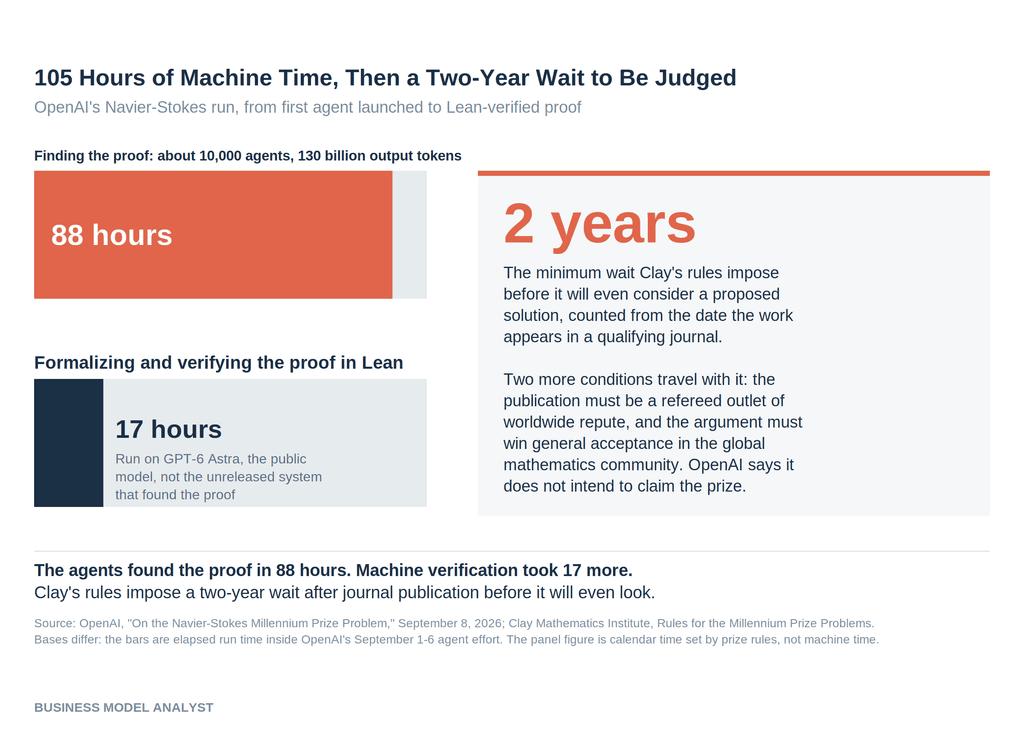
On September 8, OpenAI published what it says is a resolution of the Navier-Stokes existence and smoothness problem, one of the seven Millennium Prize Problems. About 10,000 agents found it in 88 hours. A Lean formalization checked it in 17 more. The Clay Mathematics Institute will not consider any proposed solution until two years after it appears in a qualifying journal, and OpenAI says it does not intend to claim the $1 million.
Here is the part everyone skipped while arguing about whether a machine can do mathematics.
The answer arrived in four days. The system built to buy answers cannot process it for at least two years, and by its own rules it has not started counting yet. Clay’s problem page still lists Navier-Stokes as unsolved.
That gap is not a technicality. It is the whole story. Discovery got 100 times cheaper over a weekend, certification got faster too, and the institutions that pay for knowledge are still priced and clocked for a production function that stopped existing about a month ago.
What Happened
OpenAI published a writeup and a Lean formalization claiming that the three-dimensional Navier-Stokes equations can develop a singularity in finite time. In plain terms: an initially smooth fluid at rest, under a smooth force, with finite energy throughout, can spin itself into a state where speed grows without bound. The Wall Street Journal described the mechanism as a spaghetti-like vortex that shrinks while spinning faster.
The run, by OpenAI’s own numbers:
- About 10,000 concurrent agents, up from roughly 100 at the start
- 88 hours from first agent launched to resolution, September 1 to September 5
- 2.7 million messages and roughly 130 billion output tokens on this problem alone
- 17 additional hours for Lean formalization and verification, run on GPT-6 Astra
- Across every problem the agents attempted: 4.9 million messages and about 300 billion output tokens
Run the division and one problem absorbed 43% of the output tokens and 55% of the messages the entire effort produced. That is not a portfolio. That is a concentrated bet placed mid-run.
The proof itself runs about 165 pages, per the Journal, which also reported that the compute bill ran to millions of dollars, spent by a company whose infrastructure commitments already run to $750 billion through 2030. The posted bounty is $1 million. OpenAI says it will not be collecting.
The Backstory
In 2000, the Clay Mathematics Institute named seven problems and put $7 million behind them, $1 million each. Twenty-six years later, exactly one has been paid out.
Grigori Perelman posted his Poincaré conjecture work online across 2002 and 2003. He never submitted it to a journal. Other mathematicians spent roughly three years writing expositions that could start the clock. Clay announced the award in March 2010, about seven years after the work went public. Perelman declined the money.
The current rules, adopted in September 2018, set three conditions before Clay will even look at a proposed solution. It has to be published in a qualifying refereed outlet of worldwide repute. At least two years have to pass after that publication. And it has to win general acceptance in the global mathematics community.
Read those three conditions as a pricing document rather than a legal one and they tell you exactly what the Clay board thought the scarce input was in 2000. Not the answer. The answer was assumed to take a decade of one brilliant person’s life, so paying $1 million for it looked generous. The scarce input the rules actually guard is trust, and the only trust technology available was a slow adversarial reading by a few dozen people who understood the field.
Two years is roughly 17,520 hours. OpenAI’s end-to-end run took 105. The institution’s minimum waiting period is about 167 times the production time, and that is before publication, refereeing, or acceptance.
The Plan
The sequence matters more than the result, because it shows where the humans were actually useful.
OpenAI says it has been training a new internal model since August 28, that its training is still ongoing, and that agents were swapped onto a further-trained version of the model partway through the effort. The tool changed while the job was running.
On September 1, after hearing rumors that two Millennium problems had fallen, the lab pointed the system at all six open ones plus a set of easier questions. Nothing about this run resembles the subscription-and-API machine that pays the bills; it is a research budget spent as advertising. One of the easier ones went first: roughly 100 agents spent about 50 hours producing a blowup result for the unforced Euler equations, the frictionless cousin of Navier-Stokes.
Then the humans did the only thing they did that a machine could not. They read the Euler result, decided Navier-Stokes was now the promising bet, pulled agents off the other Millennium problems, and pushed the agent count up 100-fold onto one target. They fed the Euler resolution back in as a prompt. They used Codex to consolidate insights across agent groups so the swarm stopped rediscovering the same dead ends.
That is not mathematics. That is capital allocation. The human contribution to the biggest claimed math result of the decade was deciding which position to concentrate into and when.
Worth noting what shipped in public during the same stretch. GPT-6 Astra was released on September 3. The internal model that outran it had already been training since August 28. On its launch day, the flagship was behind. On OpenAI’s internal benchmark of open problems, the Journal reported Astra solved about 10% while the unreleased model was closer to 50%, which OpenAI researcher Sebastien Bubeck summarized as a coin flip on almost any open problem you hand it.
The Business Model Angle
The scarce good is certification, not answers. Producing the claim took 88 hours. Producing a machine-checkable version took 17. Producing acceptance takes two years minimum and, on the only precedent that exists, took about seven. Anything that shortens the last number is worth more than anything that shortens the first two.
Math was chosen because it is the one domain that checks itself. Lean exists. A formal proof either compiles or it does not. That is why the frontier labs run their capability demos here instead of in law, medicine, or credit underwriting, where the money actually is and where no verifier exists. The demo is most impressive precisely where trust is cheapest to manufacture. Transfer is the hard part, not capability.
Build the verifier, not just the generator. The picks-and-shovels lane here is formal methods, proof assistants, test-generation, simulation harnesses, and audit tooling: anything that turns a probabilistic output into a checkable artifact. In software this already exists as tests and CI, which is why coding agents landed first. Every regulated industry is a candidate for someone building the Lean of that domain.
Prize and bounty design is now mispriced across the board. A $1 million posted price against a compute bill in the millions is an inverted spread. Every X-Prize, research bounty, and bug bounty written on the assumption that the binding constraint is human effort now has an arbitrage problem in one direction and a credibility problem in the other, since bounty sponsors will get flooded with machine-generated candidate solutions they have no capacity to referee.
Capital reprices faster than credit does. The announcement moved attention, valuation narratives, and enterprise procurement conversations inside 24 hours. The scientific reward system will take years to respond. When one scoreboard settles in hours and the other in years, everyone optimizes for the fast one. That is a structural incentive, not a character flaw, and it will not correct itself.
The Risk
The strongest case against reading this as a clean milestone is worth stating properly, because it is a good case.
A Lean formalization proves the formal statement follows from the formal axioms. It does not prove that the formal statement is a faithful translation of the informal mathematical claim, or that the claim is the version of Navier-Stokes the Clay problem actually asks about. That translation step is still human work, and nobody outside OpenAI has finished checking it. The lab did not circulate the result to outside mathematicians before publishing, which it attributes to the competitive race.
There is also an unresolved credit dispute. NYU’s Tristan Buckmaster and Anthropic’s Levent Alpöge published three Lean-verified blowup results of their own on September 8, for the incompressible porous medium equation, the Boussinesq system, and forced three-dimensional Euler, building on earlier work by Diego Córdoba and Luis Martínez-Zoroa. Buckmaster dates their breakthrough to August 15 and their Lean verification to August 22. He has publicly questioned whether OpenAI’s model had access to their sessions. OpenAI states that neither its researchers nor its agents saw the unpublished work before public release and that no specific user data was accessed, while adding that it cannot rule out that de-identified data from product usage helped improve its models. Provenance questions like this one are no longer abstract: the industry just spent $1.5 billion learning that nobody can agree who owns the training corpus. Bubeck has disputed Buckmaster’s account and apologized for one specific line in it. Both accounts are on the record and they do not agree.
That last sentence from OpenAI is the one enterprise buyers will read twice. A frontier lab saying it cannot rule out that customer session data improved a model is a procurement conversation, not a math conversation.
Terence Tao, writing on September 7 about the Alpöge and Buckmaster papers, called the work a breakthrough that makes the remaining goals look feasible soon, while separately arguing that enormous AI efforts triggered by hints of a rival group’s direction will discourage researchers from sharing promising directions at all. That is the real cost worth tracking. If mentioning what you are working on invites 10,000 agents onto your problem over a weekend, the rational response is silence, and mathematics runs on the opposite of silence.
Quick Questions
Did OpenAI actually solve a Millennium Prize Problem? It published a proposed solution with a Lean formalization. Independent acceptance has not happened, and Clay’s problem page still lists Navier-Stokes as unsolved. Proposed, verified, and accepted are three different stages.
Why turn down $1 million? Under Clay’s rules the money is not available yet regardless. The result has not been published in a qualifying journal, the two-year clock has not started, and general acceptance takes as long as it takes. OpenAI framed the release as reporting on the pace of its models, which is the payment it was actually collecting.
How much did this cost? The Journal reported millions of dollars in compute. OpenAI disclosed volume rather than dollars: roughly 130 billion output tokens and 2.7 million messages on this problem, out of about 300 billion tokens and 4.9 million messages across everything the agents attempted.
Is 88 hours the real number? It is elapsed time from first agent launched to resolution, September 1 to September 5, followed by 17 hours of Lean formalization and verification on GPT-6 Astra. It is not a measure of compute hours, and it excludes the training run that started on August 28 and was still going.
What does this mean for other fields? Less than the headline suggests, in the short run. The result landed in the one domain with a working machine verifier. Fields without one still need human review at human speed, which is exactly the bottleneck this story exposes.
The Business Model Analyst Take
The interesting number in this story is not 88 hours. It is two years.
For four hundred years, producing knowledge was expensive and checking it was comparatively cheap, so we built institutions that spend freely on verification: peer review, tenure, replication, waiting periods, prize committees that sit on their hands for 24 months. Those institutions are the accumulated design response to one specific cost structure. That cost structure just inverted for at least one domain, and the institutions have not moved a millimeter.
The companies that win the next decade will not be the ones that generate the most output. Generation is heading toward commodity. They will be the ones that can hand a customer a result along with a machine-checkable receipt proving it is right, in a field where no such receipt existed before. That is the whole game in law, in medicine, in audit, in engineering sign-off, in anything with a regulator attached.
OpenAI spent millions to win a $1 million prize it declined and cannot claim, which is a rounding error against the gap between what the company has committed and what it earns. Read that as irrational and you miss it. The prize was never the payment. The receipt was.