
Onitsuka Tiger grew 66.5% in Europe and 35.9% worldwide, while Japan’s tourist count fell 2%. The line outside Ginza is media spend that Asics never paid for.
Onitsuka Tiger sales rose 35.9% to ¥89.5 billion, about $574 million, in the six months to June, and Asics keeps telling reporters it is because tourists are queuing outside its Tokyo stores. Japan’s own tourism numbers say the tourist pool shrank 2% over the same six months and total visitor spending rose 0.2%. Both statements are true. Only one of them explains the growth, and it is not the queue.
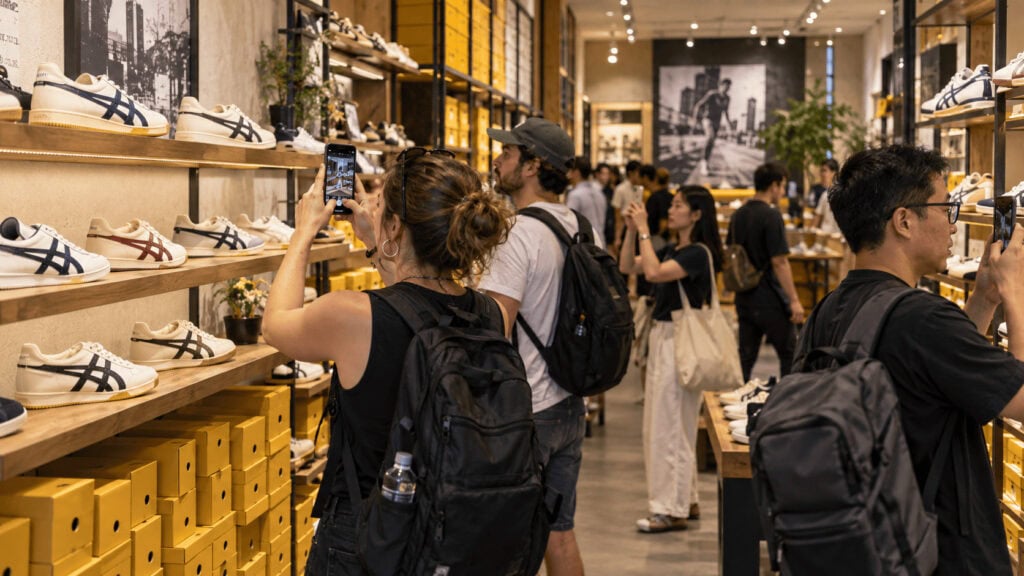
There is a photograph attached to almost every version of this story. Foreigners packed into a store in Ginza, holding up phones with a picture of the pair they want, taking a numbered ticket to get through the door, then changing into the shoes on the sidewalk outside. It is a wonderful image. It is also the single least profitable way to read what is happening at Asics.
The Wall Street Journal ran that image on September 7 under a headline about the world not being able to get enough of these Japanese sneakers. The company’s own half-year filing, published three weeks earlier, tells you where the money actually arrived.
What Happened
Asics reported first-half sales of ¥534.4 billion, roughly $3.4 billion, up 32.7%, with operating profit up 48.5% to ¥120.4 billion and an operating margin of 22.5%. It was the first time interim sales cleared ¥500 billion. Management raised full-year guidance from ¥950 billion to ¥1.05 trillion and lifted the dividend forecast from ¥38 to ¥44.
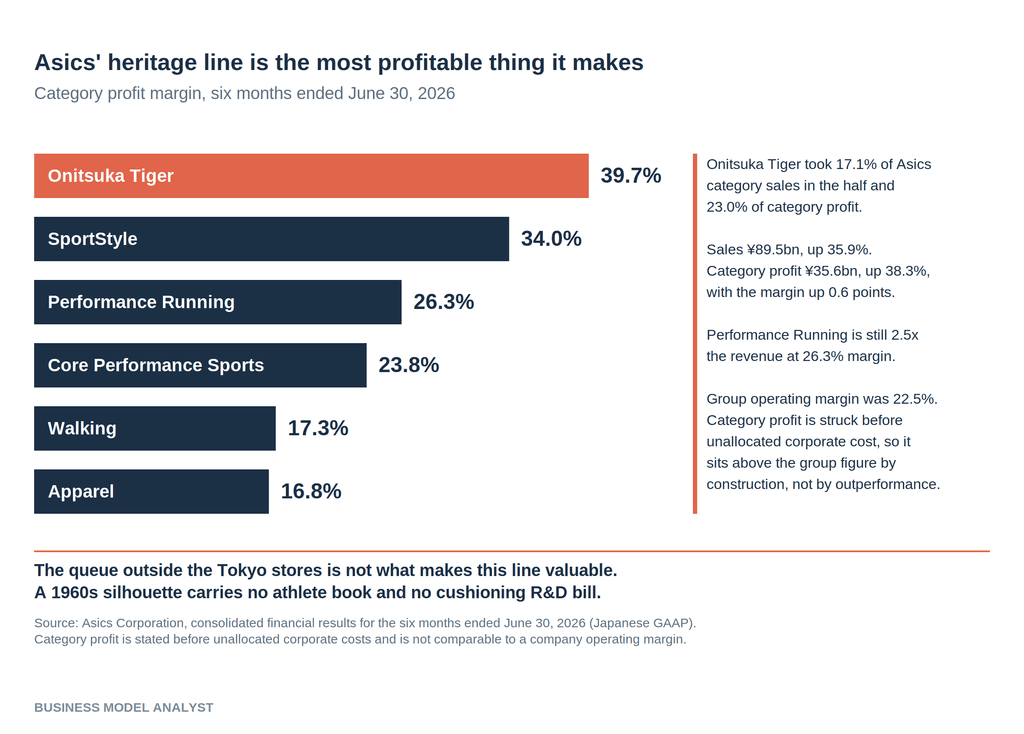
Inside that, Onitsuka Tiger did ¥89.5 billion, up 35.9%, with category profit of ¥35.6 billion, up 38.3%. The category profit margin was 39.7%, the highest of the six lines Asics reports. The retro shoe out-earns the running franchise that carries two and a half times its revenue.
Then there is the line almost nobody quoted. Asics says European sales of Onitsuka Tiger grew 66.5% in the half. The brand grew 35.9% globally. Europe is not a rounding error in this business, so if one large region is running at nearly twice the worldwide rate, everywhere else has to be running below the headline. Japan included.
The rest of the arithmetic backs that up. The Japan region grew 6.9%, the slowest of the seven regions Asics reports. Europe grew 46.4%. North America grew 28.1%. Greater China grew 30.7%. SGB Media, subtracting the first quarter from the half, put second-quarter Japan region sales at ¥46.8 billion, down 3.9% year on year, in exactly the quarter those sidewalk photographs were taken. Asics Japan, the operating company inside that segment, grew 23.8% with a 33.4% operating margin, so the inbound business is real and it is lucrative. It is just not the engine.
One more number that got skipped. Onitsuka Tiger grew 55.1% in the first half of 2024 and 50.1% in the first half of 2025. This half it grew 35.9%. The story everyone is writing about a brand exploding is a story about a brand posting its slowest growth in three years, off a base that has doubled.
The Backstory
Kihachiro Onitsuka started making basketball shoes in Kobe in 1949, and sold the first pair of Tigers a year later. In 1962 a 24-year-old from Oregon named Phil Knight flew to Kobe, talked his way into a distribution agreement, and had his father wire the company $50 to close it. He later built Nike.
Sixty-four years on, the company Knight was reselling is one of the brands taking share from Nike, and it runs a 22.5% operating margin. Nike ran 8.2% in the financial year ended May 2026 on $46.4 billion of revenue, and carries $15.5 billion of contracted endorsement obligations off its balance sheet, roughly 3.3 times its entire annual marketing budget. Asics has no equivalent commitment on the Onitsuka line, because a 1960s silhouette does not need a signature athlete or a new foam.
That is most of the 39.7% margin right there. No athlete book. No cushioning R&D to amortize. No seasonal obsolescence, because the product was already obsolete when they reissued it. Everything Asics spends on Onitsuka Tiger goes into stores and product, and a meaningful share of the demand generation is being done for free by tourists filming each other outside the Ginza door.
The distribution history matters too. Asics pulled back hard from North America in 2023 and there has not been a dedicated Onitsuka Tiger store in the United States since. For three years, the hottest brand in the portfolio was unavailable at retail in its most valuable single market. The spread between the Japanese price and whatever an American paid went to resellers, grey-market importers and multi-brand boutiques. The Michigan family the Journal spoke to said they expected to pay about twice at home what they paid in Tokyo. Almost none of that second dollar reached Asics. The rule is the same one that decides who keeps the margin in any footwear chain: whoever holds the goods and sets the price at the point of sale is the one who books the spread.
The Plan
On June 10 Asics announced it will spin Onitsuka Tiger into OT Group Corporation, effective January 1, 2027, and convert the brand’s operations inside each regional company into OT Group subsidiaries. Research and development, IT and intellectual property stay shared with Asics. The stated goal is faster decision-making and, in the company’s own words, establishing the brand as a more refined luxury lifestyle business.
Read that alongside the store plan and it stops sounding like a governance tidy-up. Onitsuka Tiger Shinjuku opened in July as the largest store in the world for the brand. Nagoya followed in August. Shanghai opened, Milan opens this month, Seoul in October, and the United States is scheduled for 2027 with a Los Angeles flagship.
Goldman Sachs analyst Sho Kawano told the Journal the company has managed the brand carefully, limiting openings and refusing discounts to hold its cachet. That reading is right, and the corporate action makes it sharper. You separate a business when you want it valued, staffed and priced on different rules from the parent. A running-shoe company optimizes for technical credibility and wholesale sell-through. A luxury lifestyle company optimizes for scarcity, full-price sell-through and store experience. Those are different operating disciplines and they were sharing a P&L.
What OT Group inherits is a brand with global proof and a margin that flatters every slide. What it does not inherit is the currency.
The Business Model Angle
A queue is a media buy you never paid for, and it only converts where you have stores. The Ginza line generates the photographs, the TikToks, the must-see-stop listicles and the Journal feature, at a marketing cost of zero. That awareness then has to land somewhere. It landed in Europe at 66.5% growth, because Asics had European distribution. It did not land in the United States, because for three years there was nowhere for it to land. Scarcity in one geography is free advertising for every other one, and it is worthless in any market where you are not open for business. Nike and Adidas spent nine years running opposite distribution strategies and landed in the same channel mix; what separated them was never who owned the store, it was whether the demand showed up at the door. Asics is fixing that in 2027, four years late.
A single price in a moving currency is an unmanaged price architecture. Asics runs a yen list price. The dollar value of that list price moved from about $97 to about $104 per unit between late July and early September without anyone in Kobe touching a spreadsheet. That is not a pricing strategy, it is a floating discount to every visitor whose income is denominated somewhere else. Brands that price their own scarcity on purpose decide who gets the cheap rung. Asics let the foreign exchange market decide, and the market handed the spread to tourists and resellers rather than to the P&L.
Reported growth and real growth are different products, and only one of them survives a currency reversal. Group sales grew 32.7% as reported and 22.0% currency-neutral, so roughly a third of the headline is translation. Performance Running, the largest category, grew 19.3% reported and 8.2% currency-neutral, which means more than half of that line’s growth was the yen. Any operator building a plan, a valuation or a bonus target off a reported number in a weak-currency year is underwriting an FX position they have not named.
The Risk
The most direct threat to this story is not fashion. It is monetary policy, and it has already started.
The yen traded at 163.87 to the dollar on July 29 and 154.33 on September 7, about 5.8% stronger in six weeks. That did not happen by accident. Japan’s Ministry of Finance spent roughly $99 billion between July 30 and August 26 buying its own currency, and the country’s foreign exchange reserves fell a record $79.6 billion in August as a result. The Bank of Japan is widely expected to raise rates this month, with another increase priced for December. The government of Japan is spending eleven figures to make Onitsuka Tigers more expensive for the people standing in that line.
Then there is a date the sneaker coverage has missed entirely. On November 1, 2026, Japan scraps its at-the-register tax exemption for visitors and switches to a refund system with no transition period. Tourists will pay the full tax-inclusive price at the till, including the 10% consumption tax, and claim it back at the airport. The tax is recoverable, so this is friction and working capital rather than a real price rise, but friction is exactly what an impulse purchase cannot absorb. Stack it on the currency move and a shoe that cost a dollar buyer about $100 in late July costs roughly $117 at the counter in November, with Asics having changed nothing.
The tourist base is also less reliable than the photographs suggest. Japan’s Chinese arrivals fell 56.4% in the first half after a diplomatic rupture, and China historically supplied close to a third of inbound spending. Taiwan, South Korea and the United States covered most of the hole, which is the good news, but the composition of that queue is now hostage to bilateral politics.
The honest counterargument to everything above is this. The inbound channel is probably the most profitable channel Asics has: full retail price, no wholesale partner, no import duty, no local advertising, and a customer who paid for their own flight to reach the store. If that channel shrinks, group revenue barely notices and the margin notices a lot. And there is a lag argument that cuts against my whole thesis. If Europe grew 66.5% partly because the Tokyo queue manufactured the brand’s global heat, then killing the queue kills the European growth two years later, not immediately. The market may already be pricing some of that. Asics shares hit an all-time high of ¥5,440 on August 17, days after the guidance raise, and closed at ¥4,164 on September 7, about 23% lower, over a stretch in which the yen strengthened sharply.
Quick Questions
Is Onitsuka Tiger actually a big business for Asics? It is 17.1% of category sales and 23.0% of category profit in the half. Meaningful, and the highest-margin line at 39.7%, but Performance Running at ¥220.7 billion is still the core.
What is growing faster than Onitsuka Tiger? SportStyle, by a distance. It grew 83.0% to ¥123.2 billion at a 34.0% margin, led by North America and Europe. It is now larger than Onitsuka Tiger and nobody is queuing for it.
Does the spin-off mean Asics is selling the brand? No. OT Group Corporation is a wholly owned subsidiary from January 1, 2027, with R&D, IT and intellectual property still shared with the parent. It is a structure for independent decision-making and a luxury positioning, not a divestiture.
When can Americans buy these in a store again? 2027, with a Los Angeles flagship, ending a gap that started with the 2023 retrenchment.
The Business Model Analyst Take
Every operator wants the queue. It is the most visible proof of demand there is, it costs nothing, and it makes for a great feature in a national newspaper. What the Asics filing shows is that the queue was never the asset. It was the campaign. The asset was having 66.5% growth in Europe when the campaign ran, and the mistake was not having a single store in the United States to catch the other half of it.
Currencies are the quietest line item in any consumer business and the one most often mistaken for genius. For four years a weak yen has been quietly selling shoes in Ginza and quietly inflating every number Asics translated home. That trade is now being unwound on purpose by the Japanese government, with a tax change landing on November 1 for good measure. OT Group launches eight weeks after that, into a market where it finally has to say out loud what the shoe is worth.
Phil Knight got the American rights to this shoe for a $50 wire in 1962. Sixty-five years later Asics is opening its own store in Los Angeles. The interesting question is not whether people still want Tigers. It is what they will pay for one when the exchange rate stops doing the selling.