
Six breweries guard a €100 million keg. The people who own the tents are playing for something 18 times bigger.
Steffen Marx raised €12.4 million to dig a hole in the ground. Not for water rights, not for a spa. For permission to sell beer at a party.
Munich lets only six breweries pour at Oktoberfest, and one qualifying rule is that the barley, hops and water come from within city limits, under a purity standard the city traces to 1487. So Marx, who founded Giesinger Bräu in a garage in 2006, spent two years chasing a drilling permit and eight figures sinking a well next to a BMW battery research facility. He still isn’t in, and now has 21,000 of the 35,000 signatures needed to force a citywide referendum on it.
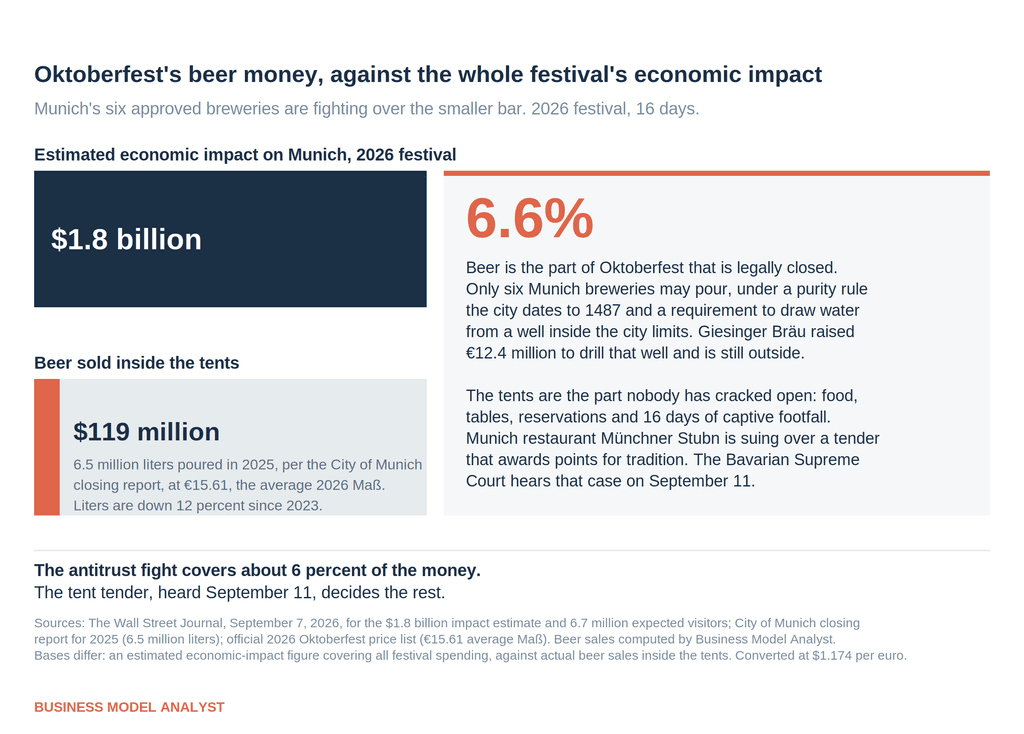
Meanwhile 6.7 million people are expected on the Theresienwiese from September 19, pumping an estimated $1.8 billion into the city, according to the Journal.
Everyone is calling this a fight about beer. The money says otherwise.
The €100 Million Keg Inside a $1.8 Billion Party
Price the thing being litigated. Munich’s closing report put 2025 consumption at 6.5 million liters, and a Maß averages €15.61 this year. That is roughly €101 million of beer, about $119 million, split across six breweries and the tent operators who ring the till.
Against $1.8 billion of economic impact, the beer at the center of the antitrust fight is under 7 cents of every dollar the festival moves. Per visitor: about $269 spent, roughly $18 of it on the liter.
And the keg is shrinking. Liters poured went 7.4 million in 2023, 7.0 million in 2024, 6.5 million in 2025, down 12% in two years, with price doing the work volume used to do.
The tent is the real asset: structures wider than a football field, several stories tall, 8,000 seats, plus food, table reservations and sixteen days of captive footfall. Munich restaurant Münchner Stubn sued the city in May after losing bids on the larger tents, alleging the tender favors families who have run them for generations by awarding points for tradition. The Bavarian Supreme Court hears the case on September 11, eight days before the first keg is tapped.
Nobody drills a well for 6% of the money. You drill it because you are not allowed to bid on the other 94%.
The “Local” Six Report to Leuven, Amsterdam and the State of Bavaria
The rule protects Munich breweries. Here is what that phrase actually buys in 2026:
- Spaten and Löwenbräu: owned by AB InBev, via Interbrew’s 2003 purchase of the Spaten-Franziskaner-Löwenbräu group.
- Paulaner and Hacker-Pschorr: the Paulaner Brauerei Gruppe, 70% Schörghuber, 30% Heineken.
- Hofbräu: owned outright by the state of Bavaria, in state hands since 1939.
- Augustiner: privately held by the Wagner family line since 1829. The only one of the six that matches the postcard.
A localism rule shuts out a Munich brewery founded in a Munich garage while licensing two of the world’s largest brewing groups and a state government that is both a participant and part of the regulatory furniture. The Modelo ownership trail teaches the same lesson with a different accent.
The precedent is brutal. Prince Luitpold of Bavaria, whose family invented Oktoberfest for a royal wedding in 1810, sued alleging a cartel. He offered to bring a portable brewery onto the grounds. Refused. He built one in a Munich park. Told his capacity was insufficient. A court ruled against him in 1990.
A standard that capital can satisfy but no newcomer can pass is not a quality bar. It is a wall with a heritage plaque bolted to it.
The Case for the Cartel, Fairly Stated
German antitrust lawyer Lukas Kestler makes the cleanest version: a city may set rules for its own festival and pick suppliers who comply, and it is not a cartel when the participants did not write the rules. Courts have upheld both the beer standard and the tent tender before, and nobody calls a stadium pouring rights deal a conspiracy.
Logistics back it up. Moving 6.5 million liters in sixteen days through tents seating 8,000 people is a supply chain problem, and six known brewers with fixed local capacity is a defensible answer to it.
The honest wrinkle is that the tradition being defended keeps moving. Beer from outside Munich was welcome for much of the 19th century, and the dirndl and lederhosen dress code only became the norm in the 1990s.
And the sharpest objection comes from the challenger himself. Marx knows that if Giesinger gets through the gate, “it’s not the rebel brand anymore.” Distribution can quietly kill the identity that made you worth distributing.
The Business Model Angle
Whoever writes the spec owns the category. A well inside city limits, a 1487 purity rule and the phrase “established and reputable” form a capex-and-calendar barrier dressed as heritage. Same machinery as airport slots and casino licenses. Challengers should attack the criteria, not the decision.
Tradition points are incumbency, priced and filed. The tent tender scores how long your family has done the job. A procurement rubric is where switching costs become legally binding, which is why Münchner Stubn is suing the scoring rather than the outcome.
The rent sits with access, not the product. Tent beer ran about 30% above typical Munich city center prices last year, roughly €3 a liter, or about €20 million of pure location premium on 2025 volumes. The liquid is a commodity. The permission is the asset.
The Takeaway
Giesinger spent €12.4 million and two years of permitting to qualify for a shrinking pool of revenue at a festival where beer is 6% of the spend. That is what a well-built moat does to a challenger: it makes him fight expensively for the least valuable square on the board. Watch September 11 instead. A tender that awards points for your surname is the more interesting cartel, and nobody drilled a well to attack it.
Quick notes on the SEO/Discover angle:
- Suggested slug: oktoberfest-beer-cartel-munich-tent-economics
- Meta description (150 chars): Oktoberfest’s beer cartel fights over 6% of the money. Inside the €12.4M well, the AB InBev-owned “local” brewers, and the tent case in court Sept 11.
- Primary keywords: Oktoberfest beer cartel, Munich six breweries Oktoberfest, Giesinger Bräu Oktoberfest, Oktoberfest beer price 2026, Oktoberfest tent bidding lawsuit, Oktoberfest economic impact
- Discover hooks working here: a contrarian title that reframes a beer story as a money story; €12.4 million and $1.8 billion inside the first 100 words; named global brands (AB InBev, Heineken, BMW) that lift the piece out of a purely German search pool; a hard date eight days out (Bavarian Supreme Court, September 11) plus the festival opening on September 19, which reads as fresh to Google’s freshness signals; and an ownership map that no other coverage of this story has published.
- Internal link used: who-owns-modelo, anchor “the Modelo ownership trail”, placed in the ownership section. Carried from the set verified live on September 2, worth one last click before publishing.
- Internal link suggestions: “captive-venue pricing” → any future pricing-power or dynamic-pricing explainer; “purity standard” → a beer or brewing category page if one exists (BMA currently has almost no beer vertical, which this piece argues for building).