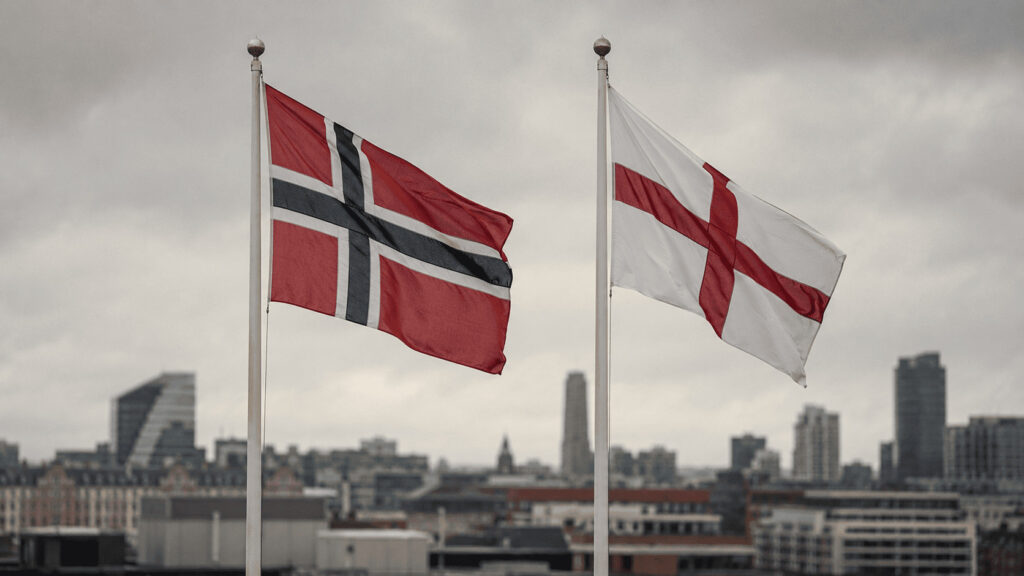

On Saturday night in Miami, Norway play their first-ever World Cup quarter-final and England arrive as the bookmakers’ favourites. On the pitch, that pricing is fair. On the balance sheet, it is the wrong way round.
What this is: A head-to-head economic comparison of Norway and England, staged as their real World Cup 2026 quarter-final and scored on the metrics that decide whether an economy is actually winning rather than just how big it is: total output, wealth per person, reserves, squad depth, growth, and financial discipline. Because England has no standalone national accounts for most modern indicators, the England figures here use United Kingdom data, of which England is roughly 86% of GDP and 84% of the population. Figures are 2026 estimates from the IMF World Economic Outlook, the World Bank, and national sources (Norges Bank, NBIM, ONS), in US dollars unless noted.
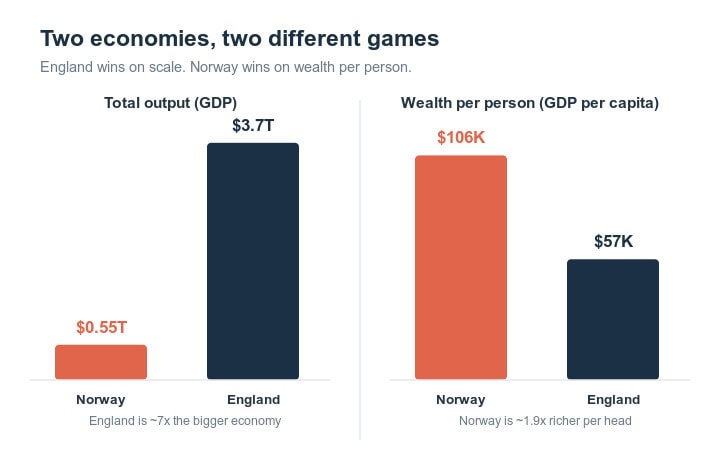
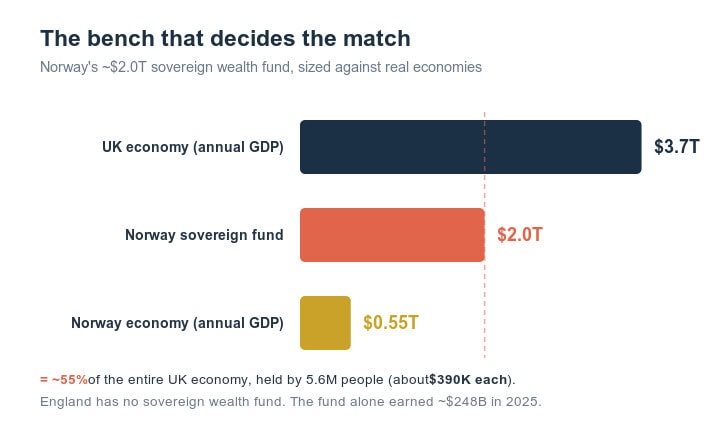
The key takeaway: England is the aggregate heavyweight, a top-five economy worth around $3.7 trillion with the deepest financial-services ecosystem in Europe. Norway is roughly a seventh of that size and has a twelfth of the population. But the average Norwegian is nearly twice as rich per head, and Norway holds the single most decisive asset on the pitch: a sovereign wealth fund worth around $2 trillion, the largest on earth, equal to about 55% of the entire UK economy and owned by fewer people than live in Greater London. One country runs a huge, high-revenue business with almost nothing in the bank. The other runs a small business sitting on a fortress balance sheet.
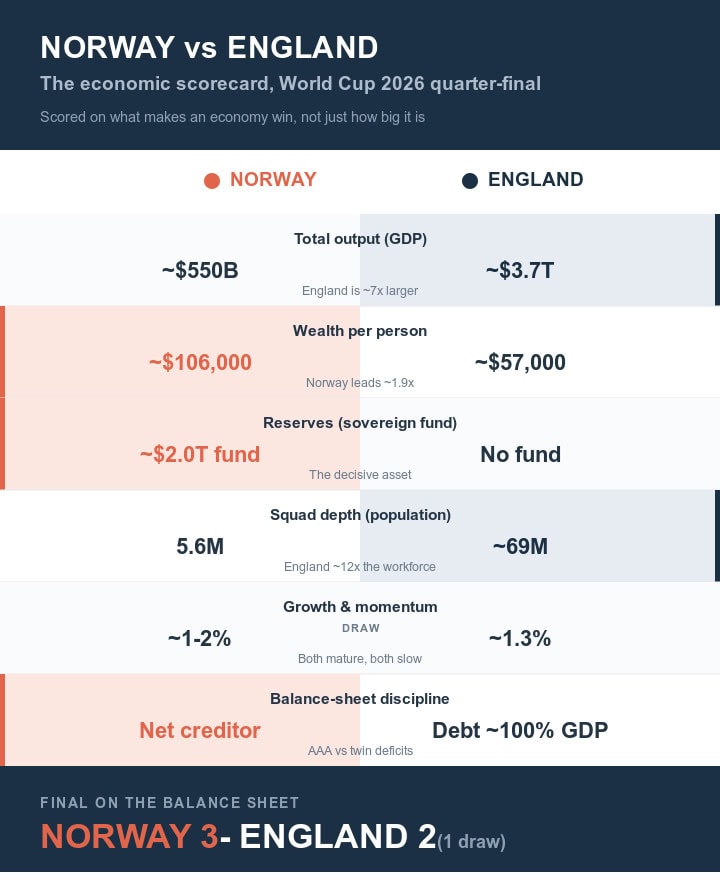
Read the top of the table and you get two different matches
On total output, this is a mismatch and Norway is barely on the card. The UK is the world’s fifth-largest economy, one of its most globalised, home to about 20 of the world’s 500 biggest companies and a technology sector with an enterprise value north of $1.2 trillion. Norway’s entire annual output is smaller than the amount London alone produces.
Flip to wealth per person and the fixture inverts completely. This is the same pattern Norway showed when it dismantled the size argument against Brazil in the Round of 16: Norway is the inversion of the usual underdog, tiny in aggregate and enormous per capita.
Norway: the 5.6-million-person vault
Norway is what every commodity economy claims it wants to become and almost none manage. It struck North Sea oil in the late 1960s and made the decision that sounds obvious and is almost never followed: do not spend the windfall, bank it.
The result is the Government Pension Fund Global, the largest sovereign wealth fund on the planet, worth around $2 trillion. That is roughly $390,000 for every one of Norway’s 5.6 million citizens, none of whom can withdraw it. The fund owns close to 1.5% of every listed company in the world, holding stakes in some 7,200 firms. In 2025 alone it returned about 15% and booked a profit near $248 billion. To put that in football terms, one asset on Norway’s bench earned more in a single year than a quarter of a trillion dollars, quietly, while the players slept.
The discipline is the masterclass. A fiscal rule caps annual government withdrawals at the fund’s expected real return, currently around 3%, so the principal is left to compound for future generations. Oil revenue smooths the economy instead of overheating it, and by law the fund invests only abroad to avoid inflating the domestic currency. The by-products are a net external creditor position, a AAA credit rating, the highest Human Development Index among rated sovereigns, and governance indicators in the 98th percentile. Beyond oil and gas, Norway is Europe’s largest gas supplier, the world’s largest salmon exporter, runs almost 100% renewable electricity from hydropower, and its star striker, Erling Haaland, is the youngest marquee name in the tournament.
The weakness is the one every vault has. Norway grows slowly because it has already arrived, and the whole edifice rests on a single, finite resource banked with rare discipline. Strip out the oil and the fund, and mainland Norway is a small, high-cost, slow-moving economy. It won the match decades ago and has been protecting the lead ever since.
England: the high-revenue engine with an empty savings account
England, read through UK numbers, is the opposite balance sheet. This is a genuine economic heavyweight: around $3.7 trillion in output, the fifth-largest economy on earth, anchored by the City of London, the deepest capital markets in Europe, a globally significant tech and fintech base, the world’s second-largest aerospace industry, and a top-ten pharmaceutical sector. Sterling is one of a handful of genuine reserve currencies. This is scale, diversification, and global reach that Norway simply does not have and cannot manufacture.
It also has a discipline problem that is the mirror image of Norway’s strength. UK growth ran about 1.3% in 2025 and GDP per head is still stuck around where it was in 2022, dragged by a long productivity slump. Public debt sits near 100% of GDP, the country runs persistent twin deficits, and, crucially, it has no sovereign wealth fund at all. The UK pumped its own North Sea oil for decades and, unlike Norway, spent the proceeds as they arrived. The contrast is not a coincidence of geology. It is a choice about what to do with a windfall, and the two countries chose opposite answers.
The scorecard
Score it on raw size and England wins comfortably, exactly as the football models predict. Score it on the metrics that decide whether an economy is winning rather than simply large, and Norway edges it on points: richer per head, a reserve position no rival can match, and a balance sheet in order. England wins the things you can measure in totals today. Norway wins the things that decide who is still standing in fifty years.
The honest counter-argument
Before crowning Norway, run the skeptic’s case, because it is strong. Norway’s entire edge is one non-replicable oil windfall that happened to be managed with unusual discipline. It is not a business model most countries can copy, because most do not have the oil, and of those that do, almost none have the restraint. A diversified $3.7 trillion economy built on finance, technology, pharmaceuticals, world-class universities, and global connectivity is arguably a far more robust and repeatable wealth machine than a vault filled by a commodity that is projected to decline for the rest of the century. Being England is a strategy you can pursue anywhere. Being Norway required striking oil.
That is the real tension, and it is the same one worth holding whenever a resource windfall meets an institutional test, which is exactly the question hanging over Argentina’s lithium and shale story on the other side of this bracket. Scale and diversification are genuine, durable advantages. A one-off jackpot, however well managed, is still a one-off jackpot.
FAQ
Is Norway’s economy really bigger than England’s? No. On total output England is roughly seven times larger. Norway wins on wealth per person and on reserves, not on size. The two are not really playing the same game: England is an aggregate power, Norway is a per-capita and balance-sheet power.
How big is Norway’s sovereign wealth fund compared to the UK? The Government Pension Fund Global is worth around $2 trillion, roughly 55% of the entire annual UK economy and more than three times the size of Norway’s own GDP. The UK has no equivalent fund.
Why use UK data for England? England does not publish standalone national accounts for most modern indicators such as sovereign reserves, trade balances, or currency. England makes up about 86% of UK GDP and 84% of its population, so UK figures are the closest fair proxy for an economic comparison at national-team level.
Who is favoured to actually win the match? England, at around 10/11 with the bookmakers, on the strength of superior knockout experience and a forward line led by Harry Kane and Jude Bellingham. Norway, powered by Erling Haaland, are in their first-ever World Cup quarter-final. The economic scorecard and the football scoreboard point in opposite directions.
The Business Model Analyst Take
This is the cleanest cash-flow-versus-balance-sheet fixture the series has produced. England is the founder with a huge top line and nothing saved: high revenue, global reach, thin reserves, and a habit of spending every windfall as it lands. Norway is the founder who runs a smaller operation but banked every good year so ruthlessly that the savings account now earns more than the business does.
For an operator, the lesson is not that one model is simply right. It is that the two failure modes are different, and both are real. England’s risk is that a diversified, high-revenue economy with no buffer is one shock away from having to cut into the muscle, because there is no fund to draw on. Norway’s risk is complacency, resting on a finite jackpot while the world electrifies away from the oil that filled the vault. Revenue without reserves is fragile. Reserves without a growth engine is slow.
If you could only own one balance sheet, the answer depends entirely on what you fear more: running out of cash, or running out of road. England has the engine. Norway has the fortress. On Saturday, the engine is favoured to win. On the fifty-year table, the fortress is already ahead. For the full series, see the Norway vs Ivory Coast and Belgium vs Senegal breakdowns.