
Quick answer: Nike target market is athletes, fitness enthusiasts, and lifestyle buyers aged roughly 15 to 45, skewed toward young adults with mid-to-upper income, concentrated in urban centers across North America, Europe, and Greater China. Nike segments its audience along five dimensions: demographic, geographic, psychographic, behavioral, and technographic. In FY2025, North America delivered 43.8% of Nike’s $46.3 billion in revenue, footwear accounted for roughly two-thirds of sales, and teens still rank Nike as their #1 footwear and apparel brand, according to Piper Sandler’s Fall 2025 Teen Survey.
That’s the headline. The interesting part is what’s changed under CEO Elliott Hill, why Nike’s grip on women and Gen Z slipped, and how the brand is rebuilding its target audience strategy in 2026.
Why Nike’s Target Market Matters More Than Ever in 2026
Nike isn’t coasting anymore. Full-year FY2025 revenue fell to $46.3 billion, down 10% year-over-year, with declines across every geography. Q2 FY2026 (ending November 30, 2025) showed the first signs of stabilization, revenues up 1% on a reported basis, but Greater China and APLA were still soft. The point: Nike’s audience hasn’t disappeared, but its mindshare is being contested by Hoka, On, New Balance, and Adidas in ways that didn’t exist five years ago.
Understanding who Nike sells to (and increasingly, who it’s trying to win back) is the lens for everything: product design, pricing, channel mix, and the marketing voice from “Just Do It” to the 2025 “So Win” campaign aimed at female athletes. That broader positioning is also central to Nike Marketing Strategy.
Nike Target Market in One Sentence
Nike targets active, image-conscious consumers aged 15 to 45 who view athletic gear as both performance equipment and identity. They’re disproportionately urban, mid-to-upper income, digitally fluent, and emotionally invested in the brands they wear. Nike calls this group “athletes,” because, in the company’s framing, “if you have a body, you are an athlete.” That definition is doing a lot of work, and it’s deliberate.
The Five Segments Nike Actually Uses
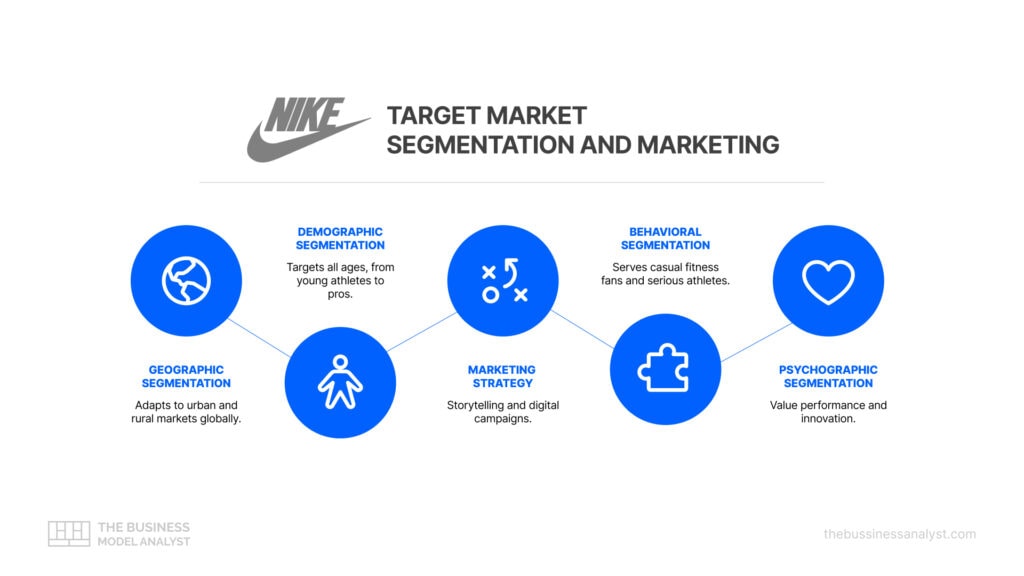
Nike’s segmentation strategy runs across five layers. Most analyses stop at four. The fifth (technographic) is where Nike’s strategy quietly outpaces its competitors.
1. Demographic Segmentation: Young, but Broadening
Age: Nike’s core buyer is 15 to 45, with the heaviest concentration in Gen Z (roughly 13 to 28 in 2026) and millennials (29 to 44). Piper Sandler’s Fall 2025 Teen Survey of 10,969 U.S. high schoolers ranked Nike #1 in both footwear and apparel, with footwear mindshare stabilizing after several quarters of decline. Male teen share, particularly upper-income, grew sequentially for the first time since fall 2022.
Gender: Nike sells to men, women, and kids, but in fiscal 2024, apparel only represented about 28% of Nike Brand revenue, a gap the company is now openly targeting. The 2025 Super Bowl “So Win” campaign featuring Caitlin Clark, Sabrina Ionescu, and Jordan Chiles was Nike’s first big-game ad in decades and signaled the women’s market is now a strategic priority. The NikeSKIMS partnership with Kim Kardashian’s Skims, with a global rollout planned for 2026, exists for one reason: claw back women who defected to Lululemon, Alo, and Vuori.
Income: Nike’s pricing positions it firmly in the mid-to-premium tier. DataWeave reported Nike footwear prices rose 17% and apparel 14% between September 2024 and September 2025, partly to absorb tariff costs (Nike disclosed a $1.5 billion tariff hit for the fiscal year). The brand is leaning into premium, not chasing the value end.
2. Geographic Segmentation: North America Carries the Business
Nike’s FY2025 revenue split tells the story:
- North America: $19.57 billion (43.82% of total revenue)
- EMEA (Europe, Middle East, Africa): $12.26 billion (27.44%)
- Greater China: $6.59 billion (14.74%)
- Asia Pacific & Latin America: $6.25 billion (13.99%)
- Converse: $1.69 billion
North America is the anchor. Greater China is the worry, Q2 FY2026 showed continued declines there as local brands and Adidas pressed advantage. The target market in each region looks different: urban U.S. consumers buy Nike for lifestyle and sport equally, while rural markets skew functional. In China, the brand is being challenged on premium positioning by domestic players like Anta and Li-Ning.
3. Psychographic Segmentation: The “Athlete Mindset”
This is where Nike’s brand actually lives. Customers aren’t bought with technical specs, they’re bought with a posture: ambition, self-expression, and the belief that effort is identity. The behavioral traits Nike targets break into a few clear micro-segments:
- Performance athletes: professional and serious amateurs in running, basketball, soccer, training, and Jordan-anchored categories
- Weekend warriors: half-marathon trainers, recreational runners, gym regulars
- Style shoppers: consumers (often women in their 20s and 30s) who buy athletic wear for daily fashion, not workouts
- Sneakerheads and collectors: Air Jordan, Dunk, and Air Max devotees who treat releases as cultural events
- Values-aligned buyers: consumers who weight sustainability, diversity, and social commitment in purchase decisions
Nike’s “So Win” campaign, BeTrue collection, and ongoing inclusivity messaging are designed to keep the values-aligned segment locked in, even when competitors offer better-engineered shoes.
4. Behavioral Segmentation: Loyalty Through Personalization
Nike uses purchase history, app activity, and engagement signals to retarget customers across channels. The Nike app ecosystem (Nike App, Nike Run Club, Nike Training Club, SNKRS) functions as a behavioral data engine. When you engage on one platform, you get pulled into ads on another. This isn’t unique to Nike, but the scale is: SNKRS alone built a global sneakerhead community years before competitors caught up.
Behavioral segments include:
- Loyal members (Nike Membership): repeat buyers who get early product access and exclusive drops
- Lapsed buyers: historical Nike customers being targeted with re-engagement campaigns
- High-frequency app users: people training inside Nike’s apps who get product nudges tied to their workouts
- Wholesale-channel shoppers: the group Hill is specifically rebuilding for after Donahoe’s direct-to-consumer push cost shelf space at retailers like Foot Locker, DSW, and Dick’s
Hill’s strategy explicitly rebuilds wholesale, Q2 FY2026 wholesale revenues grew 8% while Nike Direct fell 8%, reversing the prior CEO’s direction.
5. Technographic Segmentation: Where Nike Is Quietly Different
Most competitor analyses skip this layer. They shouldn’t. Nike treats tech adoption as a segmentation variable: which devices customers use, which apps they live inside, whether they buy through digital channels, and how they respond to performance tech in products.
Examples in market right now:
- Project Amplify: a powered footwear system using bionic technology to assist natural movement, logged over 2.4 million test steps in development
- Nike Mind 001 and Mind 002: sneakers built on a decade of neuroscience research, using foot-based sensory stimulation to support mental focus
- Aero-FIT apparel: cooling fabric designed to double airflow, set to debut at the 2026 Winter Olympics and FIFA World Cup
- Therma-FIT Air Milano: outerwear with real-time temperature regulation
These aren’t broad-market plays. They’re targeted at the technographic segment that pays a premium for innovation and signals identity through gear.
Nike’s Primary Customer Personas (2026)
If you collapse the five segmentation layers into archetypes, Nike’s audience looks like this:
The Performance Athlete: 18 to 35, trains seriously in one or more sports, buys for function first but pays a premium for brand. Heavy SNKRS and Nike Training Club user. Likely owns multiple sport-specific shoes.
The Style-First Consumer: Often female, 20 to 40, buys leggings, sports bras, and athleisure for daily wear, not necessarily for workouts. This is the segment most contested by Lululemon, Alo, Vuori, and now NikeSKIMS.
The Sneakerhead: 16 to 35, follows release calendars, lines up on SNKRS, treats Air Jordans and Dunks as collectibles. Disproportionately influential on Gen Z fashion.
The Aspirational Teen: 13 to 19, Nike is identity gear. Piper Sandler’s data shows this group stayed loyal even through Nike’s broader slump, though female teens have been the softest spot.
The Lifestyle Casual: 25 to 55, doesn’t train seriously but wears Nike for comfort, fashion, and brand familiarity. The single largest revenue contributor in volume terms, even if Nike’s marketing rarely speaks to them directly.
What Nike Is Doing Differently in 2026
Three shifts worth flagging, because they change how the target market is being approached:
Reorganization around sport, not gender. Hill restructured Nike’s internal teams away from men’s/women’s/kids categories back to sport-specific units (Running, Basketball, Football/Soccer, Training, Sportswear, Jordan). The logic: serve athletes through the lens of how they actually identify, not how retailers sort inventory.
Wholesale resurrection. The Donahoe-era DTC strategy alienated retail partners and gave Hoka and On the shelf space they needed to scale. Hill is rebuilding those relationships. For Nike’s target market, this means broader physical availability, especially for casual lifestyle buyers who don’t shop nike.com.
Women as a strategic priority, not a category. NikeSKIMS, the Aritzia partnership, the “So Win” campaign, and category-led product investment all point the same direction. Women’s was 28% of Nike Brand revenue in FY2024 and the company has effectively said that ceiling is unacceptable.
The Competitive Squeeze on Nike’s Target Market
Nike still leads, but the competitive set has tightened:
- Adidas: Samba and Gazelle franchises pulled female mindshare in 2024-2025
- On Running: moved past Hoka in the Fall 2025 Piper Sandler survey, signaling broader appeal beyond serious runners. Zendaya partnership and the Federer-Zendaya tennis stunt (15M+ Instagram views, 7M+ TikTok) widened the brand’s Gen Z reach
- Hoka: captured significant share from Nike during the running shoe boom, with Q2 sales surging roughly 35% during Nike’s weakest stretch
- New Balance: rose to third favorite footwear brand among upper-income teens
- Lululemon, Alo, Vuori: continue to own the women’s athleisure tier Nike is trying to re-enter
The takeaway for anyone studying Nike’s target market: the customer hasn’t changed dramatically. The competitive context has. Nike’s job in 2026 is less about discovering new segments and more about defending the ones it already owns while reopening doors it closed during the DTC pivot.
Frequently Asked Questions
Who is Nike’s primary target market? Active, image-conscious consumers aged 15 to 45, concentrated in urban centers, with mid-to-upper income. The core is split between Gen Z and millennials, with men still buying slightly more in footwear and women now a strategic growth priority.
What is Nike’s largest revenue market? North America. In FY2025, North America generated $19.57 billion, 43.82% of Nike’s $46.3 billion in total revenue.
Does Nike target Gen Z? Yes, aggressively. Piper Sandler’s Fall 2025 Teen Survey of 10,969 U.S. high schoolers ranked Nike #1 in both footwear and apparel. Male teen mindshare stabilized for the first time since fall 2022, though female teen mindshare remains under pressure from Ugg, Adidas, and On Running.
Why is Nike focusing more on women in 2026? Women’s apparel was only about 28% of Nike Brand revenue in FY2024. With Lululemon, Alo, and Vuori capturing premium women’s athleisure, Nike launched the “So Win” Super Bowl campaign, a NikeSKIMS partnership rolling out globally in 2026, and an Aritzia partnership specifically to win back this segment.
How does Nike segment its market? Across five dimensions: demographic (age, gender, income), geographic (region, urban vs. rural), psychographic (lifestyle, values, identity), behavioral (purchase patterns, loyalty, app engagement), and technographic (device usage, openness to performance technology).
Is Nike still the #1 brand for teens? Yes, in both footwear and apparel, per Piper Sandler’s Fall 2025 Teen Survey. But mindshare is being contested by On Running, Hoka, New Balance, and Adidas, particularly among female and upper-income teens.
What income level does Nike target? Mid-to-upper income. Nike’s premium pricing (which rose 17% in footwear and 14% in apparel from September 2024 to September 2025) positions it above value brands and roughly even with or below ultra-premium athletic specialists like Hoka and On.
The Bottom Line on Nike’s Target Market
Nike’s target market is broader than any single demographic and narrower than the company’s “if you have a body, you are an athlete” line suggests. The real audience is people who buy athletic gear to express identity as much as to perform. That’s why Nike spends so heavily on emotional advertising, athlete endorsements, and cultural moments, the product is the artifact, the brand is the purchase.
For 2026, the playbook is clear: hold the teen and young-adult base, reignite women, defend North America, stabilize China, and use innovation (Mind, Amplify, Aero-FIT) to remind premium consumers why they paid more in the first place. Whether Hill’s turnaround sticks will depend less on segmentation theory and more on execution against a competitive field that finally figured out how to take share from Nike.