
Every chain is calling this a return to hospitality. Inside a franchisee’s P&L it is a marketing fee bolted to a number the counter was just told to stop chasing.
McDonald’s spent a decade teaching its crews one question: are you using the app? A new internal training document, described by the Wall Street Journal on September 10, tells them they no longer need to ask it.
That sounds like a script edit. It is attached to a fee. Since 2025, U.S. franchisees have funded a Digital Marketing Fund charged at 1.2% of projected identified digital sales, where identified means the customer logs in at the moment of the transaction so the company can market to them afterward. The counter question was one of the conversion mechanisms for that definition.
The number underneath it is not small. Across 70 markets, trailing-twelve-month systemwide sales to loyalty members reached roughly $40 billion at the end of June, up more than 20%, on about 220 million 90-day active users. CFO Ian Borden has told investors that active loyalty members are the single most important digital metric the company tracks. The hospitality push is the first time McDonald’s has deliberately removed one of the crew-level levers that feeds it.
What Happened
The Journal reported that after years of spending on kiosks and mobile ordering, the largest U.S. chains have concluded that a meaningful slice of customers simply wants a person at the counter who is pleasant about it. Tiffanie Boyd, the company’s global chief people officer, said McDonald’s will launch what amounts to its largest service-training effort ever, starting next month.
The specifics matter more than the framing. Later this year McDonald’s begins retraining more than two million restaurant workers, corporate employees and suppliers worldwide. It is scripting new guidelines for how crew interact with customers, including checking on people in the lobby and again before they leave. Hospitality becomes a heavier weight in how franchisee performance gets graded. All of it sits under an initiative called Make it Golden, which Boyd framed as a multiyear effort.
And the crew no longer needs to ask about the app.
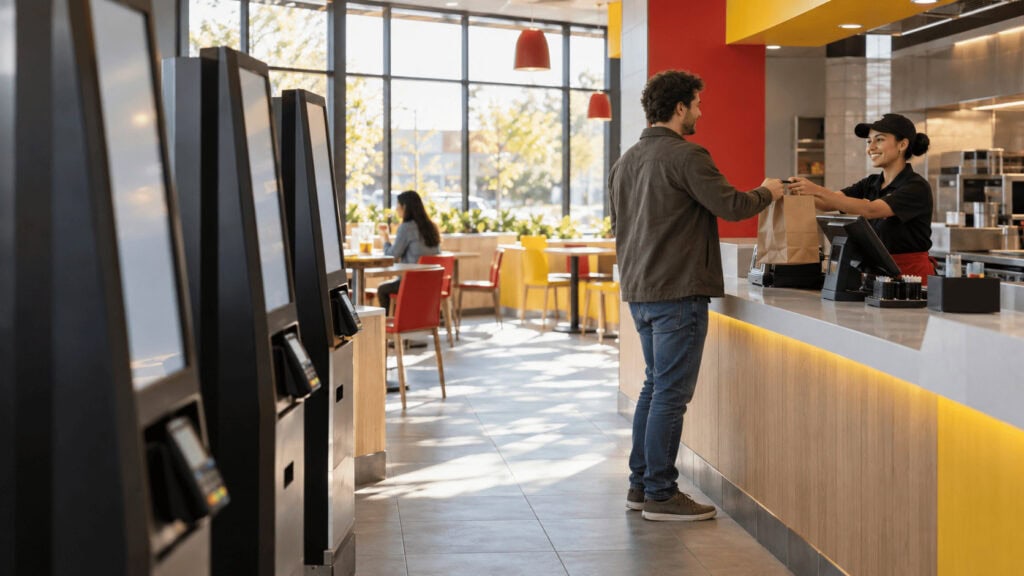
Everyone else is moving the same direction. Burger King has shown a prototype that relocates part of the kiosk bank to the side of the lobby, and U.S. president Tom Curtis says the chain wants franchisees to keep counters staffed. Managers are being told to verify orders, cover the front counter and handle complaints. Wendy’s is folding service into its broader overhaul and CEO Bob Wright is reviewing whether the chain’s AI drive-thru trials are actually helping operators. Starbucks is spending on training, labor and nicer cafes.
Nobody is removing a kiosk. That is the part worth holding on to.
The Backstory
The kiosk was sold to franchisees on two benefits, and only one of them arrived.
Benefit one was check size. A screen never forgets to offer the large fries, and it does not make anyone feel judged for saying yes. That worked, and McDonald’s executives have said so repeatedly.
Benefit two was labor. The pitch was that self-service would shorten counter lines and free workers to walk food to tables and look after the dining room. What actually happened is that the freed hour got claimed by a third channel. Delivery and drive-thru grew through the same period, and both consume assembly labor in the back. The dining room did not get the dividend; the delivery bag did. A McDonald’s franchisee group surveyed its members recently and reported that guests increasingly find the visit brusque and depersonalized.
Somewhere in that decade, the fee architecture hardened around the digital side.
In May 2024, a memo from then U.S. customer experience officer Tariq Hassan and chief information officer Whitney McGinnis told operators that from 2025 they would contribute 1.2% of projected identified digital sales into a new U.S. Digital Marketing Fund. It is not an extra charge on top of everything else. It comes out of the existing marketing contribution, which requires operators to spend at least 4% of gross sales. The company projected the shift would actually improve a typical store’s cash flow by about $2,600 a year, because it moved digital costs off the individual P&L and into the pooled fund. Franchisees in the U.K., Canada, Australia and Germany feed an equivalent global version.
Two details in that memo do the work. The rate is reset annually against a fresh projection. And the fund pays for the ongoing machinery of the digital business: the platform, data management, network security, storage.
One footnote with a long tail: Hassan left McDonald’s in January 2025 and, as of August 24, is Wendy’s chief marketing and customer growth officer. The executive who built the digital fee now runs marketing at the chain whose CEO is asking whether AI belongs in the drive-thru at all.
The Fee Nobody Connected
Read the definition again. Identified digital sales are sales where the customer names themselves. An anonymous tap on a kiosk screen does not qualify. A loyalty login does. So does a delivery order placed through an account.
Now put the two facts side by side. The fund’s cost base is largely fixed, because security, storage and platform engineering do not get cheaper when fewer people log in. The fund’s revenue base is a percentage of a behavior. And the rate gets recalculated every year against a projection.

The arithmetic is not complicated. Hold the fund’s budget flat and let identified digital sales land 10% below projection, and the rate has to go to roughly 1.33% to raise the same dollars. McDonald’s does not publish U.S. identified digital sales, so what follows is modeled, but the shape holds at any reasonable assumption.
Take the 2026 Franchise Disclosure Document average of $4.06 million for a U.S. franchised restaurant. The 4% minimum marketing obligation is about $162,280 a year. If identified digital runs at 30% of sales, the fund’s slice is roughly $14,600, or 9.0% of that marketing budget. At 1.33% it becomes about $16,200, or 10.0%.
That is 100 basis points of the marketing budget, around $1,600 per restaurant, roughly $22 million across 13,706 U.S. restaurants, moving out of brand advertising and into digital plumbing. In the exact year the franchisor is asking operators to spend more on people.
Nobody at McDonald’s designed it that way. That is rather the point. Fee formulas written during a boom encode an assumption about which direction the denominator travels, and this one assumed the counter would keep recruiting.
What the Counter Actually Costs
Hospitality is not a script. It is a shift.
Asking crew to greet arrivals, check the lobby mid-meal and say something warm on the way out describes a person who is not simultaneously bagging a delivery order. Model that person at $17 an hour fully loaded across an eight-hour shift, every day, and it runs about $49,640 per restaurant per year. Across the U.S. system that is roughly $680 million annually, and unlike a remodel it recurs forever.
At 20% incremental flow-through on a $4.06 million average unit volume, that position needs about 6.1 points of same-store sales to pay for itself. McDonald’s U.S. delivered 0.8% in the quarter ended June 30, with guest counts negative.
The franchisor sits on the other side of that trade. It collects roughly 14 cents of every franchisee sales dollar and keeps about 82.5 cents of each of those, a split covered in full in our breakdown of McDonald’s Q2 landlord margin. We are not re-running that argument here. The relevant piece of it is narrow: the hospitality standard is enforced through franchisee grading, and grading is the cheapest instrument a franchisor owns.
The building is already committed, incidentally. The prototype McDonald’s unveiled with its NEXT growth strategy in June includes dual service counters that separate drive-thru from front counter. The human counter is a construction line as well as a training module, and the construction line is funded by the operator.
The Business Model Angle
A fee indexed to a behavior is a bet on that behavior. When the denominator of a percentage fee is a customer action rather than a sale, any operating change that discourages the action silently reprices the fee. Anyone running or paying a percentage-of-something charge should ask which human behavior the denominator depends on, and who controls it.
Digital cost bases are fixed; digital revenue bases are not. Pooling platform, security and data costs into a variable-rate fund feels efficient while adoption compounds. It builds a rate that rises precisely when adoption disappoints, which is the moment operators can least absorb it.
Service is the cheapest lever and the only permanently recurring one. A training script costs the franchisor close to nothing and the operator a wage line every year from now on. Cheap levers run first when capital is gated, which is exactly the pattern Burger King is running on food quality while its remodel money waits. The suppliers positioned here are unglamorous: training platforms, labor scheduling software, service measurement, mystery shopping.
Watch the rubric, not the press release. The genuinely binding change in this story is hospitality carrying more weight in franchisee grading. In franchising, the grading rubric is the soft layer of the contract, and it gates rewrites, new territory and remodel approvals. Corporate changed a number that costs it nothing and moves everything.
The Risk
The strongest counter is Chick-fil-A, which demonstrates that screens and service are not opposites. It posts the longest total drive-thru time in the 2025 QSR Drive-Thru Report at roughly 427 seconds and the fastest time per car at roughly 157 seconds, carries 2.72 cars in the lane against a study average of 1.20, scores 93% on friendliness against a 78% average, and has led the ACSI quick-service category for eleven consecutive years. It also runs tablets in the drive-thru and Mobile Thru in more than 300 restaurants. The problem was never the screen.
But its freestanding average unit volume is about $9.16 million against roughly $4.06 million at a U.S. McDonald’s. A crew hour costs about the same in both buildings. The hospitality gap is substantially a volume-density gap, and no script closes 2.3x of sales per restaurant. Its whole structure, laid out in our Chick-fil-A SWOT analysis, is built around that density.
Second, the fee may never bite. The fund is carved out of an existing 4% minimum rather than added to it, and if identified digital keeps compounding above 20% the rate simply holds. McDonald’s targets of 250 million active users and $45 billion in loyalty sales by the end of 2027 look reachable on current growth. The exposure is the marginal user, not the installed base.
Third, the counter question was one recruiting channel among several, and probably not the largest. Web ordering without a download, delivery-platform logins and paid media all produce identified users. Dropping one ask does not stop the machine.
Fourth, hospitality may simply be worth more than a point of digital mix. Technomic’s finding that a growing share of Gen-Z consumers values friendly service is the entire argument for the pivot, and a customer who has moved to Arby’s or Chick-fil-A is a loss no marketing fund repairs. Trading some app friction for retained traffic could be straightforwardly correct.
Quick Questions
Is McDonald’s removing its kiosks? No. Neither is Burger King. The chains are re-weighting how much of the experience the screen is allowed to carry, and adding staffed counters back alongside it.
What is the Digital Marketing Fund? A U.S. pool funded since 2025 at 1.2% of projected identified digital sales, paid from inside the existing 4% minimum marketing contribution rather than on top of it. The rate is reset annually against a fresh projection.
What counts as an identified digital sale? One where the customer identifies themselves at the point of transaction, such as logging into loyalty or ordering through a delivery account, which lets McDonald’s market to them directly afterward.
How big is the loyalty business? About $40 billion of trailing-twelve-month systemwide sales to loyalty members across 70 markets as of the end of June, on roughly 220 million 90-day active users. The stated targets are $45 billion and 250 million by the end of 2027.
What actually changes for a franchisee? Retraining for a workforce of more than two million, scripted lobby check-ins, and hospitality carrying more weight when corporate grades the restaurant. The labor to deliver it sits on the operator’s P&L.
The Business Model Analyst Take
The industry is telling this story as a rediscovery. Machines got cold, customers noticed, humans are back. It is a nice story and the underlying complaint is real.
What is actually happening is a metric swap at the point of sale. For ten years the crew was paid to move one number, app attachment, and that number had a fee formula and a $40 billion loyalty rail built on top of it. The crew is now being paid to move a different number, and the fee formula did not come along.
That is not a scandal. It is what happens when a company installs a percentage charge on a behavior and then, four years later, decides the behavior was costing it something else. McDonald’s will find the identified users elsewhere, through web ordering and delivery logins and paid media, and it will probably hit the 2027 targets. The rate may never move at all.
But there is a version of the next two years where a franchisee pays a slightly larger slice of an unchanged marketing budget for a digital channel that grew more slowly, while also paying for a person to stand at a counter that a kiosk was bought to replace. Both bills land on the same P&L. Only one of them was ever pitched as a saving.
Service with a smile was always available. It was just never free.