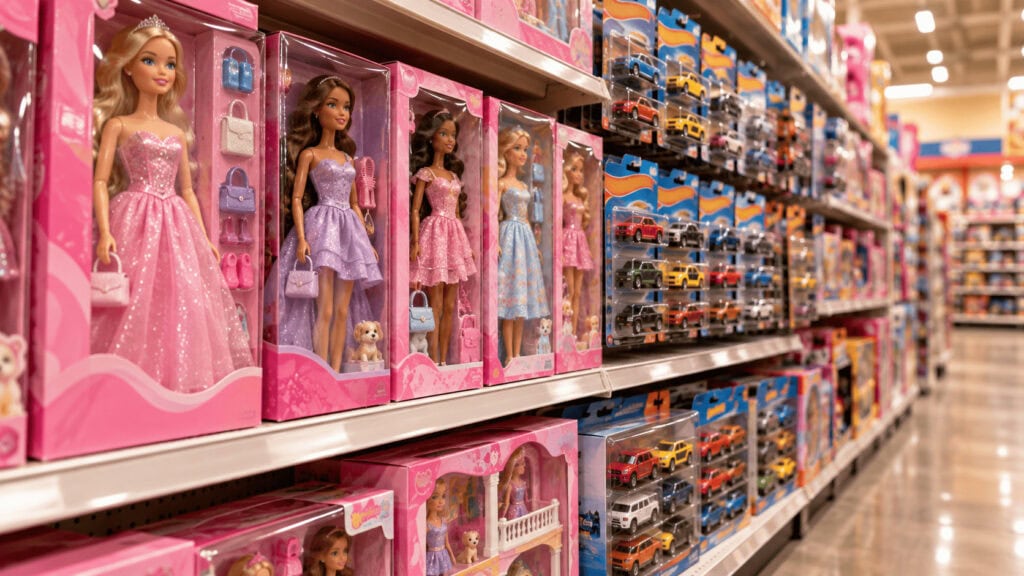

Authentic Brands collects royalties and leaves the factories to someone else. Mattel’s profit lives in the factories.
Authentic Brands Group has discussed a takeover of Mattel at more than $20 a share, a price that would value the Barbie maker at roughly $6 billion. Authentic runs one of the most profitable models in consumer goods: it owns brand names, lets partners make and sell the products, and keeps about 6% to 7% of their sales as royalties. Applied to Mattel, that model has a problem. At Authentic’s standard rate, Mattel’s 2025 net sales would produce roughly $282 million of royalty profit, about 30% of the $927 million of adjusted EBITDA Mattel actually earned. The bid only works if someone else wants the rest of that profit, and the factories that produce it.
On Wednesday, Mattel lost the chief executive who turned Barbie into a billion-dollar movie. On Thursday, a company that has never built a toy turned up asking about the price.
The stock did what stocks do. Mattel jumped as much as 36% intraday and closed about 18% higher at $15.04. The obvious read is that Barbie finally found a buyer who values the brand more than Wall Street does. The less obvious read is about what exactly Authentic would be buying, because its entire business is built on not owning the part of Mattel that makes most of the money.
What Happened
On October 1, the Wall Street Journal reported that Authentic Brands Group had been discussing an offer for Mattel that could value the company at more than $20 a share. CNBC and Reuters followed, with Reuters putting the potential value at around $6 billion or more. There is no formal sale process, there is no guarantee Mattel will engage, and Mattel declined to comment.
The timing is the story. Two days earlier, on September 29, Ynon Kreiz resigned as Mattel’s chairman and CEO, effective October 2. He is leaving to become co-CEO of the combined Paramount Skydance and Warner Bros. Discovery, the $110 billion merger BMA covered when a court froze it in July. Mattel shares fell about 4% to $12.66 on the news.
His replacement is Roger Lynch, the Conde Nast chief executive who has sat on Mattel’s board since 2018 and served as its independent lead director. Lynch becomes chairman on October 2 and CEO no later than November 2. Jonathan Anschell, Mattel’s chief legal officer, holds the fort in between.
The Journal flagged that Lynch’s transition could complicate any deal while he sets his own strategy. Mattel’s own filings show why that is worth taking seriously.
The Backstory
Mattel has been a takeover candidate in all but name since spring. On May 7, Southeastern Asset Management, which manages more than 4% of the stock, published an open letter urging the board to explore strategic alternatives. It named three kinds of buyer: private equity, another toy company (Hasbro, with which Mattel has held on-and-off talks for decades), and a large media company. Southeastern pointed to a value near $30 a share.
The share price has gone the other way. Mattel is down about 33% this year, squeezed by tariffs and a weak second quarter.
The numbers behind that slide:
- 2025: net sales of $5.35 billion, down 1%. Adjusted operating income of $620 million, down 16%. Adjusted EBITDA of $927 million, down from $1.06 billion.
- Q2 2026: net sales up 10% to $1.13 billion, but adjusted operating income fell to $39 million from $96 million. Adjusted gross margin dropped 260 basis points to 48.6%, with gross tariff costs taking 170 basis points and royalties another 110.
- Balance sheet, June 30: 285.7 million shares, $523.9 million of cash and net debt of $1.81 billion.
Authentic is the opposite kind of company. It owns more than 50 consumer names, including Reebok, Brooks Brothers, Champion, Guess and Dockers, which it bought from Levi Strauss this year, plus estates like Elvis Presley. Partners generate about $38 billion of retail sales under those names. In September, CEO Matt Maddox told Bloomberg that Authentic earns $1.8 billion of EBITDA on $2.2 billion of revenue, an 81% margin, by collecting royalties of roughly 6% to 7% on goods its partners make. He also said an IPO could come as early as the first half of 2027.
That margin exists because Authentic owns no factories, carries no inventory and spends almost nothing on capital equipment. Mattel owns all three.
The Plan
Authentic has not described a plan for Mattel, and Mattel has not said it will listen. But Authentic has shown exactly how it handles a public company with an operating business attached.
In January 2026 it closed the take-private of Guess. The structure is the template. Guess moved substantially all of its intellectual property into a new entity. Authentic owns 51% of that IP company. The Marciano family and CEO Carlos Alberini own the other 49%. The operating company, meaning the stores, the staff and the supply chain, went private and is 100% owned by Guess management, which pays royalties to the IP company.
Authentic bought the name. Somebody else kept the business that uses it.
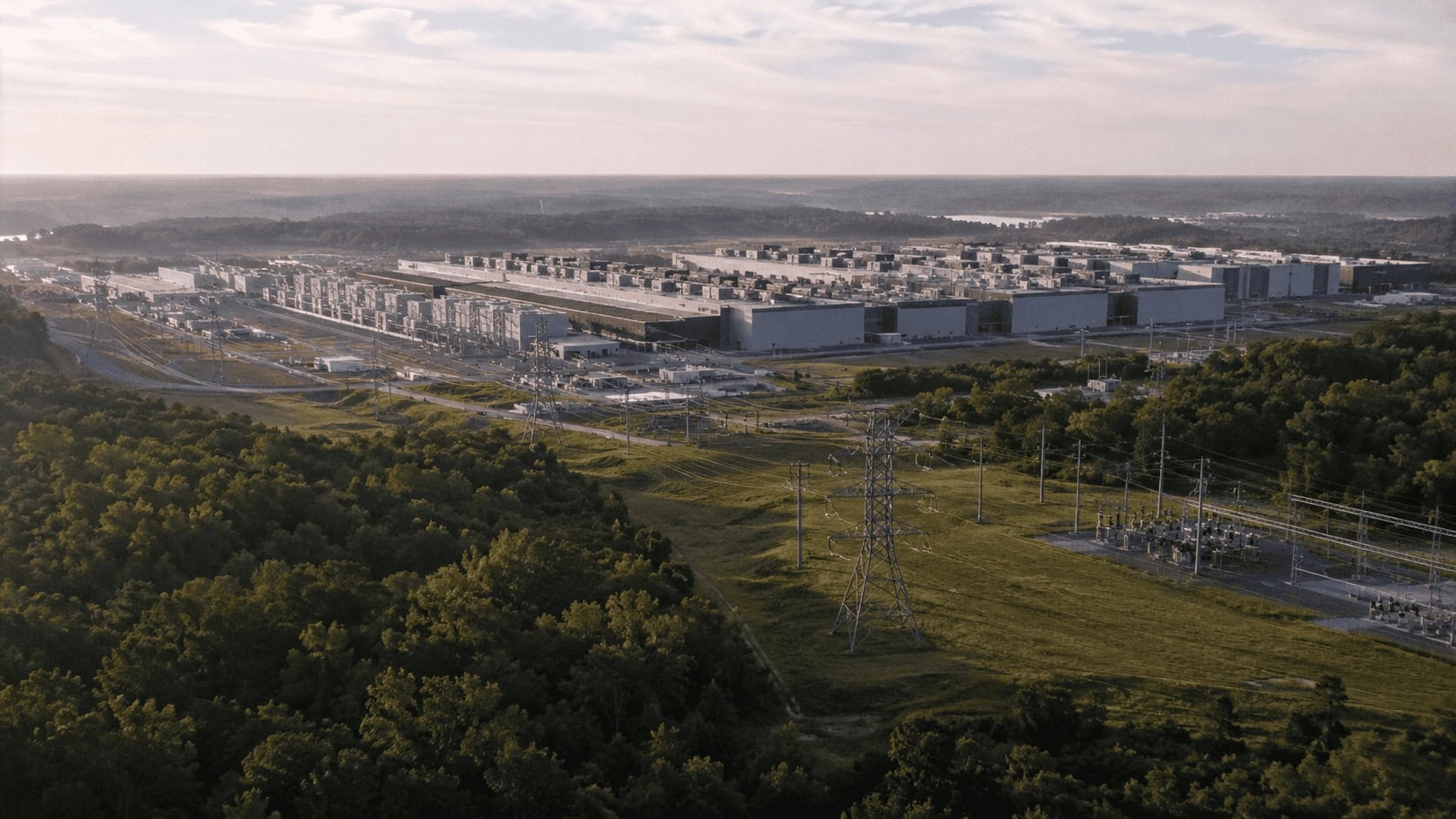
Mattel is a harder version of the same problem. Its 10-K says most core products are made in company-owned facilities, with owned principal plants in Indonesia, Malaysia, Mexico and Thailand and leased ones in China. Mattel spent $182 million on capital expenditure in 2025. It designs, molds, ships and sells, and earlier this year it paid $178.6 million to buy out the other half of its mobile games studio, Mattel163.
So the practical question is not whether Barbie is valuable. It is how a royalty company carves a royalty stream out of a manufacturer, and what that stream is worth once it has been carved.
The Business Model Angle
Here is the arithmetic nobody has run on the bid.
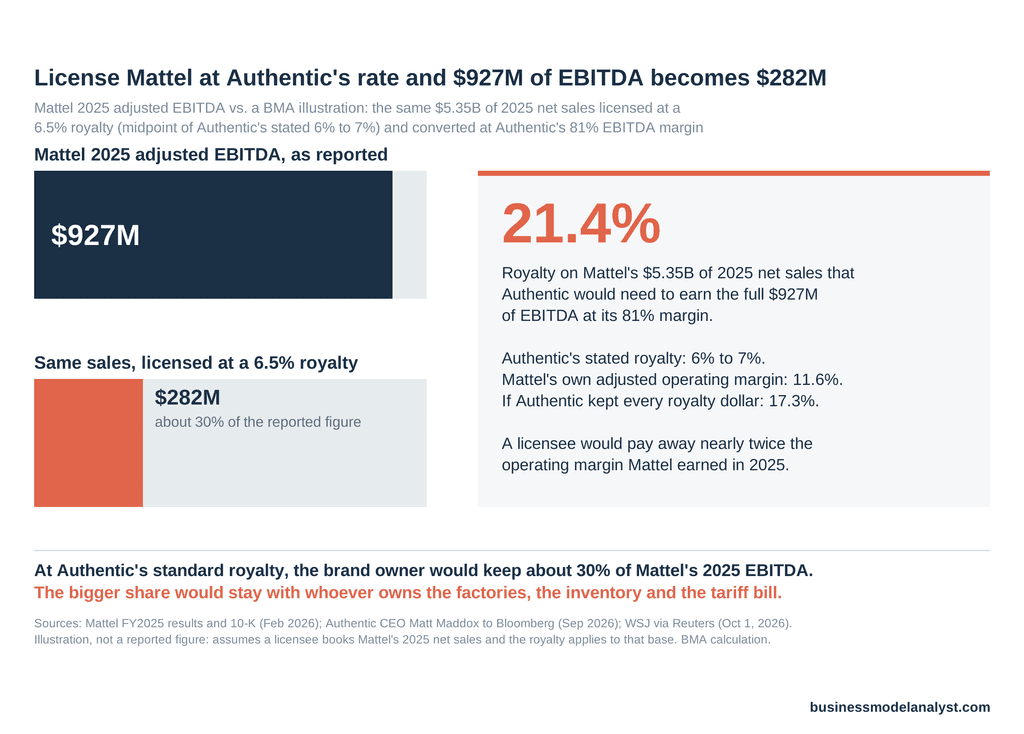
Assume a licensee takes over Mattel’s operations and books the same $5.35 billion of 2025 net sales. Authentic charges the midpoint of its standard 6% to 7% royalty on that base and converts it at its reported 81% EBITDA margin.
- Royalty revenue: about $348 million.
- Royalty EBITDA: about $282 million.
- Share of Mattel’s actual 2025 adjusted EBITDA: about 30%. The full 6% to 7% range gives $260 million to $303 million, or 28% to 33%.
Now run it backwards. To keep all $927 million of EBITDA inside the brand-owning company, Authentic would need a royalty of about 21.4% of net sales. Mattel’s own adjusted operating margin in 2025 was 11.6%. A licensee paying 21.4% would be handing over nearly twice the operating margin the entire business earned last year. Even if Authentic kept every royalty dollar as profit, the break-even rate would be 17.3%.
That gap is the whole deal. Three things follow from it.
The royalty rate becomes a transfer price. In a Guess-style split, the rate between the IP company and the operating company is not a market price. It is a dial that decides who gets the value. Set it at 6.5% and the IP side is worth a fraction of the bid. Set it at 15% and the operating company, which carries the factories, the inventory and the tariffs, may not be able to service its own debt.
The conversion layer is where toy money lives. This is the mirror image of what BMA found in Lego’s record half on borrowed characters. Lego rents Star Wars and Pokemon, owns every step that turns them into product, and printed a 26.0% operating margin. Authentic’s model would do the reverse with Mattel: own the characters and shed the machine. In toys, the evidence keeps saying the machine is worth more than the name on the box.
Concentration breaks the rating story. S&P raised Authentic’s ratings this year partly because no single licensee contributes more than 4.5% of revenue and only eight contribute 2% or more. A Mattel operating company paying $348 million a year would be about 14% of Authentic’s combined revenue, roughly three times that ceiling. Moody’s has already flagged licensee bankruptcies as the key weakness of the model. One licensee carrying Barbie, Hot Wheels and Fisher-Price would be a far bigger single exposure than any licensee on its books today.
The licensing playbook works beautifully on apparel brands whose value sits mostly in the name. As BMA argued in the KFC China piece, choosing to own the royalty rather than the operation is a real strategy with real trade-offs. Mattel is a case where the operation is most of the profit.
The Risk
The skeptic has real arguments, and they deserve a fair hearing.
Toy royalties run higher than apparel royalties. Big entertainment properties command rates in the high single digits to low teens of wholesale, which is why Mattel’s own royalty bill moved its gross margin by 110 basis points last quarter. At 13%, the illustration lifts royalty EBITDA to about $563 million, or 61% of Mattel’s 2025 figure. The catch is unchanged: the licensee would be paying 13% of sales out of a business whose whole operating margin was 11.6%.
Authentic might keep more of the operation than usual. Nothing in the reported talks says it would split Mattel at all. It could own the operating company outright for a while, or partner with a strategic or financial owner. That would be a new model for Authentic, though, and it would arrive just before an IPO that investors will price on royalty-quality earnings.
EBITDA undercounts the entertainment option. Mattel’s films, games and live experiences do not show up fully in a toy company’s EBITDA. Authentic gets about 20% of its revenue from entertainment properties and has been pushing further into that lane, most recently with a creator deal. A buyer could rationally pay for Barbie’s next decade of content rather than its last year of dolls.
The price itself is modest. At $20, equity value is about $5.71 billion. Add net debt of $1.81 billion and enterprise value is about $7.52 billion, or roughly 8.1 times 2025 adjusted EBITDA. Twenty dollars is only about 4% above Mattel’s closing price of $19.18 on October 23, 2025, and a third below Southeastern’s $30 marker. Shareholders may read this as a starting bid, which leaves room for Hasbro, a media buyer or private equity.
The board just priced a standalone plan. Lynch’s September 29 offer letter includes a $10.6 million make-whole cash bonus payable by year end, a fully vested $6 million make-whole stock grant, a $10 million 2026 equity award, a $6 million performance grant tied to three-year relative shareholder returns, and a $985,000 relocation payment. That is about $33.6 million in cash and target equity value. The repayment clauses apply if he quits without good reason or is fired for cause, not if the company is sold. None of that blocks a deal. It does show the board planned on independence two days before a bidder’s name became public.
Quick Questions
Is Mattel being sold? Not yet. The Wall Street Journal reported that Authentic Brands Group has discussed an offer above $20 a share, but there is no formal sale process and Mattel has not commented.
How much is Authentic reportedly offering? More than $20 a share, which values Mattel’s equity at around $5.7 billion to $6 billion. Including net debt of $1.81 billion, the enterprise value is about $7.5 billion.
What is Authentic Brands Group? A brand-licensing company that owns names like Reebok, Brooks Brothers, Champion, Guess and Dockers and licenses them to operating partners. It reports $2.2 billion of revenue and $1.8 billion of EBITDA, and has said it could go public in 2027.
Why did Mattel’s CEO leave? Ynon Kreiz resigned to become co-CEO of the combined Paramount Skydance and Warner Bros. Discovery. Board member Roger Lynch, the former Conde Nast CEO, takes over by November 2.
Would Barbie toys change under Authentic? Not necessarily on the shelf. Under Authentic’s usual model, an operating partner would make and sell the toys while Authentic owns the brand and collects royalties. Who that partner would be is the open question.
The Business Model Analyst Take
Everyone is pricing this as a bet on Barbie. It is really a bet on a royalty rate.
Authentic’s machine works when the brand is the business and the factory is a commodity. Reebok shoes and Guess jeans can be made by plenty of competent partners. Mattel is different because so much of its value sits in design, molds, safety compliance and a supply chain spread across six countries. Hasbro keeps teaching the same lesson, where one card game it designs, prints and sells itself now out-earns the rest of the company: the part of a toy company that throws off cash is usually the part it runs with its own hands.
So watch three things if this turns into a real offer. First, whether Authentic proposes a Guess-style split, and who signs up to own the operating side. Second, the royalty rate between the two halves, because that single number decides which side of the deal holds the value. Third, whether Lynch treats the approach as an opening bid or an interruption.
Barbie can survive almost any owner. The factories are the part looking for a home.