
Europe’s rare factory success works because it refuses to grow. The brand does its growing in someone else’s factories, mostly in China.
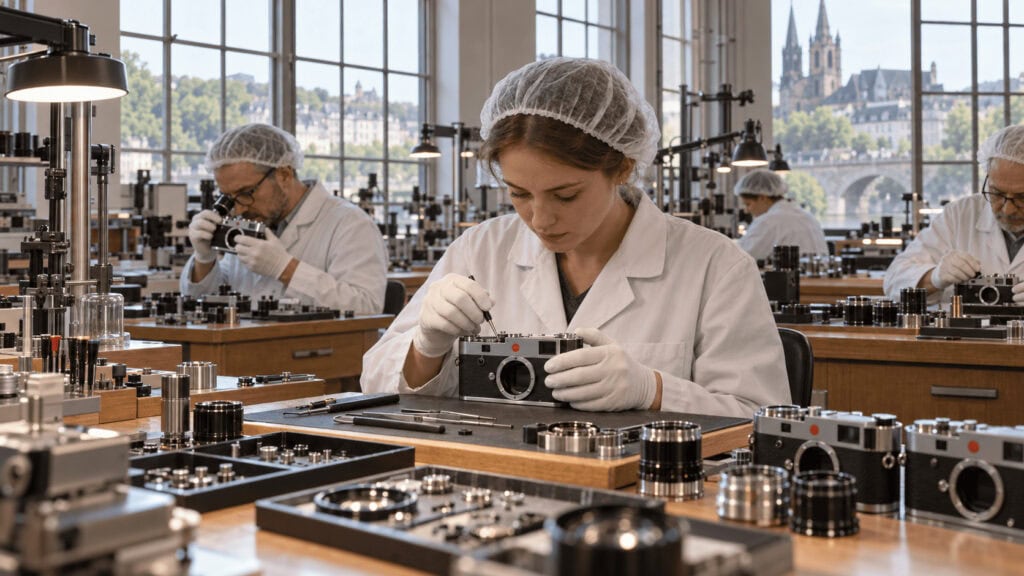
Leica’s Wetzlar plant turns out about 45 M-series rangefinders a day, priced from roughly $7,000 for a film M6 to more than $10,000 for a digital M11. Run that output for a year and, on BMA’s estimate, those famous bodies bring in about 12% of the company’s €573 million in revenue. The camera that defines “Made in Germany” is the showroom. The business is a capped factory that sets the price, plus a licensed brand that does the scaling, and both halves now run through China.
The Wall Street Journal told Leica’s story on September 28 as a rare European manufacturing win, with a lesson attached. Owner Andreas Kaufmann says anyone making things in Europe should obsess over materials and design, and that European cars are too ugly to buy.
Nice line. Wrong lesson.
The number in the story that explains Leica is not the price tag. It is the 45. Leica does not succeed because it manufactures in Europe. It succeeds because it manufactures so little there, on purpose, and grows through other people’s assembly lines. That is a business model, and it is one most European manufacturers cannot copy for the simple reason that their problem is scale and Leica’s solution is refusing it.
What Happened
Bertrand Benoit’s WSJ feature walks through a two-decade revival. Kaufmann, a former schoolteacher, started investing in Leica in 2004, when it was cash-strapped and its then-chief was dismissing digital photography as a passing phase. He brought in new management, sourced a sensor small enough for a rangefinder, and launched the M8 in 2006, the first digital Leica rangefinder. Four out of five models Leica sells are now digital.
The rest of the playbook came later. Leica took distribution back from dealers, opened about 120 of its own stores and now books half its sales through its own channels. It runs an auction house, which last year sold the late Pope Francis’s M-A camera for roughly $7.5 million, and it sells refurbished cameras through its stores. It has pushed the brand into a Hisense-built home cinema projector and a €2,000 Leitzphone made by Xiaomi.
The Journal says sales hit a record in four of the past five years. The fifth year is the latest one. Leica published its 2025/26 results three weeks before the feature. Revenue fell 3.8% to €573 million for the year to March 2026, ending a four-year run of records. The company blamed geopolitical uncertainty, unfavorable exchange rates and stricter customs regulations, and said growth came above all from its home market of Germany.
Read the release next to last year’s and the silence is loud. The 2024/25 release boasted of continued growth in profitability. The 2025/26 release says nothing about profit at all. The Journal reports that Leica passed US tariffs on to customers without losing market share. That can be true alongside a shrinking top line, but holding share in a year your revenue fell is a consolation, not a moat.
Now the 45. At about 240 production days a year, the Wetzlar line makes roughly 10,800 M bodies. Assume a blended list price near $9,000 (about €7,750) between the $7,000 M6 and the $10,000-plus M11, and assume Leica keeps about 80% of list once dealer margins on the half it does not sell directly are taken out. That is roughly €67 million, or about 12% of revenue. Stretch every assumption across a sensible range and the answer sits between about 9% and 14%.
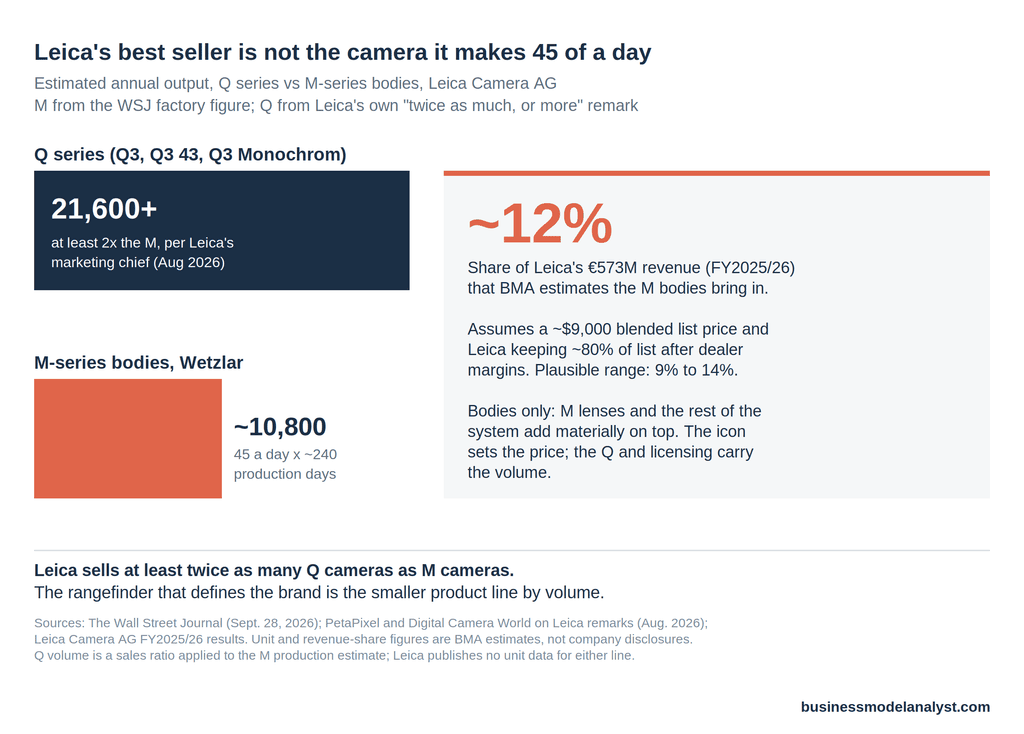
Then there is the detail that quietly contradicts the Journal’s framing of the M as Leica’s top seller. In August, Leica’s own global marketing chief, Andrea Pacella, told journalists in Wetzlar that the Q series of fixed-lens compacts sells twice as much as the entire M system, or more. The Q starts at $7,350 in the US. Leica’s 2024/25 report had already flagged the Q3 as its biggest-selling digital camera. The rangefinder is the icon. The Q is the workhorse.
The Backstory
Leica’s revival is usually told as a craft story. The financial history reads more like a sequence of decisions about what not to make at home.
The first one is 53 years old. Leica opened a plant in Portugal in 1973, and Kaufmann credits that decision for keeping most of its manufacturing in Europe at all. The Portuguese site handles preproduction of large components and builds Leica-branded binoculars. It is more automated than Wetzlar, and labor there costs just over a third of what it does in Germany. Europe’s carmakers have spent years shifting work to Morocco and Eastern Europe for the same reason. Leica made that move half a century earlier, and it is the unglamorous half of the “Made in Europe” story.
The second is the sensor. The component that decides what a digital camera actually is has never been made in Wetzlar. The M8 ran on a Kodak sensor. The current M11 runs on one from Sony. In April, Leica announced it would co-develop its first proprietary sensor with Gpixel, a CMOS maker headquartered in Changchun, China. Kaufmann’s own description of the result is a sensor engineered “between Wetzlar, Antwerp and Changchun.”
The third is capacity. Leica keeps output below demand on purpose, and it has never been shy about why. Pacella said this summer that Leica sells every Q it can build and has never considered doubling factory shifts, because it would rather hold the premium price than overproduce and be forced to cut it. That is the most important sentence anyone at Leica has said this year, and it is not about materials or design. It is about output.
Put the three together and the “European manufacturing success” has a specific shape. Germany supplies glass, mechanics, final assembly, the archive and the pilgrimage site at Leitz Park. Portugal supplies the cost base. Japan and soon China supply the silicon. The brand supplies the price.
The Plan
The new chief executive, Andreas Voll, a 44-year-old former consultant appointed in April, wants more video-focused products and a lower-priced camera to reach younger buyers, the same crowd the WSJ credits with reviving analog photography. That demand is real, and it is also the demographic most likely to treat a camera as a lifestyle object and a retro tech purchase rather than a tool.
The growth levers Voll has actually pulled so far point in one direction. The Leitzphone, unveiled in February and on sale from March, is Leica’s first internationally available smartphone, and Xiaomi builds it. The Mobile division is, per Leica’s own release, the unit still posting strong growth in a down year. The Cine 1 projector comes out of Hisense. The next-generation sensor comes out of Changchun. Leica’s first Chinese phone partner, Huawei, ended in 2021 after US sanctions, and the company simply swapped in Xiaomi.
Then there is the ownership. Blackstone holds 45% of Leica and Kaufmann’s vehicle holds the rest. Bloomberg reported in January that both were exploring a sale that could value the company at about €1 billion, with HSG (formerly Sequoia Capital China) and Sweden’s Altor among the interested parties, and HSG later described as the front-runner. The Journal now reports the talks have ended.
The multiple is the interesting part. When Blackstone came in during October 2011, Leica’s stock market value was about €277 million on trailing revenue of €248.8 million, roughly 1.1 times sales. The €1 billion figure floated this year works out to about 1.7 times the €596 million Leica booked in 2024/25. Equity value compounded at roughly 9% a year over those 14 years while revenue compounded at about 6%. Respectable. But 1.7 times sales is a premium manufacturer’s multiple, not a luxury house’s, and it tells you how outside capital reads this company: a good camera maker with a very valuable logo attached.
It also says something about who buys European champions when their founders and funds want out. The bidder list was Chinese and Nordic private equity, the same pattern BMA flagged in Germany’s scale-up funding gap. Kaufmann’s alternative is the one the Lodge Cast Iron family chose for 130 years: keep it, and accept that there is no clean exit price.
The Business Model Angle
Capacity is a pricing instrument, not a cost line. Most manufacturers size the plant to demand and then fight for margin. Leica sizes demand to the plant. Forty-five M bodies a day and no extra shifts on the Q are decisions about price, and the queue they create is what lets Leica pass through tariffs without discounting. The factory’s real output is not cameras. It is a waiting list.
Own the resale market and the used price defends the new one. Leica runs its own auction house, sells certified pre-owned cameras in its stores and gets a headline every time a prototype sells for a fortune. That matters because a camera that holds its value is easier to sell at $10,000 new. It is the inverse of the problem BMA found in Hermes watches, where a weak resale price exposes what buyers really think they are paying for, and it captures a slice of the secondhand boom that most luxury brands leave to third parties.
Rent the logo where you cannot build the factory. Leica could never build a smartphone plant or a laser TV line, and it does not try. It licenses the red dot, the color science and the design language to partners with scale, which is the same toll-booth logic behind the Thunderbolt logo. The capped core keeps the brand scarce enough to be worth renting, and the rented periphery earns volume the core refuses to produce. Remove either half and the other stops working.
The Risk
Start with the estimate. The 12% figure stacks three assumptions (production days, the blended price and the share of list Leica keeps) on one data point from a factory tour. The range of 9% to 14% is honest but wide. More importantly it counts bodies only. M lenses can cost as much as the cameras they sit on, many are built in the same plants, and the M system as a whole is certainly a much larger share of revenue than the bodies alone. The thesis that the flagship body is a showroom holds. The claim that the M system is a sideshow would not.
Voll’s own plan is the second risk. A lower-priced Leica is exactly the product that can turn a queue into a discount. The cap works only while demand for the brand exceeds output at every price point Leica sells, and every new entry-level model tests where that line sits. The 3.8% dip, with growth concentrated in Germany, is the first sign the queue can shorten.
Third, China sits on both sides of the ledger. The growing Mobile business depends on Xiaomi, the future sensor on Gpixel, and the most serious recent bidder for the company was a China-rooted fund. The Journal notes that being forced to choose between the US and Chinese markets would be a hard crisis to recover from. Kaufmann’s defense is scale itself: in a superpower standoff, he says, “We’re much too small for that.” The Huawei split in 2021 suggests small is not the same as exempt.
Finally, a caution on the valuation read. The €1 billion was a figure reported during early talks, not a price anyone paid, and the talks ended without a deal. It may have been the owners’ ask rather than a bid. The 9% compounding and the 1.7 times multiple describe what was discussed, not what the market cleared.
Quick Questions
How many Leica M cameras are made per day? About 45 of the M models are produced at Leica’s Wetzlar factory each day, according to the WSJ, which works out to roughly 10,800 a year over about 240 production days.
What is Leica’s best-selling camera? The Q series. Leica’s global marketing chief said in August 2026 that Q cameras sell twice as much as the entire M system, or more, and Leica’s 2024/25 report named the Q3 as its top-selling digital camera.
How much revenue does Leica make? €573 million in the year to March 2026, down 3.8% from the record €596 million the year before, which ended four straight record years.
Who owns Leica? Andreas Kaufmann’s investment company ACM holds about 55% and Blackstone about 45%. Sale talks reported this year at a valuation near €1 billion have ended, per the WSJ.
Where are Leica cameras made? Mostly in Wetzlar, Germany, and at a second plant in Portugal opened in 1973, where labor costs just over a third of German levels. Partner products such as the Leitzphone are built by companies including Xiaomi.
Why does Leica work with Chinese companies? Scale. Xiaomi builds its phones, Hisense its projectors, and Gpixel is co-developing its next camera sensor, the kind of volume and silicon work a company with about 2,300 employees does not do alone.
The Business Model Analyst Take
Europe keeps asking Leica for a recipe and Leica keeps handing over the wrong one. The lesson is not design and materials. It is that a manufacturer with pricing power should treat its factory as a throttle, keep the throttle nearly closed, and let the brand earn volume somewhere else under license.
That is a playbook for a company with a hundred years of mythology and a product people photograph as often as they photograph with it. It is not a playbook for a carmaker whose whole problem is filling its plants, and pretending otherwise is how you get a boardroom full of executives admiring hairnets in Wetzlar.
For founders, the transferable part is the split. Decide which part of your business must stay scarce to keep the price, protect it ruthlessly, and rent the reputation it creates to people with bigger factories. Leica’s risk is that the rented half is now growing faster than the scarce half, and the landlord is starting to look a lot like the tenant.
Forty-five a day. That is not a production constraint. It is the price list.