
Everyone else in the freezer aisle buys growth with a new flavor. Two guys from Minnesota bought a factory instead, and paid for it out of profit.
JonnyPops is the frozen novelty brand that appeared in every freezer in America this summer. Shoppers bought more than $170 million of them at major US retailers over the past year, according to Spins, in a category Circana sizes at more than $9 billion. The interesting part is not the growth. It is that the company financed a manufacturing base with $615,000 of outside equity raised across two rounds, a decade ago, and has taken no private equity since.
That single fact explains the product. Flavor innovation is cheap, fast and unownable. Format innovation requires custom machinery, a plant you control and years of underused capacity. Only one kind of balance sheet can carry that.
JonnyPops has that balance sheet. Almost nobody else in the aisle does.
What Happened
The Wall Street Journal profiled JonnyPops on September 5, 2026, in Ben Cohen’s Science of Success column, framing it as the summer’s breakout brand. The reporting anchors are strong. Spins put retail sales above $170 million over the past year. Circana puts US frozen novelty sales above $9 billion annually, up 20 percent over five years. Whole Foods, whose center store merchandising chief called the category red hot, first took the brand through a regional buyer in Northern California about eight years ago and expanded it aggressively this past year.
Start with a correction that matters for anyone comparing the company to its competitors. The $170 million is a shelf number. It is what shoppers paid at checkout, which passes through a grocer’s gross margin before any of it reaches the manufacturer. Fourteen months earlier, Forbes estimated JonnyPops’ own revenue at roughly $100 million, with an estimated 30 percent net margin and profitability from year one. Both numbers can be right. Treating $170 million as the company’s top line overstates it by roughly a third.
Use the shelf basis consistently and the comparison gets far more interesting. Circana data reported by Food Business News put Unilever’s entire frozen novelty portfolio at about $873 million in retail sales in a recent 52 week read, down 1.3 percent. That portfolio is Popsicle, Klondike, Good Humor, Breyers, Ben and Jerry’s, Magnum and Talenti, now spun out as The Magnum Ice Cream Company. JonnyPops at $170 million is running at roughly a fifth of it.
Two more numbers reframe the category itself. At $170 million against Circana’s $9 billion, JonnyPops holds about 1.9 percent share. The hottest brand in the freezer aisle is a rounding error. And the category’s celebrated 20 percent five year growth works out to about 3.7 percent a year. USDA Economic Research Service data has food at home prices rising 11.4 percent in 2022, 5.0 percent in 2023, 1.2 percent in 2024 and 2.3 percent in 2025, which compounds to about 21 percent in four of those five years.
Grocery prices outran the category. Frozen novelties are not selling more units. They are selling similar units at higher prices, which means every dollar JonnyPops added came out of somebody else’s freezer or out of a household that was not buying ice pops at all.
The Backstory
Erik Brust and Connor Wray met in a physics class at St. Olaf College in Minnesota. As economics majors they started an investment club with two friends, put in $500 each, deployed the $2,000 and got bored. Brust had wanted to start a frozen confection company since high school with his cousin Jonathan, who later died of a drug overdose. The name was decided before the product was.
The first kitchen was a dorm basement with ice cube trays. Then came church and wedding hall kitchens, which sit idle midweek, and 4 a.m. drives to farmers markets. The company still donates a portion of proceeds to addiction recovery organizations.
Wray describes it as the classic “decadelong overnight success.” The phrase is doing real work. Every capability the company is now praised for was bought slowly with money it made, not money it raised.
The capital record is short. Two funding rounds, in 2015 and 2018, totaling $615,000 according to Tracxn, with PitchBook naming Cub Stores, the Minnesota grocery chain, and the St. Olaf College Endowment among the backers. A grocery chain and a college endowment. Neither of those is a fund with an exit clock.
Everything after that came out of the business. In January 2022 JonnyPops paid $6.5 million for an 80,000 square foot former juice pouch plant in Elk River, Minnesota, and rebuilt it into a dedicated frozen production facility. In March 2025 it paid roughly $10 million for a 160,000 square foot former Sleep Number headquarters in Plymouth, reportedly at a 68 percent discount to the building’s prior value, and turned it into an innovation center. Headcount has gone from about 80 in 2022 to 157 by mid 2026.
The Plan
The strategic decision that matters was made during the pandemic, and it was deliberately contrarian. With factories unable to keep up with demand for what people already bought, Brust and Wray assumed the large manufacturers would pour capacity into proven products. So they went the other way and chose products that were harder and slower to make.
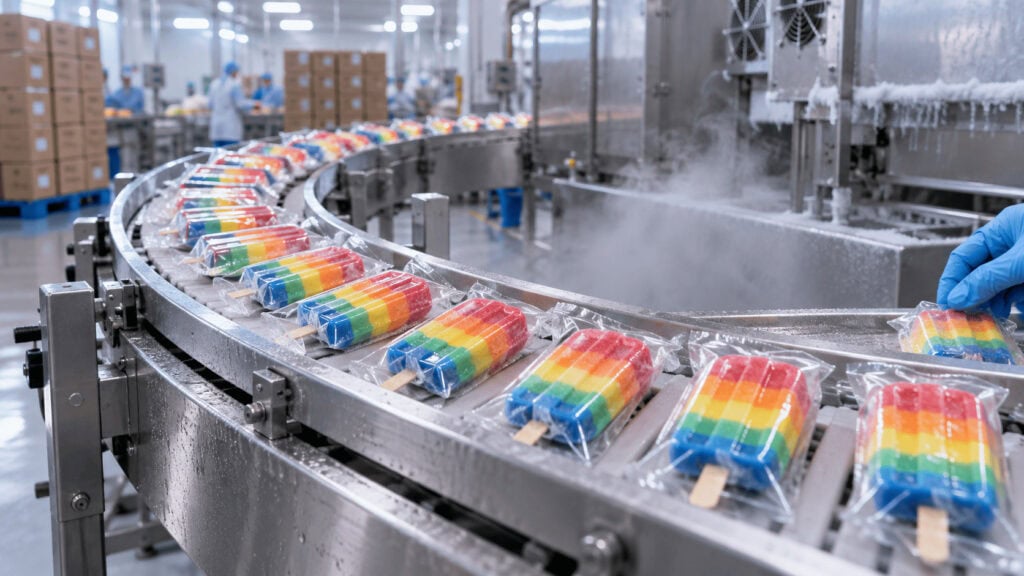
The choice was formats over flavors. The Bomb Pop has three layers. Why not six, or eight? What does a pop that looks and eats like a frosted rainbow cake require? Those questions have the same answer: custom machinery, longer cycle times, more scrap, and a production line nobody else has configured.
This is the exact inverse of how the rest of packaged food buys growth. We wrote in August about why everything suddenly tastes like pickle: a flavor variant is a purchase order at the seasoning drum, requiring no new capital, which is precisely why it produces no durable advantage for anyone. Flavor is a commons. Nobody owns dill pickle, and nobody owns rainbow either, but a six layer extrusion line is a physical object with a lead time attached.
The second thing owning the plant bought was a claim. JonnyPops products are gluten free and made in a peanut free facility, a decision that is personal for Brust, whose sister has a severe peanut allergy. A shared co-packer cannot credibly promise a dedicated allergen environment, because it runs other people’s recipes on the same equipment. Owning the line is what makes the claim underwritable.
That claim is not a health feature. It is an occasion key. A pop that can be served at any birthday party, classroom, camp or hospital is competing for a different budget than a dessert. Which brings up the metric JonnyPops used to argue for shelf space: “new to category,” the share of buyers a brand brings into a category who were not buying it at all. Retailers ration space by incrementality, not velocity, because a brand that only steals from the brand next to it adds nothing to the aisle.
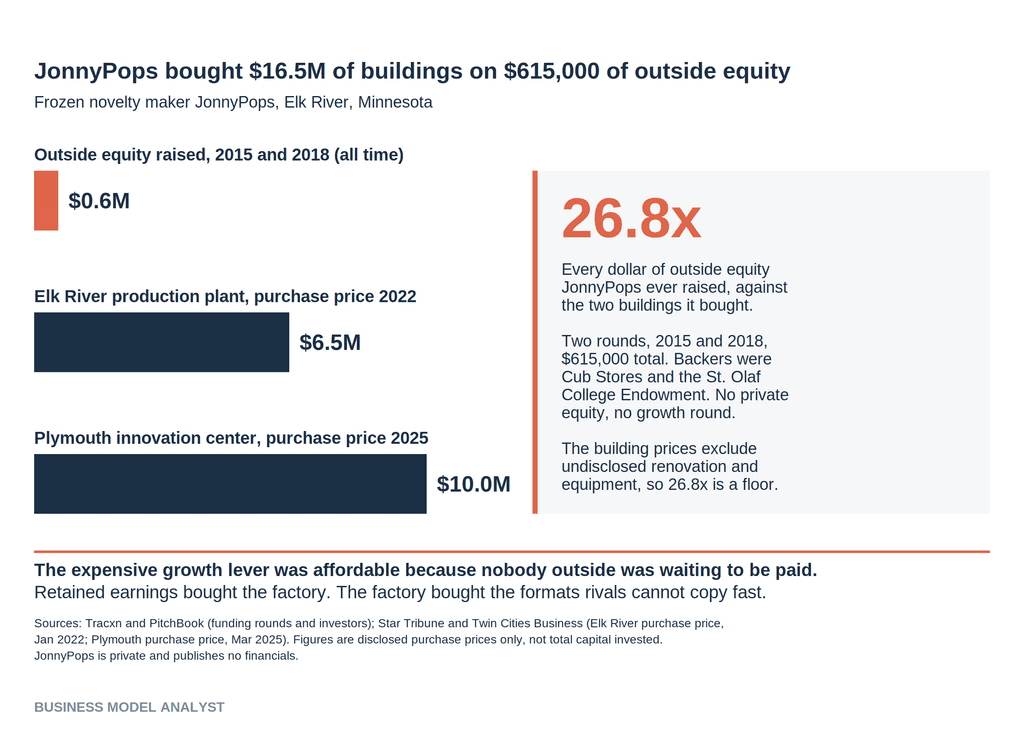
Look at the capital ratio and the whole strategy resolves. Roughly $16.5 million of disclosed building purchases against $615,000 of outside equity is a ratio of about 27 to 1, and since the purchase prices exclude undisclosed renovation and equipment, that is a floor. There is also a detail worth pausing on: the innovation center is twice the square footage of the factory. A company whose thesis is that products should be hard to make bought more room for deciding what to make than for making it, and funded it with the office market’s crash.
The last piece is the wooden stick. Every JonnyPops stick carries a prompt to do a kind deed. People kept them. Some mailed them back. So the company built a rewards program around collecting them, topping out at 10,000 sticks for a trip to Minnesota to create a flavor in the R&D lab. That is 27 years of one pop a day. It has been redeemed three times.
Read that as a marketing line and it is charming. Read it as a business model and it is something else. A wholesale brand never meets its customer at the register, because the retailer owns that moment. The stick is the only direct channel JonnyPops has, and it printed one on an input it was already buying. For contrast, Coca-Cola treated its 2026 World Cup activation as the moment it finally bought a direct customer relationship, gathering more than 25 million first party records through connected packaging.
The Business Model Angle
The growth lever you can pull is set by your cap table, not your strategy deck. Flavor is an operating expense with a two month cycle and no moat. Format is a capital expense with a two year cycle and a real one. A public CPG protecting return on invested capital will co-pack and reformulate. A sponsor backed challenger on a five year hold cannot underwrite a plant that runs hot for four months. An owner with no clock can. Ask who owns a company before asking why it innovates the way it does.
Own the constraint that your claim depends on. Peanut free, gluten free, organic, kosher, cold chain and single origin all sound like marketing. Each is actually a statement about a facility. If the claim requires a dedicated environment, it is a cost structure decision wearing a label, and outsourcing the line means renting the claim.
Incrementality is the currency of shelf space. Retail buyers do not reward growth, they reward growth that expands the aisle. Any brand pitching distribution should arrive with a new to category number, and any brand that cannot produce one is asking a buyer to fund a swap.
In a wholesale model, the product is the only owned channel. JonnyPops turned a stick into a mailing list. Packaging, inserts, QR codes and caps are the cheapest first party data an intermediated brand will ever buy, and most companies treat them as a printing cost.
The Risk
The bull case is clean enough that the counterarguments deserve real weight.
Custom machinery is bought, not invented. JonnyPops commissioned equipment. It did not patent thermodynamics. Multi component molded pops have existed at industrial scale for decades, and the spiral Twister has been produced inside the Popsicle system since 1982. What JonnyPops owns is a lead time, and lead times expire the moment a competitor decides the volume justifies the tooling.
Private label is the real predator, not Unilever. In that same Circana read, store brands collectively did about $953 million in frozen novelty retail sales, up 1.6 percent, which is more than Unilever’s entire branded portfolio and moving in the opposite direction. Store brands are also the fastest copiers of a proven format, because the retailer sees the velocity data before anyone else and controls the shelf. Winning distribution on a new to category argument hands the retailer the precise evidence it needs to commission its own eight layer pop.
The seasonal plant is the cost of the strategy, not a footnote. Roughly half of annual sales arrive in summer by the company’s account to the Journal, and Brust told Forbes about 60 percent lands in the six hottest months. A dedicated frozen line that is saturated in June and quiet in January carries its fixed cost all year. That is the entire reason big food co-packs seasonal items in the first place. The founders’ proudest early milestone, keeping an employee through a winter, is a description of the problem rather than a solution to it. Canada, added in April 2026, is northern hemisphere demand, which correlates rather than diversifies.
The financials are estimates. Forbes’ $100 million revenue and 30 percent margin are third party estimates of a private company that publishes nothing, and commercial databases disagree with each other by wide margins. The direction is well supported. The precision is not.
The clean label tailwind is not proprietary. No artificial dyes is a genuine advantage in 2026 and it is being competed away on a published schedule. FDA revoked authorization for Red No. 3 in January 2025 with a food compliance date of January 15, 2027, six other dyes are in a voluntary phase out, Nestle USA finished removing synthetic colors in June 2026, and Kraft Heinz and General Mills both target the end of 2027. When the whole aisle is dye free, dye free stops being a reason to pick a brand. The same reformulation pressure we traced in big food’s protein rebuild applies here.
Nobody has priced this equity. Two founders in their mid thirties, no institutional owner, no reference valuation. Every advantage described above depends on the absence of a clock. Introduce one, through a sale or a recap, and a half idle seasonal plant stops being a moat and starts being a line item a buyer discounts.
Quick Questions
How much money has JonnyPops raised? About $615,000 in outside equity across two rounds, in 2015 and 2018, per Tracxn, with Cub Stores and the St. Olaf College Endowment among the named backers. The company has taken no private equity and describes itself as bootstrapped and profitable since year one.
How big is JonnyPops? Spins put retail sales above $170 million over the past year at major US retailers. Company revenue is smaller than retail sales; Forbes estimated it at roughly $100 million in mid 2025. Headcount was 157 as of June 30, 2026.
Who owns JonnyPops? Cofounders Erik Brust, the CEO, and Connor Wray, the CFO, along with early friends and family backers. It is private.
How big is the US frozen novelty market? Circana puts it above $9 billion a year, up about 20 percent over five years. Spins, using a different definition, tracked the category near $7 billion in 2025. Two research firms, one category, a gap worth remembering before quoting a market share.
Why does the peanut free facility matter commercially? Because a dedicated allergen environment cannot be promised by a shared co-packer. Owning the plant is what makes the claim credible, and the claim is what opens school, camp, party and food service occasions.
The Business Model Analyst Take
The frozen aisle just ran a controlled experiment. One set of companies bought growth the cheap way, with flavors and limited editions that require no capital and produce no advantage. Another company bought it the expensive way, with a plant, a line nobody else has and a claim that only a dedicated facility can support. Both approaches work. Only one of them compounds.
What decided which experiment JonnyPops could run was not vision. It was that no outside investor was waiting to be repaid, so a seasonal factory at partial utilization was an acceptable thing to own. That is the same mechanism that let a family manufacturer like Lodge Cast Iron keep its foundry for 130 years, and the mirror image of what happened when Blue Apron sold its factories to go asset light and later shipped boxes with missing ingredients.
Asset light is a financing preference that the industry learned to call a strategy. Sometimes the moat really is just a building, and the only question is who can stand to own it.