
Seven years of folding phones never got past 2% of the handset market, and the constraint was never the hardware. It was the rectangle every app was written for.
Apple’s iPhone Duo, unveiled September 9 and on sale October 23, starts at $1,999 and fixes almost none of the things foldables get criticized for. What it does instead is decline to create a new canvas. The inner screen keeps the same aspect ratio as a normal phone, so nothing anyone has already made needs to be remade to fill it. That refusal, not the hinge, is the product.
Everyone already has the take on this one. Foldables are unpopular. They are expensive, they crease, they sit heavier in a pocket, and Apple built one anyway because scarcity sells the way a designer handbag sells. Attention getter. Halo product. Status object.
That reading is fine as far as it goes. It just cannot explain the one number that matters.
IDC expects worldwide smartphone shipments to fall 16.7% in 2026 to just over a billion units, the steepest annual contraction the industry has ever recorded. Foldables are the only line in that forecast that grows, to 22.9 million units. And IDC says that without Apple’s entry, foldable shipments would have fallen at a double-digit rate as well. Seven years into the format, after every hinge, panel and crease got measurably better, the category was pointed downward. Hardware progress was not what was holding it back.
What Happened
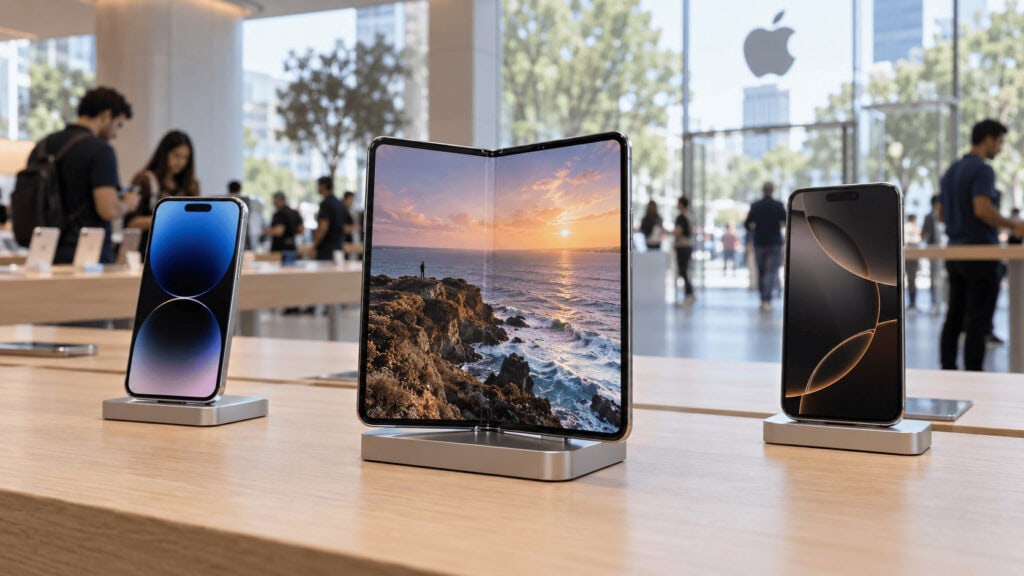
John Ternus took the stage at Apple Park for his first keynote as chief executive and introduced the iPhone Duo, a book-style foldable that opens from a 5.4-inch outer screen into a 7.6-inch inner one. It is the biggest change to the iPhone’s physical design in nearly two decades.
The spec sheet is a mix of firsts and subtractions. Machined titanium frame, Ceramic Shield 2 on the front, IP68, a custom hinge built from more than 100 precision components, and what Apple says is the thinnest iPhone it has made. Brian X. Chen at The New York Times measured it at two-tenths of an inch open and described it closed as roughly passport-sized. Touch ID moves to the side button because there is no room for a face scanner, and the camera system is not the one in the $1,199 iPhone 18 Pro.
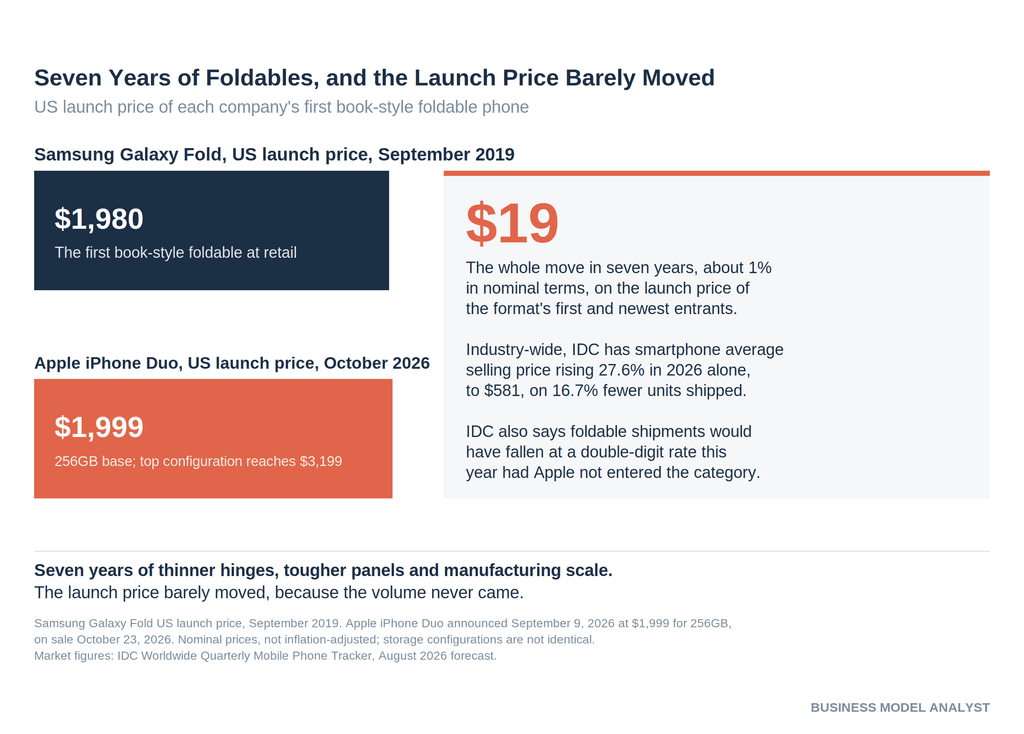
Pricing starts at $1,999 for 256GB and runs to $3,199 at the top configuration. Preorders open October 16. Samsung’s current foldable sells for about $1,900, as does Google’s Pixel 11 Pro Fold, so Apple came in with a premium of roughly 5% over devices that have been iterating for years.
Markets did not care. Apple shares were down 1.9% in afternoon trading, softer than when the livestream began.
The line worth keeping is Ternus’s own framing of the competition. Rivals, he said, built foldables that “just feel like two phones awkwardly stuck together.” Read that as a product claim and it is marketing. Read it as an engineering brief and it explains the whole device.
The Backstory
Samsung shipped the first book-style foldable at retail in September 2019. The Galaxy Fold cost $1,980 in the United States. Apple’s, arriving seven years later, costs $1,999.
Sit with that for a second. In seven years the launch price of the format moved by $19 in nominal terms, under 1%. Adjust for inflation and the category got modestly cheaper in real terms, which is roughly what you would get from doing nothing at all. Compare it to the trajectory the Times uses as its own analogy: high-definition sets commoditized until $500 bought you a big one with a good picture. That is what volume does to consumer electronics. Foldables never got the volume, so they never got the deflation.
The Times analogy is worth pushing further than the article pushes it, because it quietly argues against the article’s own conclusion. When flat TVs commoditized, manufacturers went hunting for a premium tier and tried three things. Curved screens, at around $3,000. Three-dimensional playback, also around $3,000. Both flopped. Then OLED arrived above $1,000 and stuck.
Sort those three by what each asked of the content pipeline and the pattern is immediate. 3-D needed 3-D movies to exist, so it asked the entire film industry to re-author its catalog, and the industry declined. Curved asked for nothing and delivered nothing. OLED asked for nothing and made every frame ever shot look better the moment you plugged it in.
The premium format that survived was the one that was invisible to everybody upstream of it. That is not a story about luxury psychology. It is a story about compatibility.
The Plan
Now look at what Apple actually built against that test.
Dan Frommer of The New Consumer put the problem plainly to the Times: the internet’s video, from TikTok to Instagram, has been authored for tall rectangular phone screens for 19 years, and he could not see what anyone would do with a big square one. Every foldable before this one handed you a nearly square canvas and left the content to cope. Chen noticed the difference immediately in testing, saying a Netflix video filled the Duo’s screen rather than sitting inside the side bars that other foldables produce.
Apple’s answer was to keep the shape. The Times reports the larger inner display presents pictures in the same aspect ratio as traditional phone screens, and Apple describes the two halves as a single continuous frame carrying that ratio across both displays. Hold the aspect ratio constant and run the geometry on the two diagonals Apple published: going from 5.4 inches to 7.6 inches multiplies screen area by about 1.98. Apple roughly doubled the canvas and changed its proportions by nothing.
That is a strange thing to celebrate until you ask who is allowed to change an authoring spec.
A hardware vendor holding under 2% of the handset market has no standing to tell developers, studios or advertisers to build for a new shape. Samsung has been trying for seven years from exactly that position. The one handset maker whose display dimensions function as a default authoring target is Apple, and Apple is the only company in the category that could have forced a re-author and made it stick.
It chose not to. It shipped a bigger rectangle instead of a new canvas. Coming from the single firm with the leverage to do otherwise, that is the strongest available statement about what re-authoring actually costs, and it is a genuinely unusual decision for a company whose business model normally rests on getting an ecosystem to follow it somewhere new.
The Business Model Angle
Compatibility is the cheapest feature you can ship. It costs nothing to manufacture, it needs no supplier, and it is invisible on a spec sheet, which is why product teams undervalue it and finance teams never see it. Any company adding a new form factor, screen size, container or interface is implicitly billing its whole ecosystem for the change. The winning move is usually to absorb that bill yourself.
Installed base is a standards position, and it only works in one direction. Apple can move a spec and Samsung cannot, which sounds like an advantage until you notice that the party who can move a spec is also the party who eats the cost when the ecosystem drags its feet. Companies with a small share of a market should stop shipping products that require other people to change their behavior, because they are writing checks their share cannot cash.
When the sticker outruns the wallet, the product becomes a payment. IDC has smartphone average selling price rising 27.6% this year to $581 while units fall 16.7%, which leaves total market value up 6.3% at $613 billion. Fewer, dearer phones. IDC also expects the sub-$100 tier, about 171 million devices, to become permanently uneconomical, because memory now runs past 65% of the bill of materials at the low end. Apple’s response arrived in July as Apple Upgrade, a Klarna-backed leasing program that converts a sticker into a monthly line. Expect every premium hardware category facing a component shock to reach for the same instrument.
The Risk
The luxury reading is not wrong, it is just incomplete, and the strongest version of it deserves a hearing. Nabila Popal of IDC is right that limited and expensive things generate their own demand, and halo products reliably sell the tier beneath them. IDC expects Apple to ship more than 17 million foldable iPhones by 2027 and take roughly 40% of the category. If that lands, Apple wins on brand gravity and the aspect ratio argument becomes a footnote.
The hardware objections are also real and unresolved. Bendable screens are less durable than glass-protected ones. Folded, these devices are bulkier. Chen still noticed the crease, even with a matte inner screen designed to hide it. None of that goes away because the proportions are familiar.
The clearest falsifier is developer behavior. Both of the Duo’s displays support Apple Pencil, which hints Apple may want a distinct unfolded experience after all. If a wave of apps starts shipping layouts authored specifically for the open canvas within a year, then Apple did create a new shape and simply hid the transition, and this read is wrong.
The second falsifier is commercial. If the Duo sells poorly at $1,999 despite the compatibility, then price and durability were the binding constraints all along and the shape argument was a distraction.
Then there is the input cost that could swamp everything. Popal notes memory prices are up nearly 300% year on year, the same squeeze behind Apple’s mid-cycle price increases earlier in 2026 and behind the observation that its supplier commitments have gone unusually short-dated. A foldable is not a hedge against that. It is a bigger surface to put memory behind.
Quick Questions
Is $1,999 actually a luxury price? Against the category, barely. It is about 5% above Samsung’s and Google’s foldables. Against Apple’s own line it is 67% above the $1,199 iPhone 18 Pro, for a device with a lesser camera system and no face scanner, which is the ladder question the piece on Apple’s missing entry-level iPhone took up before the event.
Why is a shrinking phone market raising prices? Because memory costs are non-negotiable and volume is. Vendors are pruning cheap models and concentrating on tiers that can absorb the bill, which is why market value is growing while units collapse.
Does the same aspect ratio limit what the big screen can do? It limits what it can do differently. Two apps side by side and a taller reading surface still work. What it forgoes is a genuinely new interaction model, and that is the trade Apple made deliberately.
Who else could run this play? Anyone selling into an installed base with authored content behind it: television makers, headset builders, in-car screens, wearables. The lesson generalizes past phones.
The Business Model Analyst Take
The most expensive iPhone Apple has ever made is, at its core, a refusal.
For seven years the foldable pitch was that you should want a new shape. Every year the hinge got better, the crease got fainter, the panels got tougher, and every year the answer came back the same, because the shape was never the offer people were declining. They were declining the work. Nobody wants to relearn a device, and nobody upstream wants to re-cut a video for 2% of the market.
Apple looked at the identical hardware everyone else had and decided the feature was the compatibility. It is a $1,999 bet that the thing customers value most is not having to learn anything, and its target market has never once been asked to. Whether or not the Duo sells, that is the more durable idea in the box.
Reporting from The New York Times, NBC News, Apple’s September 9 “Surprise and Shine” event, and IDC’s Worldwide Quarterly Mobile Phone Tracker.