

The release pipeline is back at 2019 levels. Attendance is stuck at 70% of them.
North American theaters took an estimated $4.76 billion between May 1 and Labor Day, the second-biggest summer ever in raw dollars and 17% below 2019 once you adjust for inflation. The number that actually matters sits underneath both: 248 million missing admissions, arriving in the first year since 2019 when Hollywood released a full slate of movies. The supply excuse just expired, and what is left is a demand problem wearing a record’s clothes.
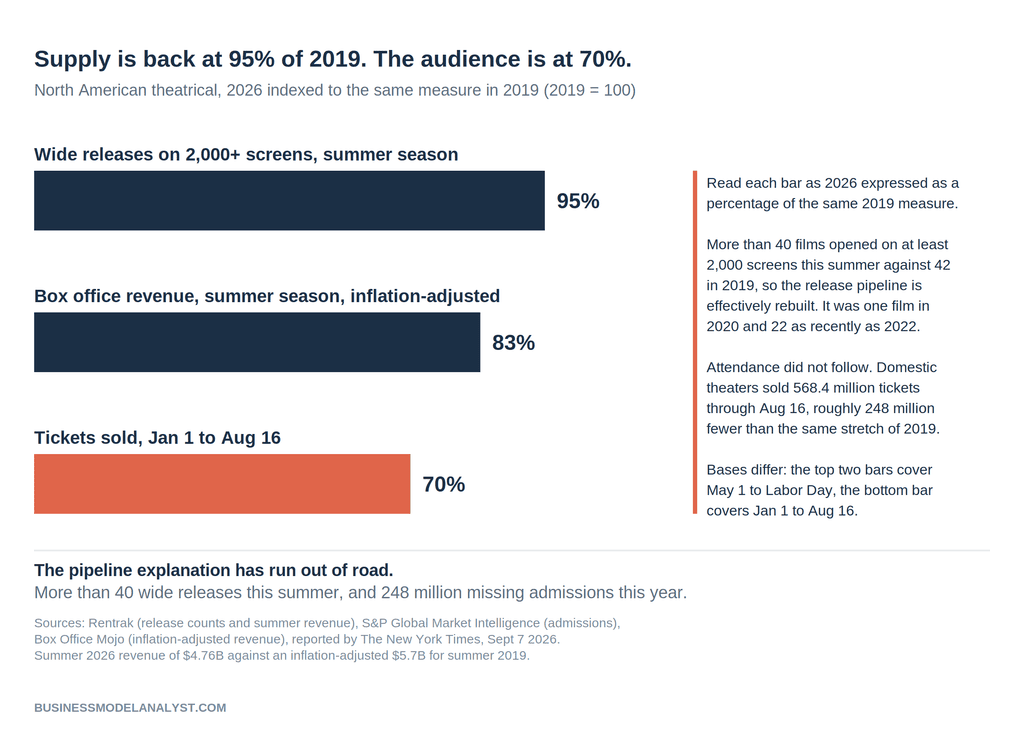
Domestic theaters collected an estimated $4.76 billion from May 1 through Labor Day, Hollywood’s definition of summer. Second-biggest in raw dollars. Highest since 2013. Then The New York Times ran the deflator and the trophy dented. Translate 2019’s $4.35 billion into today’s money and it becomes $5.7 billion, which puts this celebrated summer 17% below the last normal one.
The inflation math got the headlines. It is also the least interesting thing in the story, because everyone already knew ticket prices went up.
Here is the part worth your time. From January 1 through August 16, domestic theaters sold 568.4 million tickets, down 30% from the same stretch of 2019. Roughly 248 million missing admissions. And it happened in the summer when Hollywood finally had movies again.
What Happened
The raw scoreboard, per Rentrak and S&P Global Market Intelligence as reported by the Times:
- Summer 2026 domestic box office: $4.76 billion, up 9% from 2019’s $4.35 billion in nominal dollars
- The same comparison in real dollars: down 17%, against an inflation-adjusted $5.7 billion for summer 2019
- Real ticket revenue versus last summer: up 26%, a genuinely large one-year gain
- Tickets sold, January 1 to August 16: 568.4 million, down 30% against the same 2019 window
- Per-capita admissions across North America: roughly 1.5 tickets per person, down from just under 3 in 2006
Two of those lines are a recovery story and three of them are not. The industry publishes the first kind.
That is not a scandal. Every industry ranks itself on the most flattering available metric, and raw dollar totals happen to be the simplest one to compute. The problem is what the flattering metric hides when the underlying unit is shrinking.
The Backstory
For four years the industry had a clean, true and convenient answer for weak volume: there were no movies.
The count of films opening on at least 2,000 domestic screens tells that story precisely. In 2019, 42. In 2020, exactly one. As recently as 2022, 22. Last year, 34. This summer, more than 40.
So the pipeline is rebuilt. Shutdowns, strikes and the long restart of production have worked their way through. Supply is back at roughly 95% of the pre-Covid count.
Attendance is at 70%.
Run the same comparison per title and the gap holds. Spread $4.76 billion across 40-plus wide releases and each one is doing about $119 million of summer business. Spread 2019’s inflation-adjusted $5.7 billion across 42 and each was doing about $136 million. Same crowded calendar, 12% less real money per film.
The movies came back. The habit did not.
The Plan
Theater operators and studios have an answer, and it is not a dodge. Their argument is that fewer admissions do not mean a weaker business, because the admissions that remain are worth more.
The evidence is real. IMAX generated $207 million of “The Odyssey” domestically, about 35% of the film’s domestic total from 11% of the screens playing it. The average adult IMAX ticket runs roughly $20 against $12.75 for a standard seat, per EntTelligence. Rich Gelfond, who runs the company, calls it the “IMAX awakening.” Dolby Cinema, 4DX and ScreenX are taking share alongside it, and premium formats together have climbed from a low-single-digit slice of the North American box office in 2010 toward a quarter of it now.
This is a deliberate strategy, not an accident. The industry has spent five years converting a frequency business into an event business: fewer visits, higher yield per visit, more of the gross packed into opening weekends and premium auditoriums. It is the same trade that made Christopher Nolan’s opening so profitable, and the same instinct behind the $70 popcorn bucket that now out-earns three moviegoers. When the room is half full, you charge the people who did show up more.
Airlines ran this play. Hotels ran it. Grocers ran it. It works.
The Business Model Angle
The bottleneck is utilization, not pricing power. Trading volume for mix works when your cost base scales with units sold. A cinema’s does not. Rent, staffing, utilities, the projection stack and the cost of a screen-hour are identical whether 30 people show up or 300. Yield is priced per admission; the cost base is priced per seat and per showtime. Premium formats prove audiences will pay more for the right title on the right night. Nothing about a premium format fills a Tuesday 4 p.m. show. Worth noticing that IMAX itself has been quietly reweighting its capital toward hardware sales rather than box-office participation, which is a revealing vote from the company with the best view of premium demand.
Frequency is the product nobody is building. Per-capita admissions have roughly halved since 2006. Almost every current initiative raises revenue per visit; almost none raises visits per person. Subscriptions, passes, off-peak pricing, bundles and loyalty economics are frequency instruments, and they sit badly underbuilt next to seat retrofits and format upgrades. The category has been spending its capital on one axis of a two-axis problem.
When the excuse gets repaired, re-underwrite the demand curve. This generalizes well past cinema. Any operator who blamed a volume decline on a fixable external cause owes themselves one honest test the moment the cause is fixed. Supply restored plus volume not restored means you are no longer looking at a disruption. You are looking at a preference. Retail, gyms, offices, print media and casual dining have all had a version of this moment, and the ones that kept calling it a disruption went on buying assets for a demand curve that no longer existed.
The Risk
The strongest counterargument to all of the above is that a smaller, richer audience is a perfectly good business, and the numbers partly support it. Real ticket revenue rose 26% from last summer. Five nonfranchise films cleared $100 million each: “The Odyssey,” “Obsession,” “Michael,” “Backrooms” and “Disclosure Day,” worth about $1.4 billion together and the strongest original showing in five years even after adjusting for inflation. That is not the profile of a dying category. It is the profile of a category that got better at monetizing the people who still care.
The risk sits in what that concentration does to the schedule.
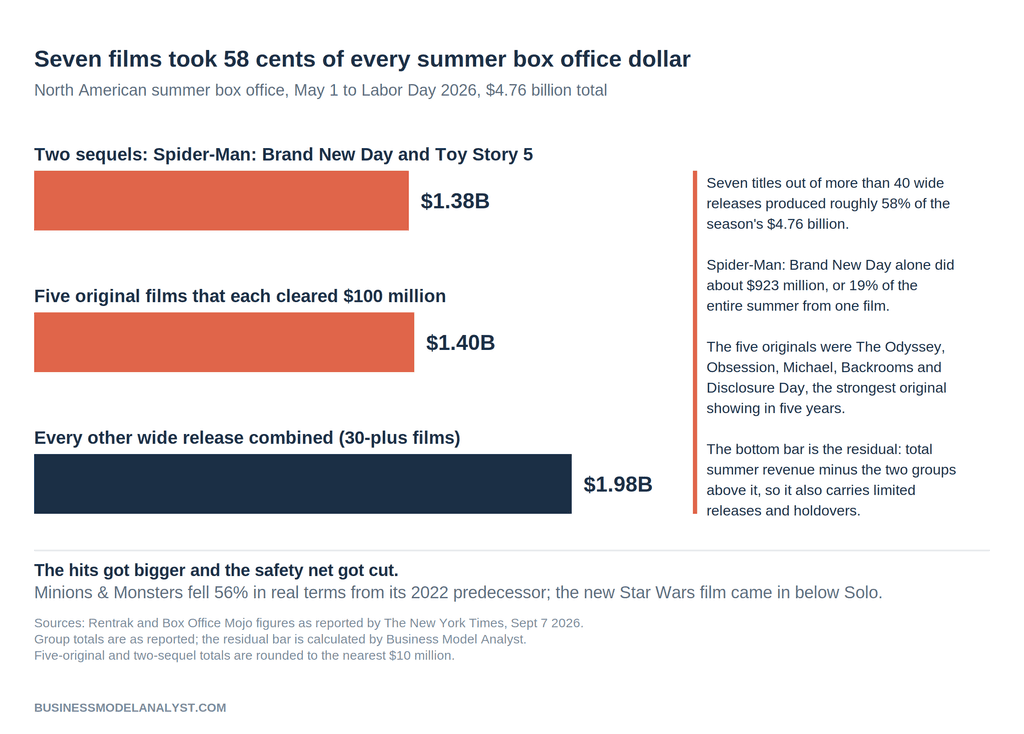
“Spider-Man: Brand New Day” collected roughly $923 million domestically, 19% of the entire summer from a single title, and Sony is not the only company getting paid on it. Add “Toy Story 5” and the pair reach $1.38 billion. Add the five originals and seven films out of more than 40 wide releases produced roughly 58% of the season.
Concentration is survivable when the mid-tier holds a floor. It did not hold this summer. “Minions & Monsters” took $183 million, down 56% in real terms from 2022’s “Minions: The Rise of Gru.” “Star Wars: The Mandalorian and Grogu” managed $178 million, below the roughly $283 million “Solo” did in 2018, a film everyone files under flop.
The hits got bigger and the safety net got cut. For an exhibitor programming 52 weeks against fixed rent, that is a harder calendar than the headline suggests, and it is why a record summer and a fragile business can be the same sentence.
Quick Questions
Is the box office actually recovering? In dollars, yes. In people, no. Revenue is up 26% in real terms year over year while admissions sit 30% below 2019. Both are true and they point in opposite directions.
Could the 248 million figure be a measurement artifact? Partly. The admissions comparison covers January 1 to August 16 while the revenue comparison covers the summer season, so the two windows are not identical. The direction is not in dispute, but any per-ticket yield calculated across those two windows should be treated as directional rather than precise.
Are premium formats a fix or a symptom? Both. They are a genuine revenue engine and a genuine sign that the industry has stopped competing for frequency. A format surcharge raises what a visit is worth without changing how often anyone visits.
Who is most exposed? Exhibitors carrying square footage built for the old attendance curve. Format licensors and studios can ride concentration. Landlords of half-empty auditoriums cannot.
The Business Model Analyst Take
The machine is fixed. Forty-plus wide releases, five original hits over $100 million, a nearly billion-dollar Spider-Man, premium formats printing money, and 248 million people who used to buy a ticket still absent.
An industry can survive a supply shock. What it cannot do is keep calling a demand reset a supply shock while every screen built for the old attendance curve sits there as a fixed cost pointed at a smaller room. The uncomfortable version of this summer is not that the movies were bad. The movies were good. That is exactly what makes the attendance number hard to explain away.
The best summer in thirteen years proved the machine works. It did not prove anyone is coming.