

HealthPartners is buying Essentia’s 14 hospitals. Most of the money those hospitals collect comes from someone other than HealthPartners, and that is the part of the deal regulators should price.
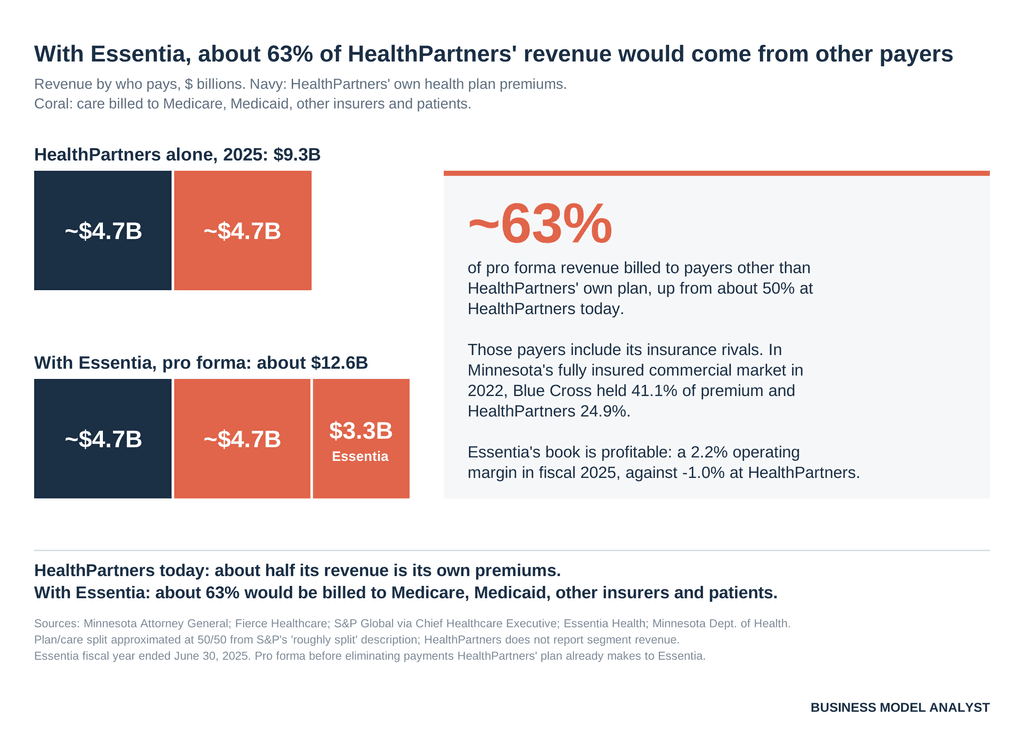
HealthPartners and Essentia Health plan to combine on January 1, 2027, creating a nonprofit with 22 hospitals, 45,000 employees and about $12.5 billion of combined annual revenue. No purchase price was disclosed. The coverage leans on the insurer: HealthPartners’ plan covers roughly 1.6 million members, so the story writes itself as “insurer buys hospitals.” The arithmetic points the other way. By BMA’s estimate, about 63% of the combined organization’s revenue would be bills sent to Medicare, Medicaid and rival insurers, up from about half at HealthPartners today. The deal makes HealthPartners less of an insurer, not more, and it hands a Blue Cross competitor the hospitals that Blue Cross members use across northern Minnesota.
Every account of this deal repeats one idea from the announcement: a single owner on both sides of the payer-provider table. Nurses read that as leverage. The two systems read it as coordination. Both readings picture HealthPartners’ health plan bargaining with HealthPartners’ new hospitals.
That bargaining barely matters. When a plan pays its own hospital, a higher rate moves money from one pocket to the other and the parent ends up exactly where it started.
The negotiations that will move the combined profit and loss statement are the ones Essentia runs with Blue Cross and Blue Shield of Minnesota, Medica and UCare. Starting in January, all three would be buying hospital care in Duluth, Brainerd and the Iron Range from a competitor’s subsidiary. That is the seat worth watching, and it is the one Minnesota’s merger review template has never had to price.
What Happened
On September 29, the two nonprofits announced a definitive agreement for Essentia to join HealthPartners. The Minnesota Attorney General’s office opened public comment the same day and summarized both sides:
- HealthPartners, based in Bloomington: eight hospitals, more than 90 clinics, about 28,000 employees, more than 1.4 million patients in Minnesota and western Wisconsin, and an insurance arm covering roughly 1.6 million members.
- Essentia Health, based in Duluth: 14 hospitals, 80 clinics, pharmacies, long-term care, an ambulance service, 16,500 employees and about 600,000 patients across Minnesota, North Dakota and Wisconsin.
The combined organization would operate as HealthPartners, with Essentia facilities keeping their name during integration. HealthPartners CEO Andrea Walsh would run it. Essentia CEO David Herman would become president of the combined care group.
The $12.5 billion is a revenue figure, not a price. HealthPartners reported $9.3 billion of revenue for 2025 and an operating loss of $95.9 million, a margin of negative 1.0%, according to Fierce Healthcare. Essentia reported $3.28 billion of revenue and $71.6 million of operating income, a 2.2% margin, for the fiscal year ended June 30, 2025. Add the two and you get roughly $12.6 billion.
The Minnesota Nurses Association asked for full financial transparency and said it was deeply concerned about back-to-back consolidation. This is the third large Minnesota hospital deal of 2026. Sanford Health closed its acquisition of North Memorial on September 1, and the $26 billion Sutter Health and Allina Health combination announced in March is still under review.
The Backstory: The Plan Has Been Carrying the Hospitals
HealthPartners is an unusual animal. Its revenue is roughly split between its insurance plans and its care delivery business, according to S&P Global’s description cited by Chief Healthcare Executive. It sells commercial, Medicare Advantage, Medicaid and individual coverage, and it runs Regions Hospital in St. Paul among others.
The last two years were rough. HealthPartners lost about $200 million on operations in 2024, exited Minnesota’s Special Needs Basic Care Medicaid program and paused enrollment in other Medicaid products. In 2025 it lost about 1% on $9.3 billion. This year the pattern flipped inside the house: Healthcare Dive reports that the health plan has been the financial bright spot, offsetting lower volumes and weaker results in the hospital division. S&P moved the outlook from negative to stable in September.
Essentia came to the table profitable and shopping. It explored a merger with Wisconsin’s Marshfield Clinic Health System in late 2022 and walked away in January 2024. In 2025 it floated a $1 billion “all-Minnesota” health system plan with the University of Minnesota and pulled out before year end. HealthPartners is its third serious partner in four years.
Put the two income statements side by side and the buyer is the one losing money. On a simple pro forma, HealthPartners’ $95.9 million loss plus Essentia’s $71.6 million profit nets to about negative $24 million on $12.6 billion of revenue, a margin near negative 0.2%. Essentia’s operating income alone would cover about three quarters of HealthPartners’ 2025 loss. The fiscal years differ by six months, so treat that as a sketch, not a forecast.
The direction matters more than the decimals. Out west, Providence is winding down its health plan after it lost $102 million on $2.5 billion of revenue, a move BMA covered in the Phil Knight gift piece. One system is leaving insurance. Another insurer-led system is buying a profitable book of hospital revenue. Both moves say the same thing about 2025: premium risk was the volatile side of the table.
The Plan: Buying Hospitals That Mostly Bill Someone Else
Here is the accounting detail that makes the headline misleading. In an organization that owns both a plan and hospitals, care delivered to the plan’s own members disappears into premium revenue in the consolidated statements. What shows up as care delivery revenue is care sold to everyone else: Medicare, Medicaid, other insurers and self-pay patients. The Star Tribune described HealthPartners’ care business years ago as one that sells services to other health insurers.
So today, HealthPartners’ $9.3 billion is about $4.65 billion of its own premiums and about $4.65 billion of care billed to others. Essentia’s $3.28 billion lands almost entirely on the second pile, because Essentia’s patients mostly carry someone else’s card. That moves the mix from about 50/50 to about 37/63.
Compare that with the template everyone has in mind when they hear “insurer owns providers.” A Brookings analysis published September 3 found UnitedHealth’s Optum Health generated $100.5 billion of revenue in 2025, 63% of it paid by UnitedHealth’s own plans. Humana’s CenterWell clinics took the same 63% from Humana’s plans. The bases differ, a provider unit’s revenue there and a whole organization’s revenue here, so do not read the matching 63s as a match. Read the direction. Optum’s providers mostly bill their parent. Essentia’s hospitals will mostly bill their parent’s competitors.
Who are those competitors? In Minnesota’s fully insured commercial market, Blue Cross and Blue Shield of Minnesota held 41.1% of premium in 2022, against 24.9% for HealthPartners and 21.4% for Medica, according to the Minnesota Department of Health’s market chartbook. In the large group market the gap was 47.3% to 22.2%. Those are statewide shares. HealthPartners’ plan is concentrated around the Twin Cities and western Wisconsin, so the gap in Essentia’s northern counties is likely wider, though no public source breaks it out.
The tangle goes deeper than contracts. Since 2016 Essentia has co-run EssentiaCare, a Medicare Advantage PPO, with UCare, and when it launched the two split the plan’s administration, risk and rewards evenly. It covers 11 Minnesota counties around Duluth, Brainerd and the Iron Range, plus three in Wisconsin. After January 1, HealthPartners would own a hospital system that shares a Medicare Advantage product with a direct competitor.
Essentia also knows how to use the network door. In September 2024 it announced it would drop UnitedHealthcare and Humana Medicare Advantage plans, saying they denied or delayed care at more than twice the rate of other plans. UnitedHealthcare reached a deal in November. Humana stayed out for 2025. That leverage now belongs to an organization that sells insurance against the plans on the other side of the table.
Then there is the clock. Minnesota’s 2023 health care transaction law requires notice at least 60 days before closing and lets the Attorney General extend the wait by 90 days. Sanford and North Memorial filed notice on May 1 and signed their oversight agreement on August 28, 119 days later. HealthPartners and Essentia are aiming for January 1, 94 days after the announcement. If they filed the day they announced, the base waiting period ends November 28, and a full extension would run to February 26, 2027. The target date assumes a review about a fifth faster than the only one Minnesota has completed under this law.
The Business Model Angle
The internal price stops mattering. The external price becomes everything. Once the plan and the hospital share a parent, the rate between them is a transfer price, an accounting choice. The rates Essentia charges Blue Cross, Medica and UCare are what move the consolidated cost structure and revenue line, and they are the rates a competitor now sets.
Vertical integration comes in two templates. Optum buys providers its members already use, then bills itself. This deal buys a provider whose patients mostly belong to other plans, then tries to grow the plan into that footprint. The second template only pays if members follow the hospitals, which makes network design and pricing to rivals the real strategy.
Minnesota’s oversight template prices the wrong risk. The Sanford and North Memorial agreement holds 21 line items by BMA’s count, covering investment, service lines, jobs, training, charity care and Medicare and Medicaid participation. None addresses contracting with commercial insurers. That fit a horizontal deal. Here the obvious ask is a network access and rate reporting clause for rival plans, and the Pittsburgh lesson is to make it last: a state-brokered consent decree between UPMC and Highmark expired on June 30, 2019, after which ten UPMC hospitals were slated to leave Highmark’s Medicare Advantage network.
Buying the side of the table that has been earning. HealthPartners’ premium business swings with medical and pharmacy trend. Essentia’s hospitals earned 2.2% last fiscal year. Shifting the mix toward care billed to others is a hedge against the kind of claims spike that hit insurers in 2024, and for self-funded employers that rent these networks, the bill lands on their own cash either way.
The Risk: Four Ways This Reading Is Wrong
Foreclosure would bite the hand that pays. If Blue Cross is the largest commercial payer in Essentia’s market, cutting it off or pricing it out would cost Essentia its best-paying patients. Rural hospitals lean on commercial margins to offset losses on public programs. The incentive to squeeze rivals is real but bounded, and Minnesota’s statute explicitly lists harm to the market for health insurance services as grounds for the Attorney General to sue to block or unwind a deal.
The 63% rests on an estimate. HealthPartners does not report segment revenue, so the 50/50 split comes from S&P’s “roughly split” description. The pro forma also ignores whatever HealthPartners’ plan already pays Essentia, which becomes internal after closing. The direction survives stress testing. If HealthPartners’ plan already paid Essentia $1 billion a year, almost a third of Essentia’s revenue, the share billed to others would still be about 60%.
Integration may be the cost cure, not the risk. Walsh’s case is that pairing a plan with care delivery finances access and makes value-based care work, because the same organization keeps the savings when a hospital stay is avoided. Members in northern Minnesota could get cheaper integrated products that do not exist there today. Shared incentives are the whole argument for the model, and HealthPartners has run it in the Twin Cities for decades.
The real driver may be defense. Sanford now owns a Twin Cities system and Sutter wants Allina. Fairview is the big Minnesota system without a partner. Essentia tried three combinations in four years. On that reading, the vertical structure is a side effect of two in-state nonprofits choosing each other before out-of-state systems chose them.
Quick Questions
When would the HealthPartners and Essentia merger close? The two systems are targeting January 1, 2027, pending review by the Minnesota Attorney General under the state’s 2023 health care transaction law.
Is $12.5 billion the purchase price? No. It is roughly the combined annual revenue of the two systems. Financial terms were not disclosed.
Can the Attorney General block the deal? The office does not approve or deny transactions. It can sue to enjoin or unwind one that violates the law or is contrary to the public interest, or negotiate an oversight agreement, as it did with Sanford and North Memorial.
Will Essentia patients lose their insurance network? Both systems say patients and members should see no changes or interruptions to care or coverage. Network terms with other insurers are set in contracts that have not been made public.
Why does it matter that HealthPartners sells insurance? Because Essentia’s hospitals will now negotiate rates with insurers that compete with their owner, including Blue Cross, Medica and UCare, which shares the EssentiaCare Medicare plan with Essentia.
The Business Model Analyst Take
“Insurer buys hospitals” sounds like a company gaining control of its costs. Run the revenue through the consolidation and this deal does something else: it turns HealthPartners into an organization that earns most of its money billing other people’s insurance.
That is not automatically bad. Essentia’s hospitals are profitable, HealthPartners’ plan has been the volatile half, and the combination may well deliver the integrated care Walsh is promising.
The review just needs to look at the right table. Minnesota’s first oversight agreement was written for a system buying a hospital. This one is a competitor buying the hospitals its rivals’ members depend on, and the clause that matters is the one that says what those rivals will pay.