
Retaliation lists tax the country a motorcycle comes from, whatever logo sits on the tank. Harley sells “made in America,” and in 2027 it moves more of its lineup home.
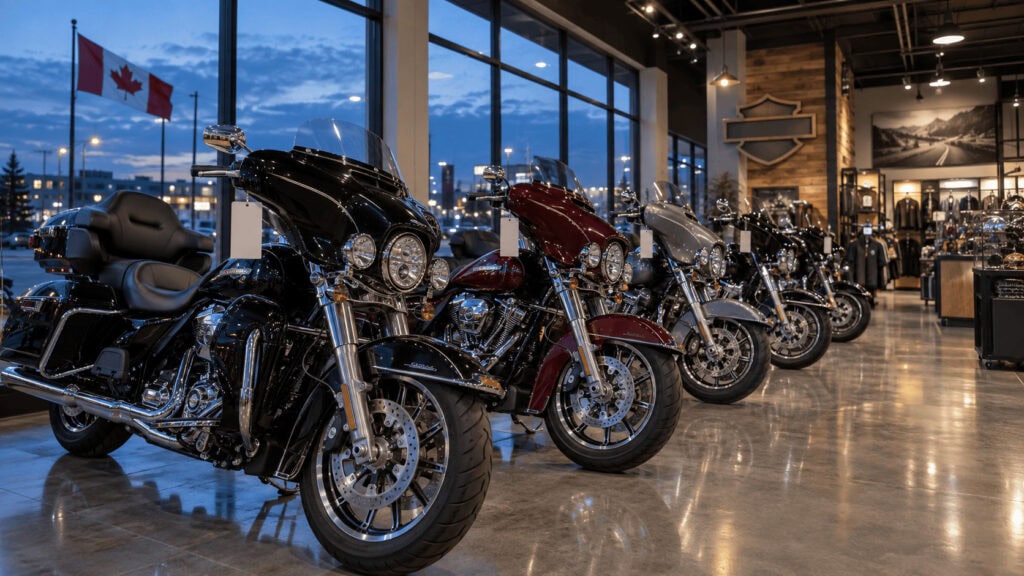
Canada’s 50% duty on American motorcycles above 800cc, in force since September 8, works out to about $10,675 on a Harley at the company’s 2025 average wholesale price. Harley-Davidson’s motor company kept roughly $5,171 of gross profit on that same bike. Absorb the duty across a year of Canadian sales and the bill comes to about $68.7 million, above the top of the $10 million to $50 million operating income Harley guides for its motor company in 2026.
The Wall Street Journal framed the story this week around symbolism: when a foreign government wants payback for U.S. tariffs, Harley lands on the list. Symbolism explains why Ottawa picked the brand. The cost of the pick, and the reason the next list will be easier to write, sit in Harley’s own filings.
Retaliation keys on origin, and Harley’s brand is its origin. In June, Harley announced it would bring its entry-level Revolution Max bikes home from Thailand. That move trims the tariff bill Harley pays Washington, and it walks those models inside the one Canada just doubled.
What Happened
Canada’s countermeasures took effect at 12:01 a.m. on September 8, at rates of 15%, 25% and 50% across a package Ottawa says covers $27.6 billion of American goods. Motorcycles got the top rate. The order never names a company. It uses a technical definition, tariff heading 8711.50, which covers combustion-engine motorcycles above 800cc of U.S. origin.
That definition catches nearly the whole Harley range. The cheapest Harley in Canada, the Nightster, runs a 975cc engine and lists at C$13,099. A Street Glide starts at C$32,199. Electric motorcycles fall outside the heading, a small break for LiveWire. Bikes already in Canada or in transit on September 8 are exempt, so the price effect arrives as dealers restock.
Washington answered the same night. President Trump signed five proclamations under Section 338 of the Tariff Act of 1930, and three of them bar Canadian alcohol, dairy and motor-vehicle goods, including larger motorcycles, from September 29. BRP confirmed that its Can-Am Spyder and Canyon three-wheelers, built in Valcourt, Quebec, will be refused entry. The Can-Am Ryker and BRP’s two-wheel motorcycles keep selling in the U.S., because BRP builds them outside Canada.
When we covered the first Section 338 duties in The Tariff Hits Canadian Cars. The Bill Arrives Inside American Trucks, the statute’s structure pointed to one step above its 50% cap: excluding a country’s goods outright. Washington took that step within three weeks, and motorcycles were on the first list.
Canada matters to Harley without carrying it. Harley sold 6,434 new motorcycles there in 2025, close to 5% of its global retail, through 46 dealership points. Reporting this week puts Canada at about 4% of Harley’s roughly $4.5 billion in annual revenue. Canadian retail slipped to 3,735 units in the first half of 2026 from 3,912 a year earlier, before the duty existed.
The Backstory
Harley has played this round before, and the court record from the last one sets the rules for this one.
In June 2018 the European Union raised its duty on American motorcycles from 6% to 31%, answering U.S. steel and aluminum tariffs. Harley opened a plant in Rayong, Thailand that year and said the bikes it built there would serve Asia and Europe. From 2019, Belgian customs issued binding origin rulings that let Harley ship Thai-built motorcycles into the EU at the old 6% rate.
The European Commission ordered those rulings revoked in April 2021. It argued that Harley moved production mainly to dodge the retaliatory duty, which made the move economically unjustified under EU customs rules, so the bikes stayed American for tariff purposes. Harley estimated the unmitigated 2021 cost at about $80 million. The EU General Court backed the Commission in March 2023, and the Court of Justice dismissed Harley’s appeal on November 21, 2024.
The rule that came out of that case matters more than the case. When avoiding a duty is the dominant purpose of a relocation, the EU assigns origin by where the major portion of the parts came from. Harley’s finance chief told investors in February that about 75% of its component purchasing comes from U.S. suppliers. Under the EU test, a Thai-assembled Harley can still be an American motorcycle.
Harley kept using Thailand anyway. In 2024 it moved Revolution Max production, which covers the Pan America, Sportster S and Nightster, to Rayong for model year 2025, calling it a temporary step to free capacity at York for touring and cruiser models. The choice paid off in Canada within months. When Ottawa put a 25% surtax on U.S.-origin motorcycles in March 2025, Regina dealer Robb Hertzog told 650 CKOM he sidestepped it by ordering Thai-built stock.
Canada lifted that surtax on September 1, 2025. Hertzog now orders from the U.S. again, and he expects almost everything he brings in to carry the new 50%. Reporting this week puts the tariff costs Harley has absorbed over the past eight years above $170 million.
The Plan
Artie Starrs, Harley’s chief executive, calls his turnaround Back to the Bricks. On June 9, Harley said it would bring Revolution Max production for North America back to York, Pennsylvania and Menomonee Falls, Wisconsin, covering machining, powertrain assembly, painting and final assembly, with the move finished before model year 2028 production starts in 2027. Harley expects York to build more than 100,000 motorcycles in 2027.
Harley’s own tariff table explains the move. The company’s 2025 annual report breaks out $67 million of new or increased tariff costs, next to a 2026 estimate made on February 8:
| Tariff line (rate shown in the filing) | 2025 cost | 2026 estimate, Feb. 8 |
|---|---|---|
| Steel and aluminum (50%) | $31 million | $15 million to $20 million |
| Thailand (19%) | $6 million | $20 million to $25 million |
| China (20%) | $6 million | $10 million to $15 million |
| Canada (35%) | $8 million | none |
| India (18%) | $2 million | $5 million to $10 million |
| European Union (15%) | $2 million | $0 to $5 million |
| Mexico (25%) | $1 million | none |
| Rest of world (10% to 50%) | $11 million | $25 million to $30 million |
| Total | $67 million | $75 million to $105 million |
Read the rate column first. The EU at 15%, Thailand at 19% and India at 18% match the duties Washington charges on imports from those places. Harley’s filing says the figures include direct exposure on products it imports and exports, plus costs passed through by suppliers. Most of the bill looks like the price of bringing things into the United States: metal, components and finished bikes. Steel and aluminum alone made up 46% of 2025.
The fastest-growing line for 2026 was Thailand, the duty on Rayong-built bikes coming into the U.S. The Revolution Max return should shrink that line from 2027. By July, Harley’s 2026 tariff range stood at $75 million to $90 million, and the company reported about $20 million of tariff recoveries in the second quarter and assumed no more for the year. Refund money follows the importer of record, a mechanism we traced in Everyone Paid the Tariffs. Only the Importer of Record Gets a Refund.
One row needs care. The Canada line carries 35%, the rate Washington applies to non-USMCA Canadian goods. Press coverage has read the $8 million as the cost of Ottawa’s 2025 surtax on Harleys, and the filing does not split it. Either way, both of Harley’s 2026 estimates predate the September 8 duty, and the February one put Canada at zero.
The Business Model Angle
The per-bike arithmetic comes from two numbers in Harley’s 10-K. The motor company booked $2.66 billion of motorcycle revenue on 124,477 bikes shipped in 2025, an average of $21,351 each at wholesale. It kept 24.2% of its revenue as gross profit, about $5,171 on that average bike.
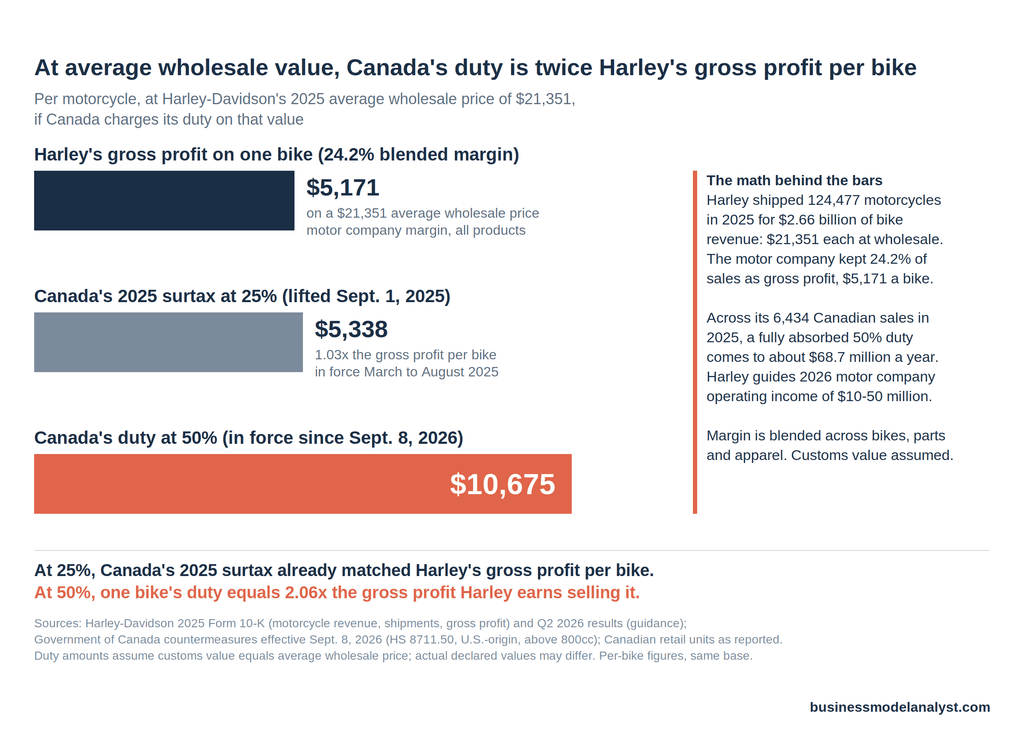
Canada’s 2025 surtax at 25% already matched that gross profit. At 50%, the duty on one bike equals 2.06 times what Harley earns selling it. Two assumptions sit under those bars and both deserve daylight: customs value may come in below average wholesale, and the 24.2% margin blends motorcycles with parts and apparel.
Now look at what the Revolution Max move does to the Canadian lineup. The Nightster clears the 800cc line with its 975cc engine. While Rayong builds it, the bike enters Canada as a Thai product unless Canadian customs decides otherwise. From model year 2028 it ships from York, inside the heading, at 50%. Visordown notes that the smaller model Harley has been expected to bring to Canada would be the only gas Harley under the threshold.
On the numbers, Harley made the right call. North America retail ran 29,751 bikes in the second quarter alone, and the U.S. dominates that figure, while Canada sits near 5% of global sales. Cutting a 19% duty on bikes sold at home beats protecting a 50% exposure on a small export market.
The bind shows up in why the call is right. Harley’s buyers pay a premium for American heritage, as our Harley-Davidson target market analysis lays out. Washington charges Harley for foreign origin on the way in. Ottawa and Brussels charge it for American origin on the way out. Harley sells American origin as the feature, and its buyers would not pay the same premium for the alternative.
Three lessons travel beyond motorcycles:
- A customs officer writes your origin, and your org chart doesn’t. The EU case turned on why Harley moved, judged by the Commission. Any company planning a footprint shift to escape a duty should expect the authority to test the purpose and count the parts, and should keep a documented business case that stands without the tariff.
- A brand built on a place inherits that place’s trade policy. BRP kept the Ryker on sale in the U.S. because it builds that model outside Canada. Some American brands cut the tie further by selling the foreign business and collecting royalties, the route we mapped in KFC Is Winning in China. Yum! Brands Owns None of It. A Harley’s value is the object that leaves York, so licensing offers Harley no exit.
- Symbolic targets cost the retaliator almost nothing. Canada imported $112.5 million of U.S. motorcycles in 2025, per UN Comtrade data cited by Forbes, well under 1% of Ottawa’s package, yet the motorcycle line drew the headlines. A company in that position should budget retaliation as a recurring cost of doing business abroad, the way Harley’s eight-year tariff tally, reported above $170 million, suggests it already is.
The Risk
The case for calm is stronger than the headline suggests, and it starts with the calendar.
Most of Harley’s 2026 inventory for Canada arrived before September 8, according to reporting this week, and the Canadian riding season is closing. The 2026 hit will be small. Spring 2027 orders are the real test.
Duration cuts the same way. Ottawa’s 2025 motorcycle surtax lasted about six months before Canada lifted it. Talks collapsed on August 21, and a deal would erase the new measure faster than any factory move could.
The $68.7 million figure is a ceiling. It assumes Harley absorbs every dollar at average wholesale value. Harley can push price instead, and Hertzog expects a $20,000 bike to approach $40,000 if the duty holds. Pass-through costs volume rather than margin, and with Canada near 5% of retail, the volume at risk has a hard cap.
The Revolution Max return also pays off in ways a tariff table misses. Pulling three models back into York, where Harley expects to build more than 100,000 motorcycles in 2027, spreads the plant’s fixed costs over more units, the same lever we examined in GM Fixed Its Margins. Toyota Fixed Its Factories. The Canadian slice of Revolution Max sales is a small share of a small share.
Last, the legal floor could move. No court has ever interpreted Section 338, and a ruling against it would unwind the U.S. side of this exchange. Canada’s measure runs on its own authority, so relief would have to come from a deal.
Mark Sheffield, a board adviser to the National Powersports Dealer Association, summed up the dealer view in a LinkedIn post the Globe and Mail quoted: “Dealers can manage a known cost.” The problem for Harley is that its known cost now depends on two governments at once.
Quick Questions
Does Canada’s 50% tariff apply to every Harley-Davidson? It applies to combustion-engine motorcycles above 800cc of U.S. origin, which covers nearly the full range. Electric motorcycles, including LiveWire, fall outside it, and bikes already in Canada or in transit on September 8 are exempt.
Why does it matter where a Harley is built? Canada’s order taxes U.S.-origin motorcycles, so a bike built in Thailand can fall outside it. The EU’s 2021 case shows that customs authorities can reject that argument when the move looks tariff-driven and most parts still come from the U.S.
What did the United States ban in response? Five proclamations signed September 8 bar Canadian alcohol, dairy and motor-vehicle goods, including larger motorcycles, from September 29. BRP’s Valcourt-built Can-Am Spyder and Canyon are affected.
How much did tariffs cost Harley-Davidson in 2025? Harley reported $67 million of new or increased tariff costs, with $31 million from steel and aluminum. It expects $75 million to $90 million in 2026, an estimate made before Canada’s September duty.
Is Harley moving production back to the United States? Yes, for the Revolution Max platform sold in North America. The Pan America, Sportster S and Nightster return to Pennsylvania and Wisconsin before model year 2028 production begins in 2027.
The Business Model Analyst Take
Harley’s tariff exposure runs through two borders pulling in opposite directions. Washington’s duties reward every part and every bike made at home. Retaliation lists punish exactly that. The company can move assembly, and the EU has already shown it can refuse to recognize the move.
Starrs chose the bigger market, and the math supports him. His choice also settles the question the Journal raised: Harley stays on the payback list because it sells the one attribute every retaliator can find on a customs form.
For founders with a brand tied to a place, the lesson sits in the table, where the rates tell you which way each government charges. Price your origin the way Harley now has to, as a feature customers pay for and a line item foreign governments can tax. Harley spent a century making “made in America” worth a premium. Canada just put a number on it.