The Gymshark marketing strategy is a community-led, creator-first system that replaces traditional advertising with long-term athlete partnerships, platform-native social content, user-generated challenges such as Gymshark66, and physical activations including flagship stores, festivals, and its own gym. Founded in 2012 by Ben Francis, the brand reached £646 million in revenue in the year to 31 July 2025, its thirteenth consecutive year of growth. The defining feature of the strategy today is that marketing spend has migrated from advertising budgets into owned physical infrastructure, compressing pre-tax profit to £7 million on a 62.3% gross margin.
Every marketing case study written about Gymshark says the same three things. It grew on Instagram. It sent free clothes to fitness YouTubers. It built a community, not a customer list.
All true, all a decade out of date, and none of it explains the most interesting number in the company’s accounts: Gymshark turned £646 million of revenue into £7 million of pre-tax profit. That is a business converting a 62.3% gross margin into roughly one penny of pre-tax profit per pound of sales. Something is eating the middle, and that something is the marketing strategy.
The Original Playbook, Briefly
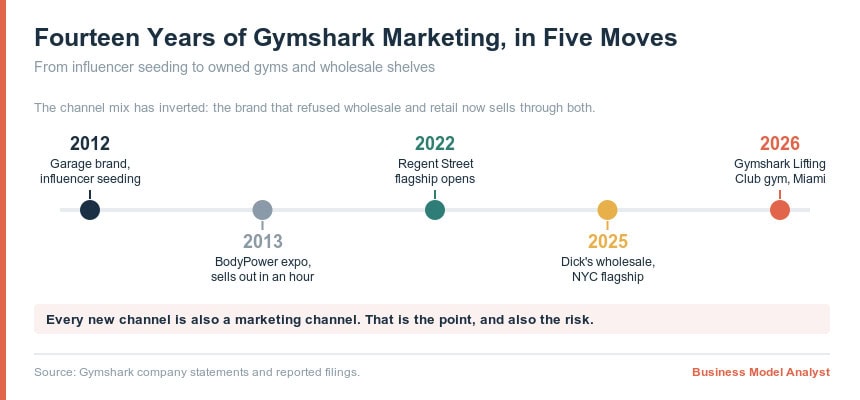
The founding story is well worn. Ben Francis was 19, screen-printing stringers in a garage in the West Midlands and delivering pizzas to fund inventory. The 2013 BodyPower expo in Birmingham was the inflection point: the Luxe tracksuit sold out in half an hour, and a Facebook post turned into roughly £30,000 of sales in an hour.
What made Gymshark different was not the product. It was the distribution insight, and it remains the core of the Gymshark business model today. In 2012, fitness culture was migrating to YouTube and Instagram, and nobody was paying for that attention because nobody thought it was worth anything yet. Gymshark seeded product to creators with 10,000 to 75,000 followers, people who filmed themselves training every day and whose audiences trusted them precisely because they were not famous.
That is the part competitors copied. It is also the part that is now table stakes.
The Four Pillars of the Current Strategy
| Pillar | What it actually is | Why it works |
|---|---|---|
| The athlete roster | Long-term partnerships with figures like Chris Bumstead, Whitney Simmons, and David Laid, who serves as a creative director rather than a paid face. Bumstead has been reported as a part-owner. | Equity and creative input make defection expensive. A sponsored post ends; a stake does not. |
| Community challenges | Gymshark66, built on the 66-day habit-formation premise, runs through the Gymshark Training App and turns customers into content producers. | The brand pays nothing for the content and gets a daily retention hook that has nothing to do with buying anything. |
| Platform-native content | Different registers per channel: aspirational on Instagram, self-deprecating and meme-literate on TikTok, long-form education on YouTube. | Ads that look like ads get scrolled. Gymshark’s social output is built to survive the feed on its own merits. |
| Physical activation | Flagship stores in London, New York, Amsterdam, Dubai and Manchester, Lift festivals, and the Gymshark Lifting Club gym in Miami. | Converts a screen-based community into a room full of people who film themselves being there. |
Note what is missing from that table: paid media. Gymshark does buy advertising, but it has never been the engine, and the brand’s positioning line, “We Do Gym,” is deliberately narrow rather than aspirational-for-everyone. That narrowness is a marketing decision disguised as a product decision.
The Shift Nobody Writes About: Marketing Moved to the Balance Sheet
Here is where the standard case study stops and the interesting part begins.
Gymshark’s revenue has grown every year since 2012. Its profit has not.
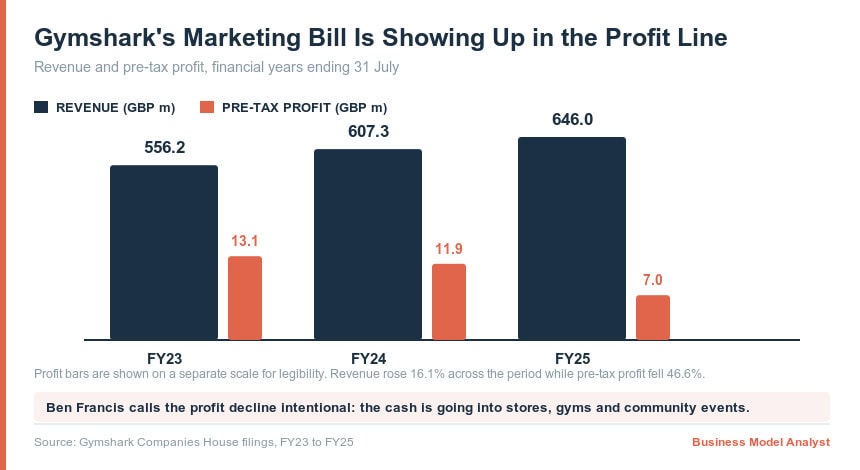
Revenue climbed 16.1% from FY23 to FY25. Pre-tax profit fell 46.6% over the same stretch, from £13.1 million to £7 million. Francis has been unusually direct about why. He describes the decline as intentional, the cost of “laying down the foundations for future growth,” and the company has declared no dividends, reinvesting profits back into the business.
Translate that from founder-speak: Gymshark stopped spending its marketing budget on impressions and started spending it on buildings.
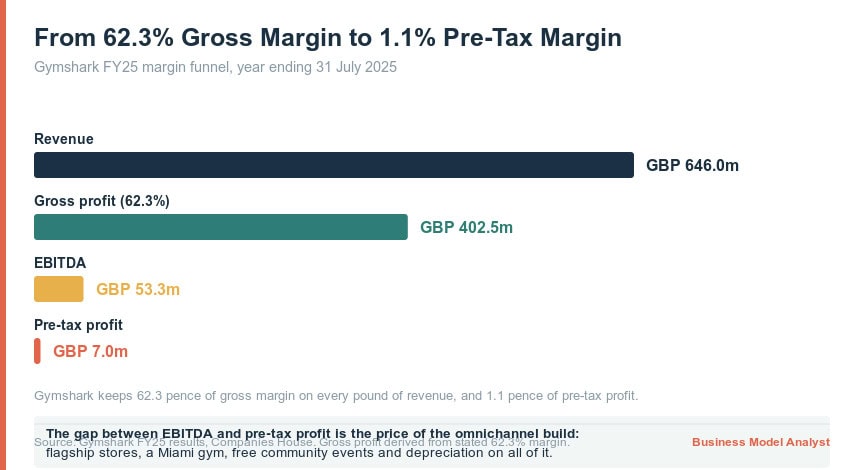
The funnel is the whole argument. A 62.3% gross margin is excellent, better than Lululemon’s roughly 59%, a company whose own marketing strategy leans on the same community levers. EBITDA of £53.3 million grew by double digits. And then pre-tax profit lands at £7 million, about 1.1% of revenue. The gap between EBITDA and pre-tax profit is where the flagship leases, the store fit-outs, the depreciation, the Miami gym and the free community events live.
Francis said the community events “cost our customer nothing.” He did not say they cost Gymshark nothing.
Wholesale: The Heresy That Proves the Point
For a decade, Gymshark’s entire identity was that it refused the middleman. Direct-to-consumer was the moat. Owning the customer relationship was the religion. The brand ran 14 localised web stores and served customers in over 230 countries without a department store in sight.
Then, in October 2025, Dick’s Sporting Goods became its first US wholesale partner, launching inside 12 House of Sport locations. In April, Gymshark opened the Gymshark Lifting Club in Miami, its first public gym concept. In February, Carly Natalizia was promoted to Chief Commercial Officer with a remit spanning all channels, not just digital.
Read those three moves together and the strategy snaps into focus. Gymshark is not abandoning community marketing. It is converting community into distribution. A wholesale shelf at Dick’s is a billboard you get paid to stand on. A gym in Miami is a permanent, revenue-generating brand activation. A flagship with a podcast studio and an event floor is a content set that also sells hoodies.
This is the actual innovation, and it is the opposite of what most DTC brands do when growth slows. The typical path is to buy performance ads until the payback period stops working. Gymshark is buying real estate instead, betting that owned physical space compounds while a Meta ad does not.
What the Numbers Say About Whether It Is Working
Cautiously, and with caveats.
The bull case: 13 straight years of growth, EBITDA up double digits, more than £37 million in cash, gross margin holding at a level most apparel businesses would kill for, and a founder confident enough to be in reported talks with General Atlantic about buying back part of the 21% stake he sold in 2020. Nobody negotiates to increase their exposure to a business they think is breaking.
The bear case: 6.4% revenue growth is the slowest in the company’s history, roughly 296 roles were cut last year, and the profit line has been sacrificed to fund a physical build-out that is expensive, slow, and directly adjacent to Lululemon’s home turf.
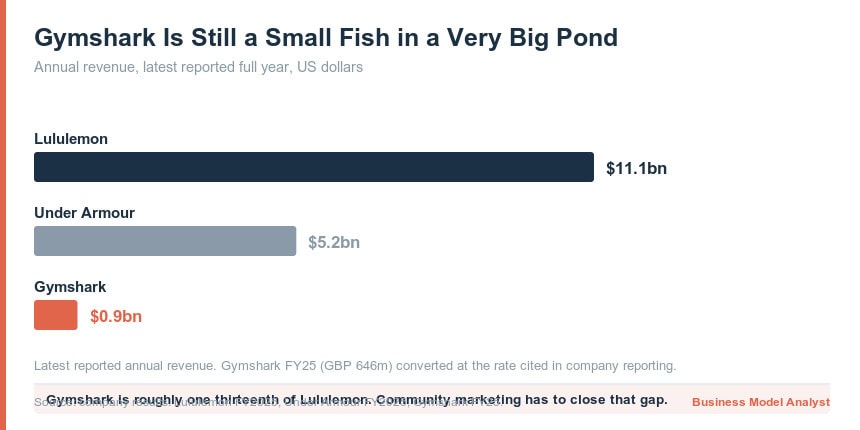
And that is the uncomfortable scale problem. Gymshark’s £646 million converts to roughly $863 million. Lululemon is at about $11.1 billion. Under Armour, in the middle of a turnaround, is at roughly $5.2 billion. Gymshark sits well down the list of Lululemon competitors by size, even as it outperforms most of them on cultural relevance. Gymshark’s community marketing is genuinely best-in-class, and it has produced a company about one thirteenth the size of the category leader.
Community is a fantastic way to get to a billion dollars. Nobody has yet proven it is a way to get past ten.
Risks the Community Model Cannot Solve
Dupe culture. TikTok has industrialised the “Gymshark leggings but £12” video. When your differentiation is fit, aesthetics and identity rather than patented technology, the identity has to carry the entire price premium.
Copycats with bigger budgets. Nike, Adidas and Alo now all run creator-led, community-flavoured playbooks, and the Nike marketing strategy has the budget to outspend everyone in the category. The tactic Gymshark invented has been commoditised, which is precisely why Gymshark is racing into physical space where capital and taste matter more than posting cadence.
The authenticity tax. Every store, every wholesale partner, every corporate hire makes the “scrappy garage brand” story harder to tell. Gymshark’s marketing depends on a founder myth that gets less true every year, which is why brand dilution keeps surfacing as the central weakness in any serious Gymshark SWOT analysis.
FAQ
What is Gymshark’s marketing strategy in one sentence? Build a fitness community through long-term creator partnerships and platform-native content, then convert that community into owned distribution through flagship stores, wholesale, festivals and gyms.
Does Gymshark use paid advertising? Yes, but it has never been the primary growth engine. The brand grew on organic creator content and earned media, and it now directs a large share of its investment into physical retail and community events rather than pure media spend.
Who are Gymshark’s athletes? The roster spans bodybuilding, fitness content and combat sports, including Chris Bumstead, Whitney Simmons, David Laid, Francis Ngannou and Katie Taylor. The brand has historically favoured credible fitness figures over mainstream celebrities.
What is Gymshark66? A community challenge built on the idea that habits take 66 days to form. Participants pick daily habits and track them through the Gymshark Training App, generating enormous volumes of user content in the process.
How much revenue does Gymshark make? £646 million in the financial year ending 31 July 2025, up 6.4% year over year, with pre-tax profit of £7 million and EBITDA of £53.3 million.
Is Gymshark bigger than Lululemon? No. Lululemon generated roughly $11.1 billion in its most recent full year, roughly thirteen times Gymshark’s revenue.
The Business Model Analyst Take
The most valuable lesson in the Gymshark marketing strategy is not the one everyone teaches. “Use influencers, build community” is advice from 2016 and it is worth approximately nothing now, because everyone does it and the arbitrage is gone.
The lesson worth stealing is what Gymshark is doing in 2026: treating marketing as a capital allocation decision rather than an expense line. Most brands ask how much to spend on ads this quarter. Gymshark is asking what assets it can buy that market the brand permanently. A gym markets. A flagship with an event floor markets. A festival markets. All three also generate revenue and sit on the balance sheet, which an Instagram campaign never will.
It is a genuinely smart trade, and it is not free. It has cut pre-tax profit by nearly half, slowed growth to single digits, and dragged an asset-light DTC business into the heaviest, most operationally punishing part of retail. The bet only pays if physical space really does compound loyalty faster than paid media buys it.
Watch the FY26 numbers. If revenue growth reaccelerates while profit stays suppressed, the thesis is working and the spending is an investment. If growth stays at 6% and profit keeps falling, then Gymshark did not reinvent marketing. It just bought a lot of expensive rent.