
HUTCHMED’s biggest single payday of the year came out of the lab, not the pharmacy. That is China’s whole biotech decade compressed into one contract.
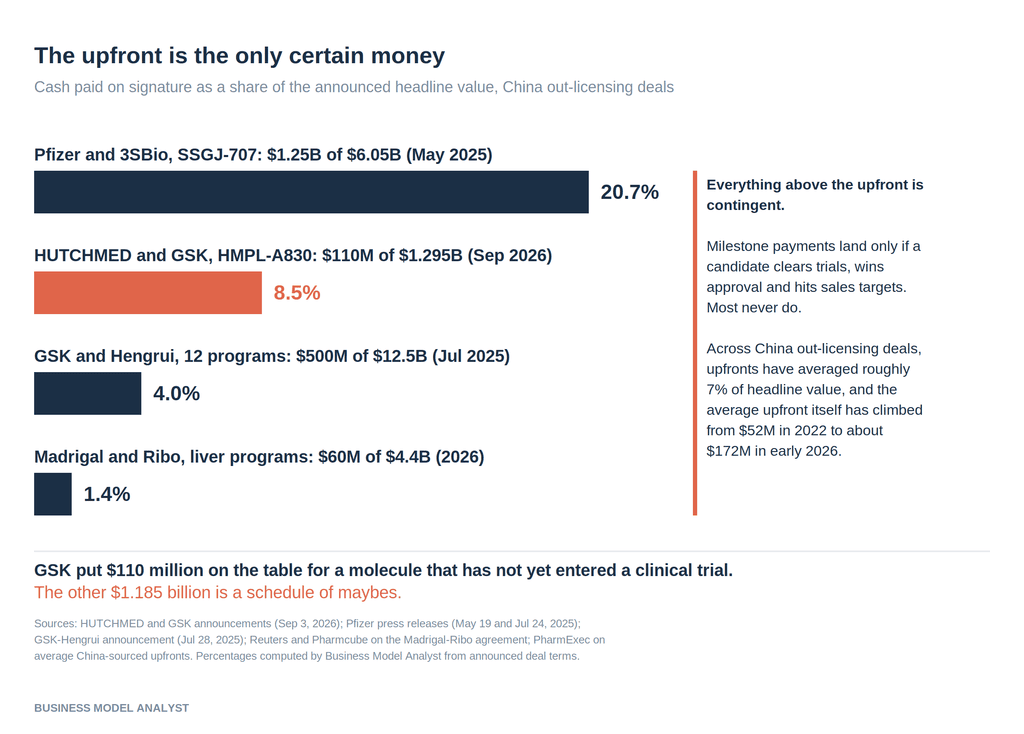
On September 3, 2026, GSK agreed to pay HUTCHMED $110 million in cash for rights outside Greater China to HMPL-A830, a cancer candidate that has not yet dosed a single patient. The headline is $1.295 billion. Only $110 million of that is money. The rest is a schedule of maybes. And that $110 million is bigger than every licensing dollar HUTCHMED booked in the entire first half of 2026, and more than double the half-year revenue of the drug it sells most of. The lab out-earned the pharmacy.
Big Pharma used to buy approved drugs. Then it started buying drugs that were nearly approved. This week it bought a molecule that has never been inside a human being.
The Wall Street Journal’s health care Market Talk column logged the deal the way the wires always do: Citi likes it, estimates go up, target price moves from HK$36 to HK$39, shares tick up 3.3% to HK$22.60. Analyst note, stock pop, next item.
That framing misses the interesting part entirely. Strip out the target price and look at the plumbing, and this small Hong Kong company just demonstrated that in 2026 the most valuable thing a biotech owns is not a drug on a shelf. It is a chemistry group that can produce candidates a Western giant will pay for sight unseen.
What Happened
HUTCHMED (Nasdaq/AIM: HCM; HKEX: 13) granted a GSK subsidiary an exclusive license to develop and commercialize HMPL-A830 everywhere except mainland China, Hong Kong, Macau and Taiwan. HUTCHMED keeps Greater China outright.
The economics: $110 million upfront, up to $1.185 billion in development, regulatory and commercial milestones, plus tiered royalties on net sales. Add it up and you get the $1.295 billion the press releases lead with.
HMPL-A830 is what HUTCHMED calls an antibody-targeted therapy conjugate, or ATTC. Instead of strapping a cytotoxic payload to an antibody the way a conventional antibody-drug conjugate does, it bolts a selective KRAS inhibitor onto an anti-EGFR antibody, so the drug blocks two signaling pathways while delivering the payload to EGFR-expressing tumors. GSK’s global head of oncology R&D, Hesham Abdullah, called the dual mechanism a potential improvement on current standard of care. First targets are colorectal, pancreatic and lung cancer.
Here is the detail that matters. The global Phase I program is expected to begin in the second half of 2026. HUTCHMED will run it. GSK takes over afterward. Which means GSK signed and paid before a single dose entered a single patient.
Markets liked it. The AIM line jumped about 17% on announcement day, from 179.5p to 210p, and Hong Kong added another 3.3% the next session. Citi lifted its 2026 to 2028 oncology and immunology revenue estimates for HUTCHMED by 14% to 27%.
The Backstory
To see why GSK paid preclinical money at clinical prices, you have to look at both sides of the table.
Start with GSK. Dolutegravir, the backbone of its HIV franchise, faces patent expiry in 2027. Shingrix, its top product, is drawing competition. The company has been buying its way out of the gap for two years: $1.2 billion upfront for a MASH candidate from Boston Pharma, a $1 billion acquisition of IDRx, and in July 2025, $500 million upfront to Jiangsu Hengrui Pharma for a package of up to 12 candidates that could reach $12.5 billion. GSK’s own framing for that Hengrui deal was growth “beyond 2031.” Translation: the internal engine is not producing fast enough, so buy someone else’s.
Now the other side. China has quietly become the place Big Pharma shops. GlobalData put Chinese partners at 28% of large pharma licensing deals in 2024. That rose to 38% in 2025, representing about 30% of all upfront payments made across the industry. By early 2026 it crossed half. Pharmcube data has the value of licensing-out deals from the greater China region at $137.7 billion in 2025, close to ten times the 2021 figure, with roughly $60 billion signed in the first quarter of 2026 alone.
Citeline’s Pharmaprojects database recorded more drug market debuts in China than in any other country in 2025. First time any nation has passed the United States on that measure.
The price of access has moved accordingly. The average upfront on a China-sourced licensing deal has gone from $52 million in 2022 to roughly $172 million in early 2026, a 230% climb, according to figures compiled by PharmExec. The old China discount, where clinical-stage assets traded 60% to 70% below Western comparables, is being competed away in public.
So HUTCHMED is not an outlier. It is a data point in a market that repriced itself in about thirty-six months.
The Plan
What GSK actually bought is not one molecule. Read the terms again.
GSK also secured a right of first negotiation on a second, earlier-stage ATTC candidate from HUTCHMED. HMPL-A830 is the third asset out of that platform; HMPL-A251 and HMPL-A580 are already in the clinic. GSK did not buy a drug. It bought a position in a factory, with an option on the next thing off the line.
That is exactly the shape of the Hengrui agreement too: one named lead asset, then eleven programs Hengrui develops through Phase I with GSK holding options afterward. Same architecture, different counterparty.
The division of labor underneath is the real product here. China runs discovery and early clinical work faster and cheaper. The West runs global Phase III, regulatory strategy and commercial launch, which is where the cost and the margin both live. HMPL-A830 fits the template perfectly: HUTCHMED does Phase I, GSK does everything after, HUTCHMED keeps its home market where it already has salespeople.
Both sides are specializing into the part of the value chain they are actually good at. That is not a distress trade. It is a supply chain forming.
The Business Model Angle
Headline deal value is a marketing number, not a revenue forecast. The $110 million upfront is 8.5% of the announced $1.295 billion. Across China out-licensing deals in 2026, upfronts have averaged around 7% of headline value. When Pfizer wanted 3SBio’s SSGJ-707, an asset already through Phase 2 and heading into Phase 3, it put $1.25 billion of the $6.05 billion package in cash, about 21%. Cash share of the headline is a cleaner read on conviction than the headline itself, and almost nobody reports it.
A discovery platform can out-earn a commercial franchise, and now regularly does. In the first half of 2026, HUTCHMED’s entire “other oncology and immunology” line, which bundles upfronts, milestones, R&D services and licensing, came to $40.9 million. One signature just delivered 2.7 times that in a single payment. ELUNATE, the drug HUTCHMED sells most of in China, produced $47.1 million in the same six months. The company guided full-year 2026 oncology and immunology revenue to $330 million to $450 million, so this one preclinical asset is worth a quarter to a third of a year of the whole commercial business. If you run an R&D-heavy company, the question is no longer only what you can sell. It is what you can license, and to whom.
Optionality is becoming its own product category. GSK is not buying certainty at $110 million. It is buying the right to find out, plus the right of first refusal on whatever comes next. This is venture-style portfolio construction executed on a corporate balance sheet, and it generalizes well beyond pharma: pay a small, certain sum for a call option on someone else’s expensive discovery process, and defer the big money until the uncertainty is resolved. The key partner is no longer a supplier. It is an outsourced R&D department you do not have to carry through a downturn.
The licensor is trading a big market for a fast dollar. HUTCHMED keeps Greater China and sells everything else. Greater China is the market where its infrastructure sits, and also the lowest-priced major oncology market on the planet. That trade converts a slow, capital-hungry global build into cash today. It is a legitimate choice, but it is a choice, and it permanently changes what the company is. Watch the revenue streams mix, not the pipeline slide, if you want to know which business a biotech is actually running.
The Risk
Now the case against everything above.
The milestones mostly will not arrive. Preclinical candidates fail more often than they succeed, and they fail at every gate: Phase I safety, Phase II efficacy, Phase III confirmation, regulatory review, then commercial uptake. The $1.185 billion assumes clean passage through all of it. Treat the $110 million as the real number and the rest as a lottery ticket with tiered payouts, and you will be closer to the truth than any headline.
The royalty tail is being sold cheap. This is the part of the China licensing boom that gets the least attention. Evaluate data shows the average royalty floor on these deals fell from 7.1% to 5.5% in the first four months of 2026, and dealmakers report Chinese biotechs accepting single-digit royalties as low as 2% to 3% in exchange for fatter upfronts, down from the 10% to 13% norm of three years ago. If HMPL-A830 becomes a real drug, GSK captures most of the economics. Selling the tail to buy the upfront feels good in the quarter it closes and looks different a decade later.
Politics is the unpriced variable. The BIOSECURE Act became US law in December 2025. The US International Trade Commission opened an investigation into Chinese state support, subsidies and pricing in biotech in February 2026. In June 2026, Representatives John Moolenaar and Debbie Dingell proposed the Biotech Investment National Security Act, aimed squarely at the surge in licensing deals with Chinese biotechs. Every model of this trade assumes the deals stay legal and the payments keep flowing. That assumption is now a live policy question, not a background condition.
The valuation gap is doing a lot of talking. Citi’s new HK$39 target sits roughly 73% above the HK$22.60 the stock traded at. Big implied upside is not a signal of confidence so much as a signal that the market and the analyst disagree sharply about what the platform is worth. HUTCHMED’s market capitalization is around $2.5 billion, so the $1.295 billion headline is about half the entire company. The shares moved a fraction of that, which tells you exactly how much of the headline investors are willing to bank.
And the operational picture is thinner than the deal suggests. HUTCHMED’s total first-half 2026 revenue was $278.3 million, essentially flat against $277.7 million a year earlier, with net income attributable to the company of $15.9 million. Johnny Cheng signed this agreement as acting chief executive while also serving as chief financial officer. A company running a leadership gap and flat top-line growth just made its biggest strategic commitment of the year.
Quick Questions
Is $110 million a good price for a preclinical asset? It is above the $30 million to $80 million band that Chinese Phase I and Phase II assets have typically commanded, and below the roughly $172 million average upfront across all China-sourced deals in early 2026. So GSK paid a premium for stage and a discount for scale. Reasonable, not remarkable.
Why does GSK want a KRAS drug specifically? KRAS is one of the most commonly mutated oncogenes in human cancer and one of the hardest targets to drug. Pairing a KRAS inhibitor with EGFR blockade attacks a known resistance pathway. Colorectal and pancreatic cancer are large, underserved indications where existing options are poor. Big commercial prize, high scientific difficulty, which is precisely the profile that gets licensed rather than built.
Does this make HUTCHMED a licensing company now? Partly, and that is the interesting bit. It still sells drugs in China and collects royalties from Takeda, Eli Lilly and AstraZeneca on FRUZAQLA, ELUNATE and ORPATHYS. But the ATTC platform is where the incremental value is being created, and this deal is the market’s first hard price on it. Three assets out, one licensed, an option written on a fourth.
Should Western biotechs be worried? They should be paying attention to pricing. Chinese assets historically carried upfronts 60% to 70% below Western comparables with total deal sizes 40% to 50% smaller. That gap is the whole reason the sourcing moved east, and it is closing fast. When it closes entirely, the advantage shifts back to whoever runs the fastest, cheapest discovery process, wherever they are.
The Business Model Analyst Take
The trade the wires reported is a licensing deal. The trade that actually happened is a repricing of what pharmaceutical R&D is worth before anyone knows whether it works.
For twenty years the industry’s implicit rule was that evidence sets price. Preclinical was cheap because preclinical is mostly wrong. Phase 3 data was expensive because Phase 3 data is mostly right. That ladder is bending. GSK just paid $110 million to a company with an acting CEO and flat revenue for a molecule with zero patients, because the alternative, waiting for data, means bidding against Pfizer and AstraZeneca and AbbVie at four times the price eighteen months later.
The scarce asset is no longer the finished drug. It is a reliable pipeline of things that might become drugs. HUTCHMED did not sell GSK a cancer therapy. It sold GSK a seat at the front of the line, and threw in a right of first negotiation on the next seat. Novo Nordisk can take a proven blockbuster and repackage it into a pill because it already owns the molecule. GSK does not have that luxury, so it is buying access to other people’s chemistry as fast as the term sheets can be drafted.
Every R&D-heavy business should be reading this as a pricing lesson. The output of your lab has two possible customers: the market, eventually, or someone with a patent cliff, right now. The second one pays sooner.