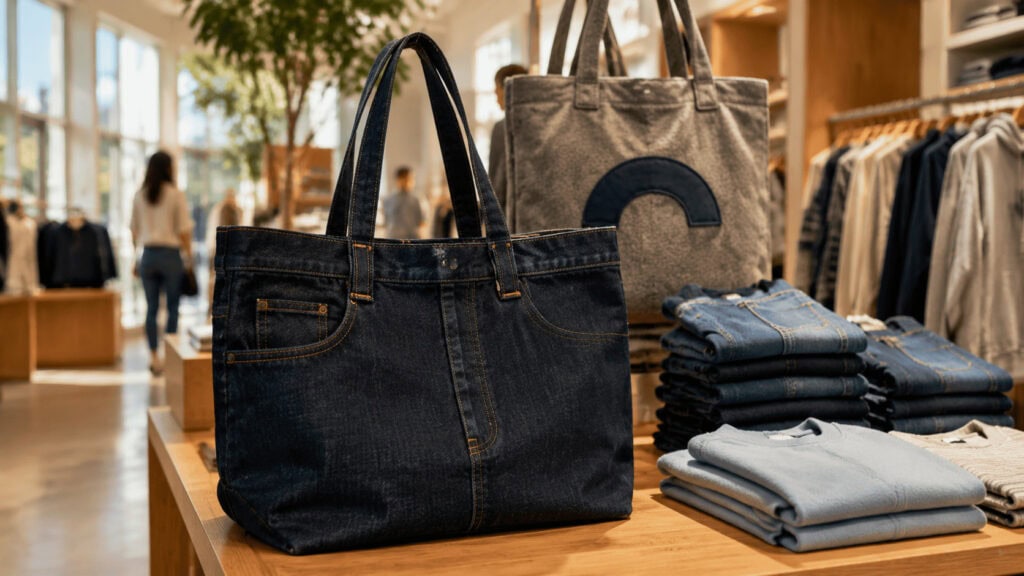

Gap’s new handbag line is aimed at a $15 billion category. Capturing one percent of it would be less than one percent of Gap Inc.
Is Gap entering the handbag market? Yes. GapBag, a line designed by former Coach president and executive creative director Reed Krakoff, hits stores and gap.com on September 8, priced from $29.95 to $148 with one limited-edition patchwork style at $498.
How big is the opportunity? The Wall Street Journal puts the accessories category Gap is entering at roughly $15 billion. One percent of that is $150 million, which is 4.2% of Gap brand revenue and 0.97% of Gap Inc. net sales.
What does that require in practice? About 7.2 bags per North American Gap store per day, on a Business Model Analyst calculation using an $80 blended selling price and Gap’s 35% online mix.
So is this a growth engine? Not at the company level. It is an attach-rate business, and attach-rate businesses pay in margin and frequency, not in top line.
Every headline about Gap’s handbag launch leads with the same figure: $15 billion. That is the size of the accessories category, and it is the wrong denominator.
The right one is seven. Seven bags per store per day is what it takes for Gap to claim one percent of that category, and one percent of that category would move Gap Inc. net sales by less than a rounding error on a bad quarter at Old Navy.
That is not a knock on the launch. It is the reason the launch makes sense. Gap is not trying to win a handbag market. It is trying to sell one more item to a customer already standing in a store it already pays rent on. That is a completely different business with completely different math, and almost nobody is doing that math out loud.
What Happened
Gap Inc. told The Wall Street Journal on September 1 that it is launching a dedicated handbag line built from the brand’s two most recognizable materials: five-pocket denim and logo fleece.
The hero product is a Five-Pocket Tote carrying real jeans hardware, belt loops, shank buttons, bar tack stitching. Alongside it sits a Hoodie Tote in fleece with the arch logo across the front, a drawstring closure and a neoprene lining so it holds shape and survives a wash cycle. There are charms and keychains too, which is Gap arriving at the trinket economy roughly on schedule.
The line runs $29.95 to $148, plus a single limited-edition patchwork bag at $498. Launch date is September 8.
CEO Richard Dickson framed it plainly to the Journal, saying Gap has sold accessories before but “never been in it with distinction or conviction.” The construction was harder than it sounds. Krakoff went through a stack of prototypes because the stretch denim Gap sells as jeans will not hold a bag’s shape, so the company engineered a stiffer, no-stretch fabric closer to what denim used to be before elastane showed up.
The timing is deliberate. Gap brand comparable sales rose 10% in the quarter ended August 1, its strongest showing in the portfolio and, per the Journal’s earlier reporting, an eleventh straight quarter of growth. The stock had its biggest one-day jump in more than a year on that print.
The Backstory
Krakoff is the most credentialed accessories hire in American mass retail, and the record is worth reading carefully because it explains both the ambition and the ceiling.
He ran Coach from 1996 to 2013 as president and executive creative director, and is generally credited with building it from a quiet leather-goods house into a $5 billion brand. He is a three-time CFDA Accessory Designer of the Year. He ran his own label from 2010 to 2015. He served as Tiffany & Co.’s first chief artistic officer from 2017 until LVMH bought the company and let him go in 2021. Since September 2022 he has been creative chairman and a minority shareholder of John Hardy, and a strategic adviser to L Catterton.
He still holds those last two jobs. That matters more than it looks.
Gap Inc.’s September 17, 2025 announcement of its beauty and accessories push used two different words for two different kinds of hire. It announced the appointment of Deb Redmond as general manager of beauty and Michele Parsons as general manager of accessories. It announced “the engagement of Reed Krakoff and John Demsey,” the latter a former Estee Lauder executive.
Appointment for the operators. Engagement for the names. Gap put employees on the P&L jobs and contracted the marquee creative talent, who kept their other gigs. That is a deliberate cost structure, and it tells you how the company is thinking about the entire accelerator portfolio.
The rest of that portfolio: beauty launched at Old Navy in about 150 stores with shop-in-shops, Gap brand beauty and a relaunched fragrance line followed in 2026, and in January the company created a chief entertainment officer role for former Paramount executive Pam Kaufman to build content and licensing. Zac Posen has been creative director since 2024.
None of it is apparel.
The Plan
Here is the arithmetic nobody ran.
Gap brand did $844 million of net sales in the quarter ended August 1, which is 23.1% of Gap Inc. Annualized at that weight, the brand is a roughly $3.56 billion business. Gap ran 461 company-operated stores in North America at quarter end, and 35% of company net sales came from online.
Assume a blended $80 selling price across a $29.95 to $148 line. That assumption is ours, not the company’s, and everything below scales with it.
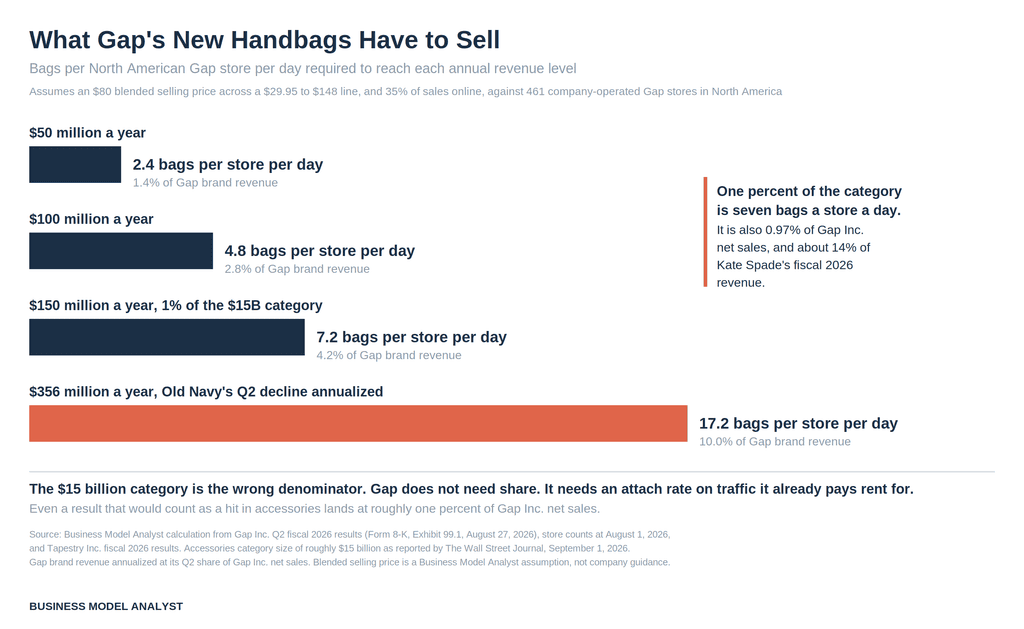
- $50 million a year needs 2.4 bags per store per day. That is 1.4% of Gap brand revenue.
- $150 million a year, one percent of the $15 billion category, needs 7.2 bags per store per day. That is 4.2% of Gap brand revenue and 0.97% of Gap Inc. net sales.
- $356 million a year, which is what Old Navy gave back in the June quarter annualized, needs 17.2 bags per store per day and would be 10% of Gap brand revenue.
Two things fall out of that table, and they point in opposite directions.
The first is that the achievable version is easy. Seven bags a day in a store doing thousands of transactions is not a stretch goal. It is a decent endcap. Any retailer with traffic can hit that.
The second is that the achievable version does not matter to Gap Inc. One percent of a $15 billion category rounds to one percent of the company. To make handbags matter at the holding-company level, Gap would need roughly $356 million of bag revenue, which is about a third of everything Kate Spade sold in fiscal 2026, from a standing start, in denim, at an average price under a hundred dollars.
So the growth story is not the bags. It never was.
What Gap is actually buying is three things it cannot invoice separately. Higher gross margin mix, because a $68 tote carries better margin than a $68 pair of jeans and costs nothing extra in rent. More frequency, because accessories turn faster than denim and give a customer a reason to come back inside 90 days. And a reason to talk about Gap in September that is not a markdown.
That is the honest case for the launch, and it is a good one. It is also completely invisible in the financial statements, which is the next problem.
The Business Model Angle
- Attach rate is the cheapest revenue in retail, and the hardest to defend. An incremental item sold to existing traffic carries no incremental rent, no incremental customer acquisition cost and no incremental store labor. The flip side is that you cannot prove it worked. Gap will never be able to show investors a clean number for what the bags did, because the mechanism runs through basket size and visit frequency in a brand that is already comping double digits for other reasons.
- Rent the creative, own the trademark. Krakoff is engaged, not employed, and kept John Hardy and L Catterton. Demsey is engaged too. Gap converted its most expensive creative inputs into variable cost sitting on top of a fixed real estate base. Founders in category-extension mode should copy this structure before they copy the product: hire operators, contract names, and keep the option to stop.
- Size adjacent categories against your own revenue, not the category’s. The $15 billion figure is a decoy for anyone building a business case. The question is never how big the market is, it is what share you can realistically take and what that share equals as a percentage of the revenue you already have. Run that second calculation first. It kills more bad extensions than any market study.
The Risk
Four things could break this read, and two of them cut against us.
You cannot see the accelerators in the P&L. Gap Inc. reports four brands plus a line called Other, which captures net sales from revenue-generating strategic initiatives. Other went from $28 million to $4 million year over year in the June quarter, down 86%, while management points at that same lane as the future. Either the new businesses are shrinking, or they are being booked inside the brands and are simply invisible. There is no accessories disclosure, no beauty disclosure, no attach-rate metric. Investors are being asked to underwrite growth engines that do not appear anywhere they can check.
The launch is running on the smaller footprint. Gap brand operates 461 North American stores across 4.9 million square feet. Old Navy operates 1,241 across 19.6 million. As we worked through in our piece on Gap’s portfolio weight, roughly two-thirds of the company’s square footage sits at the brand that is comping negative, and it is not the one getting the handbags. Beauty went to Old Navy first. Bags went to Gap. The bigger box gets the lower-ticket accelerator.
Counterpoint: Krakoff has done exactly this before, from a worse start. Coach in 1996 was a competent leather-goods maker nobody talked about. He has said that accessible luxury in handbags did not really exist as a category then, and that the business he built became a multi-billion-dollar one over the following decade. Gap starts with far more brand awareness than Coach had. And attach rate requires traffic, which Gap brand now has for the first time in twenty years. That is not nothing.
Counterpoint: our arithmetic may be measuring the wrong thing on purpose. If the bags work, the payoff appears in apparel comps and repeat visits, not in bag revenue, which means a bag-revenue calculation understates the value by construction. We think that is the strongest objection to this piece. It is also unfalsifiable, which is precisely why it is such a comfortable thing for management to say.
One more, on the read-through. Investing.com noted Tapestry shares indicated down about 1.9% ahead of Tuesday’s open, extending a 17.6% slide over the prior 30 days, and framed Gap as competitive pressure on Coach. We would be careful there. A $29.95 denim tote and a $400 Coach Tabby are not the same purchase, and the customer who buys one is not deciding against the other. As our Coach and Kate Spade comparison laid out, what protects Coach is gross margin built on desirability, not a price point Gap can undercut.
Quick Questions
When does the GapBag line launch?
September 8, 2026, in stores and online.
How much do Gap’s new handbags cost?
From $29.95 to $148, with a single limited-edition patchwork style at $498.
Who designed them?
Reed Krakoff, who ran Coach from 1996 to 2013 and was Tiffany & Co.’s chief artistic officer from 2017 to 2021. He joined Gap Inc. as executive director of accessories in September 2025.
Will handbags fix Gap Inc.?
No. One percent of the $15 billion accessories category equals about 0.97% of Gap Inc. net sales. Old Navy, at 56% of revenue, still sets the company’s direction.
What is an accelerator at Gap?
Dickson’s term for new categories layered onto the existing brands: accessories, beauty and fragrance, and entertainment and licensing under chief entertainment officer Pam Kaufman.
Is this a threat to Coach?
Not directly at these price points. The overlap is narrow, and Coach’s defense is a gross margin near 79% that Gap is not attacking.
The Business Model Analyst Take
Gap took the two things it can print on anything, a five-pocket silhouette and an arch logo, and turned them into objects. That is not a handbag strategy. That is trademark monetization with a zip closure, and it is the same instinct Dickson brought from Mattel, where the win was never selling more dolls.
The strategy is sound and the ceiling is low, and those two facts are not in tension. Seven bags a store a day is a real, reachable, margin-accretive business that will make Gap stores more interesting and Gap baskets slightly bigger. It will also never be visible in a Gap Inc. earnings release, because a company doing $15.4 billion cannot feel a $150 million category unless something else goes right first.
The tell to watch is not the sell-through. It is whether Gap ever gives accessories its own line in the release. Companies disclose what they are proud of. Right now the accelerator lane reports $4 million and a lot of adjectives.