
American business owners say they can’t tell whether $6 diesel is temporary. The companies coping best picked prices that never need the answer.
Diesel averaged $6.285 a gallon on Monday, the first weekly national reading above $6 in the Energy Information Administration’s survey, up 68% from a year ago. The Wall Street Journal went looking for how business owners are setting prices into that, and found them split on one question: is the energy shock a blip to wait out, or a new normal that justifies a price increase today?
No one in the story can answer that, and over the same summer FedEx Freight never tried. It changed its fuel surcharge every week from late May to early September, fifteen times in a row, and eight of those changes were price cuts.
The owners in the Journal’s story are treating pricing as a forecasting problem. Treat it as a duration problem and most of the agony goes away. A list price is a promise that lasts until you find the nerve to break it. A cost spike can last six weeks or six years. Hold a long promise against a cost of unknown length and you are forced to guess. Sell a price that expires on its own schedule and the guess stops mattering.
What Happened
Melissa Florio co-owns Ambix Manufacturing in New Hampshire, which makes plastic parts for power-distribution companies, including insulators for high-voltage transmission lines. Ambix had gone three years without a price increase, and for months she kept it that way, expecting the cost surge to settle. Oil kept pushing up the price of resin, her main raw material. This summer she raised prices on every product by 10% to 21%. “We reached the breaking point,” she told the Journal.
Jim Barbour, a third-generation farmer in rural Pennsylvania, went the other way. The cost of trucking hay in from three counties away is up about 15%. He sells beef, pork and milk, and he has raised meat prices once in five years. He expects fuel to come back down once the Middle East calms, so his margin absorbs the difference for now.
In between sits LupinePet, which makes dog collars and leashes from materials sourced around the world. Tariffs and carrier fuel surcharges pushed its costs up, and the company raised prices 5% this summer. Co-owner Valerie Jensen told the Journal she got through the Great Recession and Covid without ever feeling this unsure about what to charge.
The big names are split too. Walmart told investors in August it had cut prices on more than 10,000 items despite billions of dollars in expected fuel costs. Campbell’s said in June that price increases were a last resort, and it is now raising prices on more than half its portfolio. Clorox spent the spring describing a cautious approach to pricing and is now lifting the price of Glad trash bags as resin climbs.
KPMG chief economist Diane Swonk told the Journal that shocks used to arrive as one-off episodes a company could ride out, and now they are a permanent condition. Mark Zandi of Moody’s Analytics read strong corporate profits as a sign that most companies are passing their costs along. The Federal Reserve is widely expected to raise interest rates this week.
The Backstory
Freight carriers already run a working answer, and FedEx Freight publishes it every week.
Each Monday the EIA surveys retail diesel stations and publishes a national average. FedEx Freight, the less-than-truckload arm of FedEx, reads that number and applies a matching fuel surcharge to its linehaul charges starting that Wednesday. The customer’s base rate stays put. Only the fuel line moves, and it moves both ways.
FedEx Freight posts the history. On May 27 the surcharge stood at 51.0%, keyed to diesel at $5.523. Diesel then fell for six straight weeks, and the surcharge followed it down to 41.5% by July 8, with diesel at $4.578. Then diesel turned back up. By September 9 the surcharge was 55.4% on diesel of $5.967.
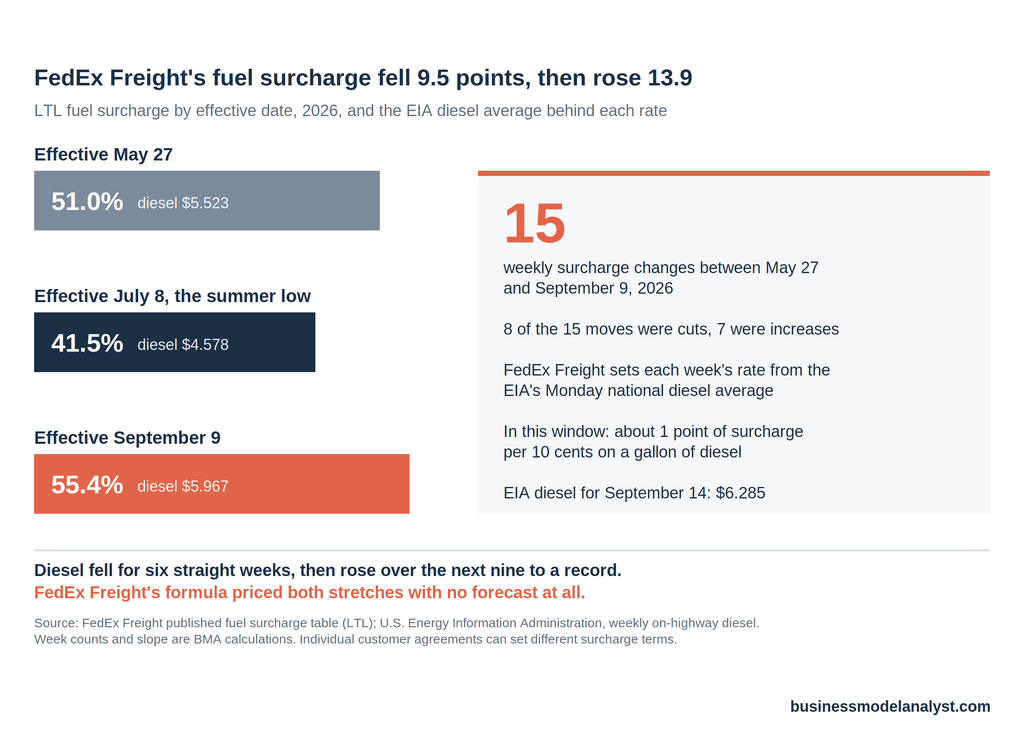
Count the weekly moves across that window and you get fifteen changes: eight cuts and seven increases. Run the surcharge against the diesel price and the relationship holds close to a straight line, roughly one point of surcharge for every 10 cents on a gallon. (BMA calculation off FedEx Freight’s published table; individual customer agreements can set their own terms.)
Put dollars on it. A shipper paying $1,000 in linehaul charges owed $510 for fuel in late May, $415 in early July and $554 by September 9. The $1,000 never moved, and the fuel line changed with no renegotiation.
Now look at the summer from the other chair. A business owner who decided in late May that the fuel spike was temporary had six weeks of evidence to feel clever about, with diesel down 17% by early July. From there diesel climbed 30% to a nominal record by the September 7 reading. The “temporary” camp was right, and then it was wrong, inside a single season. The surcharge was never exposed to either call.
We argued earlier this month that who pays for a fuel shock gets decided in the contract, long before the shock arrives. The FedEx Freight table is what that clause looks like in motion.
The Plan
Large consumer companies can’t bolt a fuel line onto a box of soup. They are solving the same duration problem with other tools, and all three names in the Journal’s story picked a different one.
Walmart picked a price with an expiration date. The retailer ran more than 11,000 rollbacks in its second quarter, up from about 7,200 the quarter before, and “rollback” is Walmart’s own word for a temporary price cut. It is paying for them with roughly $2.9 billion in tariff refunds, a one-time check, while expecting around $2 billion in extra fuel costs this year. Temporary price, one-time money, and a refund nearly one and a half times the size of the fuel bill it offsets. When the money runs out, the rollbacks can end on schedule and the shelf goes back to its everyday price. Shoppers read that as a deal ending, which stings far less than a price increase. The same quarter produced the store-sales number that spooked Wall Street, so Walmart is buying loyalty at a moment it needs traffic.
Campbell’s picked hedges first and list prices second. CFO Todd Cunfer told analysts the company has about 80% of its expected inflation covered for the first half of fiscal 2027 and only about half for the second. He named that uncovered half as one of the two things deciding whether earnings land at the top or bottom of guidance. The list-price increase, averaging 4% to 5% on roughly 60% of the portfolio, starts in the second quarter, right as the hedge cover thins. Across the whole portfolio that works out to about 2.4% to 3% (our math).
Cunfer also shared the elasticity he planned around: 1.5 times. Every 1% of price costs 1.5% of volume, so a 4.5% increase should shrink units on those products by roughly 7%. That sounds like a loss until you run gross profit. With cost per unit held flat, a 4.5% price increase at that elasticity raises gross profit dollars for any product with a gross margin below about 62%. Campbell’s adjusted gross margin was 28.6% in its fourth quarter. The company is choosing to sell fewer units at a better margin, on purpose. (BMA calculation, and a simplified one, as The Risk explains.)
Clorox picked the narrowest tool it could. The company expects more than $200 million of cost inflation in fiscal 2027, against a normal year of $75 million to $100 million. On fiscal 2026 net sales of $6.72 billion, $200 million is about 3% of revenue. Clorox is not trying to price all of it back. It guides net price and mix only slightly up, a gross margin near 42%, and productivity as the main offset. Glad trash bags, where resin exposure is direct, get a regular price increase. Everything else gets targeted moves, promotions and pack changes. “Pricing is only one tool in the toolbox,” CEO Linda Rendle said on the August call.
Clorox has a reason for the restraint. Management reminded analysts it pushed through four substantial rounds of price increases in the last inflation cycle. Shoppers remember those. Pack size is the quieter lever, and we saw Philip Morris use it on Zyn last week, cutting the price per pouch without touching the price per can.
The Business Model Angle
Split your price into a promise and a pass-through. FedEx Freight’s base rate is the promise. The fuel line is the pass-through, tied to a government index neither side controls, so nobody argues about it on a Wednesday. Florio’s customers are businesses buying engineered parts on repeat, which is the setting where this works best. A quote with a base price per insulator and a separate adder keyed to a published resin benchmark lets her charge more in a bad month and less in a good one without a single “we reached the breaking point” letter.
Match the length of the price to the length of the money. Walmart’s rollbacks work because a temporary cut is funded by a temporary check. The expensive mistakes run the other way: a permanent price cut financed by a windfall, or a permanent price hike sized for a spike that fades. Before you move a price, ask how long the cost behind it will last and how long the price will last. If those two answers differ by years, you have a mismatch.
Lumpy repricing hides a smaller number. Ambix went three years without a price increase and then took 10% to 21% in one go. Spread across those three years, that works out to about 3.2% to 6.6% a year, compounded. A customer who sees a routine annual step of 4% barely reacts. A customer who opens one letter with 21% in it starts calling competitors. The lump also has no reverse gear. If resin falls next spring, handing back part of a 21% increase takes a second letter, and few companies ever write it.
Forecast risk rolls downhill to the last fixed price in the chain. LupinePet’s carriers index their fuel costs weekly. LupinePet’s leash carries a sticker. Each supplier up the chain passes volatility down through formulas until it reaches someone who sells at a fixed number to a shopper who can skip the purchase. That company holds the forecast for everyone above it. We saw the mirror image when wholesale chicken prices collapsed and grocery shelf prices barely moved: prices set by formula fall on their own, and sticker prices wait for someone to decide.
The Risk
Consumers don’t accept surcharges the way shippers do, and regulators are closing the door. California’s SB 478 has required advertised prices to include mandatory fees since July 1, 2024. The FTC’s fee disclosure rule, in effect since May 12, 2025, already covers live-event tickets and short-term lodging. A leash company that adds a “fuel adjustment” at checkout invites legal trouble and angry reviews at the same time. Retail businesses have to find their short-duration tool in promotions, rollbacks and pack sizes, and every one of those carries its own costs.
The formula becomes the thing both sides negotiate, and the stronger side rewrites it. UPS raised its fuel surcharge table for the 11th time in under 30 months in March, according to freight consultancy FreightWise, after years of adjusting it about once a year. The diesel index stays neutral. The table that converts it into a percentage belongs to the carrier. Small shippers who assume “indexed” means “fair” are handing the pricing decision to whoever writes the table.
Indexes also measure the wrong thing for some buyers. A national diesel average understates what a California hauler pays, and a resin benchmark won’t match the grade a specialty molder buys. A bad index transfers the forecasting problem to basis risk, which is harder to explain to a customer.
Holding a price can also be the right call. Barbour’s farm runs glamping, Airbnb stays and a barbecue trailer alongside the meat, so he has other lines to absorb a margin squeeze. Walmart is spending on price to take share. ADP data cited by the Journal found more than a third of wage earners lost purchasing power between late 2020 and late 2024, which means customers are already primed to walk.
Our own Campbell’s arithmetic deserves a caveat. The 62% break-even holds unit cost flat. Lose 7% of volume in a plant and fixed costs spread across fewer units, raising the cost of each one, and Cunfer himself warned of that deleverage in snacks. The FedEx Freight slope comes from 16 weekly readings and a straight line through them, and any single customer’s contract can set different terms.
Quick Questions
How does a freight fuel surcharge work? The carrier charges a percentage on top of its linehaul rate, and that percentage resets on a fixed schedule based on a published diesel price. FedEx Freight uses the EIA’s weekly national on-highway diesel average and applies each new rate from the following Wednesday.
Should a small business add a fuel or materials surcharge? It fits best in business-to-business sales with repeat customers and a cost that tracks a published benchmark. In consumer sales, check state fee disclosure rules first. California requires mandatory fees inside the advertised price.
Why is Walmart cutting prices while its costs rise? Most of its cuts are rollbacks, which Walmart defines as temporary. It is funding them with about $2.9 billion in one-time tariff refunds while it expects roughly $2 billion in added fuel costs, and it wants the market share.
What does an elasticity of 1.5 mean? For every 1% increase in price, unit volume falls about 1.5%. Campbell’s used that assumption for its fiscal 2027 price increases, which means it expects to sell fewer units and still earn more gross profit on them.
Is $6 diesel going to last? Nobody knows, and that is the point of this piece. The EIA’s September outlook flagged low distillate inventories heading into fall refinery maintenance and harvest season. The businesses in the best position are the ones whose prices don’t depend on the answer.
The Business Model Analyst Take
The owners in the Journal’s story forecast as well as anyone else. They hold one pricing instrument, the list price, and it comes in one length: until further notice. Every cost shock forces a holder of that instrument into a bet on how long the shock will last, and a summer like this one punishes both bets in turn.
The companies with the calmest pricing teams bought different lengths. FedEx Freight sells a one-week fuel price. Walmart sells a temporary shelf price funded by a one-time check. Campbell’s locks in most of the next six months of costs and raises list prices as that cover thins. None of them know where diesel goes next. None of them need to.
So before you debate whether a cost is temporary, write down how long it could last and how long your price lasts. If the second number is “until I work up the nerve,” change the instrument before you change the price.