
The most expensive building in a truck factory is the one nobody shops for. Ford is replacing it anyway.
Ford said on Thursday it will spend $1 billion on a new paint shop at Kentucky Truck Plant in Louisville. Read the announcement twice and the interesting part is what is absent. No added capacity. No new nameplate. No hiring number. The building being replaced is a paint shop that already exists, at a plant that already runs, making trucks that already sell.
That is not a knock on the decision. It is a category. This is sustaining capital, the money a factory spends to remain a factory, and it usually gets a line in the 10-K rather than a governor at the podium.
This one got the podium, and the reason it got the podium is more interesting than the paint.
What Happened
The new shop replaces the existing paint shop at Kentucky Truck Plant, the facility on Chamberlain Lane in east Louisville that Ford calls its largest and highest-revenue US manufacturing site. It builds F-250 through F-550 Super Duty pickups and chassis cabs, plus the Ford Expedition and the Lincoln Navigator. Roughly 8,900 people work there, more than 8,300 of them hourly, and the line turns out a finished vehicle about every 45 seconds.
Ford plans to break ground before the end of 2026. The company frames the upgrade around paint quality, efficiency and what it calls “advanced environmental sustainability.” Across the state, Ford counts more than 11,500 employees, over 6,000 retirees, and total economic impact above $33 billion.
Nowhere in any of that is a number for output or headcount.
The wires attached the news to a different story. Two days earlier, the Department of Transportation made public a letter it had sent to CEO Jim Farley on September 3 raising concerns about Ford’s supply-chain ties to Chinese firms. Ford rejected the letter as containing factual errors, and Farley described the criticism as basic misunderstandings that a phone call would have cleared up.
The tidy version writes itself: company gets scolded on Tuesday, announces a billion dollars of American manufacturing on Thursday. It does not survive contact with a construction schedule. Ford Authority reported in June that Kentucky Truck Plant was in line for a major expansion, and this is one piece of that plan. Paint shops are permitted, engineered and procured over years, not over a long weekend. What moved in two days was the press release, not the capital.
Which leaves the actual question on the table. Ford just committed a billion dollars to a building that changes nothing a customer will ever notice. Why is that the right call?
The Backstory
Kentucky has taken a lot of Ford money, and until now every check came with a number attached.
In December 2015, Ford put $1.3 billion into Kentucky Truck Plant for an all-new body shop and retooling, and announced 2,000 new jobs, to build the aluminum-bodied Super Duty. In September 2022 it added $700 million and 500 full-time jobs for the next Super Duty generation. In October 2025 it committed roughly $2 billion to gut Louisville Assembly Plant across town for the Universal EV platform, a project it says secures about 2,200 hourly jobs. Ford Energy Systems in Glendale is another $2 billion or so, converting a battery site into 20 gigawatt-hours a year of storage production with at least 2,100 jobs and output starting late 2027.
Every one of those announcements named a product, a job count, or both. CNBC puts recent Kentucky commitments at roughly $4 billion before this one.
The paint shop names neither.

The Plan
Here is the part most coverage skipped, because paint sounds like a finish rather than a factory.
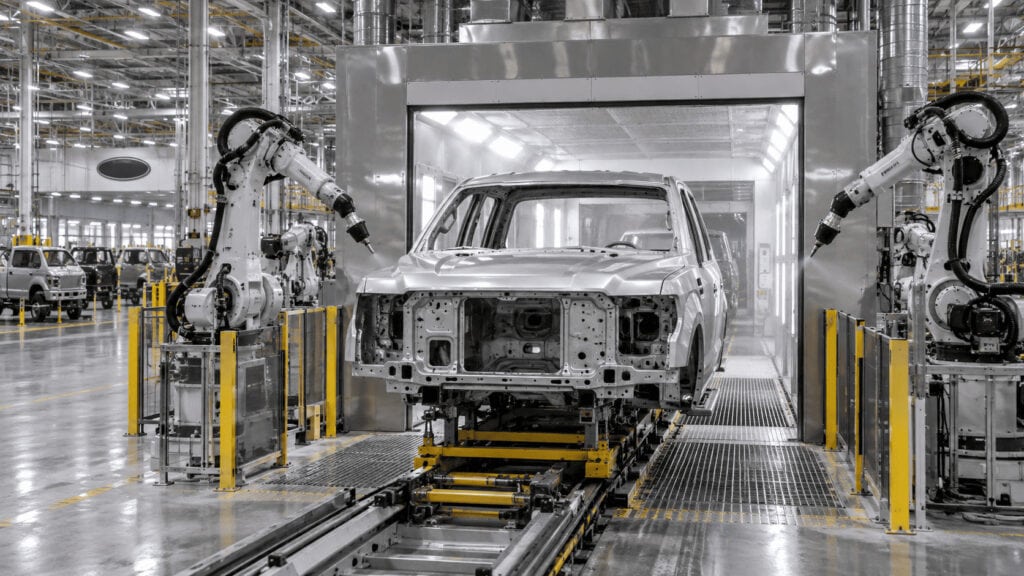
A paint shop is the most expensive and most demanding building on an assembly campus. It runs the ovens, the booths, the air handling and the emissions control, and it eats the plant’s energy budget. Industry estimates put paint at 45% to 70% of the total energy used to build a vehicle. PPG has pegged it near 70%. Stellantis says paint operations generate roughly 65% of a plant’s carbon dioxide.
It is also the governor on everything else. Bodies come out of the body shop faster than paint can process them, which is why paint sets the line rate. A paint shop failure stops the plant. There is no workaround, no second line, no supplier who can ship you a painted body from somewhere else. Every truck Ford builds in Louisville passes through that one building.
So a new paint shop buys several things at once, none of which appear on a window sticker: headroom on line speed, a lower energy bill per unit, fewer repaint loops, more color and material capability, and a fresh environmental permit position instead of an aging one.
Now put that next to the opposite bet, made in the same country in the same year. Slate, the Bezos-backed startup chasing a $25,000 pickup, designed the paint shop out of the business entirely, using molded body panels that arrive already colored. Ford is paying a billion dollars for the building Slate deleted.
Both companies are right. That is the point. If your product sells for $28,000 and your volume is unproven, the paint shop is the single largest fixed cost standing between you and a viable price. If your product is a Super Duty in a lineup where Ford’s brand-wide average transaction price ran $56,826 in June 2026, the paint shop is the thing protecting the highest-margin line in the company.
The Business Model Angle
Sustaining capital keeps getting announced in the vocabulary of growth capital. The test is simple and works on any capital announcement in any industry: does the release name a new unit of output, a new product, or a new job? If it names none of the three, you are looking at replacement spend, however the adjectives read. This applies just as cleanly to data center refreshes, refinery turnarounds, hotel renovations and grocery remodels. The dollar figure tells you the size of the asset base, not the size of the ambition.
Money follows the constraint, not the feature. No buyer cross-shops paint shops. Paint is invisible to demand and decisive to supply, which is exactly why it is worth a billion dollars. In asset-heavy businesses the profitable capital rarely goes where the marketing goes. It goes to the one node that can stop everything, and the tell that management understands its own factory is whether it spends there before it has to.
A paint shop is the most powertrain-agnostic asset in the plant. It paints whatever comes down the line. Ford spent $2 billion at Louisville Assembly on tooling built for a single electric truck, a one-way door we worked through in Ford’s Fathom bet. The paint shop is the inverse trade: a twenty-year asset that survives any decision Ford later makes about what Kentucky Truck Plant builds. In a company that keeps changing its mind about powertrains, the flexible building is the safest billion on the books.
The Risk
The strongest case against this framing is arithmetic, and it deserves a fair hearing.
Ford does not publish annual output for Kentucky Truck Plant. Take the company’s own figure of one vehicle every 45 seconds, assume two eight-hour shifts across a normal production year, and you land near 300,000 units. Spread $1 billion across a twenty-year paint shop life at that rate and the cost is roughly $167 per truck. Against a Ford brand average transaction price of $56,826, that is about three tenths of one percent. Framed that way, this is not a billion-dollar gesture. It is cheap insurance on the plant that carries Ford Pro, the segment that earned $6.84 billion of EBIT on $66.3 billion of revenue in 2025 while the consumer-facing half of the company contributed nothing.
Deferring paint shops is also how plants quietly die. The capital does not announce itself, the quality data drifts, and eventually the product moves somewhere newer. Companies that skip this spend look more profitable for about a decade.
The real risks sit elsewhere.
Ford held full-year capital expenditure guidance at $9.5 billion to $10.5 billion when it raised its earnings outlook in July, a segment picture we covered in Ford’s EV unit losing 92 cents on every revenue dollar. A billion dollars is roughly a tenth of a year of company-wide capital, and while construction spreads it over several years, an unchanged budget means this comes out of something else.
Then there is where the marginal Super Duty gets built. Ford committed about $2.3 billion to add roughly 100,000 units of annual Super Duty capacity at Oakville in Ontario, coming online this year, which puts a meaningful slice of the franchise on the wrong side of a trade border that keeps moving. Kentucky Truck Plant’s value is not just its own line rate. It is its line rate relative to a Canadian plant whose landed cost is set in Washington.
And the demand under all of it is commercial and cyclical. Super Duty buyers are fleets and contractors, the customer group we mapped in Ford’s target market analysis, and fleet orders turn faster than plants do. Utilization is what converts fixed cost into margin, the same absorption problem running through Detroit that we worked through in GM Fixed Its Margins. Toyota Fixed Its Factories.
The closing test is narrow and checkable. If this paint shop is really about capability rather than replacement, Ford eventually publishes a line rate or a capacity number for Kentucky Truck Plant. If it never does, the honest label was always maintenance.
Quick Questions
Does the $1 billion add production capacity? Ford has not said so. The announcement describes a replacement for the existing paint shop and names no capacity figure.
How many jobs does it create? Ford did not give a number. The three most recent Kentucky commitments each did.
Why is a paint shop so expensive? It is the most energy-intensive and most heavily permitted building in an assembly plant, running booths, ovens, air handling and emissions control. Estimates put it at 45% to 70% of the energy used to build a vehicle.
Was this a response to the Transportation Department letter? The timing is two days, the engineering is years. Ford Authority reported the plant expansion in June, before the letter existed.
When does it get built? Ford plans to break ground before the end of 2026. It has not published a completion date.
The Business Model Analyst Take
Every asset-heavy business runs two capital programs at once and only ever talks about one of them.
There is the program that buys new things: nameplates, plants, platforms, gigawatt-hours. It gets the podium, the governor, the CEO quote about the future of American manufacturing. Then there is the program that keeps the existing thing alive, which is larger, more boring, and almost never gets a press release because there is nothing to name. Ovens wear out. Permits age. Line rates slip.
What happened in Louisville on Thursday is the second program borrowing the language of the first. That is worth noticing, not because Ford is being dishonest, but because the two kinds of spending mean opposite things about a company. Growth capital says management sees somewhere new to go. Sustaining capital says management intends to still be here.
Ford is spending $2 billion a few miles away on a bet that a $30,000 electric pickup can find 100,000 buyers a year. It is spending $1 billion at Kentucky Truck Plant so that the trucks paying for that bet keep coming off the line every 45 seconds.
The second check is the less exciting one. It is also the one that has to clear.