
When a carrier files your import in its own name, the government’s refund check goes to the carrier, and the trip back to you was never built.
In February the Supreme Court struck down the IEEPA tariffs, and Washington ended up owing importers about $166 billion. Walmart has already collected $2.9 billion of it. Apple got $2.2 billion. For the giants, the money arrived fast enough to pad a quarter’s earnings.
Asher Rapkin had a different year. The co-founder of California watch retailer Collective Horology filed for $164,000 in March. The first wire, $59,200, showed up in September with no breakdown of what it covered. Another $91,000 followed later that month, after The Wall Street Journal asked FedEx about his case.
The easy read is a customer service horror story. The better read is structural. Thousands of small businesses never paid the government directly. They paid FedEx, DHL and UPS, which filed the entries in their own names. Now the money travels back through a pipe built to run one way.
43% of the Paperwork, Half a Percent of the Money
FedEx says it was the importer of record on 43% of the 53 million tariff entries the government collected. That is roughly 22.8 million entries. In June, it said it was holding $800 million in refunds that belong to its customers.
Put those numbers side by side:
- Share of all tariff entries: 43%
- Share of the $166 billion refund pool: about 0.5%
- Average refund per FedEx entry: roughly $35
- Walmart’s refund alone: 3.6 times FedEx’s entire June tally
The last three lines are BMA’s arithmetic on FedEx’s June disclosure, its latest public total.
Walmart files on its own account and gets billions back in a few transfers. FedEx has to slice $800 million into millions of small refunds and route each to the right business. Same program, opposite unit economics.
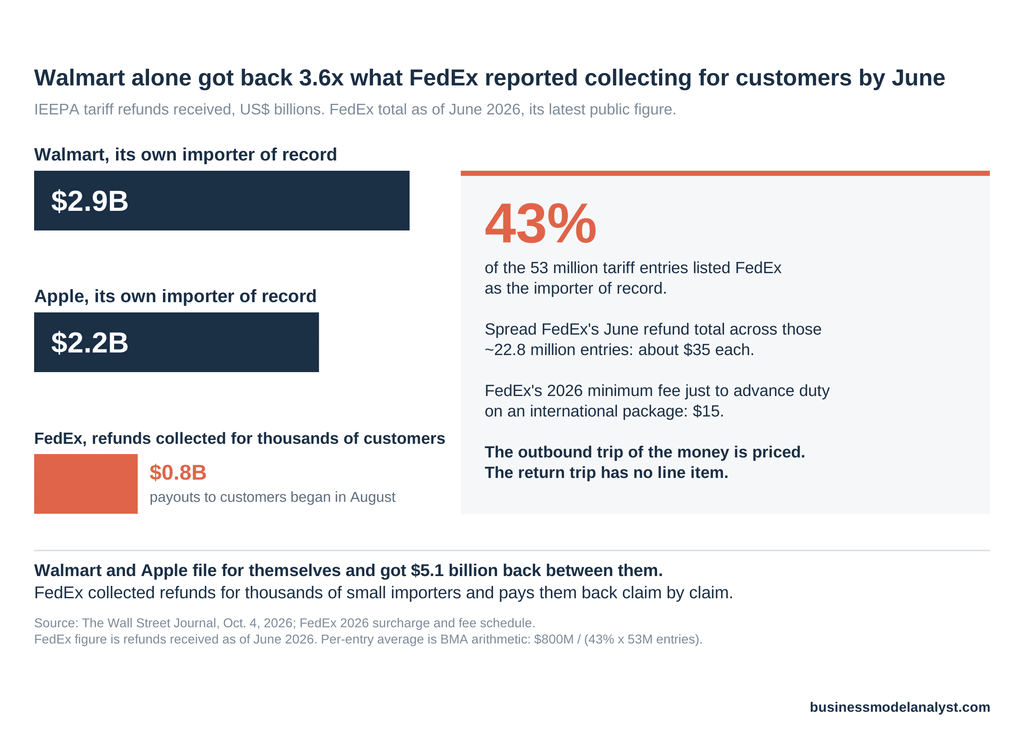
Now the kicker. FedEx’s brokerage business charges the greater of $15 or 2% of the duty just for advancing it to customs on an international package, per its 2026 fee schedule. The outbound trip of the money is priced. The return trip has no line item.
Three Carriers, Three Refund Designs
The big carriers did not even agree on who does the work.
- UPS pushed refunds back to the card that paid. Knife importer Derek Swanson got about $6,000 in August without filing anything.
- DHL says it filed claims for every shipment where it was importer of record and had returned about 92% of eligible refunds by mid-September.
- FedEx built a claims portal. Customers submit invoices, tax IDs, W-9 forms and bank details before any money moves.
Swanson still estimates he is owed about $5,000 by FedEx and $9,000 by DHL, roughly 70% of his total. DHL did not say whether its 92% counts customers or dollars, and those diverge fast when the stragglers are the messy accounts.
Push versus pull is the whole game. A push refund lands whether you care or not. A pull refund becomes a task, and every task has a size below which people quit. Lenny Merryman of keyboard and mouse retailer Man & Machine, chasing a few thousand dollars, summed it up: “Is it really worth it?”
When the answer is no, the money does not disappear. It just sits on someone else’s side of the ledger.
FedEx’s Case Is Better Than It Sounds
The fair version: refunds include interest, and interest is taxable. That makes FedEx the payer of interest to thousands of businesses, so it needs Social Security or employer ID numbers for IRS forms. Botch that and FedEx owns the penalties. Pay the wrong account and the money is gone.
FedEx says it is matching millions of entries against government data, has released hundreds of millions of dollars, is adding automation, and pays within 30 days once a submission is complete. And UPS’s card reversal only works when a card paid the duty.
So the delay is not pure stalling. Verification costs something. The question is who got assigned that cost, and FedEx’s design handed it to the customer. Rapkin’s sore spot is the asymmetry: FedEx chases his invoices within weeks and threatens to close accounts, then takes months when money flows the other way.
The Business Model Angle
Price both directions of the money. Any intermediary touching customer cash, from carriers to payroll processors to marketplaces, has a reverse flow it probably never modeled. Retailers hit the same wall with return fees that don’t cover the return.
Importer of record is a product with a liability tail. Small importers bought convenience and quietly handed over legal title to their own refunds. Anyone importing at volume should weigh a direct CBP registration or an independent broker. With CBP’s Phase 3 still ahead, contingency-fee refund recovery is a picks-and-shovels niche worth watching.
Refund speed is retention marketing. Swanson gave UPS a free testimonial in a national newspaper while FedEx got the headline. In the FedEx vs UPS rivalry, where service is the product, a slow payable costs more than the automation that would fix it.
The Takeaway
The tariff refund is the first time the parcel brokerage machine ran in reverse at scale, and part of it was never built. The lesson travels far beyond shipping: a business that holds other people’s money inside a convenience product owns the return trip too, whether it priced it or not. Fast collection is a capability. Fast refunds are a reputation.