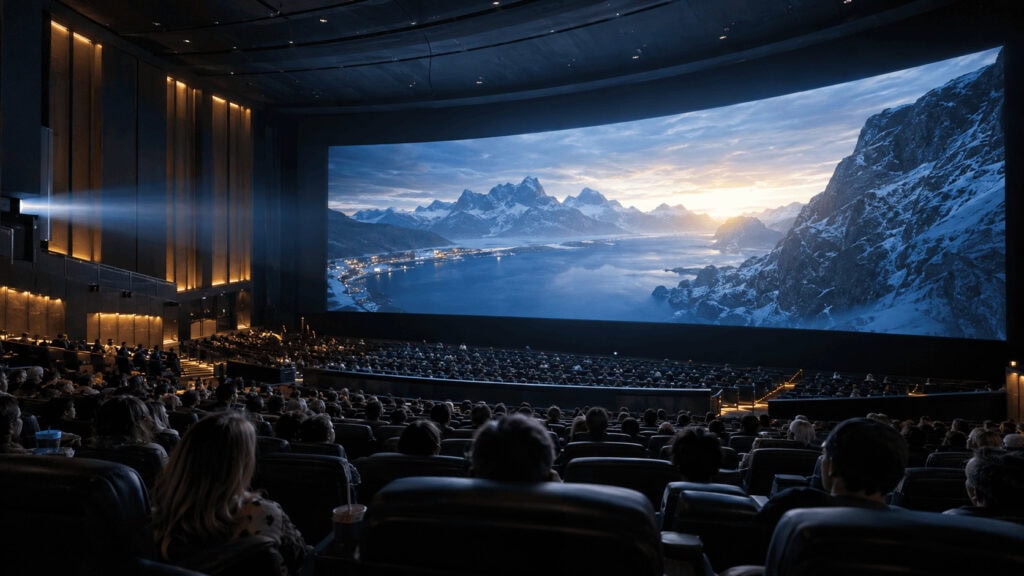

A record $4.76 billion summer was built on premium screens. The company that owns the best ones told Disney no.
North American theaters took $4.76 billion between May 1 and September 7, the biggest summer gross ever recorded. The scarce input underneath that number is not the screen. It is the premium screen on the right date, and IMAX handed three of those weeks in December to “Dune: Part Three” rather than “Avengers: Doomsday.” Disney’s answer was Infinity Vision, a certification badge for auditoriums it does not own, does not equip and does not charge. In ten weeks it drew more than 7,500 applications, four times IMAX’s entire global commercial network.
The industry spent the summer celebrating a record and then spent April through September quietly fighting over roughly two thousand rooms.
That is the part of this box office story nobody put in the headline. Ticket revenue is being manufactured at the top of the price ladder, the top of the price ladder is a fixed number of auditoriums, and those auditoriums are allocated by calendar. When a studio loses that allocation, it discovers something uncomfortable about its own leverage.
What Happened
Domestic theaters collected $4.76 billion between May 1 and September 7, per Rentrak, the highest summer haul in cinema history. The previous record was $4.75 billion in 2013, the summer of “Iron Man 3,” “Despicable Me 2,” “Man of Steel,” “Monsters University” and “Fast & Furious 6.”
The two numbers are a million dollars apart. The two seasons are not the same length. Summer 2013 ran May 3 to September 2, a window seven days shorter than this year’s.
Divide each total by the days it actually had:
- Summer 2026: $4.76 billion across 130 days, or about $36.6 million a day
- Summer 2013: $4.75 billion across 123 days, or about $38.6 million a day
Per day of season, 2026 came in roughly 5.2% below 2013 in raw, unadjusted dollars. Before anyone reaches for an inflation deflator. The record is partly a calendar.
The rest of the scoreboard, per CNBC’s reporting:
- 68 films have gone wide in 2026 so far, meaning 2,000 or more theaters, against 79 by the same point in 2019, a 14% decline
- Attendance sits almost a quarter of a billion admissions below 2019, per S&P Global Market Intelligence
- The average ticket was $9.16 in 2019 across all formats, per Cinema United. A standard 2026 seat runs $12.75, per EntTelligence
- Premium large format averages $18.26, with IMAX at $20.57
Paul Dergarabedian of Rentrak called the season a blueprint, arguing that “one movie should not have to carry an entire season.” He is right about the slate. He is describing a season in which the money still concentrated at the top of the pricing ladder.
The Backstory
Fewer rooms, fewer films, fewer people, higher prices. That combination has been running for five years, and we walked through the demand side of it this week. What matters here is the supply side of the premium tier specifically.
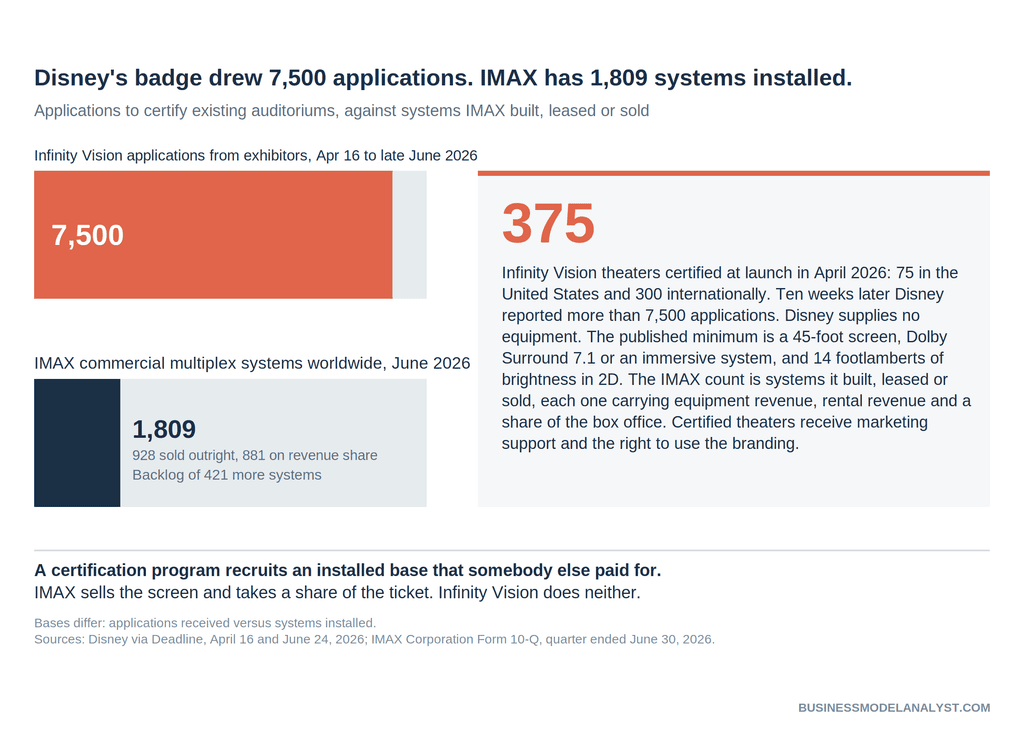
Premium formats have climbed from a low single-digit slice of North American box office in 2010 toward roughly a quarter of it now. IMAX is the apex of that tier and the most extreme case of it. The company’s commercial multiplex network stood at 1,809 systems worldwide on June 30, 2026, with 928 sold outright to exhibitors and 881 running on joint revenue sharing. Its backlog is another 421 systems. Both of those numbers move slowly, because each one represents equipment that has to be manufactured, shipped and installed into a building.
So the highest-yielding auditorium in the world exists in a quantity that cannot expand to meet a December weekend. Which means it gets rationed, and rationing means a queue, and a queue means somebody is at the back of it.
In December, “Dune: Part Three” and “Avengers: Doomsday” open on the same day. Reporting on the arrangement indicates Warner’s film takes exclusive IMAX access for the first three weeks. Disney, releasing the culmination of a two-decade franchise, is out.
You cannot outbid your way into a screen that a rival has already booked. You cannot build one in eight months. You can, apparently, define one.
The Plan
Disney announced Infinity Vision at CinemaCon in April 2026 alongside its global exhibition partners. It is a certification program: theaters that meet a published technical standard may carry the badge and market themselves under it.
The published minimum is a screen at least 45 feet wide, Dolby Surround 7.1 or an immersive system such as Atmos, and brightness of 14 footlamberts in 2D or 6 in 3D. Certified theaters get marketing support from Disney and the right to use the branding.
At launch there were 75 certified auditoriums in the United States and 300 internationally. By late June, Disney said applications had passed 7,500.
The first release under the badge is the September re-release of “Avengers: Endgame,” retitled “Endgame: Encore,” with new footage attached. Then “Doomsday” in December, the weekend Disney cannot get IMAX.
IMAX’s own chief financial officer, Natasha Fernandes, dismissed the program as a marketing play. The Hollywood Reporter’s James Hibberd went further and predicted nobody would mention Infinity Vision again once “Doomsday” had opened.
The Business Model Angle
A certification is how you rent an installed base you cannot buy. IMAX’s 1,809 systems took four decades, a manufacturing operation, a leasing book and a field services organization to assemble. Infinity Vision’s addressable network is every auditorium on earth that already clears 45 feet, and Disney reached 7,500 applicants in ten weeks by publishing a document. The trade is real and it cuts both ways: you get reach without capital, and you also get reach without control, without a meter and without exclusivity. The closest working precedent is not in cinema at all. Intel paid computer makers co-op marketing dollars to put a sticker on machines Intel did not build, and turned an invisible component into a consumer brand. It worked. The closer precedent is in cinema and is nearly as old: Lucasfilm launched THX in 1983 to certify theaters it had no intention of owning, for the same reason Disney is doing this now.
No money moves in either direction, which is the tell. IMAX books equipment sales, technology rentals of $20.0 million in the second quarter alone, and a share of the box office through its revenue-sharing systems. Every screen in its network is attached to a revenue line. Infinity Vision has no disclosed fee, and what is reported flows the other way, since Disney supplies marketing support to participating theaters. That does not make it a bad idea. It makes it a distribution expense wearing a standard’s clothes, which means the honest scorecard is not badge count. It is what share of “Doomsday” opens on premium screens in December.
Standards are worth what the excluded competitor is worth. A 45-foot screen with Atmos and a brightness floor describes a competent modern auditorium, not a rare one. If nearly every good room qualifies, the badge carries information about Disney’s marketing budget rather than about the room. Look at the ladder it is meant to defend: $12.75 standard, $18.26 PLF, $20.57 IMAX. That $5.51 spread over standard already exists, and the exhibitor already collects it. Disney is not creating a premium. It is attempting to name one it does not receive, on hardware it did not pay for, so that a Marvel ticket in a non-IMAX room feels like a decision rather than a consolation.
The Risk
The strongest objection is that this is a proportionate answer to a small problem, and the analysis above inflates it. Disney has one blocked corridor on one title. A badge that steers audiences toward good non-IMAX screens for that weekend is cheap, fast and roughly the right size. Read that way, Hibberd’s prediction that the program vanishes after December is not a criticism. It is the plan executing as designed, and calling a tactical marketing decision a strategic failure is a category error.
Second, breadth may simply beat prestige on a film this size. IMAX cannot serve an “Avengers” opening weekend even when it wants to. If 7,500 auditoriums carry the badge, Disney has more premium capacity available than any single format vendor can offer anybody, and Dolby Cinema, 4DX and ScreenX have all been taking real share alongside IMAX. Volume is a legitimate strategy.
Third, Disney holds the one asset that makes a standard stick over time: recurrence. Certifications die when nobody has a reason to renew them. Marvel, Pixar, Lucasfilm and Avatar give Disney more qualifying tentpole weekends per year than any rival studio, which is precisely the drumbeat a consumer-facing standard needs.
Fourth, the alternatives are worse. Buying the bottleneck is not obviously available, as the strange, stalled process around IMAX’s own salability demonstrates, and building parallel capacity means capex against a demand curve that has been shrinking in people even while it grows in dollars. Against those options, zero capital deployed looks less like weakness than like the only move on the board.
Quick Questions
Was summer 2026 really a record? In total dollars, yes, and it is a real achievement. Per day of season it ran about 5.2% behind 2013 in nominal terms, because this year’s window carried seven extra days. Both statements are true and only one of them gets published.
Does Infinity Vision compete with IMAX? Not on equipment, pricing or revenue. It competes for the audience’s belief about which screen is the good screen, which is the only layer of the stack where Disney can move quickly.
What does Disney collect from a certified theater? Nothing has been disclosed, and the reported flow runs outward in the form of marketing support. Any return arrives indirectly, through premium-format share on Disney releases.
What would prove it worked? Its second life. If the badge appears on a non-Marvel Disney release in 2027, it is a standard. If it disappears after December, it was a campaign with a logo.
The Business Model Analyst Take
The summer number is genuinely good and structurally fragile at the same time. Concentration keeps rising, a single Spider-Man film carried a fifth of the season, and the growth is arriving through price rather than people. Every operator in the chain has responded the same way: extract more from each visit. Format surcharges, reserved recliners, a $70 popcorn bucket that out-earns three admissions, and the director-level premium economics that made “The Odyssey” so profitable. It is a coherent strategy and it has a ceiling, and the ceiling is made of drywall and steel in about two thousand specific rooms.
Which is what makes Infinity Vision the most revealing thing Disney did all year. A company booking more than $90 billion a year discovered that the binding constraint on its biggest release is a scheduling decision made by a mid-cap equipment vendor, and its available response was to write a specification.
That is the generalizable lesson, and it has nothing to do with movies. Watch which direction money flows through a standard, because that tells you whether it is an asset or an advertisement. LEED charges for certification. Fair Trade charges. THX charged. Those standards became businesses because the participants paid to be inside them, which is also what forced them to stay meaningful. When the money flows outward instead, the standard is marketing, and marketing has to be re-bought every time you need it.
Disney did not build a competitor to IMAX. It bought an option on a word, priced at one press release, exercisable once, in December.