
Phone prices went up again this week. The bigger number was never the phone, and four of the five budget carriers that fix it answer to the three networks they are supposed to undercut.
The New York Times published a frugality column this morning on how to survive “techflation.” The advice is sound and the arithmetic is honest. It also contains a fact its own framing walks straight past: the cheap carriers it recommends are, with one exception, the expensive carriers wearing a different logo.
Apple announced a $1,999 foldable last week and quietly put $100 on the iPhone 17, the iPhone Air and the entry-level 17e. The new iPhone 18 Pro costs $100 more than last year’s model. Memory chips are the reason, and we have written about Apple’s memory-driven price hikes at length.
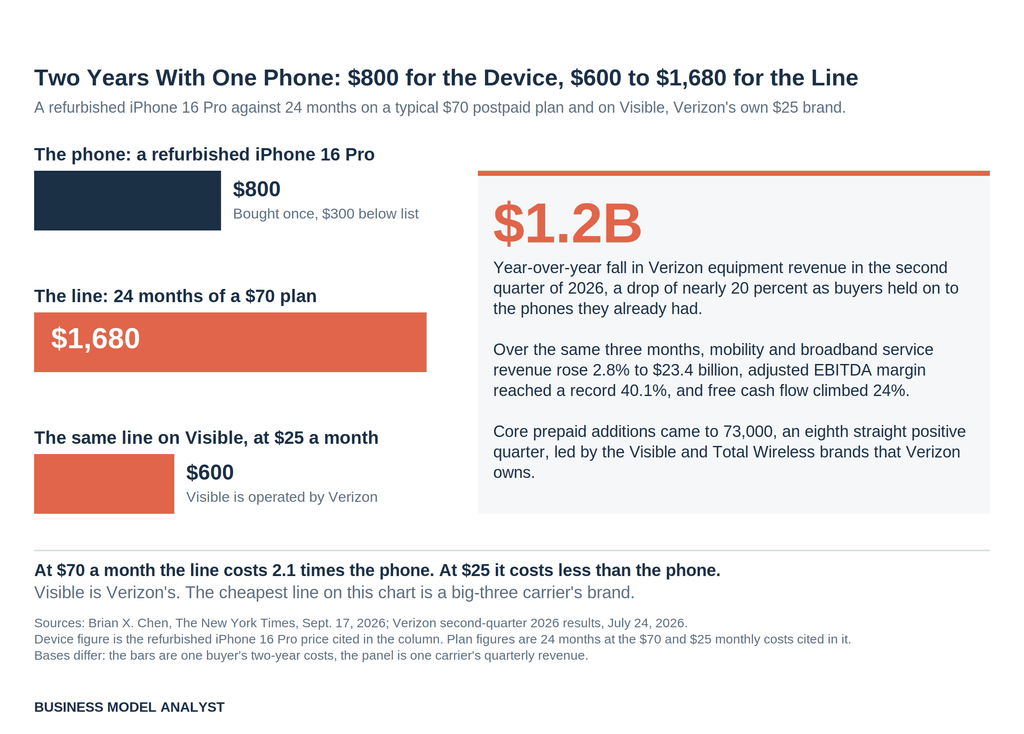
Brian X. Chen’s response is four moves: cheaper plan, older phone, haggle the broadband bill, replace the battery. Inside move one is the number that reframes the whole category. A typical individual postpaid plan runs about $70 a month. Over two years that is $1,680, more than most phones cost.
The device has the price tag. The line has the bigger number. And the market for that bigger number is far more concentrated than the shopping advice suggests.
What the column actually said
Chen’s own setup is the cheapest version of the story. He moved from Verizon to Visible late last year and his bill fell from roughly $70 to $25 a month. He bought a refurbished iPhone 16 Pro on Amazon for $800, a $300 discount. Two years of that combination costs about $1,400, or $58 a month. Pay Apple $119 for a battery and keep the phone four years and it drops to $44.
The rest of the numbers come from the same place. WalletHub, cited in the column, puts the combined saving from an older phone plus a low-cost carrier at up to $1,604 for an individual and $2,743 for a family over two years. His AT&T broadband bill had drifted from $70 to $100 over three years; a call scripted by a chatbot brought it to $55.
The supply side is not in dispute either. TrendForce expects conventional DRAM contract prices to rise another 13% to 18% in the third quarter of 2026 and NAND another 10% to 15%. The telling part of that forecast is the reason the increases are slowing. Supply has not improved. Phone and PC buyers have simply reached the limit of what they will pay, so the pass-through stalled at the checkout rather than at the fab.
That is demand destruction, not relief. Every strategy in the column is a form of it, and each one moves money from one pocket of the industry to another.
Three networks, five brands
Here is the paragraph that should have been the story. Chen lists five discount carriers: Cricket, Straight Talk, Boost Mobile, Mint Mobile and Visible. He notes correctly that they lease capacity from the big carriers and trade away some speed for the price.
What he does not say is who owns them.
- Cricket Wireless is AT&T’s prepaid brand.
- Straight Talk came to Verizon with the TracFone acquisition that closed in late 2021, roughly 20.1 million subscribers and a shelf of brands including Total, Simple Mobile, Net10 and Walmart Family Mobile.
- Visible is Verizon’s own digital-only brand, which the column does say.
- Mint Mobile belongs to T-Mobile, which bought its parent Ka’ena and folded it into the flanker portfolio alongside Metro.
- Boost Mobile is EchoStar’s, and it is the exception that proves the point. EchoStar shut down its own 5G network and has carried no customer traffic on it since November 2025. In May 2026 the FCC approved the sale of its spectrum for $42.6 billion, about 50 megahertz to AT&T for $23 billion and 65 megahertz to SpaceX for $17 billion, with a hybrid arrangement that keeps Boost’s roughly 7.5 million customers running on AT&T’s network.
So the escape list is not five alternatives to three carriers. It is three carriers, four of their own brands, and one independent that now rides on a fourth set of towers it no longer owns. The attempt to build a fourth national network ended this year, and the discount tier absorbed what was left of it.
This is not a scandal. It is a price ladder, and it is one of the cleanest ones in American consumer business. One network, four prices, sorted by how much shopping a customer is willing to do. The brand is the fence between the segments. Switching from the postpaid brand to the prepaid brand is not leaving the company. It is self-selecting into a cheaper tier and telling the company exactly what you were worth.
Why holding your phone makes your carrier richer
Now run the frugality advice through the carrier’s income statement.
Verizon’s second quarter of 2026 is the cleanest illustration available. Equipment revenue fell nearly 20%, more than $1.2 billion year over year, because people are doing precisely what the column recommends: keeping the phone. Total revenue slipped 0.7% as a result.
And the quarter was a record. Mobility and broadband service revenue rose 2.8% to $23.4 billion. Adjusted EBITDA hit a record $13.7 billion at a 40.1% margin. Free cash flow climbed 24%. Management named the mechanism on the call: promotional amortization is turning from a headwind into a tailwind.
That is the whole trick. A subsidized upgrade is a cost the carrier capitalizes and bleeds through the P&L for years. Every customer who skips the upgrade removes a future expense line without removing the subscription. Device revenue is the low-margin half of the Verizon business model and always has been. Shedding it is accretive.
The subscriber data says the same thing from the other side. Consumer postpaid phone churn improved to 84 basis points. Core prepaid added 73,000 in the quarter, an eighth consecutive positive one, led by Visible and Total Wireless. Customers are getting cheaper and staying longer, and both halves of that sentence are good for the owner of the network.
The same logic runs through the repair advice. When a device gets expensive enough that fixing it beats replacing it, the value migrates from the manufacturer to whoever holds the recurring relationship, a shift we traced in the make do and mend economy. Apple has hedged this better than anyone, which is why its hardware-plus-services machine keeps working when hardware stalls, as our Apple business model breakdown lays out. The carriers never needed to hedge. They were already on the right side of it.
The Business Model Angle
The price ladder is the product, and the brand is the fence. If your business has one expensive cost structure and customers with very different willingness to pay, a second brand on the same infrastructure captures the low end without repricing the high end. The carriers run four rungs on one network. The question for any operator is whether you have built the fence or whether your customers are simply leaving.
Know which revenue line you would be happy to lose. Verizon’s top line shrank and its margin set a record, because the revenue that disappeared was the revenue it least wanted. Most companies cannot name their least valuable dollar. Run the exercise: if one product line vanished tomorrow, which one would improve the business?
Inertia pricing is now a chatbot away from repricing. A meaningful share of broadband and wireless profit is collected from customers who do not call. Chen’s bill went from $100 to $55 with a script an AI wrote in a minute. Any margin that depends on a customer’s friction is now a margin with a countdown on it, and the defensive move is already visible: multi-year price locks and bundles that make the comparison harder to run.
The Risk
Four things cut against this reading, and they deserve air.
First, the savings are real. Visible’s ownership does not make $45 a month less valuable to the person keeping it. Nothing here argues against following the column’s advice. The point is about who collects, not whether you should.
Second, the flanker brand may be defense rather than offense. The alternative to a $25 Visible customer is not a $70 Verizon customer. It may be no customer at all. Read that way, the discount tier is a retention product and the cannibalization is the price of not losing the household entirely.
Third, the arithmetic cuts at Verizon too. A line that moves from $70 to $25 loses 64% of its revenue. Verizon’s net income fell 22.9% in the quarter and its leverage rose to 2.5 times adjusted EBITDA from 2.2 times at year end. Record margins on a shrinking base of average revenue per account is a trade with a clock on it. If the migration accelerates, the mix shift stops being a hedge and starts being the problem.
Fourth, the chatbot negotiation is one anecdote. Retention desks have scripts of their own, and the standard counter to universal haggling is to stop discounting and raise the list price instead. A discount everyone gets is not a discount. It is a price cut, and companies rarely deliver those on purpose.
Quick Questions
Are discount carriers actually worse? Usually slower during congestion, since their traffic is deprioritized behind the parent brand’s postpaid customers. Chen reports noticing only slower photo uploads. The trade is real but small for most usage.
Is this the same thing as airlines and basic economy? Structurally, yes. One asset, several fare classes, and a set of removed features that exist to keep the high-paying customer from buying down. Wireless just does it with separate brand names instead of separate fare codes.
Does the memory shortage end soon? Not on current guidance. Contract prices are still rising in the third quarter, only more slowly, and the slowdown is coming from buyer resistance rather than new supply. Apple’s own position in the supply queue has become a strategic question in itself, which we covered in our look at Apple’s purchase commitments and buyer power.
What should a founder take from this? That the durable margin sat in the monthly relationship, not the object. Everyone watched the price tag on the phone for fifteen years while the larger number arrived in twenty-four monthly instalments nobody shopped.
The Business Model Analyst Take
Techflation is a real cost shock and it is being described almost entirely in the wrong denomination. The industry talks about it in device prices because device prices are the number that gets published, photographed and compared. Meanwhile the biggest line in the cost of owning a phone is a subscription that three companies sell under roughly a dozen names, and the consumer response to expensive hardware is to hold devices longer, which quietly improves the economics of those same three companies.
The most valuable sentence in the column is the one about cost of ownership being like a car. It is more true than intended. The car has a sticker price everyone argues about and a total cost almost nobody computes. So does the phone. The difference is that with the phone, the company selling you the expensive version and the company selling you the cheap version are frequently the same company, and it prefers you to shop between its own shelves rather than leave the store.
Watch two numbers from here. Whether Verizon’s equipment revenue keeps falling while service revenue keeps rising, which would confirm that the hold-your-phone behavior is structurally good for carriers rather than a one-quarter artifact. And whether average revenue per account holds as the prepaid brands keep adding customers. The first says the model is working. The second says how long.