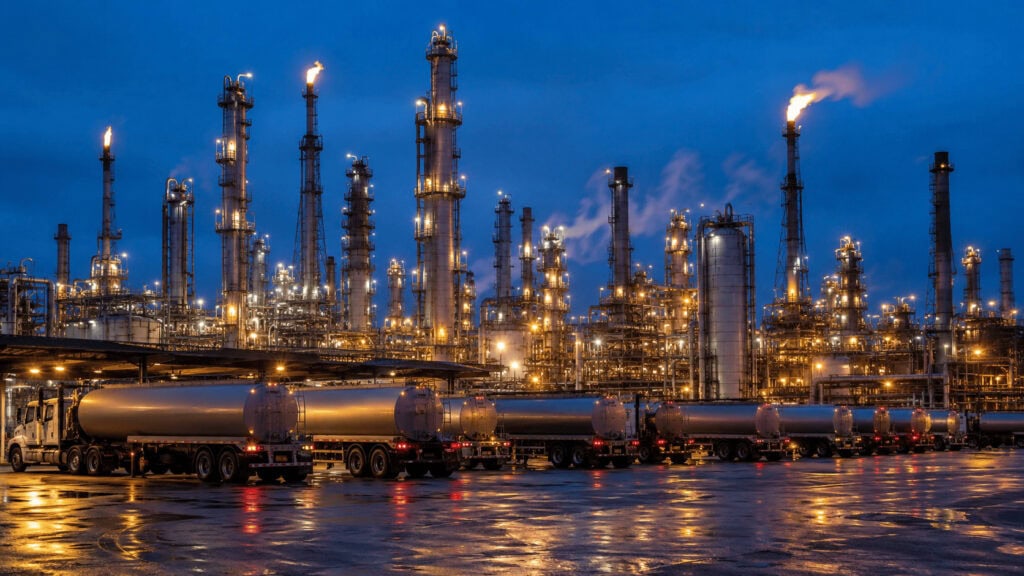

The scarce thing in energy right now is not oil. It is the machinery that turns oil into something a truck can burn.
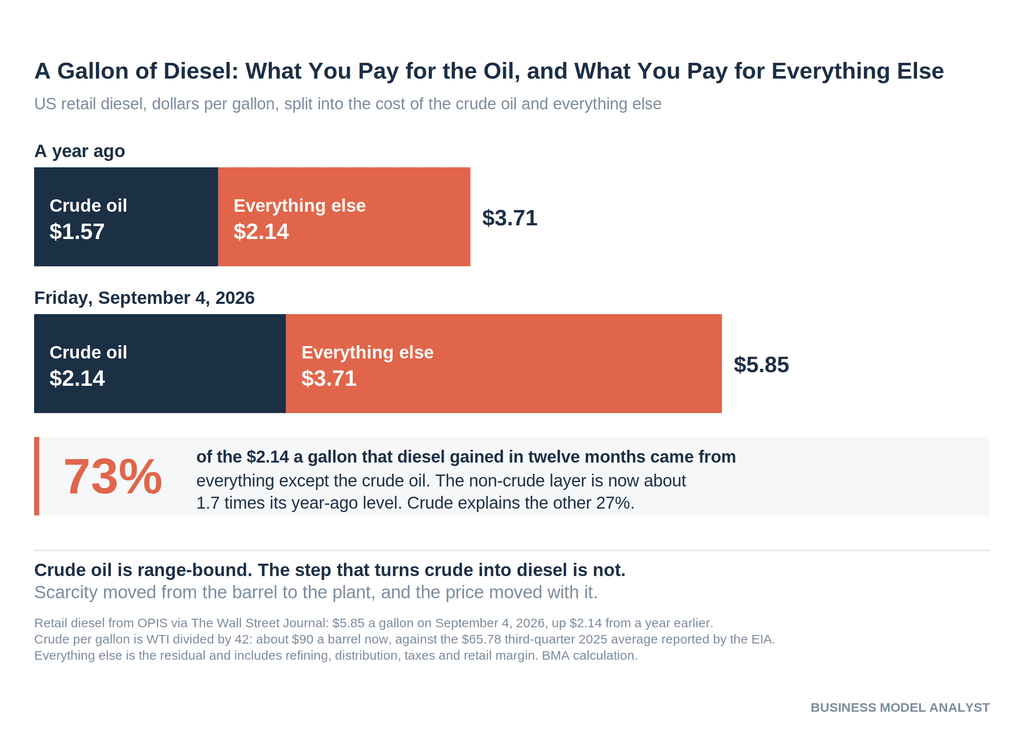
US retail diesel reached an average of $5.85 a gallon on Friday, an all-time high, according to OPIS data reported by The Wall Street Journal. That is $2.14 above where it sat a year ago. Crude oil, meanwhile, is sitting at roughly $90 a barrel and has spent months bouncing between $80 and $90. Run the arithmetic on those two facts and you get the story: about 27% of the increase is the oil. The other 73% is the cost of turning that oil into diesel and getting it to a pump.
That is not an energy story. It is a bottleneck story, and every industry has one.
Here is the reflex reading of a record fuel price. War in the Middle East, a closed Strait of Hormuz, oil markets in chaos, therefore expensive diesel. Tidy, intuitive, and mostly wrong.
Crude is a globally traded liquid with a spot market, floating storage, and a dozen willing buyers. Block one route and a barrel finds another. That is exactly what happened. The oil price never broke out, because the oil never really went missing.
What went missing was refining capacity. Roughly 5 million barrels a day of the world’s ability to convert crude into fuel is offline, some of it hit by missiles and drones, some of it deliberately shut down. And unlike a barrel, a refinery cannot be rerouted. It cannot be re-priced. It can only be rebuilt, and nobody wants to build one.
What Happened
Diesel set a record on Friday at $5.85 a gallon, passing the previous high from 2022. Gasoline is running around $4.15, the most expensive it has ever been at this point in the calendar, and nearly 95 cents dearer than last Labor Day.
The tightness shows up in the tanks. Diesel stocks in New England and the Lower Atlantic fell last week to their lowest levels since the Energy Information Administration started tracking the series in 1990. California inventories dropped to 1.16 million barrels from 1.73 million a year earlier, per the California Energy Commission, a decline of about 33%.
Andy Lipow of Lipow Oil Associates gave the WSJ the cleanest framing of what that means: any supply disruption now lands with magnified force “because there’s no cushion.”
And the timing is unkind. Farmers are heading into harvest. The Northeast is weeks away from burning heating oil. Several refineries, including the largest plant in Canada, which sends more than half its output to the Northeast, are down for seasonal maintenance.
Meanwhile the barrels are leaving. The US shipped an average of 1.77 million barrels of diesel a day in the four weeks to August 28, per the EIA, up 31% year over year. Work backward from that and last year’s run rate was about 1.35 million, which means roughly 420,000 additional barrels a day are now exiting the country. Domestic buyers are not the customer anymore. They are one bid among many.
The Backstory
Split a gallon of diesel into its two big pieces and the last twelve months get very legible.
WTI at about $90 a barrel works out to $2.14 a gallon of crude. The EIA reported an average of $65.78 a barrel for the third quarter of 2025, which is $1.57 a gallon. So the crude in a gallon of diesel got about 57 cents more expensive.
Diesel itself got $2.14 more expensive. Everything that is not crude, meaning refining, distribution, taxes, and retail margin, went from about $2.14 a gallon to about $3.71. That layer is now roughly 1.7 times its year-ago size, and it accounts for about $1.56 of the $2.14 increase.
Sit with the symmetry for a second. What the entire non-crude portion of a gallon cost a year ago is what the crude alone costs today. The barrel is a smaller share of a much bigger number: 42% of the pump price last year, 37% now. Taxes barely moved. This is a conversion problem, not a commodity problem. (BMA calculation, and a rough one: WTI is not the specific crude any given refinery buys, and a quarterly average is not a spot price. The direction is solid, the decimal places are not.)
Why is the conversion step so expensive? Because there is less of it. Iranian strikes damaged plants across the Middle East. Ukrainian drones took out Russian refineries. Then there is the voluntary side: the US and Europe have both closed capacity in the past year, and California alone has lost 17% of its refining base to shutdowns, according to William O’Neil of S&P Global.
Crude that cannot reach an Asian refinery goes somewhere else. A refinery that no longer exists produces nothing, forever. The industry spent a decade treating refining as the boring, low-return middle of the value chain. It is now the part with pricing power.
The Plan
There are two obvious fixes and neither one is happening.
Fix one is to keep the fuel at home. An export ban would flip 1.77 million barrels a day back toward domestic tanks. Energy Secretary Chris Wright has publicly rejected the idea more than once, and a White House official told the WSJ there is no plan to restrict oil and gas exports. Record prices will keep the debate alive anyway.
Fix two is to build more refineries, which the administration has urged the industry to do. The industry’s answer is that its plants are already running flat out to maximize profit and there is no appetite for new multibillion-dollar projects.
Read that as capital allocation rather than stubbornness. A refinery greenlit in 2026 starts up in the early 2030s and needs to earn for thirty years after that. It would be underwritten against a demand curve that essentially every forecaster, including the refiners themselves, expects to flatten. Chinese refiners are already living in that future: Sinopec’s domestic refined product consumption fell 8.6% in the first half of 2026, and diesel fell 11.5%, which is a slate problem we unpacked separately.
Nobody underwrites a thirty-year asset on a three-year spread. So the rational move for an incumbent is to run the existing plant hot, bank the margin, and let the shortage persist. The shortage is not a market failure they are suffering through. It is the reason the margin exists.
The Business Model Angle
A bottleneck you own is a product, not a problem. The spread lives in the missing capacity. Any capex that closes the gap deletes the thing that generates the return. This is the same logic that made airline capacity discipline stick after 2010, kept memory chip makers from over-building, and handed container shipping a once-in-a-generation 2021. If your margin depends on scarcity you control, the pitch deck for expansion is also the pitch deck for margin compression.
Value migrates between steps in a chain, and it does not send a memo. For two decades the money in energy sat in the barrel, which is why the majors are organized around reserves and why our own ExxonMobil teardown reads as an upstream story. Right now the money is in conversion. The operator question is not “what do we sell” but “which step in our chain is capacity constrained, and do we own it or rent it?”
Pass-through is a contract term, not a market outcome. J.M. Smucker flagged higher-than-expected inflation partly driven by freight. Campbell’s guided to double-digit logistics inflation for fiscal 2027. One Boston freight operator quoted by the WSJ runs eight trucks burning 40 to 60 gallons a day each and is eating an extra $480 to $640 daily, roughly $60 to $80 per truck, or $18,000 to $24,000 a truck across a 300-day year. He is charging some customers more. Some. Who absorbs a cost shock gets decided months earlier, in surcharge clauses nobody reads at signing. We watched the same asymmetry run in reverse when wholesale chicken prices collapsed and grocery shelves barely moved.
Your inventory buffer is a strategic position priced as a working-capital line. Regional diesel stocks at 1990 lows are the endpoint of decades of sensible optimization. Every barrel of cushion was a barrel of tied-up capital, until the week it was the only thing standing between a maintenance turnaround and a price spike. Efficiency and fragility are not two decisions. They are one decision, viewed from different quarters.
The Risk
The strongest counterargument is mean reversion, and it deserves respect.
Most of that 5 million barrels a day of offline capacity is war damage and scheduled maintenance, not permanent closure. Refineries get repaired. The Canadian plant comes back. Seasonal turnarounds are seasonal by definition. Crack spreads are famously the most violent line in energy, and refiners who chased a good spread into a capex commitment have been punished for it before. A ceasefire plus a few restarts could compress this quickly.
Second, high prices ration demand. Diesel at $5.85 destroys some of its own volume through softer freight, deferred trips, and substitution. That is a real self-correcting mechanism, and it is already visible in the industrial data.
Third, the feedstock picture is shifting. A White House official said refiners have expressed interest in expanding capacity as Venezuelan crude starts flowing into the US. Heavier crude runs better for distillate yield in Gulf Coast plants configured for it, and yield improvements arrive years faster than new plants.
Fourth, an export ban is a genuine tail risk that would invert this trade overnight. It has been rejected repeatedly, but “repeatedly rejected” and “impossible” are different words.
And a caveat on our own math: the residual bucket is a residual. It contains refining margin but also trucking, terminals, taxes, and retail markup, and it is measured against a benchmark crude that no refinery literally buys. The 73% is a directional finding, not an income statement.
Quick Questions
Why is diesel at a record when crude is not? Because the shortage is in refining capacity rather than in oil. Roughly 5 million barrels a day of global conversion capacity is offline, and crude simply finds another buyer while a damaged refinery produces nothing.
Would banning exports fix it? It would redirect about 1.77 million barrels a day toward domestic tanks and would probably lower US pump prices in the short run. It would also cut refiner margins, strand Gulf Coast plants built for export, and raise fuel prices for allies. The Energy Secretary has said no, more than once.
Why won’t refiners build? A new refinery is a thirty-year bet started today and finished in the early 2030s, against long-run demand nobody is confident about. Running existing plants at maximum rates captures the same spread with none of the capital risk.
Who ends up paying? Whoever has the weakest contract. Food companies are already flagging freight inflation to analysts, which means it is in guidance and heading to shelf prices. Small carriers without surcharge clauses eat it directly.
Is this the same as the 2022 spike? Not quite. Adjusted for inflation, truckers are not yet at 2022 levels. The bigger difference is structural: 2022 was a crude shock, and this one lives in the conversion step, where supply cannot respond in a season.
The Business Model Analyst Take
The interesting number here is not $5.85. It is the gap between a raw material that stayed flat and a finished product that hit a record. That gap is the market’s way of announcing where a bottleneck lives, and bottlenecks are the most reliable source of pricing power in any industry.
The uncomfortable part is that whoever owns the bottleneck has no incentive to widen it. Refiners are not refusing to build because they are short-sighted. They are refusing because the shortage is the asset. Every industry has a step like that somewhere, usually a step that took decades to build and can be destroyed in an afternoon. Most companies do not find out where theirs is until the price of the finished thing detaches from the price of the raw thing.
Crude is cheap and easy to move. The plant that turns it into diesel is neither. That is the whole trade.