

Busy work used to train your next senior hire for free. AI split the training from the work, and now it has a price tag nobody wants to pay alone.
Companies are replacing the grunt work that used to train junior staff with simulations and boot camps, a shift Gartner calls “experience starvation.” The deeper problem is economic, not pedagogical. Once practice becomes a separate, visible cost, it becomes training that walks out the door, so each firm’s rational move is to stop hiring juniors and poach experienced people later. Cognizant is betting the other way, and its own attrition math explains why.
Nobody ever put “trained a future partner” on an invoice. It just happened, one spreadsheet, one contract redline, one ugly first draft at a time.
That free ride is ending. According to The Wall Street Journal, EY is running AI simulations of difficult clients, Cisco is blocking calendar time for sales role-play, and Cognizant has put new hires through a 12-week boot camp. Pretend work is standing in for real work.
The coverage treats this as a management puzzle: how do you teach judgment without the reps? The better question is who pays for the reps now that they cost money. The answer explains why the entry-level market is freezing, and why an IT services giant with 356,700 employees is hiring more graduates than ever.
What Happened
The WSJ’s Allison Pohle reported on Sept. 25 that restructurings and AI have automated much of the repetitive work junior staffers used to do, and that managers now worry about what gets lost. Gartner, which coined the term “experience starvation,” describes junior staff being handed decisions that require experience-based judgment they have not had time to build.
Companies are responding with manufactured practice:
- EY built simulations where an AI plays a client pushing back on a recommendation, with real-time feedback on the response.
- Cisco schedules time for employees to rehearse customer pitches.
- Cognizant sends most of its 1,500 entry-level US hires through a boot camp on programming and data structures, now paired with an AI tool called Skillspring that breaks each role into tasks and targets individual gaps.
- A&O Shearman partners now teach juniors how they would prompt an AI to draft a document, where they once walked through the draft itself.
The early evidence is thin but encouraging. A Stanford Law School lab gave Dechert summer associates an AI negotiation simulator for two hours a week. In a mock negotiation at the end of the summer, three of the four finalists came from the simulator group. The lab’s director warned against reading much into a small sample.
The macro backdrop is not subtle. Unemployment among recent college graduates hit 5.7% in June, near a five-year high, per the New York Fed.
The Backstory
The best evidence that practice matters comes from the operating room. UC Santa Barbara’s Matt Beane spent more than two years studying robotic surgery across more than a dozen hospitals. Once robots took over the precision cutting, residents got 10 to 20 times less hands-on practice, because the senior surgeon no longer needed a second pair of hands. The residents who still became good surgeons mostly did it by quietly breaking protocol, a pattern Beane calls “shadow learning.”
That is the mechanism the whole economy is now running. The latest Stanford Digital Economy Lab update, built on ADP payroll records through June 2026, shows who is absorbing the change.
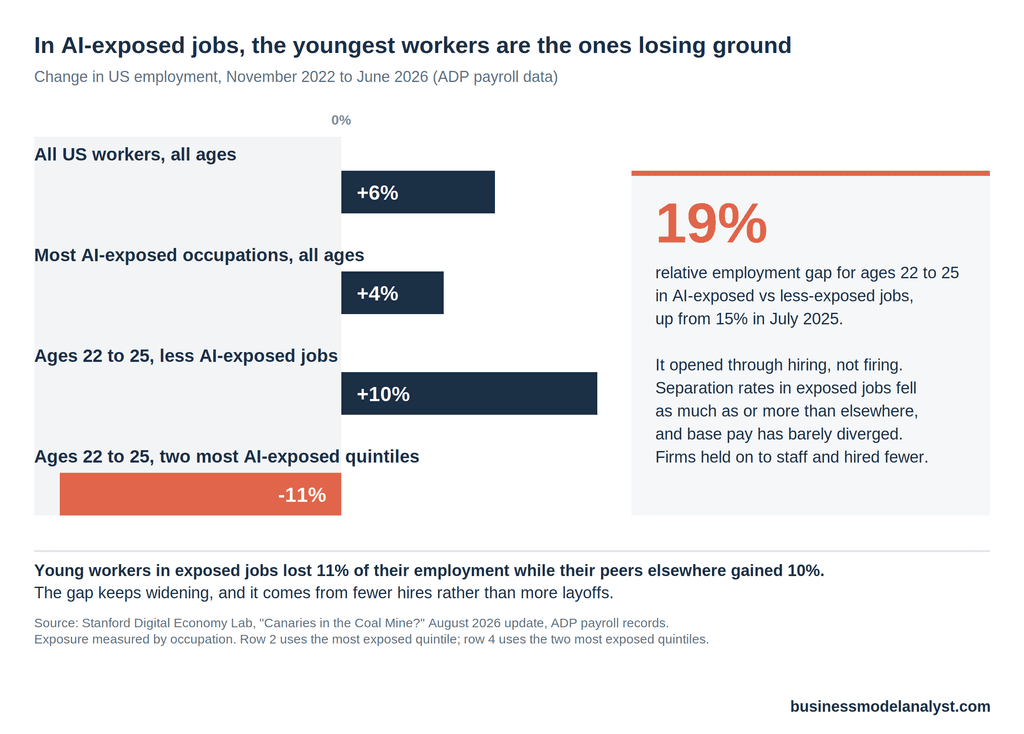
Workers aged 22 to 25 in the most AI-exposed occupations saw employment fall about 11% since November 2022, while the same age group in less-exposed jobs grew about 10%. Overall employment rose about 6%. The relative gap for young workers widened from 15% in July 2025 to 19% by June 2026.
Two details in that update matter more than the headline:
- It is happening through hiring, not firing. Separation rates in exposed occupations fell as much as or more than elsewhere. Firms are keeping the experienced people they have and simply taking fewer new ones in.
- Wages are not moving. Adjustment is showing up in headcount, not base pay. There is no price signal yet telling anyone that experience is getting scarce.
Hold on to both. They are the whole story.
The Plan
Every company quoted in the WSJ has the same plan in different packaging: rebuild the reps artificially, compress them, and hope judgment still forms.
The IBM Institute for Business Value survey behind the WSJ’s skills figures shows why the pressure is real. IBM polled 8,800 employees in 28 countries and 1,500 chief HR officers between April and June 2026. Some 60% of employees worry AI is eroding their skills, and three in four of those say the erosion has already started, which is where the 45% figure in the coverage comes from.
The more revealing number is the mismatch. 71% of CHROs say the most essential skill is the ability to supervise, validate and override AI output. Only 29% of employees rank judgment as important. Companies are hiring juniors to do exactly the thing juniors do not yet know they need, and 80% of CHROs admit AI creates “invisible” validation work nobody measures.
Cognizant’s plan is the most aggressive. It hired about 20,000 fresh graduates in 2025 and plans 24,000 to 25,000 in 2026, roughly 20% to 25% more, which it calls a “broader pyramid.” CEO Ravi Kumar S. describes the shape as abundant entry-level roles at the front, a leaner middle where AI absorbs tasks, and abundant verification roles at the back. His pitch to rookies, per the WSJ, is that they are effectively managing work on day one. (For the other end of that ladder, see how Uber is cutting 20% of its managers.)
It sounds like optimism. It is actually a very specific business model.
The Business Model Angle
Busy work was joint production, and joint production just broke.
An hour of grunt work used to produce two things at once: a deliverable the firm could sell and a slightly better junior. Economist Gary Becker’s classic insight on training is that when skills are general, meaning useful at any employer, workers end up paying for them through lower starting pay. The junior absorbed the cost as a modest salary, the firm got the output, and training never appeared as a line item.
AI unbundles the two products. The deliverable now comes from the model. The training, if it happens at all, has to be produced separately, in a simulator, a boot camp or a role-play session. That is a visible cash cost with no output attached. “Pretend work” is just what training looks like once it has its own budget line.
Visible, general training is a gift to your competitors.
Here is the catch. A negotiation simulator teaches negotiation, not Dechert. A client-objection drill teaches client handling, not EY. The skill is portable, so every dollar spent on it partly subsidizes whichever firm hires that person away in three years.
When each firm faces that math alone, the rational move is to stop training and hire experienced people from someone else. Add it up across the economy and nobody trains. That is exactly the pattern in the Stanford data: fewer hires at the entry point, fewer separations among the experienced, and no wage signal yet to break the standoff. Experience starvation is not a management oversight. It is a classic free-rider problem, and it will not fix itself until experienced people get expensive enough to hurt.
Cognizant is the rare firm that gets paid to make experience.
This is why Kumar’s bet is rational for Cognizant specifically. An IT services firm does not buy experience for its own use. It rents it to clients, and it bills for the junior while the junior is still on its payroll.
Run the flows. Cognizant’s trailing 12-month voluntary attrition in tech services was 13.0% at the end of June. Apply that rate to roughly 350,000 people and about 45,000 walk out each year, many of them trained engineers heading to clients and rivals. Against 20,000 to 25,000 freshers, Cognizant exports roughly two experienced workers for every graduate it imports.
For most companies, that would be a disaster. For a firm like Cognizant, and the rest of the Accenture competitor set, it is the business model. The client that starves its own juniors ends up renting Cognizant’s, and the “broader pyramid” is a factory for the input everyone else stopped producing.
Note where the factory sits, though. North America delivers 75.3% of Cognizant’s revenue, yet the WSJ’s 1,500 US entry-level hires work out to about 6% of this year’s planned graduate intake. The reps are still happening. They are just happening where they are cheapest.
The contract that let employers own training is being outlawed.
The traditional fix for the poaching problem was a “stay or pay” clause: leave early and repay your training costs. California’s AB 692, effective Jan. 1, 2026, bans most of those for new contracts, with a narrow exception for prorated tuition toward a transferable credential and damages of at least $5,000 per affected worker. (A&O Shearman, one of the firms in the WSJ story, published client guidance on it.)
So the legal tool for capturing general training is shrinking at the exact moment training becomes a visible cost. What survives is firm-specific practice: drills built on your own clients, systems and processes. Skillspring decomposing Cognizant roles into Cognizant tasks is the defensible version. A generic AI negotiation simulator is a very nice gift to the next employer.
The Risk
The reps may be worth less than everyone remembers. A lot of busy work taught very little. Stanford’s Megan Ma argues simulated practice can surface patterns faster than years of repetition, while conceding it will not fully replace learning by doing. If a targeted simulator delivers more judgment per hour than a year of formatting slides, the “starvation” is partly nostalgia, and Kumar’s framing wins on the merits.
The flagship evidence is weak. If the Dechert simulator and control groups were the same size and finalists were picked at random, the chance that three or more of four finalists come from one named group is 5 in 16, or about 31%. The result is consistent with chance roughly one time in three. The lab said as much.
Causality is still contested. The Stanford authors find no economy-wide displacement, and an earlier 2026 note from the same lab examined interest rates and timing as alternative drivers of weak youth hiring. The age-and-exposure split is striking, but it is not a controlled experiment.
The exporter math is an order of magnitude, not a ledger. Cognizant reports attrition for tech services, not the whole company, and it hires experienced laterals as well as graduates. Many leavers join other IT services firms, which keeps the experience inside the “maker” sector rather than subsidizing clients. The direction holds. The precise ratio does not.
The broader pyramid may not travel. Cognizant’s model leans on graduate intake in lower-cost markets. At US starting salaries, like those in our list of the highest-paying entry-level jobs, the arithmetic of paying for reps changes. And Beane’s surgeons are a warning about what “verification” can mean: reviewing work you have never done is exactly the role that left residents watching from the side of the table.
Quick Questions
What is “experience starvation”? A term coined by Gartner for the gap that opens when AI takes over the routine tasks junior employees used to learn from, leaving them to make judgment calls without the practice behind them.
Why don’t companies just keep hiring juniors and training them? Because training that is useful anywhere can walk out the door. When one firm pays and another hires the result, each firm’s best move is to wait, and the Stanford payroll data shows the adjustment running through fewer hires rather than more layoffs.
Why is Cognizant hiring more graduates when others are hiring fewer? It sells experienced people’s time to clients. It bills for juniors while they are still employees, so manufacturing experience is its product rather than a cost center.
Do AI simulations actually work? Early signs are positive but thin. The Stanford-Dechert pilot’s result is suggestive and small, and even its lead researcher says simulation will not fully replace learning by doing.
Can employers make workers repay training costs if they leave? In California, mostly no for contracts signed since Jan. 1, 2026, under AB 692, apart from narrow prorated tuition arrangements for transferable credentials.
The Business Model Analyst Take
For a century, experience was a byproduct. Companies made it by accident while doing billable work, so nobody had to decide who owned it.
AI turned the byproduct into a product, and products get made by whoever can sell them. That points to a split economy: a few firms that manufacture experienced people and rent them out, and everyone else renting. We made the pyramid version of this argument in how the consulting pyramid explains why new grads are moving home, and the chief of staff boom showed what happens when coordination gets rebought at a higher price. Experience is next in line.
The signal to watch is not simulator adoption. It is the day wages for five-year veterans start climbing faster than everyone else’s. That is when the free riders discover the price of the reps they skipped.