
New nuggets landed on September 1. The Whopper patty has not changed, and a 75-year low in the American cattle herd explains why.
Burger King’s quality program is not organized around taste. It is organized around the cost curve of each input. Every upgrade the chain has shipped in 2026, from the bun to the mayonnaise to the produce to the box to the chicken to the dipping sauces, sits on an input whose price is flat or falling. The quarter-pound flame-grilled patty, the one input running at an all-time high, has not been touched. And because roughly 96% of the US system agreed in 2024 to raise its advertising contributions only if average franchisee profitability clears $230,000 at the end of 2026, the brand’s marketing budget for 2027 and 2028 is now, in a contractual sense, a function of the price of cattle.
A Wall Street Journal video published on September 10 walks through Burger King’s test kitchen at its Miami headquarters, where the corporate chef has been reworking sauces, buns and packaging. The framing is the one the whole industry has been running with since August: the No. 2 US burger chain rediscovered food quality, and it is working.
It is working. US comparable sales rose 8.5% in the second quarter, Whopper sales are up about 20% according to CNN, and Burger King passed Wendy’s to become the second-largest burger chain in the country by sales, behind only McDonald’s.
Then read the list of what actually got upgraded. Bun. Mayonnaise. Onions and tomatoes. A clamshell box. Chicken nuggets. Dipping sauces. Not one of those things is beef.
What Happened
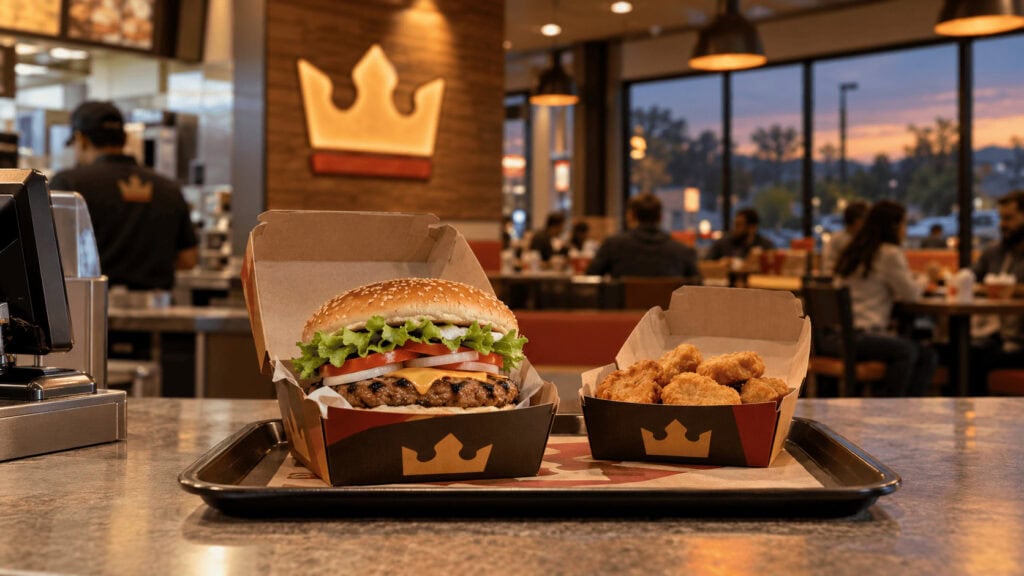
On August 25, Burger King announced a full rebuild of its chicken nuggets, which reached restaurants on September 1. New recipe made with 100% white meat chicken, a new marinade, crispier breading, and a box instead of a bag. The company said guests had described the old version as rubbery, dry and disappointing through a customer listening initiative that generated thousands of calls and texts. Head chef Amy Alarcon said the culinary team went back over every element, from the chicken and the breading to the sauces. The dipping lineup was refreshed alongside it, including a new limited-time Special Savory Sauce.
That followed the Whopper revamp announced on February 26, the first change to the sandwich in roughly a decade: a glazed sesame bun, a creamier mayonnaise with citrus notes, fresh-cut onions and tomatoes, and a clamshell box replacing the paper wrap. The quarter-pound flame-grilled patty was left exactly as it was. The package costs each restaurant about $4,000 a year, and corporate advised franchisees not to raise prices to cover it.
In late August, Burger King US and Canada president Tom Curtis told Fox Business the chain is still asking operators to hold menu prices while beef costs climb, on the argument that customers need the value right now and traffic will pay for it.
So the pattern is not subtle once you line it up. The company is spending its franchisees’ money on every component of the plate it can specify, and the one it cannot afford to specify is the one the brand is named after.
The Backstory
The two proteins on Burger King’s menu are on opposite clocks, and the clocks are not close.
The US cattle herd has fallen to about 86.2 million head, the smallest since 1951, after years of drought across the Great Plains and Southwest, high borrowing costs through 2024 and 2025, and border restrictions tied to New World screwworm. USDA’s Economic Research Service has been cutting its 2026 beef production forecast through the year. Cattle are expected to average roughly $241 per hundredweight in 2026, about 8% above 2025. The national average retail price for all-fresh beef hit a record $9.64 a pound in April, up about 13% from a year earlier. Bureau of Labor Statistics average-price data put fresh 100% ground beef at $6.885 a pound in July, another record. USDA does not expect the herd to begin a meaningful rebuild before 2028, because a cow takes years to turn into supply.
A broiler takes six to eight weeks. Wholesale boneless skinless breast meat spiked near $2.77 a pound in mid-2025, then collapsed to $1.16 by the end of December as production responded. Platts assessed it at $1.45 in February. At retail, BLS put boneless chicken breast at $4.15 a pound in July 2026, slightly below where it sat a year earlier.
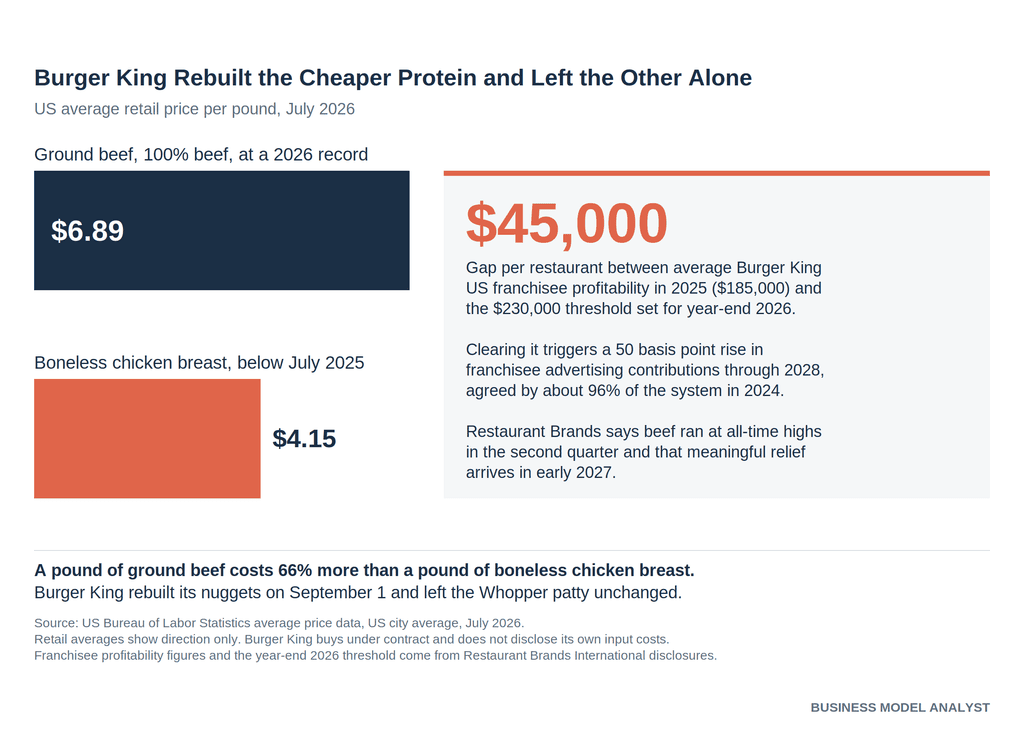
None of this is a secret inside the company. On the second-quarter earnings call in August, RBI CFO Sami Siddiqui told analysts that the quarter still ran at all-time high beef costs flowing through franchisee P&Ls, that futures point to only modest relief, and that most of the relief arrives at the beginning of 2027. CEO Josh Kobza said menu price increases are being held to low single digits.
Two earlier pieces on this site set up the rest of the mechanism. The chef swap that moved Alarcon from Popeyes to Burger King explained why changes that stop at the loading dock ship in a week while changes that reach the crew take 18 months. The Steak ‘n Shake profit-share contract explained why a franchisor whose fee base is sales alone never pays for an ingredient increase it orders. This piece is about a third constraint that sits on top of both: which inputs a chain can afford to specify at all, given where their prices are going.
The Plan
Here is the part almost nobody has connected.
When Burger King announced the extra $300 million for Royal Reset 2.0 in April 2024, it disclosed a second agreement in the same document. Participating franchisees, roughly 96% of the system, agreed to increase their advertising fund contributions by 50 basis points through 2028 if certain profitability thresholds were met: average trailing-twelve-month franchisee profitability above $175,000 at year-end 2024, and above $230,000 at year-end 2026.
The first gate cleared easily. Average US franchisee profitability ran $205,000 in both 2023 and 2024, up from $140,000 in 2022 and $125,000 in 2021.
Then beef happened. Profitability fell to $185,000 in 2025, which management attributed largely to beef running roughly 20% higher, and called a step back.
That leaves a $45,000 per-restaurant gap to the year-end 2026 threshold, a required jump of about 24% in a single year, in the year RBI’s own CFO describes as running at all-time high beef costs.
What is riding on it is not small. Burger King’s home-market system sales were about $11.58 billion in 2025 across roughly 7,025 restaurants. Fifty basis points of that is about $58 million a year of additional advertising money, or roughly $8,200 per restaurant per year. Put next to the $4,000 a year the Whopper upgrade costs each restaurant, the marketing step-up is worth about twice the cost of the spec change that helped produce the comp.
The same profitability number gates the expensive half of the program. Royal Reset commitments total $550 million and only $194 million had been funded as of June 2026, leaving $356 million parked. Siddiqui told analysts the remodel pace should accelerate once franchisee P&Ls strengthen, which he ties to beef easing in early 2027. Royal Reset 2.0 alone put $300 million behind roughly 1,100 remodels, about $273,000 of franchisor co-investment per restaurant, or roughly 68 times the annual cost of the Whopper change.
That is the whole plan in one sentence. The cheap quality lever runs at full speed because it costs $4,000 a restaurant and lands on inputs whose prices are cooperating. The expensive quality lever sits parked, waiting on a commodity nobody at Burger King controls.
The Business Model Angle
Quality budgets follow the input cost curve, not the brand deck. When a chain tells you it is investing in food quality, ask which line items. Burger King’s 2026 upgrades cluster in packaging, produce, sauces, bakery and chicken, which are inputs with short supply cycles and soft prices. A quality program is a procurement decision wearing a marketing costume.
A profitability tripwire converts a commodity into a marketing budget. Franchisors increasingly index franchisee obligations to franchisee outcomes, which sounds fair and is, until the outcome depends on a cattle cycle. Any operator signing a conditional contribution schedule should model the threshold against the two or three input prices that actually move it, not against a sales plan.
Cheap quality is the lever that works when capital is gated. A recipe change needs a supplier spec and a distribution swap. A remodel needs a construction loan. When operator balance sheets tighten, the entire innovation pipeline shifts toward changes that never reach the crew or the contractor. Suppliers positioned there, in marinades and breading systems, sauce packs, bakery glazes and folding cartons, get the volume while the equipment vendors wait.
Direction of price beats level of price. Chicken breast is cheaper than ground beef in every year on record, which by itself explains nothing about 2026. What explains 2026 is that one of them is at a record and the other is drifting down, so one input can absorb a specification upgrade and the other cannot.
The Risk
The simplest counter-explanation is that the nuggets were bad, customers said so in the thousands, and a company that just rebuilt its reputation on listening had no choice. That is probably true, and it does not conflict with anything above. Cost curves determine which complaints a company can afford to act on quickly.
Second, Burger King could not reformulate the patty even if beef were free. The flame-grilled quarter-pound patty is the entire differentiation of the brand, and Alarcon has said publicly that touching the Whopper too much is how you upset a lot of people. Leaving the patty alone is defensible product judgment before it is anything else. The point here is that the judgment and the commodity cycle happen to agree.
Third, chicken is not permanently cheap. Wholesale breast meat was at $2.77 fourteen months before this article. Bird flu remains in circulation, and Texas A&M’s David Anderson has flagged that production growth is slowing in response to weaker prices. A quality program leaning on the soft protein is exposed when that cycle turns, and it turns much faster than the beef one.
Fourth, relief may simply arrive. If beef eases in early 2027 as RBI expects, franchisee profitability improves, remodels accelerate, and the threshold question resolves itself without any strategic cleverness. The comp is also mostly traffic and mix rather than price, which flows through to operator profit better than pricing does.
Fifth, the fee-base problem does not go away. Burger King collects a percentage of sales, so an upgrade that raises the check is worth real money to the franchisor and an upgrade that raises cost is worth nothing to it. RBI paid $0 for the Whopper change and collected royalties on an 8.5% comp. That asymmetry is not a scandal, and it is the reason the refranchising story and the McDonald’s landlord margin both matter more to RBI’s equity than any recipe does.
Quick Questions
Did the Whopper patty change in 2026? No. The February revamp changed the bun, the mayonnaise, the produce specification and the packaging. The quarter-pound flame-grilled patty is the same.
What is actually different about the new nuggets? They are made with 100% white meat chicken, use a new marinade and a crispier breading, and come in a box. The dipping sauce lineup was reworked at the same time.
What does all this cost a franchisee? The Whopper package runs about $4,000 per restaurant per year, and corporate advised operators not to raise prices to cover it. Burger King has not published a cost for the nugget change.
Why does the price of cattle affect Burger King’s advertising? Because about 96% of the system agreed to lift advertising contributions by 50 basis points through 2028 only if average franchisee profitability clears $230,000 at the end of 2026, and beef is the largest swing factor in that number.
When does beef get cheaper? RBI expects meaningful relief in early 2027. USDA does not expect the herd itself to rebuild before 2028.
The Business Model Analyst Take
Every restaurant turnaround gets told as a story about courage: someone finally cared about the food. The Burger King version is more interesting than that, because you can read the constraint straight off the menu board. The company upgraded the bun, the sauce, the produce, the box and the chicken, and left the beef exactly where it found it, in the same year the American cattle herd hit its lowest level since Harry Truman was president.
That is not a lack of ambition. It is a chain doing the only kind of quality it can currently underwrite, on the inputs whose prices are pointing the right way, while $356 million of committed remodel capital waits for a cow. Investors reading the 8.5% comp as proof that product wins should notice which products, and why those ones.
The cheapest thing in the fast-food business right now is a better sauce. Burger King figured that out first.