BMW marketing strategy, defined: BMW’s marketing strategy is a performance-first brand promise (“The Ultimate Driving Machine” in the US, “Sheer Driving Pleasure” elsewhere) sold through three levers the company controls more tightly every year: a multi-brand portfolio (BMW, BMW M, MINI, Rolls-Royce), a captive finance arm that now leases or finances more than half of new BMW Group cars, and a sales model in Europe that is moving from independent dealers to fixed-price agency selling. In 2025 BMW Group spent €5.69 billion on selling expenses, about €2,310 for every car it delivered.
Most write-ups of the BMW marketing strategy describe the tagline and a famous short-film series from 2001. Both matter. Neither explains what BMW’s marketing looks like in 2026.
Here is what does. BMW Group delivered 2,463,715 cars in 2025, up 0.5%, while revenue fell 6.3% to €133.5 billion. China, still its biggest single market, dropped 12.5% for the year and then 30.2% in the second quarter of 2026. The company cut selling expenses by 7.3%, handed its CEO job to production chief Milan Nedeljković in May 2026, and lowered its 2026 automotive margin guidance to between 1% and 3%.
Meanwhile three things quietly grew: MINI deliveries, BMW M’s record run, and the share of new cars leaving on BMW’s own financing, which jumped from 43.7% to 52.9% in a year. That last number is the most underrated fact in BMW’s marketing story, and almost nobody writes about it.
This breakdown uses the BMW Group Report 2025 and the first-half 2026 results rather than recycled brand-story writing. For the competitive picture, see our BMW SWOT analysis and the BMW generic competitive strategy and growth strategies breakdown.
BMW Marketing Strategy at a Glance
| Metric | Figure | Why it matters for marketing |
|---|---|---|
| Group deliveries, 2025 | 2,463,715 cars, up 0.5% | Volume held while revenue fell, so the price and mix story weakened |
| Group revenue, 2025 | €133.5 billion, down 6.3% | Tariffs, currency and China pricing ate into every car sold |
| Selling expenses, 2025 | €5,690 million, down 7.3% | The marketing and sales budget shrank faster than deliveries |
| Selling expenses per car delivered | About €2,310 in 2025, against about €2,500 in 2024 | BMW sold slightly more cars on a smaller selling budget |
| China deliveries, 2025 | 625,527, down 12.5% | Still the largest single market, now the biggest drag |
| Fully electric share, 2025 | 17.9% (442,056 cars) | Neue Klasse is built to push this up from 2026 |
| Finance penetration, H1 2026 | 52.9%, up from 43.7% | BMW Financial Services now touches more than half of new-car sales |
| Interbrand brand value, 2025 | $46.8 billion, down 10%, 14th globally | Third among car brands, behind Toyota and Mercedes-Benz |
Sources: BMW Group Report 2025 and delivery releases, BMW Group H1 2026 results, Interbrand Best Global Brands 2025. Selling expenses per car are our calculation from the reported line and delivery count.
BMW’s Marketing Goals in 2026
BMW’s marketing goals are no longer just “stay premium.” The 2026 targets are more specific and more defensive.
| Goal | What it means in practice | Where you can see it |
|---|---|---|
| Protect price in a shrinking China | Balance volume, transaction prices and dealer profitability | Management’s stated China approach in its 2026 outlook |
| Sell the Neue Klasse as a reset of the whole brand | Every future BMW gets the new technology and design language, whatever the drivetrain | iX3 launch, i3 early orders, new X5 in five drivetrain variants |
| Own the customer in Europe | Move the BMW brand to an agency model with national fixed prices | MINI already switched from 2024; BMW brand planned from 2027 |
| Spend less per car sold | Cut selling and administrative costs without losing volume | S&A down 6.1% in H1 2026 after a €2.5 billion group cost cut in 2025 |
| Keep the performance halo burning | Grow BMW M and motorsport visibility while electrifying | BMW M’s 213,457 cars in 2025, a record |
The tension is between goals one and four. A brand trying to hold price in a falling market usually needs to spend more on marketing, not less. BMW is betting that a new product generation, a tighter sales channel and its own finance arm can do that job cheaper than advertising can.
The Budget Line Behind BMW’s Marketing
BMW does not publish an advertising figure. It reports selling expenses and administrative expenses, and says the combined line “primarily include[s] expenses for IT, marketing and communications, and personnel.”
| Line (€ million) | 2024 | 2025 | Change |
|---|---|---|---|
| Selling expenses | 6,135 | 5,690 | -7.3% |
| Administrative expenses | 5,161 | 4,916 | -4.7% |
| Selling and administrative, total | 11,296 | 10,606 | -6.1% |
| Group revenue | 142,380 | 133,453 | -6.3% |
| Selling expenses as a share of revenue | 4.31% | 4.26% | -0.05 points |
Two readings come out of this table. First, BMW cut the selling line roughly in step with revenue, so marketing intensity barely moved. Second, per car delivered the budget fell by about €190, because deliveries rose while the money shrank. The cuts continued into 2026: selling and administrative expenses were €4,777 million in the first half, down 6.1%.
Compare that with Nike, which disclosed $4.75 billion of demand creation at 10.2% of revenue in fiscal 2026 (our Nike marketing strategy teardown covers it). A carmaker is a different business, but the contrast is still useful. BMW spends far less of each sale on “marketing” in the ad-agency sense, because a large share of the persuading happens in the showroom, in the finance offer and in the product itself.
China: The Market BMW Can No Longer Advertise Its Way Through
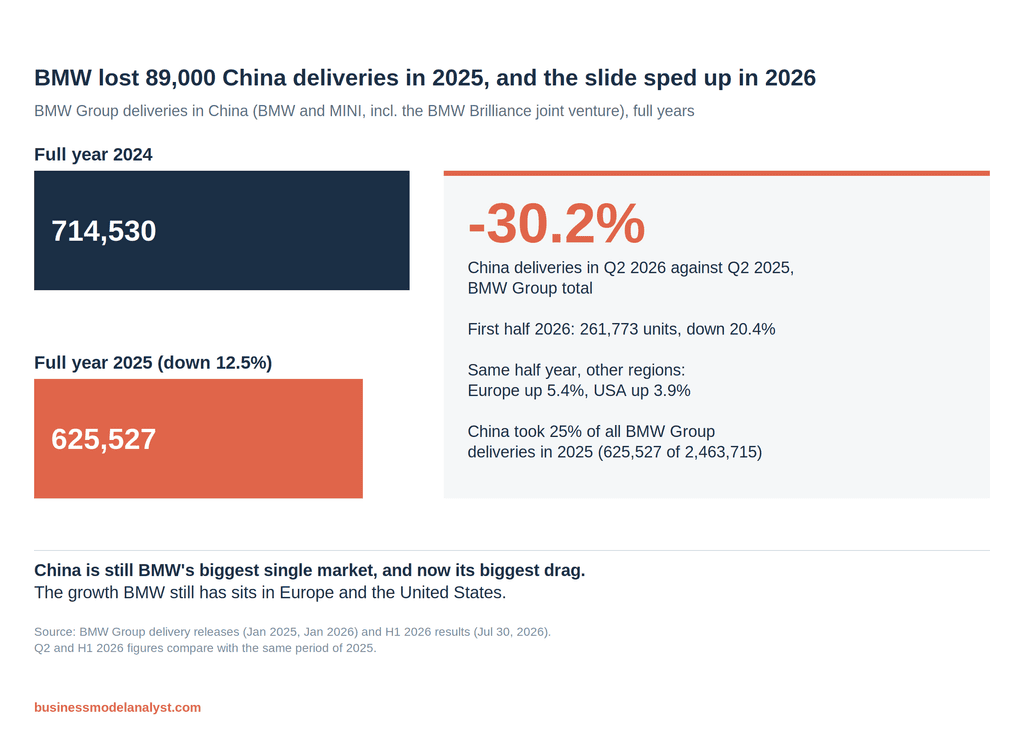
China took about a quarter of all BMW Group deliveries in 2025. It is also where the brand’s premium is under the most direct attack, from domestic electric brands that sell technology at prices BMW cannot match.
The numbers moved fast. BMW Group delivered 714,530 cars in China in 2024, then 625,527 in 2025. In the first half of 2026 China deliveries were 261,773, down 20.4%, and in the second quarter alone they fell 30.2%. Over the same six months Europe grew 5.4% and the US grew 3.9%.
BMW’s stated response is instructive: it is looking to “balance sales volume, transaction prices and dealer profitability” in China. Translated from investor language, BMW is choosing not to buy volume with discounts. That is a marketing decision as much as a financial one, because a premium brand that discounts to hold share in its biggest market teaches every buyer to wait for the next deal. Mercedes-Benz faces the same squeeze, with China sales down about 19% in 2025 according to our Mercedes-Benz SWOT analysis.
The China-specific answer is product. The first Neue Klasse models for China, a long-wheelbase iX3 and i3, are planned for production in Shenyang and are being developed for local preferences.
BMW’s Quietest Sales Tool: Its Own Bank
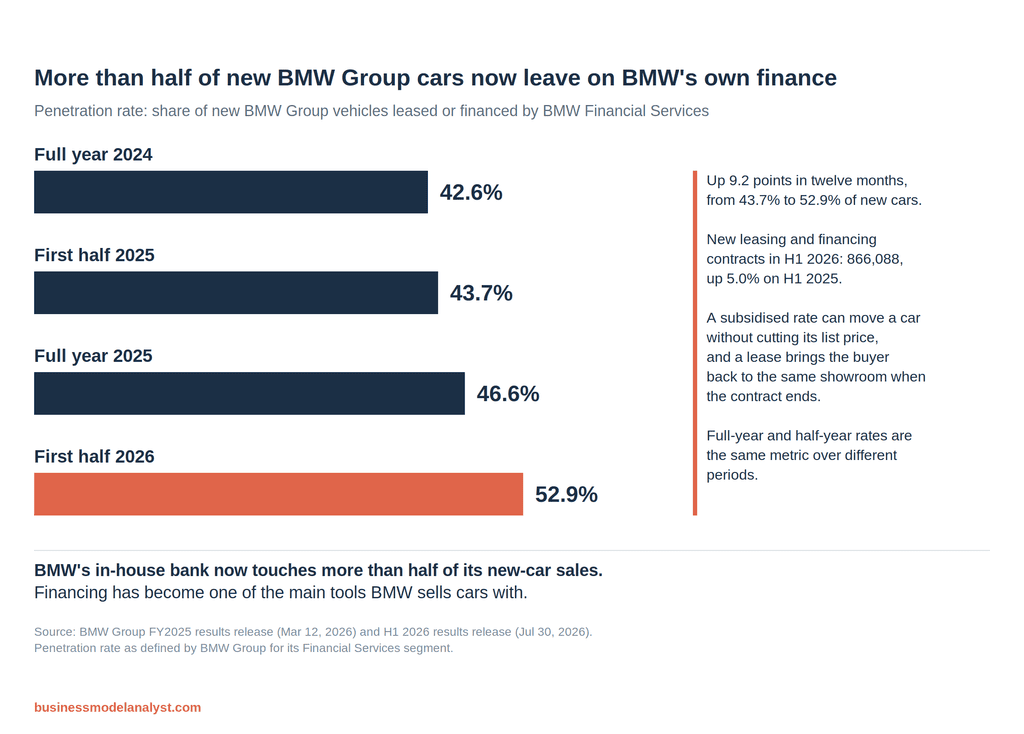
This is the part of BMW’s marketing strategy that no advertising case study covers, and it may be the most important one in 2026.
BMW Financial Services reports a penetration rate: the share of new BMW Group vehicles that are leased or financed through BMW’s own finance arm. It was 42.6% in 2024 and 46.6% in 2025. In the first half of 2026 it reached 52.9%, against 43.7% a year earlier, according to BMW’s half-year results. New leasing and financing contracts rose 5.0% to 866,088.
Why does this count as marketing? Because a finance offer is a price tool that does not touch the sticker. A subsidised lease rate or a lower monthly payment moves a car without printing a lower list price, which protects the brand’s price positioning and the residual values that support used-car prices. A lease also builds a return trip into the purchase: the customer comes back to the same brand when the contract ends.
The risk is the flip side of that same mechanism. When the finance arm carries more of the selling, the company takes on more residual value and credit exposure. BMW’s Financial Services profit before tax was €1,008 million in the first half of 2026, down 15.4%, partly because of a higher provision for a UK customer compensation programme.
Brand Architecture: Four Brands, Four Different Jobs

BMW Group’s marketing works as a portfolio, and 2025 showed why that matters.
| Brand | 2025 deliveries | Change | Marketing role |
|---|---|---|---|
| BMW | 2,169,761 | -1.4% | The core premium promise, “Ultimate Driving Machine” or “Sheer Driving Pleasure” by market |
| BMW M (inside the BMW total) | 213,457 | +3.3% | Performance halo; a record year, with the X3 M50 its most popular model |
| MINI | 288,290 | +17.7% | Urban, design-led, first brand to move to agency sales; more than one in three sold fully electric |
| Rolls-Royce | 5,664 | -0.8% | Bespoke ultra-luxury; the Cullinan was its best seller |
BMW Group’s full-year 2025 delivery release has the detail worth noticing: MINI added 43,375 cars in 2025, more than the 30,416 the BMW brand lost. The smaller, sharper brand carried the group’s volume growth. MINI’s momentum continued into 2026, with second-quarter deliveries up 17.1%.
BMW M is the other signal. Its sales record while the parent brand shrank says the performance promise still sells when it is delivered in its purest form. That matters for the Neue Klasse era, because BMW has to prove that “Ultimate Driving Machine” can survive the switch to electric drivetrains.
BMW’s Marketing Mix in 2026
Product. The Neue Klasse is the biggest product and brand reset BMW has attempted in decades. The BMW iX3, its first model, collected more than 50,000 orders between its September 2025 premiere and the end of March 2026, was named World Car of the Year, and is on track for 100,000 orders. The second model, the i3 sedan, opened early orders in June 2026. BMW says every future model will carry Neue Klasse technology and design, regardless of drivetrain, and that more than 40 new and updated models will arrive by 2027. The marketing point is that BMW is not selling “an EV.” It is selling a new generation of BMW that happens to come electric first.
Price. BMW prices at a premium and defends that premium with tools other than list-price cuts: captive financing (see above), a mix shift toward high-margin M models, and in Europe a move to fixed national prices under the agency model. Where it cannot defend price, it accepts lower volume, as the China strategy shows.
Place. This is where the biggest structural change sits. Under the agency model, BMW invoices the customer directly, owns the stock, and pays the retailer a fixed commission for handling the sale. Customers get the same price at every retailer in a country, so haggling disappears. MINI moved first, starting in Italy, Poland and Sweden on January 1, 2024. The BMW brand’s switch, originally planned for 2026, was pushed to 2027. Sales board member Jochen Goller said the company is “honestly even more convinced than before that that is the right approach.” The US is excluded, because many state franchise laws bar direct sales.
Promotion. The slogan is the constant. Martin Puris of Ammirati & Puris wrote “The Ultimate Driving Machine” in 1974 for BMW of North America, when BMW sold 15,007 cars a year in the US; by 1986 US sales reached 96,759. The line is still in use, and US dealers still build their pitch on why a BMW is considered the Ultimate Driving Machine. Outside the US the equivalent is “Sheer Driving Pleasure,” from the German “Freude am Fahren.” Around it sit sponsorships, motorsport and owner experiences, covered below.
The Campaign Everyone Cites, Told Correctly
BMW Films’ “The Hire” is the most referenced piece of BMW marketing, and it is often described wrongly, including on the old version of this page.
The series ran as eight short films released online in 2001 and 2002, starring Clive Owen as “the Driver.” The directors were John Frankenheimer, Ang Lee, Wong Kar-wai, Guy Ritchie and Alejandro González Iñárritu in the first season, then John Woo, Tony Scott and Joe Carnahan in the second. David Fincher was executive producer of season one; Ridley Scott and Tony Scott executive-produced season two, and Ridley Scott did not direct any of the films. The series returned in 2016.
The lesson is not “make a short film.” It is that BMW paid for content people chose to watch at a time when online video barely existed, and built the distribution before the platform did. The modern equivalent is BMW’s content work around its sponsorships, such as a behind-the-scenes series on the BMW Championship made with the PGA TOUR and NFL Films.
Sponsorships and Motorsport in 2026
| Property | Status in 2026 | What BMW gets |
|---|---|---|
| BMW Championship (PGA TOUR FedExCup Playoffs) | 20th year as title sponsor, held at Bellerive in 2026 | An affluent US audience; more than $63 million raised for the Evans Scholars Foundation since 2007, per BMWBLOG |
| BMW PGA Championship (DP World Tour, Wentworth) | 22nd year as title partner, about 120,000 spectators expected | Owner hospitality and a “BMW Village” built around the new i3 and iX5 |
| FIA World Endurance Championship | BMW M Hybrid V8 in the Hypercar class with BMW M Team WRT | Performance credibility for the M brand at Le Mans-level racing |
| Formula E | Exited after the 2020-21 season | BMW said it had “essentially exhausted” the technology transfer it could get (Autosport) |
The old version of this page listed Formula E as a current BMW marketing property. It has not been one since 2021. Golf is the steadier investment: it reaches older, wealthier buyers, and BMW turns each tournament into an owner event, with owner-only terraces and pavilions that reward existing customers rather than just reaching new ones.
Digital Channels and the Owner App
BMW’s owner app is now called My BMW (the old “BMW Connected” name has been retired). It handles remote functions such as locking, climate and vehicle status, and it doubles as an identity check at events: at the 2026 BMW Championship, owners could enter the BMW Owners’ Pavilion with a key fob or the Digital Key in the My BMW App. That is a small detail with a big meaning. The app turns a car purchase into an ongoing relationship BMW can market to directly.
The agency model extends the same logic to buying. BMW’s plan is to digitalise the entire purchase process so customers can switch between online and in-store buying, with BMW, not the dealer, holding the customer record. For a brand that historically sold through independent partners, owning that data is a bigger marketing shift than any campaign.
Who BMW Markets To
- Affluent drivers who value performance. The core promise has not changed in 50 years, and BMW M’s record year shows the purest form of it still sells.
- European buyers moving to electric. In the second quarter of 2026, nearly one in three new BMW Group cars delivered in Europe was fully electric (31.3%).
- US premium buyers. US deliveries rose 5.0% in 2025 and 3.9% in the first half of 2026, and golf sponsorship remains BMW’s main US brand stage.
- Urban, design-led buyers through MINI. The brand that grew fastest in 2025, with a renewed range and more than a third of sales fully electric.
- Chinese premium buyers, selectively. BMW is protecting price rather than chasing volume, and building long-wheelbase Neue Klasse models locally.
For how another premium brand frames the same buyer, see our Ralph Lauren marketing strategy, which also leans on sponsorship and full-price selling. For the mass-market contrast, our Toyota marketing strategy shows a brand built on reliability rather than driving pleasure.
What BMW’s Marketing Strategy Teaches Other Businesses
- A great positioning line can outlive every campaign. “The Ultimate Driving Machine” has survived agency changes, fuel crises and electrification because it describes the product, not a mood. Write the line your product can keep proving.
- Finance is a marketing tool. A payment plan can move a product without cutting its price. If you sell anything expensive, the offer structure is part of your marketing, not an afterthought for the finance team.
- Own the customer relationship. BMW’s shift to agency sales in Europe is about fixed prices and customer data. If a middleman owns your customer, your marketing ends at the handoff.
- Let the sharp sub-brand carry growth. MINI and BMW M grew while the core brand shrank. A focused sub-brand can move faster than the parent.
- Refuse volume you have to buy. BMW is accepting lower China volume rather than discounting. Discounting a premium brand to hold share teaches customers to wait.
More examples across industries sit in our marketing strategy examples library and the wider companies marketing strategy examples collection.
Frequently Asked Questions
What is BMW’s marketing strategy? BMW markets a performance-first premium promise, “The Ultimate Driving Machine” in the US and “Sheer Driving Pleasure” elsewhere, through a portfolio of BMW, BMW M, MINI and Rolls-Royce. In 2026 it leans increasingly on the Neue Klasse product reset, its own finance arm and a move to fixed-price agency sales in Europe.
How much does BMW spend on marketing? BMW does not report a separate advertising figure. Its selling expenses were €5,690 million in 2025, down 7.3%, and the company says selling and administrative costs mainly cover IT, marketing and communications, and personnel. That works out to roughly €2,310 of selling expenses per car delivered.
Who came up with “The Ultimate Driving Machine”? Martin Puris of the agency Ammirati & Puris wrote the line in 1974 for BMW of North America. It is still BMW’s US tagline more than 50 years later.
What is BMW’s agency sales model? Under the agency model, BMW sells directly to the customer at a fixed national price and pays the retailer a fixed commission for handling the sale. MINI switched in several European countries from 2024. The BMW brand’s rollout in Europe is planned from 2027, and the model is not planned for the US.
Is BMW still in Formula E? No. BMW left Formula E at the end of the 2020-21 season. Its current top-level motorsport program is the FIA World Endurance Championship, where it races the BMW M Hybrid V8 in the Hypercar class.
Who is BMW’s CEO in 2026? Milan Nedeljković became Chairman of the Board of Management on May 14, 2026, succeeding Oliver Zipse. Jochen Goller is the board member responsible for customer, brands and sales.
What is the Neue Klasse? It is BMW’s new vehicle generation, launched with the iX3 electric SUV. BMW says every future model will use its technology and design language, whatever the drivetrain, and that more than 40 new and updated models will arrive by 2027.
The Business Model Analyst Take
BMW’s marketing strategy in 2026 is a story of the promise staying still while the machinery underneath it gets rebuilt.
The promise is in good shape. “The Ultimate Driving Machine” is 52 years old and still accurate, BMW M just had a record year, and the iX3 won World Car of the Year with order books that suggest buyers accept an electric BMW as a real BMW. That is not a given. Plenty of premium brands have lost their identity in the switch to electric.
The machinery is where the risk sits. BMW is cutting its selling budget in the same year its biggest market collapsed, and it is leaning on two tools to fill the gap: a finance arm now writing more than half of new-car deals, and an agency model that will not reach the BMW brand in Europe until 2027. Both are smart. Both also move risk onto BMW’s own balance sheet, through residual values and inventory, at the moment its automotive margin is guided to 1% to 3%.
Watch two numbers. The first is the penetration rate: if it keeps climbing past 50% while car prices hold, BMW has found a cheaper way to sell than advertising. If it climbs while residual-value provisions climb too, the finance arm is buying volume the brand could not earn. The second is China. BMW has chosen price over volume there, which is the right call for a premium brand, but the choice only pays off if the local Neue Klasse models win buyers back. Until then, BMW’s marketing is doing its best work in Europe and the US, and its hardest work in the one market where a great slogan is no longer enough.