
The loudest advice in project management is usually wrong: there isn't one universally “best” certification. The right choice depends on the work you want to be trusted with, whether that's broad project leadership, entry-level foundation work, agile delivery, governance-heavy oversight, Scrum specialization, or enterprise-scale transformation. That's why the best project management certifications shouldn't be ranked as interchangeable badges, but as tools that solve different career problems, from getting past hiring filters to proving you can lead in a specific operating model.
A useful way to judge them is by eligibility, learning format, exam or course commitment, renewal burden, employer recognition, role fit, and business value. That last point matters for readers who think like strategists, not just job seekers. The Business Model Analyst lens is especially helpful here, because certification choices connect directly to business strategy, SWOT, PESTLE, delivery risk, and the kind of operating model a company runs.
1. Project Management Professional (PMP), PMI
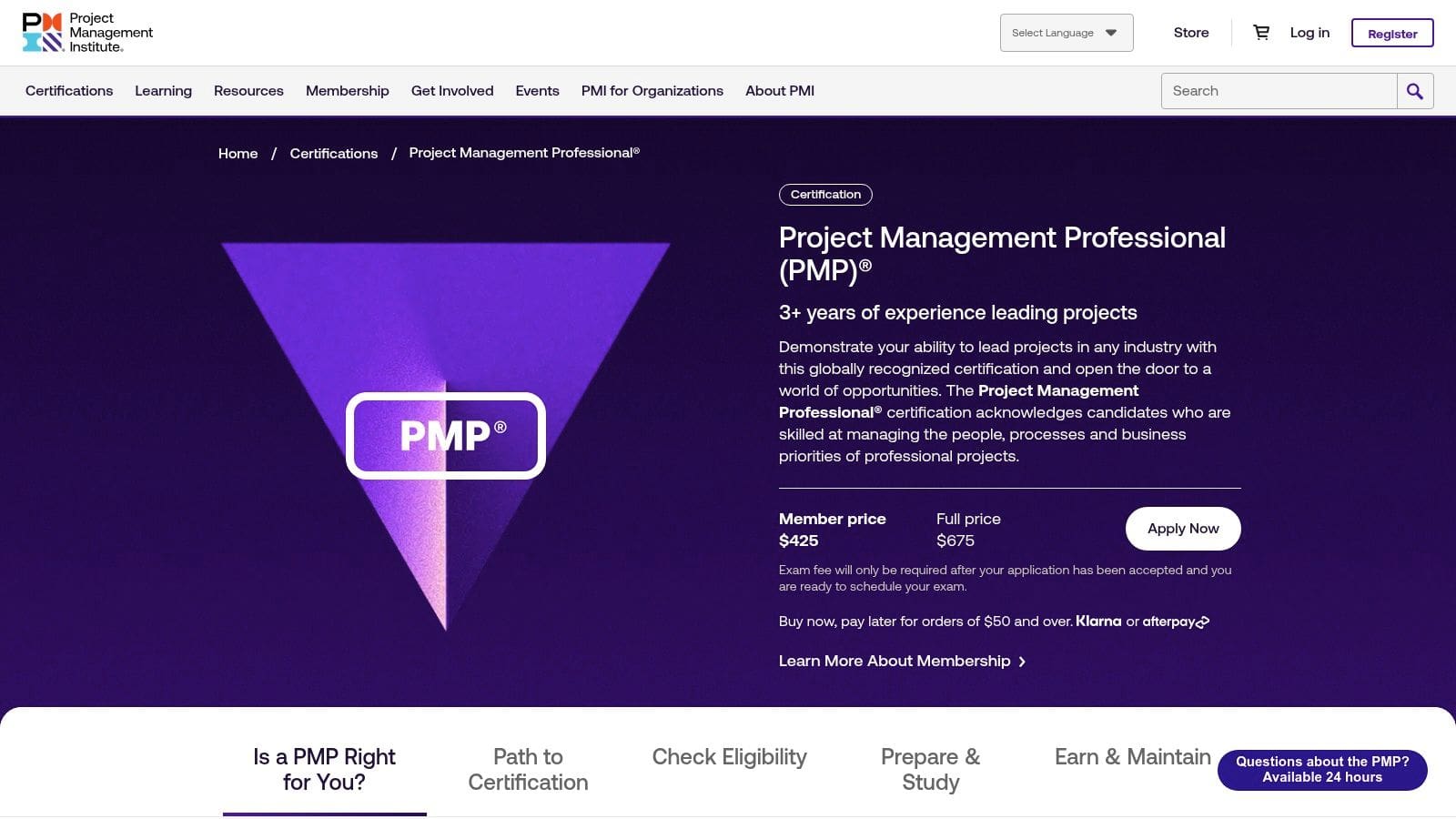
PMP is still the default answer for experienced project leaders because it solves the most expensive career problem in project management, proving you can operate credibly across industries. PMI says it has nearly 1 million credential holders worldwide, and one 2026 industry summary says it appears in about 80% of U.S. project manager job postings. That same summary reports a typical 17% to 33% salary premium for PMP holders, which explains why employers keep treating it as the clearest screening credential for mid- to senior-level work. PMI's PMP certification page is the place to start if you want the employer-facing version of the credential, and Business Model Analyst's professional certification guide helps put that signal into a broader career strategy.
Why PMP wins broad market access
PMP is not a beginner certificate. PMI frames it as an advanced credential for experienced practitioners, and another 2026 guide says it requires 36 to 60 months of documented project leadership experience plus 35 contact hours of training, so the barrier is real. That's exactly why employers trust it, because the credential usually sits on top of evidence that the person has already led work, not just studied theory.
Practical rule: If the role description mentions project manager, PMO, capital projects, enterprise delivery, or cross-functional leadership, PMP is usually the best first comparison point.
PMP's other advantage is portability. It is methodology-agnostic, so it works in predictive, hybrid, and many agile-influenced environments without forcing you into one framework. The trade-off is maintenance, because you don't just earn it and forget it, you need to stay current, which makes it best for people who expect to remain in project leadership for years, not months.
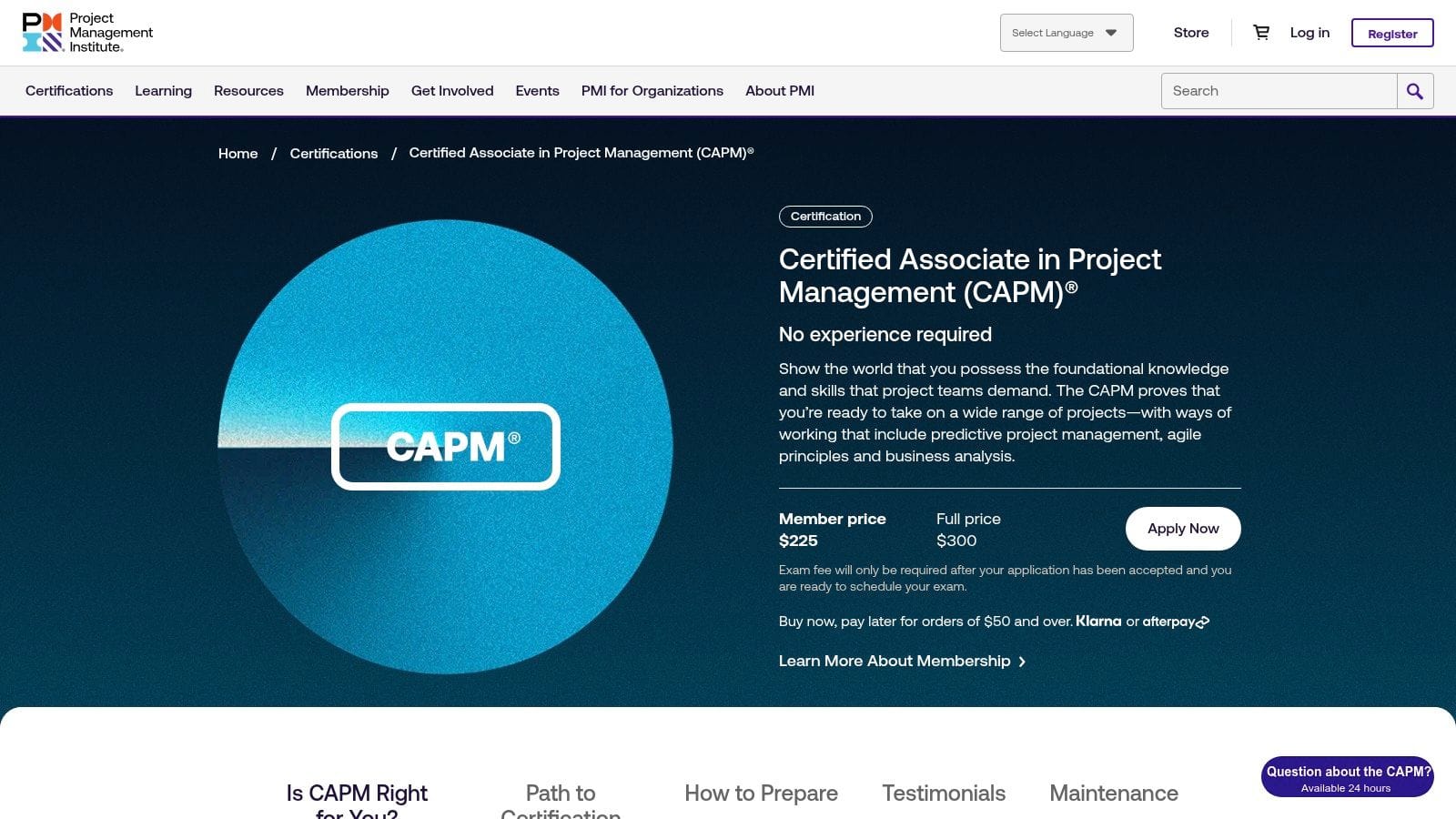
2. Certified Associate in Project Management (CAPM), PMI
CAPM solves a different problem. It helps you get into the profession before you've accumulated enough experience to justify PMP, which makes it the right move for early-career candidates, career switchers, and people who need a formal signal before they can claim full project-manager status. PMI positions CAPM as the lower-barrier certification in its stack, and its certification pathway is designed so that CAPM can establish formal methodology fluency before a candidate steps up to advanced credentials. PMI's certification pathway is the clearest source for how the sequencing works, and this requirements-gathering guide from Business Model Analyst is a good companion if you're trying to connect project credentials to practical delivery work.
CAPM is a bridge, not a finish line
The most useful way to think about CAPM is as a bridge into project work, not a destination. It fits candidates who are building a resume, moving from coordination into management, or trying to show formal competence before they have the logged leadership history required for PMP. In practical hiring terms, that matters because many employers separate “project coordination” from “project management” in their screening process.
CAPM is also the cleaner choice when you want to learn the vocabulary, lifecycle thinking, and core methods that keep showing up in project environments. It won't carry the same signal as PMP for senior roles, and that's the point. It's cheaper in career risk because it gets you moving sooner, then leaves room for a later jump when your experience is strong enough to make PMP worth the effort.
CAPM makes sense when the main problem is access. PMP makes sense when the main problem is leverage.
3. PMI Agile Certified Practitioner (PMI-ACP), PMI
PMI-ACP solves the career problem of being stuck between traditional project management and modern delivery teams that work across agile frameworks. It's a fit for people leading in hybrid environments, where Scrum, Kanban, Lean, XP, and other methods all show up in the same organization. That makes it more specific than PMP and more transferable than a single-framework agile badge. PMI's agile certification page is the natural starting point, PMI-ACP, and the broader market shift toward specialized agile pathways is visible in recent certification roundups that now place agile credentials alongside traditional project-management options.
The right credential for hybrid delivery
PMI-ACP is experience-based, and that matters. It's not trying to train someone from zero, it's validating that you can work across agile methods with enough context to make judgment calls. That is why it tends to fit delivery leads, product-facing project managers, and practitioners who already work in environments where planning is iterative and coordination is continuous.
The biggest trade-off is brand breadth. PMP is easier for general employers to recognize, while PMI-ACP is stronger when the job itself signals agile maturity. If you're aiming at a role where business stakeholders expect iteration, team facilitation, and fast reprioritization, PMI-ACP can be a better business-case investment than another generalist credential.
It's also a logical complement to PMP. Together, they tell hiring managers you can manage scope, stakeholders, and delivery discipline without being locked into waterfall assumptions. For readers who care about operating model fit, that combination often signals more than either credential alone.
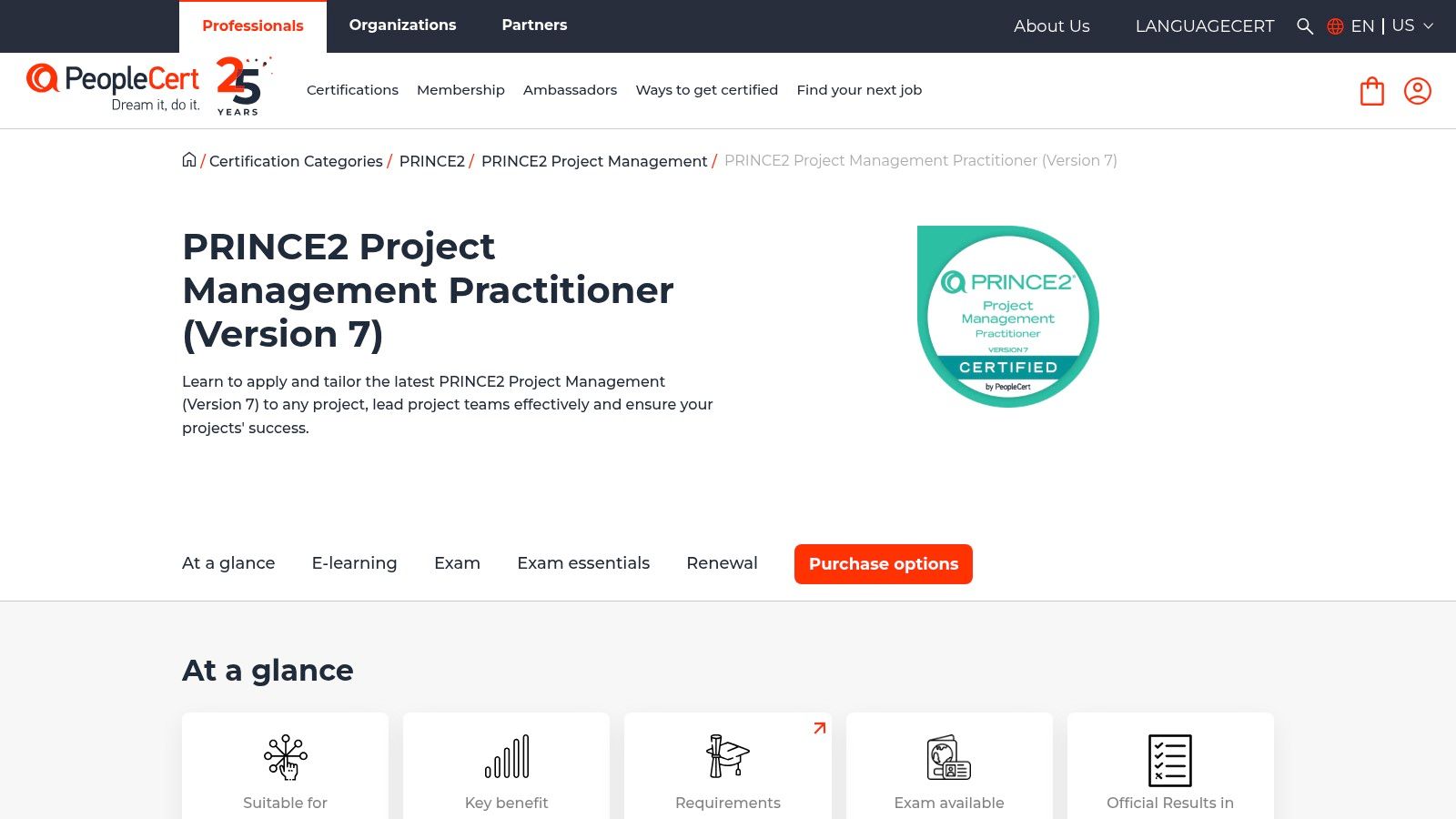
4. PRINCE2 7 Practitioner, PeopleCert
PRINCE2 Practitioner solves a governance problem. It fits organizations that care about controlled delivery, defined roles, and customized process, especially when projects run across countries, vendors, or regulated functions. The method is strong in government, consulting, infrastructure, pharma, and global firms that want a shared structure rather than a personality-driven project style. PeopleCert's official PRINCE2 Practitioner page is the direct source for the credential itself, PRINCE2 7 Practitioner, and Business Model Analyst's change management strategy article is a useful companion if you're connecting project governance to organizational change.
Best for controlled environments
PRINCE2 is process-driven by design, which is why it often fits enterprises that need consistency across many teams or business units. The Practitioner level matters because it's not just about knowing the method, it's about tailoring it to project context. That distinction is important in large organizations where standardized reporting, escalation, and governance can prevent expensive ambiguity.
The downside is market familiarity. In the U.S., employer recognition can vary by industry, so PRINCE2 is usually a stronger bet where governance is already valued or where the company has UK or international roots. It also expects prior grounding, often through Foundation or an accepted equivalent, so it's not the easiest door into the field.
If your role sits inside a PMO, a public-sector programme, or a consulting environment where auditability matters, PRINCE2 can be the smarter ROI play than a more generic certification. It gives you a language for control, not just delivery.
If your organization asks for stage gates, business cases, and formal tailoring, PRINCE2 usually fits better than a purely agile badge.
5. Certified ScrumMaster (CSM), Scrum Alliance
CSM solves the problem of needing practical Scrum facilitation fast. It's a better fit than broader project-management certifications when the employer wants someone who can work closely with product teams, support ceremonies, and coach team behavior inside a Scrum framework. Scrum Alliance's certification page lays out the structure clearly, Certified ScrumMaster, and the credential is built around instructor-led learning rather than self-study alone.
Why teams choose CSM
The course requirement is part of the value. CSM asks you to complete a 14 to 16 hour instructor-led class, the exam is included in the course, and you get two free exam attempts within 90 days after the course. That package makes it appealing to teams that want a guided, shared learning experience rather than a solitary exam grind. It also comes with a two-year Scrum Alliance membership, which adds community access and ongoing practitioner visibility.
The trade-off is obvious. You can't just self-study your way through it, and that means schedule friction. But for managers who want a credential that also builds facilitation confidence, the forced instructor-led format can be a strength. It helps people absorb Scrum as a working system, not just as terms on a test.
CSM is usually strongest when the role is explicitly Scrum-heavy, especially in software, digital product, and cross-functional delivery teams. If the employer wants a Scrum Master, agile coach, or team facilitator, CSM can be a cleaner fit than a more abstract project credential.
6. Professional Scrum Master I (PSM I), Scrum.org
PSM I solves a different Scrum problem, proving mastery without paying the time and maintenance cost of a course-based credential. It suits experienced practitioners and strong self-learners who want a test-verified baseline and don't need the structure of instructor-led training. Scrum.org's certification page is the direct reference, Professional Scrum Master I, and its main appeal is that the certification is lifetime, with no renewal fee.
Lower maintenance, sharper self-study
The biggest business-case advantage of PSM I is total cost of ownership over time. Because it's exam-only and lifetime, you avoid the renewal burden that comes with many professional credentials. For consultants, independents, and people who change roles often, that matters. A credential that doesn't create future admin or fee obligations is easier to keep in the background while you move between employers.
PSM I also rewards people who already know the Scrum Guide and can apply it under pressure. That makes it attractive in organizations that care about conceptual rigor, especially when hiring managers value assessment performance more than course attendance. The downside is that market familiarity can vary by region and company, so CSM sometimes wins on recognition even when PSM I is the cleaner testing model.
If your goal is credibility in a Scrum-specific role without ongoing renewal costs, PSM I is one of the most efficient certifications in the field. It won't replace PMP for broader leadership work, but it's often a better use of time for a pure Scrum Master track.
7. SAFe Agilist (SA), Scaled Agile
SAFe Agilist solves the enterprise scaling problem. It is designed for organizations that need multiple teams, program-level coordination, and Lean-Agile alignment at scale. That makes it especially relevant for large U.S. firms, transformation programs, and roles like Release Train Engineer, Scrum Master, and product-facing positions inside scaled agile setups. The credential's official page is SAFe Agilist, and the fit is strongest when the employer already operates within the Scaled Agile Framework.
Best for enterprise agile operations
SAFe Agilist requires the two-day Leading SAFe course and passing the exam, so it's not an exam-only route. That course requirement is a plus if you want a shared enterprise vocabulary, because it pulls teams into the same operating assumptions quickly. It also comes with access to the SAFe community platform, guidance, and updates, which can matter in organizations that want standardization across large delivery portfolios.
The limitation is that it's not the most flexible or universal agile credential. It's strongest when the company already uses SAFe, and weaker when the organization is smaller or works in a lighter Scrum/Kanban model. Renewal also adds ongoing cost, so the return depends heavily on whether your current or target employer uses the framework in a real, operational way.
SAFe Agilist is a business-case credential. It makes sense when the company's challenge is scale, coordination, and portfolio alignment, not just team-level agility. If that's your environment, it can outperform more general certifications on role fit alone.
Top 7 Project Management Certifications Comparison
| Certification | Implementation complexity 🔄 | Resource requirements ⚡ | Expected outcomes ⭐ / 📊 | Ideal use cases 💡 | Key advantages ⭐ |
|---|---|---|---|---|---|
| Project Management Professional (PMP), PMI | High, strict experience prerequisites and rigorous exam | High, extensive study time, formal education, ongoing PDUs/renewal | ⭐⭐⭐⭐⭐, strong employer recognition; high organizational impact 📊 | Senior project leaders, cross‑industry roles, strategic delivery | Broad, methodology‑agnostic coverage; large PMI ecosystem |
| Certified Associate in Project Management (CAPM), PMI | Low–Medium, entry‑level, exam focused | Medium, course/exam cost; counts toward PMP education requirement | ⭐⭐, signals foundational PM knowledge; useful early career 📊 | Early‑career PMs or career pivoters aiming for PMP later | Lower barrier to entry; integrates with PMI resources |
| PMI Agile Certified Practitioner (PMI‑ACP), PMI | Medium, requires verified agile experience and education | Medium, agile training + experience hours; exam | ⭐⭐⭐, recognized for multi‑framework agile competence 📊 | Practitioners in hybrid/agile environments needing cross‑framework skills | Covers Scrum/Kanban/Lean/XP; complements PMP in hybrid settings |
| PRINCE2 7 Practitioner, PeopleCert | Medium, process‑driven application and tailoring focus | Medium, official training/eLearning bundles; renewal every 3 years | ⭐⭐⭐, strong governance/controls impact in specific sectors 📊 | Governance‑heavy, global or government/pharma projects | Clear process governance; well‑documented tailoring guidance |
| Certified ScrumMaster (CSM), Scrum Alliance | Low–Medium, mandatory instructor‑led course (14–16 hrs) | Medium, course cost, exam included, renewal fees and SEUs | ⭐⭐⭐, practical facilitation and team coaching skills 📊 | Teams adopting Scrum; roles needing hands‑on facilitation | Instructor‑led training; strong practitioner community |
| Professional Scrum Master I (PSM I), Scrum.org | Low, exam‑only path; no mandatory course | Low, self‑study option; one‑time exam cost; no renewal fee | ⭐⭐⭐, validated Scrum Guide mastery; lifetime credential 📊 | Self‑learners and experienced practitioners preferring assessment route | Lower lifetime cost; flexible timing; lifetime certification |
| SAFe Agilist (SA), Scaled Agile | Medium, course + exam; focuses on enterprise scaling | Medium–High, two‑day course required; renewal/membership fees | ⭐⭐⭐, aligns teams/portfolios for scaled Lean‑Agile delivery 📊 | Large enterprises running SAFe or undergoing transformation | Enterprise‑scale alignment; widely requested in U.S. enterprise roles |
Build a Certification Path That Pays Off
The cleanest way to choose among the best project management certifications is to match the credential to the career problem, not the brand. Use CAPM if you need an entry point into project work. Use PMP if you already lead projects and need the broadest employer recognition. Use PMI-ACP if your work crosses agile frameworks and hybrid delivery is the norm. Use PRINCE2 Practitioner if governance, tailoring, and controlled delivery define the job. Use CSM or PSM I when the role is specifically Scrum-based. Use SAFe Agilist when the employer runs at enterprise scale and needs coordinated agile execution.
Before you pay for training, read the target job descriptions carefully. Look for the language employers use, PMO, governance, Scrum, agile transformation, release trains, business case ownership, or cross-functional delivery, then map the certification to that work problem. That's the ROI test, because a credential only pays off when it improves role access, delivery credibility, or organizational fit.
The strongest paths are sequenced, not isolated. CAPM to PMP is the natural progression for people building toward broad project leadership. Scrum certification to PMI-ACP makes sense when you start in team-level delivery and later need cross-framework agile credibility. PMP combined with PRINCE2 or SAFe can be a strong pairing when the role demands both governance depth and scaling knowledge. For resume positioning that supports those moves, find PM resume help on Eztrackr.
The Business Model Analyst helps you make certification choices through a strategy lens, not a badge-collecting one. If you're deciding between PMP, CAPM, agile credentials, or governance-heavy options, visit The Business Model Analyst for analysis that connects career decisions to business models, delivery systems, and real organizational fit.