

Wall Street’s AI job ads now want nearly two governance skills for every model-building skill, six months after regulators took agents out of the rulebook.
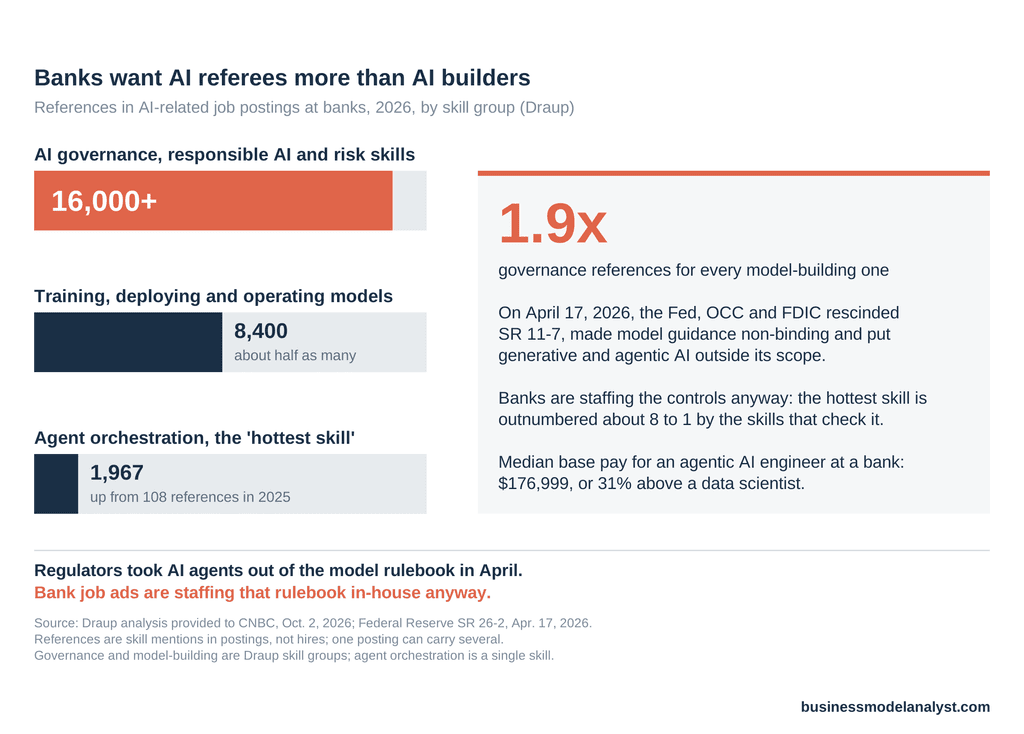
AI-related job postings at banks including JPMorgan Chase, Citigroup and Capital One rose 49% this year to 139,819, according to hiring-data firm Draup. The headline is a 1,721% jump in “agent orchestration.” The real story is underneath it: governance-related skills now show up in more than 16,000 posting references, against about 8,400 for training, deploying and operating models. And that control layer is being built voluntarily, because in April the Fed, OCC and FDIC explicitly left generative and agentic AI out of their new model risk guidance.
Here is the version of this story you will read everywhere today. AI was supposed to delete Wall Street jobs. Instead it is creating them, and the hottest new skill grew eighteenfold in a single year.
That version is true. It is also the least interesting thing in the data.
Look at what banks are actually asking for, and a different shape appears. The bulk of the new AI demand is not for people who build agents. It is for people who decide what agents are allowed to touch, when a human has to sign off, and who answers for it when something breaks. Wall Street is not just hiring AI engineers. It is hiring the babysitters, and it is doing it at a moment when no regulator is requiring them.
What Happened
CNBC published an exclusive analysis from Draup, an enterprise hiring-data firm, on October 2. The top-line numbers:
- 139,819 AI-related job listings at banks this year, up 49% from 2025, which puts last year’s count at roughly 93,800
- Agent orchestration, meaning the design of multiple AI agents that hand work to each other, jumped from 108 references in 2025 to 1,967 this year. That is the 1,721%
- LangGraph, a framework for multi-step agent workflows, up 679%; LlamaIndex, which connects AI apps to company data, up 291%; retrieval-augmented generation, up 259%
- “Responsible AI” references up 657%, AI governance up 394%, AI risk management up 359%
Draup CEO Vijay Swaminathan called orchestration “arguably the hottest skill on Wall Street.” Fair enough on growth rate.
But the line that matters most sits further down the analysis. Governance-related skills now account for more than 16,000 references in Draup’s bank data. Skills tied to training, deploying and operating models account for about 8,400. That is a ratio of roughly 1.9 to 1.
Put the hottest skill next to that and it gets smaller fast. For every reference to agent orchestration, there are about eight references to the skills whose job is to check what the orchestrated agents do.
The pay data, also from Draup and excluding bonuses and equity, shows where the money is going:
- Chief data scientist: $235,158
- Generative AI manager: $190,836
- Agentic AI engineer: $176,999
- Machine learning engineer: $166,764
- Data scientist: $134,986
An agentic AI engineer now earns about $42,000 more in base salary than a data scientist, a 31% premium for the person who wires agents together rather than the person who builds the statistics underneath them.
The Backstory
To see why the governance number is the strange one, rewind to April 2011.
That month the Federal Reserve issued SR 11-7, its supervisory guidance on model risk management. It told banks to inventory every model, validate it independently, and keep someone around whose job was to challenge the model’s builders. On paper it was guidance. In practice, examiners cited it so routinely that it functioned like a rule for fifteen years, and it built an entire profession: the model validation team.
On April 17, 2026, the Fed, the OCC and the FDIC rescinded it. The replacement, SR 26-2, is principles-based and scaled to risk, applies most directly to banking organizations above $30 billion in assets, and states plainly that falling short of it will not draw supervisory criticism.
Then comes the sentence that matters for this story. The new guidance says generative AI and agentic AI models are novel and rapidly evolving, and so they are “not within the scope of this guidance.”
Read that against the Draup numbers. In the same year that regulators stepped back from model rules and explicitly declined to write agent rules, references to AI governance in bank job postings grew nearly fivefold, responsible AI more than sevenfold, and governance skills overtook model-building skills nearly two to one.
Nobody made the banks do this. That is the point.
Meanwhile the workforce underneath is already moving. JPMorgan, which has budgeted $19.8 billion for technology in 2026, told investors in February that operations headcount fell 4% and support staff 2% over the past year, while front-office and revenue-producing teams grew 4%. Its total workforce sits around 318,500. Jamie Dimon described “huge redeployment plans” for people displaced by AI. And back in May 2025, consumer banking chief Marianne Lake said AI could cut operations and account-services headcount by 10%, and that she would take the over.
So the picture is two flows at once: fewer people processing statements and payments, and more people deciding what software is allowed to do instead.
The Plan
What are banks actually building that needs this much supervision?
Swaminathan’s description is the clearest map. Banks are moving past chatbots to systems where several specialized agents split a single workflow. One pulls internal data, one reads documents, one checks compliance, and a human handles the exceptions. Someone has to design how those pieces talk, what data each one can see, and where the human approval sits. That someone is the orchestrator.
To get there, banks are hiring forward-deployed engineers who sit inside trading desks, compliance teams, HR and back offices rather than in a central AI lab. The reason is unglamorous. Swaminathan’s point is that enterprise processes are full of complexity that is often hidden, and that even a simple process takes a long time to automate. The knowledge of where a workflow breaks lives in the heads of the people who run it today.
That is also why the soft-skill language shows up in these postings: problem solving, asking hard questions, being assertive about how a process really works. It is not career-fair filler. It is a job description for the person who has to find the exception before the agent does.
The governance hires complete the stack. Their job is the boring and essential list: permissions, data access, human-in-the-loop checkpoints, logging, and making sure third-party AI tools plugged into a bank’s systems do not become a cybersecurity hole. Swaminathan flagged that last one specifically.
Then there is redeployment, the quiet third leg. If operations headcount is shrinking and governance headcount is growing, the obvious bet is to move the first group into the second. Whether that works is the open question further down.
The Business Model Angle
In a regulated industry, the cost of AI moves from doing to vouching. The pitch for agents is fewer people. The postings say the bill does not disappear, it relocates. Every agent that touches a customer, a payment or a credit file creates a new supervisory relationship, and banks are staffing those relationships before the agents scale. Think of it as a new span of control. We showed how flattening pushes more direct reports onto each manager; agents add a second kind of report that never sleeps and never asks before acting.
No rulebook is more expensive than a strict one. Under SR 11-7, every bank followed roughly the same template and examiners graded against it. With agents carved out, each bank has to write its own standard and be ready to defend it in an exam, a fair-lending review or a courtroom, since lending, anti-money-laundering and consumer-protection obligations did not get rescinded in April. Writing a governance framework is a fixed cost. Spread across a $19.8 billion technology budget like JPMorgan’s, it is a rounding error. For a regional bank it is a meaningful line, which is why model-risk software, validation shops and consultancies are the picks-and-shovels play here. Regulatory silence tends to favor whoever can afford to fill it.
The human approval is the product, not the safeguard. When an agent asks a person to confirm before it acts, the click does two jobs: it catches errors, and it moves accountability onto whoever clicked. We broke down how that works in OpenAI’s approval-first agents. In a bank, that signed approval is the compliance artifact an examiner will ask to see. Orchestration is partly the craft of deciding where those signatures go, which helps explain why the person who designs the handoffs out-earns the person who builds the model.
Redeployment has a skills gap, and it is not the one you think. An operations analyst is not becoming a LangGraph engineer next quarter. But the governance and orchestration roles prize exactly what operations people have: knowledge of how the process really runs and where it fails. The banks that win this transition will be the ones that treat their own back office as a talent pool rather than a cost to cut. The ones that skip it will end up waiting to poach the trained people someone else paid for.
The Risk
The governance-heavy reading is the strongest one in the data, but it deserves a real stress test.
First, postings are not hires. Draup counts skill references in job listings, and one listing can carry several. A posting that mentions “responsible AI” in a bullet is not proof the bank hired a responsible-AI team. We have already shown how AI keywords get added because they are free to type, and that cuts both ways: some of this surge is almost certainly existing compliance and model-risk roles getting relabeled with new vocabulary.
Second, the headline growth rate sits on a tiny base. Agent orchestration went from 108 references to 1,967. That is a real shift in direction, but 1,967 references against nearly 140,000 AI listings is a niche, and prompt engineering, at 11,368 references, still appears almost six times as often. A 1,721% jump says momentum, not scale.
Third, the comparison mixes buckets with single skills. The governance and model-building numbers are Draup groupings, while orchestration is one skill. The 1.9-to-1 ratio between the two groups is the cleanest comparison in the release; the eight-to-one comparison with orchestration is directional.
Fourth, the scaffolding may come down. The modern direction in model risk is to produce governance evidence automatically, as a byproduct of how systems are built, rather than by hand afterward. If that works for agents, a lot of today’s governance headcount becomes software. And the agencies have said agent-specific expectations are still to come, so a future rule could either lock this staffing in or make some of it redundant.
Fifth, the sample is not fully disclosed. CNBC describes the data as covering banks including JPMorgan, Citi and Capital One, so the 139,819 cannot be divided by any one bank’s headcount, and we have not tried.
None of these flips the core finding. They say the governance surge is partly vocabulary and partly durable, and that the durable part is the interesting part.
Quick Questions
Why would banks hire for AI governance if regulators excluded agents from the guidance? Because the underlying obligations did not go away. A biased lending agent, a missed money-laundering flag or a leaky third-party tool is still a bank problem, and with no template to follow, each bank has to build and document its own controls.
What is agent orchestration, in plain English? Designing how several AI agents split one task, what each can access, in what order they work, and where a human must approve before anything happens.
Is AI cutting bank jobs or creating them? Both, in different places. JPMorgan’s operations and support headcount fell over the past year while front-office teams grew, and AI-related postings across banks rose 49%. The jobs are moving, not just disappearing.
How much do these AI roles pay? Per Draup’s bank data, median base salaries run from about $135,000 for data scientists to $177,000 for agentic AI engineers, $191,000 for generative AI managers and $235,000 for chief data scientists, before bonuses and equity.
What replaced SR 11-7? SR 26-2 and the matching OCC bulletin, issued April 17, 2026. They are principles-based, aimed mainly at banks over $30 billion in assets, and leave generative and agentic AI out of scope.
The Business Model Analyst Take
Every automation story starts with the promise of fewer people and ends with a discovery about which people you actually needed. Banks are making that discovery in their job ads right now. The scarce input of the agent era on Wall Street is not the model and not even the orchestrator. It is the person willing to stand behind what the agent did, with a name on the approval and an answer ready for the examiner.
Regulators stepped back in April and left that job unassigned. The banks are filling it themselves, at nearly two governance skills for every building skill. When the rulebook goes quiet, the cost of compliance does not vanish. It just becomes your own line item.