
The lawsuit names two engineers. The number buried inside it names the real problem: Apple spent decades and tens of billions building a hardware organization, and the only tool it has left to stop that organization from walking out the door is a courtroom.
Apple filed suit against OpenAI, its hardware unit io Products, and two former employees on July 10, alleging trade secret misappropriation and breach of contract. The complaint accuses ex-Apple executives of using insider knowledge to extract more insider knowledge, and of coaching Apple staff on how to slip past the company’s departure security. OpenAI denies it. But the document also confirms something Apple has never said out loud: more than 400 of its former employees now work at the company building a device to compete with the iPhone.
Every big company loses people to a hot startup. That is not a lawsuit, that is a Tuesday. What Apple is describing is different in kind, and the difference is the whole story.
What Happened
Apple filed the complaint in the U.S. District Court for the Northern District of California. The named defendants are OpenAI, io Products, and two former Apple employees: Tang Tan, who ran product design for iPhone and Apple Watch before leaving in February 2024, and Chang Liu, an eight-year Apple senior system electrical engineer who joined OpenAI in January 2026.
The allegations are unusually specific for an opening filing. Apple says Tan used an internal Apple project codename during job interviews to ask candidates still employed at Apple what the plan was for an unannounced product. It says he directed candidates to bring actual Apple parts to interviews for show-and-tell sessions, and that at least one candidate was surprised enough to note he did not think components could leave the office. Apple says OpenAI asked interviewees for CAD files, prototypes, subsystem and component selections, simulation tooling, and vendor relationships.
The Liu allegations are narrower and more damaging. Apple claims he exploited a security bug after his departure to download a compilation of technical files running more than a thousand pages, including manufacturing documentation for the circuit boards inside Apple hardware. Apple says he joked about the exploit in messages rather than reporting it, and never returned his company laptop.
Apple also alleges Tan circulated an internal Need to Know document covering Apple’s departure security protocols to OpenAI hires before they resigned, and that Apple’s investigation found a pattern of departing employees taking steps to evade those protocols.
Finally, Apple says OpenAI had one of its trusted manufacturing partners perform an Apple proprietary metal-finishing process, leading the partner to believe it had Apple’s blessing, and approached a second longtime Apple supplier on power and battery manufacturing using insider terminology to ask targeted questions.
Apple says it raised the issue with OpenAI privately in February and got no response. It calls the conduct in the filing the tip of the iceberg.
OpenAI’s Director of Strategic Communications, Drew Pusateri, responded publicly the same day, saying the company has no interest in other companies’ trade secrets and remains focused on building technology that empowers people. That is the full extent of OpenAI’s on-record answer so far.
The Backstory
The talent pipeline Apple is now suing over took seven years to build, and Apple watched every step of it.
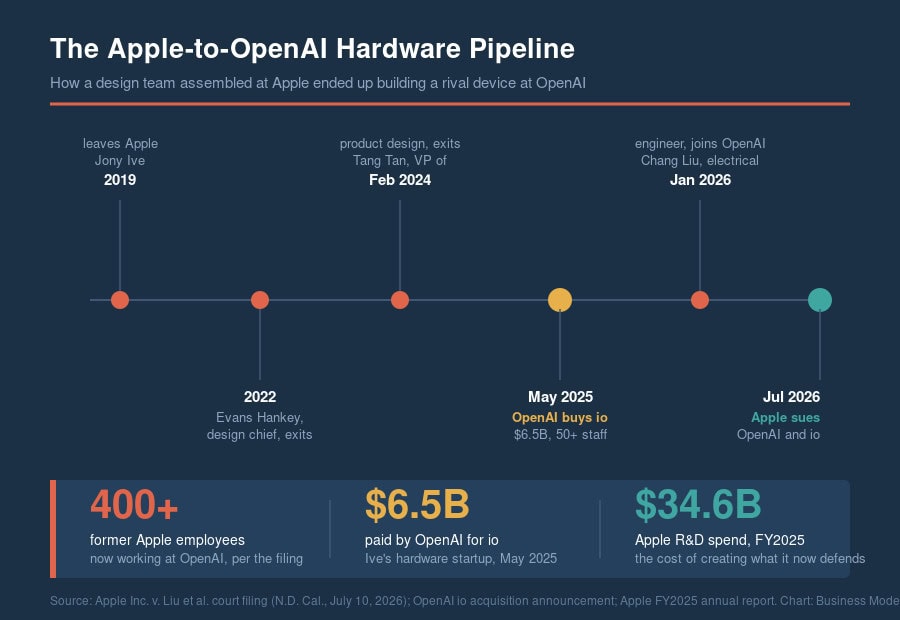
Jony Ive, Apple’s chief design officer, left in 2019. Evans Hankey, who ran design after him, left in 2022. Tang Tan left in February 2024 to work with Ive. Scott Cannon, also ex-Apple, joined them. Together they founded io. In May 2025, OpenAI bought io for $6.5 billion, absorbing more than 50 engineers and designers in the process.
None of that was secret, and none of it was illegal. Building a startup out of your former colleagues is how Silicon Valley has always worked, and California famously refuses to enforce non-compete agreements, which is a large part of why the Valley exists at all.
Notably, Ive, Hankey, and Cannon are not personally named anywhere in Apple’s initial filing. Apple has aimed at two individuals and the corporate entities, not at the design legends. That is a deliberate choice, and it tells you Apple is trying to litigate conduct rather than relitigate departures.
The Plan
OpenAI is building consumer hardware. Ming-Chi Kuo has reported the company is developing a smartphone that could arrive in 2028. The Information has reported on a HomePod-style smart speaker. The suit lands precisely as OpenAI works to get its first device to market.
That timing is not coincidental, and Apple’s own language gives away the strategy. The complaint argues that OpenAI’s hardware business now rests on what it allegedly took. Apple is not seeking a settlement check. It is seeking injunctive relief, which in plain terms means it wants a court to slow down or constrain what OpenAI can ship.
For a company sitting on $416.2 billion in annual revenue, damages are rounding errors. Delay is the asset.
The Business Model Angle
Here is the part most coverage will miss.
Apple’s entire competitive structure depends on the fact that hardware is hard. The Apple business model works because vertical integration is expensive and slow to replicate: custom silicon, a supplier network built over two decades, proprietary manufacturing processes, and an institutional memory of what does not work. Apple spent $34.6 billion on R&D in fiscal 2025 alone. That spending is not just innovation. It is a moat expressed as a cost curve, and it is the reason no software company has ever successfully walked into Apple’s category.
Trade secret law is the only legal instrument that prices that moat. Patents cover inventions. Copyright covers expression. Neither covers the accumulated tacit knowledge of which vendor can hold which tolerance, which finishing process fails at scale, which board layout ships and which one gets scrapped. That knowledge lives in people, and people are free to walk.
So the interesting question is not whether OpenAI behaved badly. It is what happens to Apple’s moat if the answer turns out to be no. If a well-funded rival can legally hire 400 Apple veterans and compress a twenty-year hardware learning curve into three, then the barrier to entry Apple has spent its whole history building was never really a barrier. It was a hiring problem that nobody had enough capital to solve.
OpenAI has the capital. The OpenAI business model is currently one of the most capital-hungry structures in technology, and hardware is its most plausible route out of pure compute economics. Owning the device means owning distribution, which is exactly the thing OpenAI does not have and Apple does.
The Risk
Apple’s risk is discovery, and it cuts both ways.
Suing forces Apple to describe, in a public docket, what its trade secrets actually are. Trade secret litigation requires the plaintiff to identify the secrets with reasonable particularity. That is an uncomfortable exercise for the most secretive company in consumer technology, and it hands OpenAI’s lawyers a roadmap to argue that most of what Apple calls confidential is in fact general industry knowledge that any senior hardware engineer carries in their head.
The second risk is the countersuit. Bloomberg reported in May that OpenAI was preparing legal action against Apple over how the ChatGPT-in-Siri partnership played out. Apple’s filing pointedly states that the Siri agreement is not at issue in this case, which reads less like a legal clarification and more like an attempt to keep two fights from becoming one. It probably will not work.
The third risk is reputational, and it is the one Apple may be underestimating. Apple has spent a decade arguing in antitrust courtrooms that it is not a bully. A suit that a jury could read as an attempt to stop engineers from changing jobs is not a comfortable posture in California, where the law has sided with employee mobility for over a century.
OpenAI’s risk is simpler and larger. This is the second trade-secret allegation touching io in a year, after the hardware startup iyO amended its own complaint in March 2026 to add trade secret misappropriation claims and named Tan as a defendant. One suit is a nuisance. A pattern is a valuation problem, particularly for a company whose financial position leaves little room for a hardware program to stall.
Quick Questions
Is Apple suing over Siri or over hardware? Hardware. Apple explicitly states the ChatGPT-Siri partnership agreement is not at issue in this complaint.
Is Jony Ive a defendant? No. Ive, Evans Hankey, and Scott Cannon are not personally named anywhere in the initial filing. The named individuals are Tang Tan and Chang Liu.
Can Apple stop OpenAI from shipping a device? It is asking a court to try. Apple seeks injunctive relief alongside damages. Injunctions in trade secret cases are difficult to obtain and typically narrow, but even a partial one would create delay, and delay is what Apple is buying.
Is hiring 400 people from a competitor illegal? No. California does not enforce non-compete agreements. The alleged misconduct is not the hiring. It is what Apple says happened around the hiring: the parts, the files, the coaching, and the supplier approaches.
The Business Model Analyst Take
Strip out the drama and this lawsuit is a company discovering that its most valuable asset was never on the balance sheet, and never protected either.
Apple’s real defensibility has always been the compounding institutional knowledge of a hardware organization that has shipped at a scale nobody else has attempted. That is not patentable. It is not copyrightable. It has no line item. It walks out of Cupertino every evening and it can choose, at any moment, to walk somewhere else. For thirty years that was fine, because nobody could afford to buy enough of it at once to matter. What changed is not OpenAI’s ethics. What changed is that a company appeared with enough money to buy the org chart.
The strategic read for any operator watching this: if your moat is your people, you do not have a moat. You have a retention budget, and someone with more capital can outbid it. Trade secret litigation is what a company reaches for when the actual defense, which is being the place those people want to stay, has already failed. Apple is not fighting for its secrets here. It is fighting for the time to rebuild the thing that stopped keeping them.
Whether OpenAI crossed the line matters enormously to the two men named in the complaint. It matters far less to the question Apple actually needs to answer, which is why the people who built the iPhone would rather build something else.